
Pricing yoga classes: how studios set rates and automate billing
! Yoga studio desk with tablet and charging dock
The most profitable approach to pricing yoga classes is a tiered membership model backed by class packs, with automated billing running underneath it.
Friday afternoon. You're trying to finalise next week's roster, but your phone's buzzing with "failed payment" alerts. Your inbox is drowning in "can I freeze my membership?" emails. That uneasy feeling in your gut? It's the constant churn of chasing payments and manually updating spreadsheets, instead of focusing on what you love: building community and transformative experiences.
Most studio owners know that a tiered membership model, backed by flexible class packs and rock-solid automated billing, is the gold standard for predictable revenue. But getting that architecture right for the Australian market isn't just about clever pricing; it's about eliminating the daily chaos and ensuring you're 100% compliant with local tax laws. Get it wrong, and you're spending your week playing accounts receivable instead of teaching.
This isn't just about making money; it's about reclaiming your time, securing your studio's future, and creating a seamless experience for your Australian clients - all while keeping the ATO happy.

Before any pricing model truly earns its keep (and buys you back those precious hours), these four operational pillars must be in place:
- Automated Recurring Billing: Charges members on schedule, every time, without you touching a keyboard. Think set-and-forget certainty.
- Intelligent Dunning Sequences: Automatically retries failed payments and proactively messages members before you lose crucial revenue. This isn't just about recovering funds; it's about customer retention.
- Live Class-Balance Tracking: Provides instant, accurate updates for both students and your front-desk team, ensuring clarity on what's left on a pack. No more manual look-ups.
- Self-Service Freezes: Empowers members to pause their subscription when life happens, without needing to email you and wait three days for a reply. It's a game-changer for reducing admin.
Purpose-built studio management platforms, like Revively, exist precisely to run this entire stack seamlessly. Whether you're opting for Direct Debit or card-on-file payments, having a robust system behind them is non-negotiable. For an Australian studio with around 150 members, automating payment collection can reclaim 5 to 10 hours of admin every single week. Imagine what you could do with that time.
Key Takeaways for Australian Studios
A tiered membership model with automated billing, smart dunning, and class-pack auto-replenishment is the single most reliable way to make your studio pricing predictable, compliant, and blissfully low-admin.
| Area | Revively's Australian Advantage |
|---|---|
| Membership Tiers | Implement three tiers: entry at 70-75% of unlimited, plus a premium tier for workshops/extras, tailored to the AU market. |
| Automated Dunning | Staged retries and SMS/email reminders recover nearly 70% of failed payments, keeping revenue flowing and admin low. |
| Pack & Freeze Rules | Standardised pack sizes, clear expiry windows, and capped annual freezes prevent revenue leakage specific to local demands. |
| Core KPIs | Track MRR, churn, utilisation, LTV, and average revenue per member monthly, not just at year-end, for agile business optimisation. |
| Unified Platform | Revively unifies billing, memberships, class packs, and Xero reconciliation for flawless BAS on one dashboard. |
Table of Contents
- How do you choose the right yoga class pricing model for your Australian studio?
- What membership tiers and pass rules actually convert in Australia?
- How should Australian studios run billing, dunning, and Xero reconciliation?
- How do you set up class packs so they sell themselves?
- How do you launch memberships without losing regulars?
- [Which KPIs tell you the pricing model is working?](#which-kpis-tell-you the-pricing-model-is-working)
- How do you set this up in your studio-management system?
- What changed once billing ran itself
- Run your pricing model on one connected platform
- Frequently Asked Questions for Australian Studio Owners
- Sources
How do you choose the right yoga class pricing model for your Australian studio?
Three crucial lenses shape a defensible price point for any Australian wellness studio: cost, market, and value.
- Cost-based pricing begins with your fixed overheads: rent, wages, insurance, and critically, 10% GST. Then, work backwards to determine what a single class needs to earn per teacher hour to break even.
- Market-based pricing involves a shrewd look at what comparable yoga, Pilates, or recovery studios in your local area are charging. Where do you want to position yourself: budget, mid-market, or premium?
- Value-based pricing asks a deeper question: what is the true worth of consistent practice to a student's mobility, stress reduction, or sleep quality? Does your pricing genuinely reflect that intrinsic value?
Each model caters to a different client profile. Drop-in rates are perfect for the tourist, the occasional visitor, or anyone testing the waters before committing. Class packs suit occasional regulars who attend on their own schedule but appreciate a discount for buying in bulk. Memberships are your retention engine, ideal for students already coming two or three times a week who are just waiting for the right nudge to commit.
A few rules of thumb will simplify this. Price your entry-level membership tier at roughly 70 to 75% of your unlimited tier. Pricing research on studio membership models consistently shows this ratio converts casual attenders without cannibalising your top-tier offering. Ensure your unlimited option is priced low enough that it easily beats frequent drop-in spending - let the maths do the persuading for you.
Pro Tip: First, work out your break-even per teacher hour (wages plus room cost, divided by average class size). Then, price every tier against that number. If a tier doesn't clear break-even at realistic attendance, it's not a viable tier; it's a loss leader that will slowly drain your bottom line.
What membership tiers and pass rules actually convert in Australia?
Offering a single membership tier is one of the most common pitfalls for studios. This "all or nothing" approach forces every student into an inflexible decision, often pushing hesitant clients back to less predictable drop-in options. A three-tier structure offers a flexible ladder instead of a financial cliff edge.
The proven pattern involves:
- An entry tier capped at a set number of classes per week.
- A standard tier with unlimited group classes.
- A premium tier that adds valuable extras like workshops, priority booking, or even specific wellness treatments.
Membership modelling for yoga studios consistently recommends pricing the entry tier at around 70 to 75% of the unlimited rate. The premium tier should sit above standard by whatever margin your workshop or extras genuinely cost to deliver, ensuring it remains profitable.
| Tier | Typical Structure | Price Relative to Unlimited |
|---|---|---|
| Entry | Limited classes per week (e.g., 2-3) | ~70 - 75% of Unlimited |
| Standard | Unlimited group classes (core offering) | Base Rate (100%) |
| Premium | Unlimited + workshops/specialist classes/extras | Standard + Premium Margin |
Policy rules are as crucial as the price tag itself. Decide upfront how many freezes a member receives annually (two is common), the maximum length of a freeze, whether billing runs on a fixed calendar date or the member's join anniversary, and whether workshop credits roll over or expire with the billing cycle. These clear boundaries minimise confusion and prevent revenue leakage.
None of this will convert if it's buried on a generic pricing page. A dedicated, well-optimised membership page featuring a side-by-side tier comparison and genuine social proof from your current Australian members will outperform a plain price list every single time.
How should Australian studios run billing, dunning, and Xero reconciliation?
For Australian studio owners, navigating payment processing and tax compliance is paramount. Direct Debit and recurring card payments each solve the same problem differently. Direct Debit typically boasts a lower failure rate (around 1-2%) compared to recurring cards (3-5%), though it can take slightly longer to activate. Many forward-thinking studios offer both, letting the member choose their preferred method, which smartly spreads your payment risk across different types.
A well-oiled, compliant billing sequence for an Australian studio looks like this:
- Pre-billing Notice: Send a polite billing reminder two to three days before the scheduled charge. This prevents surprises, reduces support tickets, and maintains client trust.
- Charge Attempt & Receipt: Attempt the charge on the scheduled date. Upon success, an automatic, legally compliant Australian Tax Invoice (clearly showing 10% GST) is immediately issued to the member.
- Automated Dunning Trigger (First Retry): On failure, trigger the first automated retry within 24 to 48 hours, paired with an SMS or email prompting the member to update their card details.
- Escalated Grace Period: Escalate through a short grace period, typically 7 to 14 days, before temporarily suspending class access. This gives the system time to recover the payment without alienating a loyal member.
- Flawless Xero Reconciliation: Reconcile all settled payments against Xero or your preferred accounting platform. This is where 100% legal tax compliance shines, with automated two-way mapping of tax codes, revenue accounts, and liabilities ensuring your quarterly Business Activity Statements (BAS) are flawless and audit-proof, completely removing manual spreadsheet errors.
Critical Compliance Note: For Australian businesses, having a system that automatically calculates and reports 10% GST, then seamlessly integrates with Xero for BAS submissions, is non-negotiable. It's the difference between a smooth audit and a significant headache. Revively provides this native functionality, ensuring your client data, booking histories, and sensitive health intake forms are stored locally in Australia, fully complying with the Australian Privacy Principles (APPs).
Pro Tip: Never give up on a failed payment after one attempt. Staged, automated retry sequences are incredibly effective, recovering close to 70% of failed payments. This transforms what looks like potential churn into a recoverable admin task, directly impacting your bottom line without requiring staff intervention.
How do you set up class packs so they sell themselves?
Class packs bridge the gap between casual drop-ins and committed memberships, and they demand their own well-defined rulebook. Standard pack sizes of 5, 10, and 20 classes will cater to most studio needs. Their expiry windows - typically between three and twelve months - should be strategically positioned: shorter for budget-friendly top-ups, longer for more serious commitments.
- Tailored Expiry: Set pack expiry to align with your studio's brand positioning. Shorter windows encourage faster usage, while longer ones offer more flexibility for premium packs.
- Opt-in Auto-Replenishment: Build auto-replenishment as an opt-in feature, triggering when a member's class balance drops to two credits or fewer, using their saved card details. This creates seamless continuity.
- Proactive Notification: Notify the member before the auto-charge fires, not after. Nobody likes being blindsided; transparency builds trust.
- Instant Updates: Credit balances should update instantly upon purchase and display clearly in your booking app or on a foyer display board. Clarity equals confidence.
- Capped Intro Offers: Cap intro-offer redemptions per person to prevent the same student from cycling through multiple "first pack" discounts, protecting your revenue.
Always keep your plain drop-in rate visible. Not every visitor wants to commit to a pack, and class packs, while excellent, don't fully solve the commitment challenge the way a robust membership structure does.
How do you launch memberships without losing regulars?
Don't guess. Start with your booking data, not your gut instinct. Pull a list of students attending three or more times a week on drop-in or existing packs. These are your founding-member targets.
- Data Review: Analyse attendance data and flag high-frequency drop-in and pack users. They're already committed to your studio in practice; now it's time to formalise it.
- Founding-Member Offer: Design an irresistible founding-member offer: a locked-in rate for roughly 12 months, available only within a clearly defined window. This creates exclusivity.
- Limited Window: Set that enrolment window to four to eight weeks, no longer. Genuine urgency is a powerful motivator.
- Phased Communication: Communicate through personal outreach first, then broader email and SMS campaigns, followed by prominent on-site signage. This multi-channel approach maximises visibility.
Keep introductory packs or offers concise. A three-class intro offer, for instance, has been shown to reduce churn and limit potential fraud more effectively than an overly generous ten-class version. It creates a taste, not an endless buffet.
Which KPIs tell you the pricing model is working?
Five numbers matter more than the rest for any Australian studio owner looking to optimise their pricing and operations:
- Monthly Recurring Revenue (MRR): The ultimate indicator of whether your income is growing or flatlining.
- Monthly Churn Rate: A stark signal of whether your retention tactics are holding up.
- Lifetime Value (LTV) vs. Acquisition Cost: Reveals if your founding offers and marketing efforts are genuinely worth their expense.
- Average Revenue Per Active Member (ARPU): Uncovers if your tier mix is skewing too low, indicating a need to promote higher-value options.
- Utilisation Rate: Classes filled against capacity, telling you if your pricing is out of step with actual demand.
Beyond these, keep a sharp eye on:
- Failed-payment volume and dunning recovery rate weekly. This tells you how effective your payment collection is.
- Class-pack expiry rollovers. Spot revenue quietly slipping away due to unused credits.
- Freeze counts and average freeze duration each month. Understand member behaviour and potential revenue pauses.
- Strategic Reporting: Route the daily roster to teaching staff, the weekly finance snapshot to owners, and the monthly board pack to anyone with equity in the studio. Clear, timely data empowers better decisions.
Warning Sign: Rising churn alongside falling utilisation is the clearest, most urgent signal that your pricing has drifted out of step with what your students truly value and attend. It's time for a re-evaluation.
How do you set this up in your studio-management system?
Treat the rollout of a new pricing and billing structure as a focused project, not a hurried weekend task. For most studios, implementation and thorough testing typically takes two to four weeks. Rushing it is how billing errors reach real members and erode trust.
- Define Tiers & Rates: Carefully set your membership tiers, prices, drop-in, and pack rates within your system.
- Configure Payments: Integrate and configure payment providers, including both Direct Debit and card-on-file options.
- Billing Dates: Establish whether billing runs on fixed dates (e.g., the 1st of each month) or individual member anniversary dates.
- Dunning Rules: Enable and customise your dunning rules: retry timing, grace period, and the trigger for temporary access suspension.
- Pack SKUs: Create your class pack SKUs with specific expiry dates and auto-replenish thresholds.
- Freeze Policies: Turn on and define your freeze policies, including self-service freeze limits.
- Xero Connection: Crucially, connect your system to Xero for seamless GST reconciliation and audit-proof BAS.
- Notifications: Customise billing notices and receipt templates to ensure clarity and professionalism.
- Sandbox Testing: Run "sandbox" or test members through simulated payments, failed payments, and freeze/unfreeze cycles. This is non-negotiable.
- Verify Xero Exports: Before going live, verify that all test Xero exports match your expectations for tax codes and revenue categorisation.
Assign one person to configure, another to rigorously test, and a third to handle member-facing communication. And critically, ensure someone watches the first live billing cycle from end to end.
What changed once billing ran itself
Studios that move to automated billing and intelligently tiered memberships consistently report the same profound shift:
Admin hours plummet, renewal no-shows virtually disappear because payments just process, and payroll forecasting becomes infinitely easier because MRR is finally a real, predictable number, not a hopeful estimate. Your staff stop dreading the first of the month.
A unified cloud command centre like Revively tends to be the critical difference between a pricing model that looks good on paper and one that actually runs itself. Every essential piece - billing, packs, freezes, client management, and detailed reporting - sits on one intuitive dashboard instead of being fragmented across three disconnected tools. This unified approach is essential for any modern wellness studio booking system in Australia.
Run your pricing model on one connected platform
Trying to run a growing studio with spreadsheets and a payment gateway bolted onto a basic booking calendar is a recipe for frustration. It works for a year, maybe, but it will crack under real membership volume and Australian compliance demands.
Revively is the all-in-one spa booking software and Mindbody alternative Australia has been waiting for. It's built to prevent you from stitching together three separate tools for managing your pricing and operations. Our single dashboard runs recurring billing, intelligent dunning, class-pack auto-replenish, and Stripe-powered memberships seamlessly. A failed payment, a freeze request, or a pack expiry all show up in the same place, instead of requiring you to check three different inboxes.
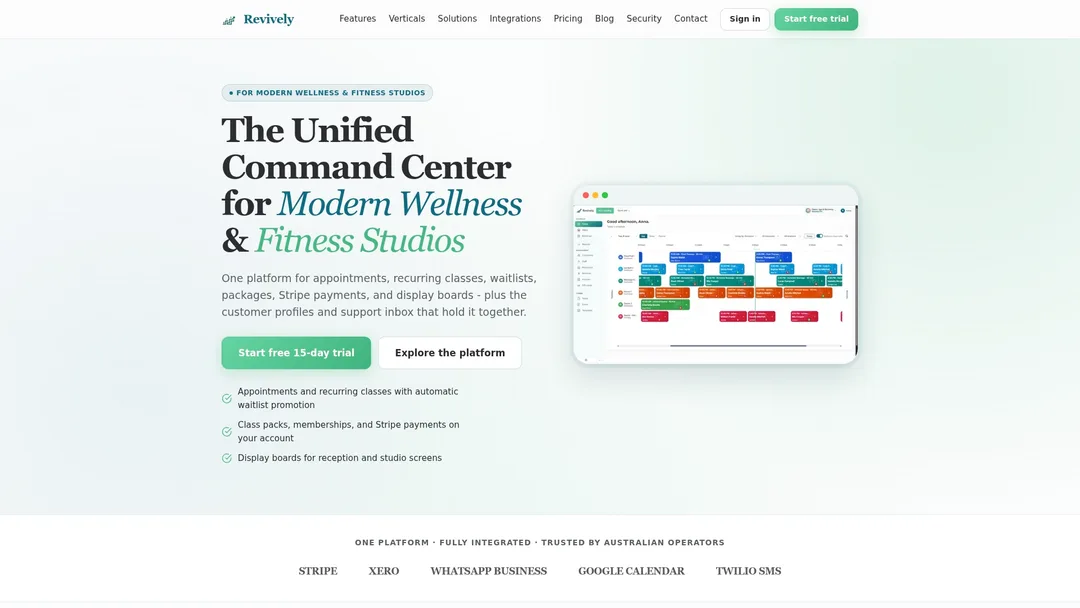
Revively's robust feature set maps directly onto everything discussed: automated recurring billing with staged dunning, flexible class-pack SKUs with auto-replenish rules, secure Stripe payment processing, native Xero export for GST reconciliation, and foyer display boards that show live class and membership status to walk-ins.
If your Australian studio is still wrestling with memberships via spreadsheets and a separate payment link, it's time to explore GST compliant studio software built specifically for this workflow. See what your first automated billing cycle could look like, and rediscover the joy of running your business.
Frequently Asked Questions for Australian Studio Owners
What's the best way to start pricing yoga classes for a new studio in Australia?
Begin with cost-based pricing to determine your break-even per teacher hour, incorporating 10% GST. Then, benchmark this figure against local market rates before setting your unlimited membership price. Structure your drop-in and pack rates as clear multiples of that base figure, rather than pricing them independently, for logical consistency.
Should new studios lead with class packs or memberships?
Memberships are designed to convert your most frequent attenders into predictable recurring revenue, which is why they should take centre stage on your pricing page. However, class packs remain crucial for occasional visitors or those not quite ready for a full commitment. It's about offering options that cater to different levels of engagement.
How many membership tiers should an Australian studio offer?
A three-tier structure - entry, standard, and premium - gives hesitant students a lower-commitment option, avoiding the "all or nothing" decision. This is often the single biggest lever for improving membership conversion rates and broadening your appeal.
How long should a grace period be before suspending a member for a failed payment?
A grace period of seven to 14 days is standard practice. This duration provides ample time for automated retries and reminder messages to work their magic before class access is temporarily cut, maximising recovery rates without being overly punitive.
Does switching to automated billing really save meaningful admin time for an Australian studio?
Absolutely. For an Australian studio with around 150 members, automating billing, dunning, and renewal communication can save a significant 5 to 10 hours of administrative work each week compared to manual management. This frees up valuable time for strategic growth or a much-needed break.

This article provides general information and is not a substitute for advice from a qualified financial advisor. Always consult a qualified financial professional about your specific circumstances before acting on any information presented here.
Sources
- Automating Payment Collection for Yoga Studios | AMES Resources
- The Membership Model for Yoga Studios: Why It Beats Drop-In and How to Build It | GladeForm Journal
- AI vs traditional debt collection - Paidmate blog
Recommended
- The Essential Australian Guide to Choosing a Yoga Studio Booking System - Revively
- Beyond Spreadsheets: How Integrated Software Transforms Recurring Class Management for Australian Studios - Revively
- The Hidden Drain: Booking Software vs. Manual Scheduling for Australian Wellness Studios - Revively
- Pricing - Revively