
Pre-exercise screening in Australia: the APSS guide for studios
! Wellness studio screening setup with equipment
The Adult Pre-Exercise Screening System (APSS) is the national standard for pre-exercise screening in Australia.
Another new client strides into your studio, brimming with excitement for their first Pilates reformer class or hot yoga session. Great! But in the back of your mind, a little voice whispers: Have they told us everything? Are they truly ready for that dynamic flow or high-intensity workout? This isn't about playing doctor - it's about duty of care, and in Australia, that means understanding and implementing the Adult Pre-Exercise Screening System (APSS).

The APSS is Australia's gold standard for pre-exercise screening. It's a two-stage framework designed to pinpoint potential risks before they become incidents. Stage 1 is a compulsory self-screen for every new client. If it flags a concern, Stage 2 steps in: a professional assessment that turns a red flag into a safe, tailored exercise prescription.
For you, the studio owner juggling schedules, staff, and a thousand other things, three actions cut through the noise and cover your duty of care from day one:
- Compulsory Stage 1 on Intake: Every new client completes the 7-question self-screen before their first class or session. This isn't optional, whether it's for a high-energy dance workshop or a gentle recovery centre circuit.
- Prompt Triage for 'Yes' Answers: If a client answers 'yes' to any of the first six Stage 1 questions, they need to see an accredited exercise physiologist (AEP), their GP, or a relevant specialist before increasing intensity. No exceptions.
- Secure, Accessible Records: All screening records belong in the client profile. Staff need to access them easily, especially at the point of programming, and these records must be updated if a client's health status changes.
The official APSS forms, the Stage 1 tool, and the User Guide are published jointly by AUSactive, Exercise & Sports Science Australia (ESSA), and Sports Medicine Australia (SMA). These are your ultimate source of truth for all screening decisions.
The APSS: Your Studio's Essential Risk-Mitigation Tool
The APSS is a two-part screening system developed collaboratively by Australia's leading health and fitness bodies. Its purpose is elegantly simple: identify individuals at higher risk of an adverse event during physical activity and guide a safe exercise journey before that risk escalates.
Before APSS, many Australian studios relied on the PAR-Q (Physical Activity Readiness Questionnaire). While a good start, PAR-Q lacked the nuanced risk stratification and professional-collaborative structure that APSS offers. Migrating to APSS isn't just a compliance tick-box; it's a vital alignment with contemporary international evidence and a deepening of your studio's duty of care. The updated Pre-Exercise Screening Guide released in July 2025 reflects these global trends, aiming to support safe participation across all exercise settings.
For dance schools, Pilates, yoga studios, spas, and recovery centres, APSS provides a clear, proportionate framework. You're not running a cardiac rehabilitation clinic, but you are responsible for the safety of every person who walks through your doors.
"Use of the screening system does not guarantee safety, and the peak bodies accept no liability for loss, damage, or injury arising from reliance on the material."
--- Official APSS forms
This isn't a loophole. It's a critical reminder that screening is a robust risk-mitigation framework, not a magic shield against all eventualities. Your studio's commitment to safety goes far beyond just a form.
Stage 1: The Client's First Step in Self-Screening
Stage 1 is the essential, self-administered questionnaire. Your client completes it, not your instructor. It comprises seven questions designed to identify potential cardiovascular, metabolic, respiratory, musculoskeletal, or other health conditions that might require professional input before they hit the mats or machines.
The Seven Questions of Stage 1
The official Stage 1 tool asks clients to respond 'Yes' or 'No' to these questions:
| # | Question Area | Focus |
|---|---|---|
| 1 | Heart condition or surgery? | Cardiovascular history |
| 2 | Chest pain during activity? | Cardiac symptoms |
| 3 | Dizziness, loss of balance, or loss of consciousness? | Neurological/cardiac |
| 4 | Bone, joint, or soft-tissue problem? | Musculoskeletal |
| 5 | Taking prescribed medications? | Pharmacological considerations |
| 6 | Pregnant, or given birth recently? | Obstetric status |
| 7 | Current physical activity levels? | Activity baseline |
Questions 1 to 6 are your primary risk-flags. Question 7, however, guides appropriate exercise intensity once the first six are cleared.
Decoding Activity Levels: The 150-Minute Threshold
Question 7 asks clients to estimate their current weekly physical activity. The APSS uses a clever weighted formula:
Weighted minutes = (light + moderate minutes) + (2 × vigorous minutes)
For example, a client doing 60 minutes of moderate walking and 30 minutes of vigorous cycling per week scores: 60 + (2 × 30) = 120 weighted minutes. This sits below the 150-minute threshold and guides the intensity recommendation, not whether they can exercise at all.
What to Do After Stage 1
- Any 'Yes' to Questions 1-6? The client must seek guidance from an AEP, GP, or relevant allied health professional before starting or increasing exercise intensity.
- All 'No' to Questions 1-6? Proceed to Question 7 and use the weighted activity score to determine appropriate starting intensity.
- Question 7 Result Below 150 Minutes? They should begin at low-to-moderate intensity and progress gradually.
- Question 7 Result At or Above 150 Minutes? They can generally begin at moderate-to-vigorous intensity, always with appropriate professional guidance.
Pro Tip: Optimise your intake workflow. Send Stage 1 digitally the moment a client books. A short, online form removes the awkward clipboard moment at reception and gives your team time to proactively triage any flags before the client arrives for their session. Keep the language plain and approachable to encourage honest answers.
When Stage 1 Flags: The Stage 2 Professional Assessment
If Stage 1 raises a 'yes' flag, Stage 2 is a recommended, collaborative assessment conducted with an exercise professional. This is where clinical judgement shines, interpreting risk factors, setting appropriate exercise intensity, and determining if further medical advice is needed before programming begins.
Who Should Perform Stage 2?
- Accredited Exercise Physiologists (AEPs): These are the go-to professionals for complex or higher-risk presentations. AEPs hold university-level qualifications and ESSA accreditation.
- Accredited Exercise Scientists with documented Stage 2 training: Suitable for lower-risk presentations where the professional has specific training in risk-factor assessment.
- Allied health professionals (physiotherapists, GPs, specialists): Appropriate when the Stage 1 flag directly relates to a condition within their scope, like a specific musculoskeletal injury or a cardiovascular event.
Remember, Stage 2 isn't a checklist; it's a dynamic conversation between the professional and the client, informed by the Stage 1 result, culminating in a tailored, safe exercise prescription.
Key Assessment Areas in Stage 2
A thorough Stage 2 assessment should cover:
- Cardiovascular history (hypertension, coronary artery disease, arrhythmias)
- Respiratory conditions (asthma, COPD)
- Metabolic conditions (type 2 diabetes, obesity, thyroid disorders)
- Musculoskeletal status (current injuries, chronic pain, joint replacements)
- Current medications and any potential exercise interactions
- Recent significant health events (surgery, hospitalisation, acute illness)
Red Flags Requiring Immediate Referral
| Red Flag | Action |
|---|---|
| Chest pain or pressure at rest or during activity | Do not proceed. Refer to GP or emergency services immediately. |
| Unexplained syncope (fainting) or near-syncope | Refer to GP before any exercise. |
| Severe dyspnoea (shortness of breath) at minimal exertion | Refer to GP or respiratory specialist. |
| Uncontrolled hypertension (resting BP ≥180/110 mmHg) | Refer to GP; defer exercise until controlled. |
| Active musculoskeletal injury causing significant pain | Refer to physiotherapist. |
Pro Tip: When a client's Stage 1 flags a condition managed by a treating clinician, seek their written consent to contact that clinician directly. A brief, professional note from your AEP to the client's GP - outlining the proposed exercise type and intensity - often secures faster clearance than asking the client to relay information themselves.
Navigating Referrals: Who, When, and How to Communicate
The phrase "seek guidance" in the APSS means the client must consult an appropriate health or exercise professional before starting or increasing exercise intensity. For your studio staff, this translates to a firm "stop" - you do not proceed until guidance has been obtained and meticulously documented.
Here are three realistic referral pathways for most studio scenarios:
- GP Referral: Ideal when the Stage 1 flag relates to a diagnosed medical condition, recent surgery, or unexplained symptoms. Ask the client to obtain a written note from their GP, explicitly confirming they are cleared for the proposed exercise type and intensity your studio offers.
- Accredited Exercise Physiologist (AEP): The preferred pathway for most fitness-related risk flags. AEPs can expertly complete Stage 2, provide detailed exercise prescription, and effectively liaise with the client's broader medical team.
- Relevant Specialist: When the flag is condition-specific - think a cardiologist for a cardiac history, an obstetrician for a recent birth, or an orthopaedic surgeon for a recent joint replacement.
Age and Risk Thresholds: Don't Overlook Them
The APSS specifically flags males aged 45 and older and females aged 55 and older as higher-risk groups. The risk of an adverse event during exercise increases significantly with age. When a client in these age brackets also answers 'yes' to any Stage 1 question, treat their referral as urgent, not routine. This is a critical nuance often missed.
Clear Communication: Sample Wording for Staff
When you need to ask a client to obtain medical clearance, keep your language calm, factual, and empathetic:
"Thanks for completing your pre-exercise screen. To ensure you can exercise safely with us, the screening tool has indicated you should chat with your GP, or an Accredited Exercise Physiologist, before starting our classes. We need a brief note from them confirming you're cleared for [specific activity, e.g., 'reformer Pilates' or 'vigorous gym sessions'] before we can get you started. How quickly can you arrange that?"
Crucially, sufficient clearance is a written statement from the relevant professional confirming the client is cleared for the specific activity type and intensity level your studio offers. A generic "cleared for exercise" note is far less useful than one that names the activity.
Your Studio's Responsibility: Duty of Care & Record-Keeping
Pre-exercise screening isn't a one-off administrative chore. It's an ongoing responsibility shared between the studio, its management, and its staff.
Who's Responsible for What?
- Stage 1 Completion: The client completes it, but your studio is ultimately responsible for ensuring it happens before the first session and is stored correctly.
- Stage 1 Review and Triage: A suitably trained staff member must review the result and decide whether to proceed, refer to Stage 2, or request medical clearance. This isn't a task to be rushed.
- Stage 2 Assessment: Completed by an AEP or appropriately qualified professional. Your studio should document who performed the assessment and when.
- Health Status Updates: Any material change in a client's health (a new diagnosis, surgery, pregnancy, significant injury) should trigger a re-screen. The responsibility for prompting this sits squarely with your studio.
Best Practise for Record-Keeping in Australia
- Integrated Records: Store screening records within the client profile in your studio management software. Don't hide them in a separate filing system that staff can't access easily when they're scheduling or programming.
- Retention Periods: Retain records for the duration of the client relationship and for a reasonable period after it ends. Always consult your professional indemnity insurer for specific, jurisdiction-compliant guidance.
- Privacy First: Share screening information only with the client's explicit written consent, especially when liaising with their treating clinician. This is critical under Australian Privacy Principles (APPs).
- Digital is Superior: Digital records beat paper every time. They're harder to lose, easier to search, and can be automatically flagged for re-screening when a client's intake date exceeds a set period or their health status changes. Moreover, storing sensitive client data, booking histories, and health intake forms locally in Australia ensures full compliance with APPs and builds trust with your clientele.
Pro Tip: Integrate screening status directly into your client profile in your multi-resource studio scheduling software. When a staff member opens a client record to book a class, the screening status - current, expired, or pending clearance - should be immediately visible without opening a separate document. This visibility is what makes re-screening a practical reality, not just a theoretical obligation.
Seamless Intake: An APSS Workflow for Australian Studios
Implementing APSS into your daily operations doesn't demand a clinical overhaul. Here's a practical workflow that suits dance schools, Pilates, yoga studios, and spas equally well:
- Automate Stage 1 Delivery: Use your studio's digital intake system to automatically send the Stage 1 form the moment a new client books. This gives them time to complete it before arrival and gives your team time to review it.
- Staff Review Before First Session: Designate a trained staff member to check every new client's Stage 1 result before their first session begins. Immediately flag any 'yes' answers.
- Proactive Triage for 'Yes' Results: For any Stage 1 flag, contact the client before their scheduled session to clearly explain the next step: a Stage 2 assessment with an AEP, or GP clearance, depending on the nature of the flag.
- Book Stage 2 If Required: If your studio employs or partners with an AEP, schedule the Stage 2 assessment before the client attends a class. Document the outcome meticulously in their client profile.
- Store and Link Records Digitally: Save the completed Stage 1 form, any Stage 2 notes, and clearance documentation directly within the client profile. Consider linking screening status to class enrolment, so higher-intensity classes require a current, cleared screening record.
- Re-screen on Material Change: If a client discloses a new health condition, returns after a significant absence, or requests to move to a higher-intensity programme, trigger a new Stage 1 before proceeding.
Digital Intake Template: Key Fields to Capture
- Full name, date of birth, contact details
- Stage 1 answers (Yes/No for each of the seven questions)
- Weighted weekly activity minutes (calculated from Q7 responses)
- Stage 2 assessment date, professional name, and outcome notes (if applicable)
- Name and contact details of treating clinician (where applicable)
- Consent statement (client confirms information is accurate and consents to storage)
- Clearance documentation reference (e.g., file name or upload link)
Pro Tip: Keep Stage 1 to a single screen on mobile. Clients encountering a multi-page form before their first class often abandon it or rush through it. A concise, well-designed digital form completed pre-arrival has a materially higher completion rate than a paper form handed over at reception. This attention to user experience is key for platforms striving to be Mindbody alternatives in Australia.
Beyond the Form: What APSS Doesn't Do (and Your Studio's Wider Safety Obligations)
The APSS is a powerful risk-mitigation tool, but it doesn't eliminate risk entirely. The peak bodies are explicit about this. The official APSS User Guide states:
"Pre-exercise screening is a crucial risk management strategy; however, it is important to acknowledge that it is not a substitute for medical advice, does not guarantee safety, nor can it predict or prevent adverse events during exercise."
This disclaimer doesn't reduce your obligation to screen; it reinforces why screening alone isn't enough. Your studio must layer practical safety measures on top of the APSS process:
- First Aid & CPR: Ensure all client-facing staff maintain current first aid and CPR certifications.
- AED On-Site: Keep a defibrillator (AED) on-site and ensure all staff are trained and confident in its use.
- Emergency Plan: Develop a written emergency action plan and rehearse it with your team at least annually.
- Active Supervision: Supervise clients actively during sessions, particularly new clients, older participants, or those returning after a health event.
- Monitor for Distress: Teach staff to monitor for signs of distress during class: unusual breathlessness, pallor, disorientation, or complaints of chest discomfort.
Managing "Borderline" Clients
Some clients fall into a grey zone: they answer 'no' to all Stage 1 questions but possess characteristics that warrant closer attention. This might include a male aged 45 or older with a sedentary history, or a female aged 55 or older beginning vigorous exercise for the first time. For these clients, a voluntary Stage 2 assessment is well worth recommending, even if not technically required. It's about prioritising their long-term health and safety.
Pro Tip: For borderline clients, build a staged intensity plan with explicit checkpoints. Start them at low-to-moderate intensity for the first two to four weeks. Schedule a brief check-in at week two. Only progress intensity after the client confirms they are tolerating the programme without symptoms. Document each checkpoint in their client profile. This is the hallmark of truly client-centric, all-in-one spa booking software.
Stop Treating APSS as a Compliance Box: Embrace the Process
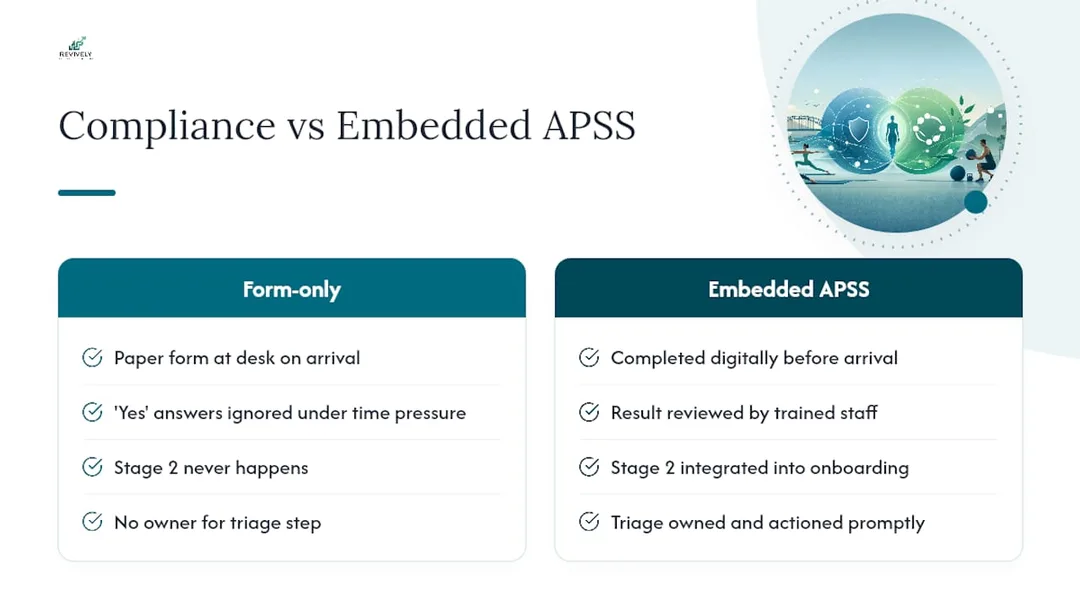
Many studios struggle with pre-exercise screening because they treat it as a form to collect rather than a process to run. The form gets filed away, 'yes' answers are overlooked under time pressure, and Stage 2 never happens because no one truly "owns" the triage step.
The APSS works when it's deeply embedded in your intake workflow, not just bolted onto it. A client who completes Stage 1 digitally before arrival, whose result is reviewed by a trained staff member before the session, and who is referred promptly when a flag appears, is genuinely safer. This smooth flow enhances the experience and helps your studio shine as a leading multi-resource studio scheduling provider.
There's also a compelling business argument. A studio that can demonstrate a documented, consistent screening process is in a materially stronger position if an incident occurs. Insurance assessors and legal advisers look for evidence of robust processes, not just the mere existence of a form. Properly implemented, the APSS provides that invaluable evidence.
Stage 2 is the component most studios underutilise. It's often treated as a mere checklist instead of a collaborative, professional assessment. An AEP sitting down with a client to review their Stage 1 flags, understand their goals, and set an appropriate starting intensity isn't a clinical overhead; it's precisely where effective exercise prescription truly begins. Studios that proactively build Stage 2 into their onboarding for flagged clients report fewer early drop-outs and fewer incidents because clients start at the right intensity, rather than the one they optimistically assumed they could handle.
Revively: Making APSS (and Australian Compliance) Effortless for Your Studio
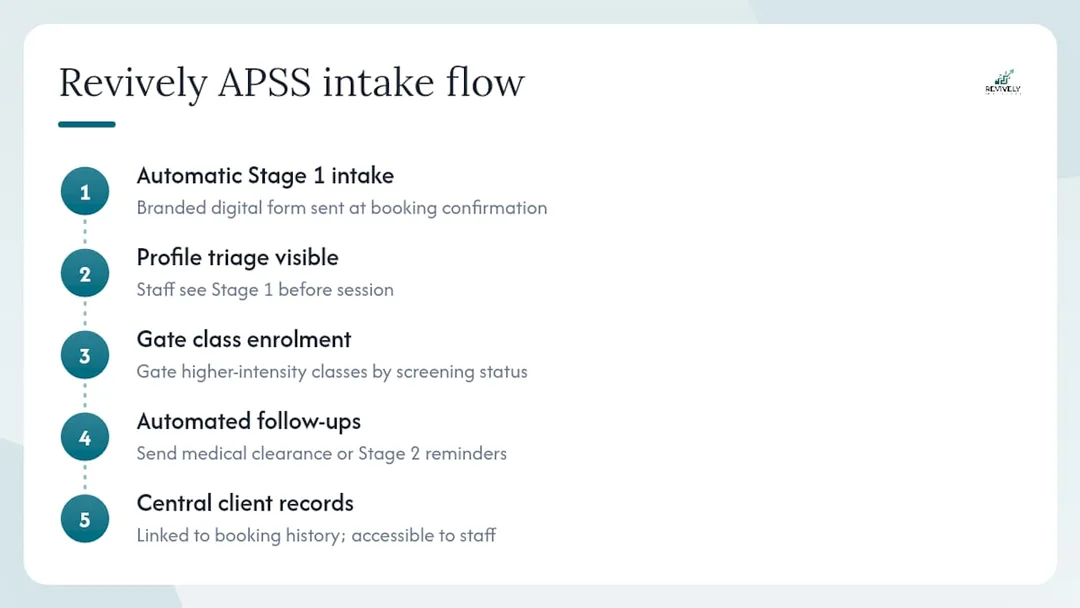
Running APSS properly means collecting Stage 1 before the first booking, triaging results before the first class, and keeping records accessible to staff at the point of programming. Revively's online booking software handles the intake side flawlessly: branded digital forms go out automatically at booking confirmation, ensuring clients complete Stage 1 before they arrive, and your team sees the results immediately within the client profile.
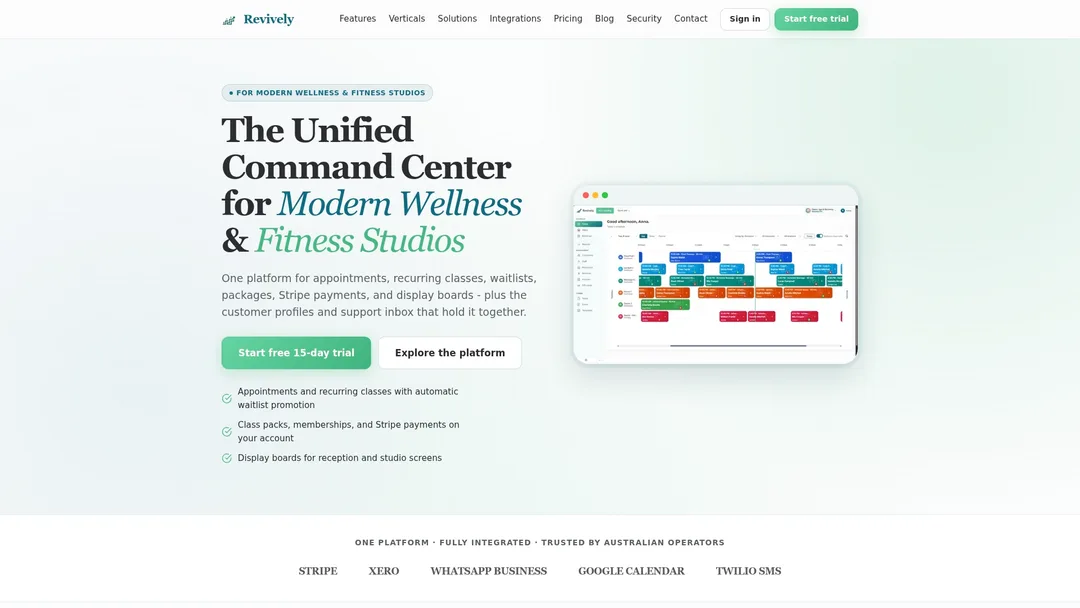
From there, Revively's class scheduling tools let you gate enrolment in higher-intensity classes by screening status, while our team task features automate follow-up reminders for clients who need medical clearance or a Stage 2 booking. Every record stays securely in the client profile, linked to their booking history, and accessible to the staff member running the session.
But Revively goes further, offering robust solutions specifically for Australian studios:
- Australian Data Residency & Privacy: All your client data, booking histories, and sensitive health intake forms (like APSS results) are stored locally in Australia, fully complying with the strict Australian Privacy Principles (APPs). Trust and security are paramount.
- Flawless GST & Tax Invoice Handling: Our system natively handles 10% GST calculations across casual classes, memberships, and multi-resource packages. It automatically issues legally compliant Australian Tax Invoices to your clients, removing guesswork and manual calculations.
- 100% Legal Xero integration for BAS Accuracy: Revively's two-way Xero integration guarantees seamless financial compliance. Automated mapping of tax codes, revenue accounts, and liabilities ensures your quarterly Business Activity Statements (BAS) are flawless and audit-proof, completely removing manual spreadsheet errors.
Revively streamlines your administration and operational compliance. It is not a clinical assessment tool and does not replace the professional judgement of an AEP or allied health practitioner.
Ready to ditch the chaos and embrace a truly unified cloud command centre that understands the unique needs of Australian wellness and fitness studios? Start a free trial at Revively and see how your studio's intake workflow looks when screening, scheduling, and financial compliance are all part of one intelligent system, not separate headaches.
Official APSS Resources and Downloads
All official APSS materials are free to download from the peak body websites. Utilise these links to access the current forms and user guide directly:
- Adult Pre-Exercise Screening Tool (Stage 1 form) - SMA: Contains the seven Stage 1 questions, the weighted activity calculation method, and the age-risk thresholds for males ≥45 and females ≥55.
- Pre-Exercise Screening eBook 2025 - SMA: The updated July 2025 guide covering both Stage 1 and Stage 2, reviewed to reflect current international evidence.
- Updated Pre-Exercise Screening Guide release notice - SMA: Confirms the July 2025 update and links to the revised guidance.
- AUSactive APSS resource page - AUSactive: The joint endorsement page for the APSS, with links to the User Guide and supporting materials.
- APSS framework overview - Exercise is Medicine Australia: Background on the APSS framework and Stage 2 collaborative assessment process.
Download the Stage 1 form and the 2025 eBook as your essential starting point. The User Guide, available through the AUSactive page, provides the full implementation context, including the crucial no-warranty wording your studio should understand before relying on the system.
Please note: This article offers general information and is not a substitute for advice from a qualified medical or legal professional. Always consult a qualified healthcare professional about your own circumstances before acting on any information presented here.
Sources
- Pre-exercise-screening-ebook_2025.pdf
- Updated Pre-Exercise Screening Guide released
- Adult-Pre-Exercise-Screening-Tool.pdf
- Adult Pre-Exercise Screening System (APSS)
Recommended for Australian Studio Owners
- Studio Chaos to Calm: Choosing the Right Australian Management Software in 2024 - Revively
- Studio Chaos to Calm: Choosing the Right Australian Management Software in 2026 - Revively
- Ditch the Chaos: The Definitive Guide to Australian Studio Management Software (2026) - Revively
- Choosing Gym Membership Software: An Australian Studio's Guide to True Fit - Revively