
Does GST apply to yoga classes in Australia?
!
Picture this: it's BAS quarter. Your studio is buzzing, classes are full, and your Xero is... well, it's a bit of a mystery box. You're trying to reconcile payments, untangle class packs, and suddenly you're staring at an invoice, wondering: "Does GST even apply to this? Am I charging too much? Too little? Is the ATO going to come knocking?"
You're not alone. The Goods and Services Tax (GST) is one of those perennial headaches for Australian small business owners, especially in the wellness sector where services sometimes feel like they should be exempt. For yoga, Pilates, and other wellness studios, the rules aren't as fluid as a vinyasa flow - they're concrete, and missing a step can lead to significant back-payments and penalties.
The short answer, for most commercial studios, is a resounding yes. Once your studio's GST turnover hits the standard registration threshold, almost all your offerings will attract GST.
The Australian Taxation Office sets that threshold at $75,000 in GST turnover. Cross that line, and you're legally required to register, charge GST on your classes and services, and regularly lodge Business Activity Statements (BAS). While some narrow exceptions exist for registered charities, recognised health practitioners, or formal institutional education, the ATO's "health services" guidance sets a stringent test that most commercial studios simply won't meet.
This isn't about general therapeutic benefits; it's about explicit compliance.
The Nitty-Gritty: What You Need to Know
| Your Studio's Reality | GST Impact & Action |
|---|---|
| Hitting the Threshold | Compulsory GST registration at $75,000 turnover (or $150,000 for registered charities). Don't wait for the ATO; register proactively. |
| Exemptions? Think Again. | "GST-free" status is rare for commercial studios. It typically requires formal charitable registration or a service delivered by a recognised health practitioner, not just a yoga teacher. |
| Product Nuances | Casual classes, packs, memberships, and even online offerings each have specific GST implications. Bundled retreats? Even more complex. |
| Claiming Credits | Once registered, you claim GST credits on business purchases (mats, rent, software). This offsets the GST you collect, reducing your net payment to the ATO. |
| Simplify with Software | Unified systems like Revively automatically handle GST-inclusive pricing, generate compliant Australian Tax Invoices, and integrate seamlessly with Xero for flawless BAS. |
Table of Contents
- GST on yoga classes: when exemptions actually apply
- When do you need to register for GST as a yoga teacher?
- How GST applies to classes, packs, memberships and retreats
- What can yoga teachers claim as tax deductions?
- Working through a GST example: classes, packs and credits
- Which tools help studios manage GST without the manual work?
- What should you check this week?
- Frequently asked questions
- Sources
The Elusive "GST-Free": When Exemptions Actually Apply to Wellness Offerings
Let's clear the air: many yoga instructors assume their teaching counts as "education" or a "health service" and can therefore sidestep GST. The ATO doesn't see it that way. They draw a crucial line between formal, curriculum-based institutional education (think TAFE courses) and commercial coaching. A weekly vinyasa class at your studio firmly sits in the second, taxable category.
The "health services" test is the most common pitfall for wellness businesses hoping for an exemption. It's incredibly specific, hinging on whether a recognised health practitioner (like a physiotherapist, chiropractor, or psychologist) is delivering a genuinely clinical service. The fact that a yoga class offers therapeutic benefits in a general sense won't cut it. A physio running rehabilitation sessions that incorporate yoga postures might qualify; a certified yoga teacher running a general flexibility class almost certainly won't.
Before you even think about claiming GST-free status, ask yourself these tough questions:
- Is your organisation formally registered as a charity or not-for-profit with the ACNC?
- Is the primary purpose of the offering clinical health treatment, not general fitness, wellbeing, or relaxation?
- Is the service being delivered or directly supervised by a recognised health practitioner registered under AHPRA (not just a certified yoga teacher)?
- Is any education component delivered under an accredited curriculum, not an informal class structure?
Warning: Nearly every commercial studio fails at least one of these tests. This is precisely why the ATO rejects most exemption claims from yoga and wellness providers operating on a standard business model. Document your position thoroughly and obtain written advice from a qualified Australian accountant if you believe you qualify. Assuming GST-free status without proper grounds could lead to significant financial penalties down the track.
Crossing the Threshold: When to Register for GST
GST registration becomes mandatory the moment your GST turnover reaches, or is projected to reach, $75,000 in any rolling 12-month period. For charities, this threshold is higher at $150,000. You can register voluntarily before hitting this threshold, which allows you to claim GST credits on your setup costs (e.g., studio fit-out, initial equipment purchases). Below the threshold, it's optional, but once you're on track, it's compulsory.
Here's your action plan to get registered and compliant:
- Confirm Your ABN: Ensure you have an active Australian Business Number (ABN). You can check or apply for one through the Australian Business Register.
- Register for GST: Do this through Business.gov.au or directly via ATO online services.
- Choose Lodgement Frequency: Decide whether you'll lodge your BAS monthly, quarterly, or (for very small turnovers) annually. Most studios opt for quarterly.
- Update Pricing: Adjust your studio's pricing and invoicing to include GST from your registration date. This means displaying GST-inclusive prices for all services.
- Track Diligently: Start meticulously tracking GST collected on your sales and GST credits on your business purchases.
Once you're registered, BAS reporting transforms from a looming threat into a manageable routine:
- GST collected is the 10% tax you charge on all your classes, packs, merchandise, and services.
- GST credits are the 10% tax you've paid on eligible business purchases - things like yoga mats, insurance, rent, marketing, and, yes, your booking and accounting software subscriptions.
- The difference between these two figures is what you either remit to (or claim back from) the ATO each reporting period.
If your turnover is steadily climbing toward $75,000, don't play a dangerous game of 'chicken' with the ATO. Get registered before the deadline forces a scramble. It's far easier to implement systems proactively than to unravel months of non-compliance.
Decoding GST: Classes, Packs, Memberships, and Retreats
GST treatment isn't a "one-size-fits-all" scenario across your studio's diverse offerings. This is where many studios stumble into compliance errors.
Single drop-in classes are the simplest case: a fully taxable supply, with GST included in the advertised price.
Class packs and memberships introduce a timing nuance. When a client pays upfront for a 10-class pack, you generally account for the GST at the time of that payment, not as each class is redeemed. For ongoing memberships with recurring billing, the GST is spread across each billing cycle, accounted for as payments are received.
Online classes and downloadable content are taxable when sold to Australian customers. However, if you're selling significantly to genuinely overseas students, place-of-supply rules can alter the GST treatment. If this forms a large part of your revenue, consult your accountant.
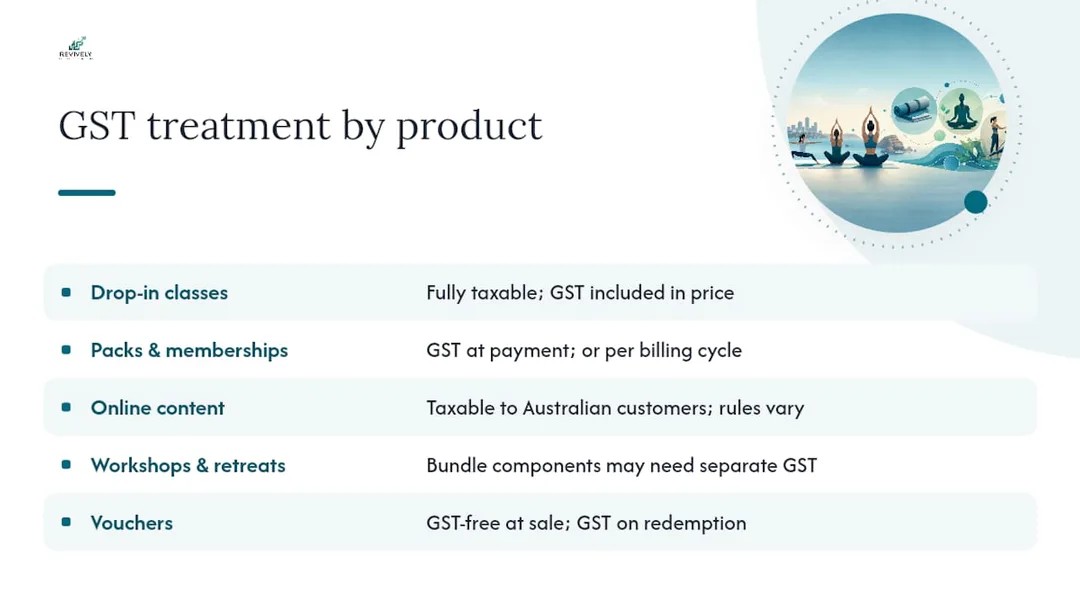
Workshops and retreats are often the most complex. They typically bundle multiple components: a weekend of classes, perhaps accommodation, meals, or even merchandise. Each element might require separate GST treatment depending on who's supplying it (e.g., are you supplying the accommodation, or just arranging it via a third party?). Unbundling these components for GST purposes is critical.
Vouchers are generally GST-free at the point of sale. GST is then applied when the voucher is redeemed against a taxable class or product.
Pro Tip: Always display GST-inclusive pricing on your website, booking portal, and all marketing materials. Australian consumers expect to see the total price upfront. A multi-resource studio scheduling system that correctly handles and displays GST-inclusive pricing removes customer friction and ensures transparency.
Claiming Your Credits: What Wellness Studios Can Deduct
While GST and income tax deductions are separate systems, they are inextricably linked in your studio's bookkeeping. Understanding both will significantly reduce your overall tax burden.
Common deductible expenses for yoga, Pilates, and wellness instructors include:
- Studio or room rental costs.
- Yoga mats, props, audio equipment, and other teaching necessities.
- Professional indemnity and public liability insurance premiums.
- Teacher training, workshops, and continuing education.
- Marketing costs, including website hosting, social media advertising, and content creation.
- Booking, scheduling, and accounting software subscriptions (like Revively and Xero).
- Work-related travel between teaching locations, typically calculated using the cents-per-kilometre method for your vehicle.
If your studio is registered for GST, you generally claim the GST component of these purchases as a credit on your BAS, and the GST-exclusive amount as your income tax deduction. If you're not GST-registered, you claim the full GST-inclusive amount as your income tax deduction instead. The ATO's comprehensive guides for teachers and education professionals offer occupation-specific rules that often map closely onto wellness teaching, including self-education expenses for advanced certifications.
Critical Compliance Tip: Keep every valid Australian Tax Invoice, not just bank statements. A bank record confirms money left your account; only a proper tax invoice proves the GST component you're legally entitled to claim as a credit. This is non-negotiable for audit-proofing your records.
Crunching the Numbers: A GST Example
GST accounting boils down to two running totals: the GST you've collected from clients and the GST you've paid on your eligible business expenses.
- A $33 drop-in class includes GST of exactly $3 (one-eleventh of the total price), which you record as GST collected.
- A $330 ten-class pack includes $30 in GST, recorded when the pack is purchased.
- A $55 yoga mat purchased for studio use includes $5 in GST, which becomes a GST credit if your studio is registered.
- Your BAS reports the difference: GST collected - GST credits = what you owe (or can claim back) from the ATO.
Remember to retain every tax invoice and electronic receipt for at least five years - this is the ATO's standard retention period for all business records.
Revively Pro Tip: Reconcile your Stripe payouts before you finalise your BAS. Processing fees affect your net revenue but do not change your GST liability. Separating the two prevents under or overstating what you owe and keeps your GST compliant studio software accurate.
Beyond Spreadsheets: Tools for Seamless GST Management
The most efficient workflow for any modern Australian wellness studio is simple: capture the sale accurately in your booking system, automatically sync it to your accounting software, and let GST lines reconcile themselves. This eliminates manual data entry, reduces human error, and ensures your BAS is audit-proof.
Look for a unified studio management platform that offers:
- Consistent GST-inclusive pricing applied automatically across every offering: single classes, class packs, memberships, workshops, and multi-resource bookings.
- Automatic Australian Tax Invoice generation, ensuring every client receives a legally compliant receipt detailing the 10% GST, saving you countless hours at BAS time.
- A robust, two-way, native integration with Xero that maps each sale to the correct tax code, revenue account, and liability, ensuring that quarterly BAS figures are 100% legal and accurate. This is crucial for studios seeking Mindbody alternatives Australia.
- Integrated Stripe payment reconciliation that separates payment processing fees from your GST liability, keeping your books clean and accurate.
Studios running this kind of connected, all-in-one spa booking software setup spend significantly less time on quarterly BAS preparation. The reconciliation work happens continuously in the background, rather than in a stressful, error-prone scramble every three months.
Your Weekly Compliance Check-List
Before another class ends, take five minutes to run through these vital checks:
- Calculate your rolling 12-month GST turnover, both current and projected. Are you approaching or over $75,000?
- Confirm your ABN and GST registration status accurately reflect your actual trading position.
- Review your class and service pricing. Does it correctly reflect GST-inclusive amounts as per ATO guidelines?
- Check your booking software's tax settings. Are Australian Tax Invoices generating properly for all sales?
- If you're genuinely unsure whether an exemption applies to any of your offerings, or you're running complex mixed supplies like retreats with accommodation, speak to an Australian accountant or consult the ATO directly before making any assumptions.
A Studio Owner's Reality: Getting GST Right
"Honestly, most of the GST stress vanishes once you stop treating BAS as a quarterly emergency. When your bookings, payments, and Xero seamlessly talk to each other, compliance stops being the scary part. Complex exemption calls still belong with a qualified accountant, but the day-to-day transaction heavy lifting? That's where good software shines."
Revively: Your Partner for Audit-Proof GST Reporting
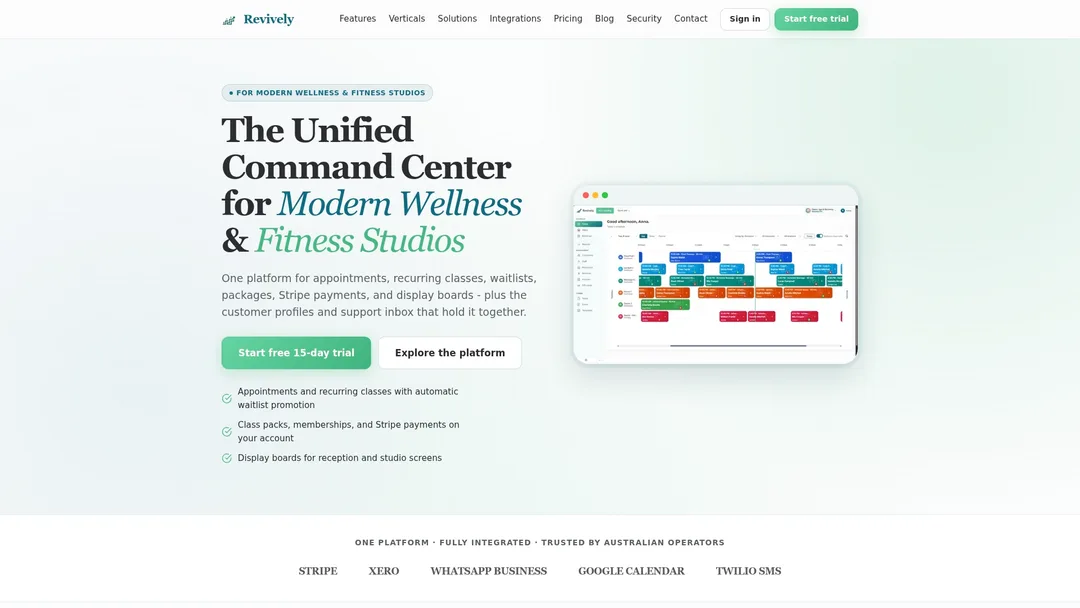
Managing class packs, memberships, casual drop-ins, and multi-resource bookings through separate spreadsheets is a recipe for GST errors and BAS anxiety. Revively is engineered to close that gap for Australian yoga, Pilates, and wellness studios.
Revively handles 10% GST calculations natively across every casual class, membership, and multi-resource package. It then automatically generates and issues legally compliant Australian Tax Invoices to your clients, ensuring your books are always ready for an audit.
Crucially, your client data - from booking histories to sensitive health intake forms - is stored right here in Australia, fully complying with Australian Privacy Principles (APPs).
Our seamless, automated two-way Xero integration guarantees 100% legal tax compliance. Tax codes, revenue accounts, and liabilities map perfectly, ensuring your quarterly Business Activity Statements (BAS) are flawless and audit-proof, eliminating those spreadsheet nightmares. Because Revively syncs natively with Xero, your BAS preparation draws from figures that already match your bookings, not a rebuilt spreadsheet at the end of each quarter. If you're managing complex offerings, that single, trusted sync point is often the difference between a ten-minute BAS review and a full afternoon of manual reconciliation.
Remember, this article is a practical operational guide, not a substitute for professional tax advice. For specific exemption questions or mixed-supply rulings, a qualified Australian accountant or the ATO remains your authoritative source. To see how Revively simplifies the scheduling and billing side of your studio's operations day-to-day, explore our class scheduling software and start a free trial to test it against your own studio's unique offerings.
Frequently Asked Questions
Do I need to charge GST on a single yoga class in Australia?
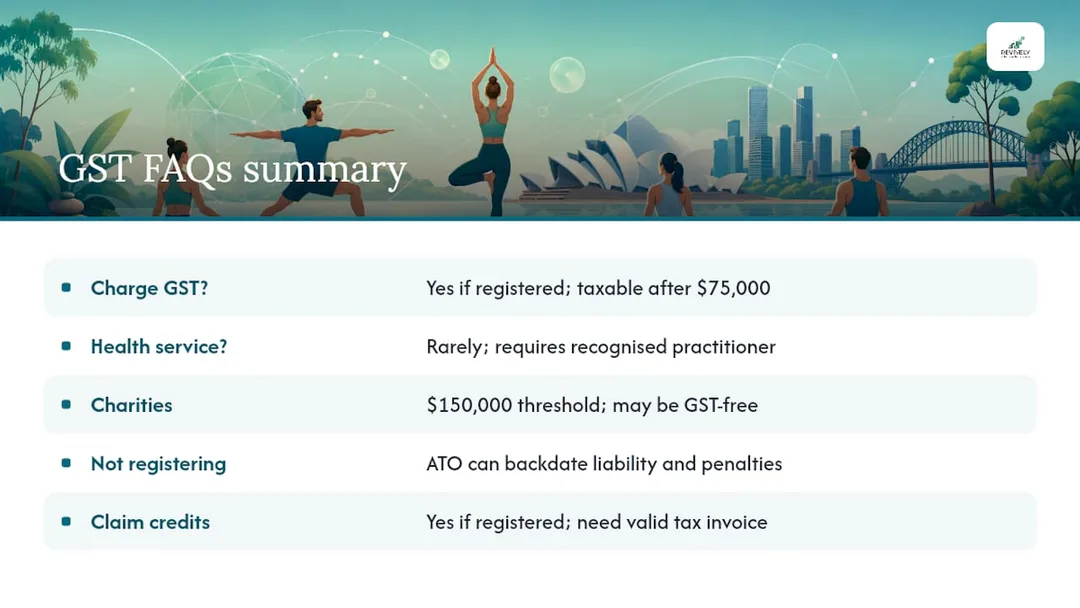
Yes, if your studio is registered for GST. Once your turnover reaches the $75,000 threshold, single drop-in classes are treated as any other taxable supply, and you must charge 10% GST.
Is yoga considered a health service for GST purposes by the ATO?
Rarely, for standard commercial classes. The ATO's health services test is very strict, generally requiring a recognised health practitioner (like a physiotherapist) delivering clinical treatment, not a general fitness or wellbeing class delivered by a yoga teacher.
Do charitable yoga programs still need to charge GST?
Registered charities have a higher GST registration threshold ($150,000 instead of $75,000) and may qualify for GST-free treatment on some community services. However, this depends entirely on their specific charitable registration and the precise nature of the program. Always confirm with the ATO or a charity tax specialist.
What happens if I don't register for GST once I hit the threshold?
The ATO can backdate your GST liability to the point you should have registered and may apply significant penalties. It's always best to register as soon as your turnover approaches $75,000, rather than waiting until you've passed it.
Can I claim GST credits on my yoga mats and studio equipment?
Yes, if your studio is registered for GST, you can generally claim the GST component (1/11th of the price) of eligible business purchases as a credit on your BAS, provided you hold a valid Australian Tax Invoice.
This article provides general information and does not constitute financial or tax advice. Always consult a qualified financial professional or the Australian Taxation Office for advice tailored to your specific circumstances before making any financial decisions.
Sources
- Registering for GST - Australian Taxation Office
- Register for goods and services tax (GST) - business.gov.au
More for Australian Studio Owners
Dive deeper into optimising your wellness business with these insightful articles from Revively:
- Ditch the BAS Headache: The Definitive Guide to Australian Yoga & Wellness Studio Software in 2026 - Revively
- The Essential Australian Guide to Choosing a Yoga Studio Booking System - Revively
- How to Start a Wellness Business in Australia: Your Blueprint to Launch & Profit - Revively
- Ditch the Daily Chaos: Why Your Australian Studio Needs More Than Just a Booking System - Revively