
Customer retention strategies for spas: a practical guide
! Spa manager reviewing client retention materials
The highest-impact customer retention strategies for spas combine membership programmes, rebooking automation, personalised client profiles, and targeted packages - not discounts.
You know the feeling. That satisfying sigh of a client floating out the door, treatments complete, looking utterly blissful. Then, the quiet dread. Will they rebook? Or will they melt back into the daily grind, another one-off visit lost to the ether?
This isn't just about losing a single booking. It's about the silent bleed of unpredictable revenue, the constant scramble for new leads, and the crushing admin burden of a business built on a revolving door. For Australian spas, recovery centres, and wellness studios, client retention isn't a 'nice-to-have' - it's the bedrock of sustainable growth.
Forget chasing the next trend or slashing prices into oblivion. The spas truly thriving in our market aren't just attracting clients; they're keeping them. They're doing it with intelligent systems that combine membership programs, savvy rebooking automation, deeply personalised client profiles, and value-driven packages. This isn't rocket science; it's operational discipline.

Let's be blunt: the highest-impact retention strategies for spas combine smart systems - not discount-driven desperation. When these elements click, you'll see more repeat visits, higher average spend, and that holy grail: predictable monthly revenue.
Where to start? Focus on these actions in the first 30-90 days:
- Structure a membership tier offering monthly credits and at least one included add-on.
- Activate automated post-visit reminders perfectly timed to each treatment's natural cadence.
- Arm your front-desk and therapists with a concise rebooking script at checkout.
- Build out essential client profiles capturing service history, preferred therapist, and critical contraindications.
- Launch a 3 or 6-session package with a clear expiry, presented as a seamless checkout offer.
The data doesn't lie: a significant chunk of first-time clients vanish without a follow-up. Nail these five elements, and you can expect a measurable lift in your rebooking rates within 60 days.
Table of Contents
- How do membership programmes drive repeat visits and predictable revenue?
- What loyalty programme mechanics actually change client behaviour?
- How to make rebooking a standard part of every visit
- How do you use client profiles to personalise the spa experience?
- What automated communication sequence keeps clients coming back?
- How should you collect and act on client feedback?
- Why do packages and treatment plans outperform one-off discounts?
- How do seasonal campaigns support client retention, not just acquisition?
- What KPIs and benchmarks should you track for spa retention?
- What does a 90-day implementation plan look like?
- How does Revively support these retention strategies in practice?
- Key takeaways
- What actually works in Australian spas: a practical perspective
- Revively gives Australian spas the tools to retain more clients
- Useful sources
Membership Programmes: Your Secret Weapon for Predictable Revenue
Memberships aren't just about charging a monthly fee; they fundamentally reframe the client relationship. A fleeting discount might entice a single visit. A well-designed membership, however, gives clients a compelling reason to return month after month - they've already committed, already paid. This psychological pivot from "occasional indulgence" to "routine wellness" is precisely what successful membership spas leverage to generate significantly higher revenue than those stuck in the walk-in lottery.

Structuring Your Membership Tiers for the Australian Market
For a mid-market Australian spa or recovery centre, three tiers often hit the sweet spot. An accessible entry-level option lowers the barrier to commitment, a robust mid-tier attracts the majority of sign-ups, and a premium tier anchors perceived value, making the middle option look eminently sensible.
A practical structure might look like this:
- Essential ($79 - $99/month): One 60-minute treatment credit, 10% off retail products.
- Wellness ($149 - $179/month): Two treatment credits, priority booking, plus a complimentary add-on (e.g., scalp massage or foot soak).
- Signature ($229 - $269/month): Three credits, a complimentary enhancement with every visit, and a quarterly gift.
Pro Tip: These price points are indicative for a typical Australian mid-market spa. Always adjust based on your specific cost structure, local market dynamics, and competitive landscape. Remember, Revively natively handles 10% GST calculations on all membership fees, ensuring your pricing is transparent and your financial reporting is compliant from day one.
Sign-up, Trial, and Cancellation Terms
A 30-day free trial or a discounted first month can dramatically boost conversions for hesitant clients. Keep your cancellation terms crystal clear: a 30-day written notice period is standard, protecting your recurring revenue without feeling punitive. Avoid upfront 12-month lock-ins; a rolling monthly agreement with a minimum 3-month commitment generally sees higher sign-up rates and better long-term retention.
Streamlining day-to-day membership management:
- Tag members in your booking system. Staff should be able to identify membership status at a glance.
- Set credit balances to roll over by one month only. This creates a healthy sense of urgency without frustrating clients who miss a month.
- Run monthly reports on credit utilisation. Members who haven't used credits in 45 days are prime candidates for a friendly, automated prompt.
- Brief your reception team weekly on which members are due for a visit. Empower them to proactively engage.
Pro Tip: Always offer a compelling membership sign-up incentive at the point of a first visit. Think a complimentary add-on on their next booking. Clients are most receptive immediately after experiencing your service first-hand.
Loyalty Programmes: Deeper Engagement, Not Just Discounts
Loyalty programmes and memberships serve distinct purposes. Memberships drive frequency through upfront commitment. Loyalty programmes, on the other hand, reward behaviour after the fact. They're ideal for deepening engagement alongside memberships or as a standalone tool for clients not yet ready for a monthly commitment.
Reward Mechanics That Actually Work
Visit-based rewards and experiential perks consistently outperform blanket percentage discounts. A client earning a complimentary enhancement after five visits is far more motivated to return than one chasing a 10% discount they could snag anywhere. Introducing recognition tiers - Bronze, Gold, Platinum - adds a valuable social dimension that percentage-off schemes utterly lack.
Effective mechanics include:
- Visit milestones: A complimentary add-on at visits 5, 10, and 20.
- Experiential perks: Priority access to new treatments, exclusive seasonal events, or a bespoke birthday ritual.
- Targeted bonus offers: Double points during typically slow months, or a bonus credit for a successful referral.
- Personalised recognition: A handwritten note or a small, thoughtful gift at the annual anniversary of their first visit.
Critically, avoid mechanics that train clients to wait for sales. If your loyalty programme constantly offers 20% off, you're inadvertently teaching your clients to delay bookings until the next promotion. This is a revenue killer.
Measuring Loyalty Programme Effectiveness
| Metric | What it tells you | Review Cadence |
|---|---|---|
| Redemption Rate | Are your rewards compelling enough to motivate action? | Monthly |
| Incremental Visits per Member | Is the programme genuinely driving additional bookings beyond baseline? | Quarterly |
| Revenue per Loyalty Member vs. Non-Member | The clearest overall ROI signal - are loyal members spending more? | Quarterly |
| Referral Rate from Members | Indicates advocacy and word-of-mouth lift from your most engaged clients. | Monthly |
A redemption rate below 20% usually signals that your rewards aren't compelling. Conversely, if it climbs above 60%, it's time to review your reward cost per visit and adjust to protect your margins.
Rebooking: Making It a Non-Negotiable Part of Every Visit
Let's be honest: client retention failure is rarely about service quality. More often, it's a systems and timing failure. The spas that consistently retain the most clients treat rebooking as a standard, seamless step in the guest journey, not an awkward, optional upsell.
The Seamless Rebooking Process Flow
- In-service prompt: The therapist subtly plants the seed during the treatment. "For optimal results, most clients find coming back every 3-4 weeks works best."
- Pre-checkout rebook: Reception proactively offers the next appointment before the client leaves. "Would you like to lock in your next visit while you're here to ensure you get your preferred time?"
- Automated 48-hour SMS: A brief, personalised message sent the day after their visit, complete with a direct booking link.
- 30-day interval reminder: If no rebooking has occurred, an automated email or SMS, referencing their last treatment and gently suggesting a return date based on your recommended cadence.
- Package trigger (if lapse continues): If the client hasn't rebooked after 45 days, an automated offer for a 3-session package at a modest saving.
Sample Scripts for Your Staff
Therapist (at the end of treatment):
"Your skin is responding really well to today's treatment. To maintain these results and keep that glow, I'd suggest we look at another session in about three to four weeks. I'll make a note for [reception name] at the front desk."

Reception (at checkout):
"[Therapist name] mentioned that coming back in three to four weeks would be ideal for you. I can book that in for your preferred time right now, if that works for your schedule?"
48-hour SMS template:
"Hi [Name], it was lovely having you yesterday. Ready to secure your next [treatment] experience? Book here: [Direct Booking Link]"
Pro Tip: Always frame the next appointment around the treatment result, not a discount. "Lock in your next visit to maintain your glowing results" is far more compelling than "Book again and save 10%."
Implementing multi-channel reminders - SMS, email, and booking confirmations - can significantly reduce no-shows. This isn't just a rebooking benefit; it keeps your schedule consistently full and revenue flowing.
Client Profiles: The Foundation of Personalisation
Personalisation doesn't demand complex AI. It demands consistent data capture and the habit of using it. A client who is greeted by name, whose preferred therapist is already assigned, and who receives a message referencing their last treatment feels known. And clients who feel known become loyal clients.
Minimum Profile Fields to Capture
- Full name, contact details, and explicit communication preferences.
- Complete service history (treatment type, date, therapist, specific notes).
- Preferred therapist and ideal appointment times.
- Crucially for Australian studios: Health contraindications, allergies, and responses from their essential client profiles.
- Product preferences and retail purchase history.
- Visit cadence (how often they typically book for different services).
Using Visit History to Trigger Relevant Messages
Once you have two or three visits logged, valuable patterns emerge. A client who books a deep tissue massage every six weeks should receive a reminder at week five. A client who regularly purchases a specific skincare product is an ideal candidate for a restock message. If a client consistently books with the same therapist, notify them if that therapist has new availability after a break.
Your essential data capture checklist:
- Digital intake form completed at or before their very first visit.
- Therapist notes added to the client record within 24 hours of each visit - no exceptions.
- Product purchases linked directly to the client profile at the point of sale.
- Communication preferences confirmed and accurately recorded (SMS, email, or phone).
A critical privacy note for Australian studios: Under the Australian Privacy Principles (APPs), collect only the information you genuinely need, store it with robust security, document explicit consent at intake, and provide clients a clear, accessible way to update or remove their information. Revively ensures client data, booking histories, and sensitive health intake forms are stored securely and locally in Australia, fully complying with these APPs. This isn't just good practice; it's a legal mandate.
Research consistently shows that personalised communication significantly increases repeat visit rates. Clients receiving messages that reference their specific treatment history respond at meaningfully higher rates than those inundated with generic broadcast messages.
Automated Communication: Timely, Personal, and Effective
Automation handles the consistent follow-up that staff, however dedicated, often forget or simply lack time to do manually. The goal here is a sequence that feels personal, arrives at the precise right moment, and stops the instant a client books their next visit.
Optimal Timing Sequence
- Immediate (same day): An automated thank-you email with a brief summary of the treatment and a subtle rebooking prompt.
- 48 hours post-visit: A direct SMS with a booking link, referencing the specific treatment by name.
- Treatment-cadence interval (e.g., 3-4 weeks for facials, 6-8 weeks for remedial massage): An email or SMS reminder perfectly aligned with the recommended return window for that service.
- 45-60 days (if no booking): A targeted win-back message, perhaps with a package offer or a seasonal promotion.
- Suppress on booking: Crucially, all automated sequences must cease the moment a future appointment is confirmed. Don't annoy your clients.
Channel Guidance for Impact
| Trigger | Preferred Channel | Reason |
|---|---|---|
| Booking Confirmation | Email + SMS | Clients need both a detailed record and an immediate reminder. |
| 24-Hour Reminder | SMS | High open rate, immediate visibility, keeps appointments top-of-mind. |
| Post-Visit Thank-You | Allows for more detail, a soft upsell, and brand reinforcement. | |
| Rebooking Prompt | SMS | Short, direct, easy to act on - perfect for a quick rebook. |
| Win-Back / Package Offer | Allows for richer content (images, pricing, clear call to action). | |
| Reactivation (90+ days) | Phone or Email | A more personal touch for clients who have truly lapsed, to understand why. |
Remember, 67% of clients prefer online booking, and a massive 40% book outside traditional business hours. Your automated sequences must always include a direct, frictionless link to your online booking portal - not just a phone number.
Sample 30-day interval reminder (email):
Subject: Time for your next [treatment], [Name]?
"Hi [Name], it's been about a month since your last [treatment] with us. [Therapist name] recommends coming back around now to keep up your results and maintain that feeling of wellbeing. Book your next visit here: [Direct Booking Link]. We look forward to seeing you!"
Collecting & Acting on Client Feedback: Your Ear to the Ground
Long, rambling surveys are dead. Short, sharp surveys with immediate follow-up on negative responses are your secret weapon for recovery rates and staff training insights. A two-question post-visit survey - one NPS-style rating and one open text field - gives you the crucial signals without fatiguing clients.
Recommended survey questions:
- "How likely are you to recommend us to a friend or colleague?" (0 - 10 scale)
- "Is there anything we could do better to enhance your experience?" (open text field)
Send this survey within 4 hours of checkout, while the experience is still fresh. For new clients, survey after every visit. For regulars, every third or fourth visit is sufficient to avoid fatigue.
Your crucial follow-up script for a low score (6 or below):
"Hi [Name], thank you for sharing your feedback. We're genuinely sorry your recent visit didn't meet your expectations. Could we arrange a brief call to better understand what happened and explore how we can make things right? Please contact [Staff name] directly at [phone/email]."
Closing the Feedback Loop: Essential Steps
- Assign a dedicated staff member to respond to every negative feedback response within 24 hours. Speed matters.
- Log the issue and its resolution directly in the client's CRM record.
- Review feedback trends monthly in a concise team meeting. What patterns are emerging?
- Report on NPS movement quarterly and directly tie it to staff training priorities.
Clients who receive a genuine, empathetic response to a complaint are significantly more likely to return than those who hear nothing. Often, the follow-up and resolution become more memorable than the original issue itself.
Packages & Treatment Plans: Commitment Over Quick Discounts
A 3-session or 6-session package does something incredibly powerful: it commits the client to future visits at the point of purchase. This pre-commitment is vastly more effective for driving frequency than a discount applied after the fact. Packages and treatment plans shift the client's mental model from "I'll go when I feel like it" to "I have sessions to use; I'd better book!"
Your Package Checklist
- Clear session count and treatment type: e.g., "6 x 60-minute Remedial Massage Sessions."
- Explicit expiry date: 12 months is standard; shorter creates urgency but can risk client frustration.
- Flexible scheduling: Clients should be able to book sessions individually, not all at once.
- Unambiguous redemption rules: Typically one session per visit; clarify if splitting across treatments is allowed.
- A modest saving: 10-15% versus single-session pricing is usually enough to motivate without eroding your margins.
Positioning language that safeguards your margin:
Instead of saying "Save $X," opt for "Lock in your results" or "Your 6-session Wellness Plan." This framing shifts the focus to the outcome and value of the treatment, attracting clients who prioritise their wellbeing, not just bargain hunters.
Present packages proactively at checkout immediately after a positive treatment. Also, integrate a package offer into your 45-day automated win-back sequence for clients who haven't rebooked. Even a brief, one-line package mention with a link in your post-visit thank-you email can yield surprising conversion rates.
Seasonal Campaigns: Retain, Don't Just Acquire
Seasonal campaigns are potent, but their true power for retention lies in how they create a clear path to a membership or a package, rather than just generating a single, one-off visit. A Mother's Day promotion selling a gift voucher brings in immediate revenue. A Mother's Day promotion offering a discounted first month of a membership, however, cultivates a recurring client.
Smart seasonal tactics, especially when tied to local community events, are excellent for converting occasional clients into regulars when the underlying offer drives ongoing commitment.
A Simple 12-Week Seasonal Campaign Timeline
- Weeks 1 - 2: Define the campaign theme, offer, and chosen channels (email, SMS, social media, local press).
- Weeks 3 - 4: Develop the landing page or streamline the booking flow; craft compelling email and SMS copy.
- Weeks 5 - 6: Launch exclusively to your existing client database first. These clients typically convert at significantly higher rates.
- Weeks 7 - 8: Expand your reach to local community channels - think local Facebook groups, physical community noticeboards, and targeted Google Business Profile posts.
- Weeks 9 - 10: Conduct a mid-campaign check. Analyse booking data and adjust your messaging or offers if necessary.
- Weeks 11 - 12: Implement a final push with a clear deadline. Follow up with non-converters with a targeted package offer.
Local SEO and community engagement tactics:
- Keep your Google Business Profile updated with current offers, seasonal hours, and compelling photos.
- Post genuinely, not spammingly, to local community Facebook groups with a value-driven offer.
- Partner strategically with nearby complementary businesses (e.g., gyms, yoga studios, health food cafés) for cross-referral arrangements.
- Proactively encourage clients to leave Google reviews after positive visits. This significantly boosts local search visibility organically.
The Golden Rule: Always tie every seasonal campaign to a membership enrolment or package purchase as the primary call to action. A blanket discount without a path to a recurring relationship is pure acquisition spend, not retention investment.
KPIs & Benchmarks: Measuring Your Spa's Retention Health
Retention isn't some nebulous concept; it's entirely measurable. The spas that improve fastest are those that consistently review these numbers and, critically, act on what they see.
| KPI | Industry Benchmark (Australian Context) | Expected Time-to-Impact |
|---|---|---|
| Rebooking Rate | 55% with automated follow-up | 30 - 60 days after automation launch |
| First-Visit Rebook Rate | 40 - 55% (vs. 28 - 35% with no follow-up) | Immediate on script + automation |
| Client Lapse Rate Reduction | 35% with interval reminders | 60 - 90 days |
| Membership Penetration | 15 - 30% of active client base | 3 - 6 months |
| Average Visits per Active Client/Year | 6 - 10 (varies by treatment type) | 6 - 12 months |
| Loyalty Programme Redemption Rate | 20 - 60% (below 20% = reward redesign needed) | 3 months post-launch |
Benchmarks above are drawn from industry automation research and leading scheduling platform data, adapted for the Australian market.
Your Reporting Cadence:
- Weekly: Rebooking rate, no-show rate, new membership sign-ups. These are your immediate operational signals.
- Monthly: Client lapse rate, NPS trend, package sales, loyalty redemption rate.
- Quarterly: Revenue per active client, membership penetration, average visit frequency. These reveal your strategic progress.
Start with your rebooking rate and lapse rate. These two numbers will tell you instantly whether your core systems are working effectively before you need to dive into the deeper metrics.
Your 90-Day Implementation Plan: Build Momentum, Not Chaos
Implementing these systems doesn't demand a complete operational overhaul. A phased, intelligent 90-day rollout allows you to build sustainable momentum without disrupting your day-to-day operations.
The 90-Day Rollout Plan
- Days 1 - 14: Laying the Foundations
- Audit your current booking system. Confirm it supports automated reminders, robust client profiles, and online booking capabilities.
- Clean up your client database. Ensure every active client has a recorded email and mobile number.
- Draft and practice your rebooking script. Conduct a concise 30-minute staff training session.
- Configure deposit requirements (25 - 50% of service value) to significantly reduce no-shows.
- Days 15 - 30: Activating Automation
- Launch your post-visit automated sequence: thank-you, 48-hour SMS, and interval reminders.
- Set up your online booking portal with 24/7 availability. Ensure the link is prominently displayed on your website and Google Business Profile.
- Introduce your first package offer prominently at checkout.
- Days 31 - 60: Memberships and Loyalty
- Finalise your membership tiers and pricing. Configure recurring billing within your system.
- Train staff on membership conversations and how to gracefully handle objections.
- Launch your loyalty programme or visit-milestone rewards.
- Begin collecting post-visit survey responses.
- Days 61 - 90: Optimise and Measure
- Review rebooking rate and lapse rate data. Adjust reminder timings or messaging if required.
- Execute your first seasonal or local campaign explicitly tied to membership enrolment.
- Hold a team review of feedback trends and implement necessary adjustments to service protocols.
- Set your quarterly KPI targets based on the solid data from your first 90 days.
Essential Staff Training Checklist:
- Rebooking scripts: Both therapist and reception versions, with role-playing practice.
- Membership explanation: How to articulate value and handle common questions/objections.
- Package presentation: Confidently offering packages at checkout.
- CRM data entry: The how and when of logging visit notes and preferences.
- Complaint handling: How to respond empathetically and when to escalate.
- Communication preferences: How to record and, critically, honour client opt-outs (a legal requirement under Australian privacy laws).
Approximate costs for a small-to-medium Australian spa:
- Booking and CRM software: ~$80 - $250/month, depending on features and team size.
- SMS automation: Typically included in platform plans, or ~$0.08 - $0.15 per message.
- Staff training time: 2 - 4 hours upfront, 30 minutes monthly for refreshers.
- Loyalty programme setup: Minimal if integrated into your booking platform; ~$0 - $50/month for standalone tools.
The truth is, investing in technology that unifies self-scheduling, automated reminders, and package management closes the operational gaps that cause most client lapses. The cost of this technology is almost always recovered within the first month alone, thanks to improved rebooking rates and reduced admin.
How Revively Supercharges Retention for Australian Spas
Revively isn't just another booking system; it's a unified cloud command centre built specifically for Australian wellness and fitness studios. Its feature set maps directly to every single high-impact retention tactic detailed in this guide.
Key Revively features that turbocharge your retention:
- Membership & Recurring Billing: Stripe-powered memberships with flexible, configurable tiers, precise credit balances, and automatic, legally compliant renewal cycles - no manual invoicing headaches. Handles 10% GST calculations natively across all membership types.
- Intelligent Automated Reminders & Sequences: Customisable post-visit follow-ups, perfectly timed interval reminders, and proactive rebook prompts configured to the specific cadence of each treatment type.
- Comprehensive Client Profiles & CRM: A single source of truth for full service history, digitised intake form responses, preferred therapist, and communication preferences for every client.
- Branded Online Booking Portal: A frictionless, 24/7 self-scheduling experience that is fully branded to your studio, with direct booking links ideal for SMS and email campaigns.
- Flexible Packages & Class Packs: Seamlessly manage session-based packages with customisable expiry dates, redemption rules, and integrated checkout presentation.
- Multi-Resource Scheduling: Efficiently track and manage treatment rooms, saunas, and even crucial cleaning buffers simultaneously - eliminating frustrating double-bookings.
- Flawless Xero Integration: GST reconciliation is handled natively and automatically, ensuring your membership and package revenue flows cleanly into your accounts. Automated two-way mapping of tax codes, revenue accounts, and liabilities guarantees your quarterly Business Activity Statements (BAS) are accurate, audit-proof, and free from manual spreadsheet errors.
- Client Display Boards: Engaging foyer screens that show current bookings and class schedules, keeping clients informed, engaged, and reducing front-desk queries.
Imagine this typical scenario for an Australian studio: A bustling Sydney day spa with three treatment rooms activates Revively's automated post-visit sequence. Within 60 days, their rebooking rate lifts from under 30% to over 55%. They then launch two membership tiers through Revively's robust billing module, and within three months, 20% of their active client base is securely on a monthly plan. Result? Reception staff spend less time chasing lapsed clients and more time delivering exceptional in-person service.
The Revively Advantage for Australian Studios: Our deep Xero integration and Stripe-powered membership billing mean Australian spa owners spend dramatically less time grappling with admin and compliance, and significantly more time focusing on the client experience - both of which are direct, powerful drivers of long-term client retention and revenue growth.
For Sydney spa operators and Melbourne spa operators, Revively offers localised onboarding and support tailored specifically to the Australian market. This isn't just software; it's a partnership.
Key Takeaways: Your Retention Blueprint
The most reliable path to higher spa retention is a strategic combination of membership programmes, intelligent rebooking automation, and deeply personalised client communication - not relentless discounting.
| Point | Details |
|---|---|
| Automate Rebooking First | Automated 4-touch sequences consistently lift rebooking rates to 55-65%, a stark contrast to the 28-35% seen with no proactive follow-up. |
| Memberships Drive Frequency | Membership models fundamentally shift clients from occasional visitors to ingrained routine wellness habits, unlocking significantly higher annual revenue. |
| Packages Beat Discounts | A 3-session or 6-session package pre-commits the client to future visits at the point of purchase; a one-off discount rarely achieves this. |
| Measure Weekly, Adjust Monthly | Track rebooking rate and lapse rate weekly for immediate insights. Review NPS, package sales, and membership penetration monthly for strategic adjustments. |
| Revively Operationalises the System | Revively's powerful membership billing, automated reminders, and unified CRM provide Australian spas with a single, compliant platform to execute all these tactics without software fragmentation or compliance headaches. |
What Actually Works in Australian Spas: A Practical Perspective
The conversation around retaining spa clients in Australia often gets derailed by focusing on the wrong variables. Owners endlessly debate whether to discount, which fleeting social platform to master, or how to outcompete the shiny new spa down the road. The operators who consistently grow their client base year after year, however, are often doing something far less glamorous but immensely more effective: they've made rebooking and client follow-up boring, automatic, and utterly consistent.
What truly stands out in the Australian market, particularly in high-demand centres like Sydney and Melbourne, is the pronounced seasonal pattern. Demand naturally spikes around Mother's Day, the bustling pre-summer period in October and November, and the post-Christmas wellness reset in January. The smart spas capitalise on these windows by converting seasonal clients into committed members - rather than simply filling the diary for a fleeting fortnight. These studios emerge from each peak with a larger, stable recurring revenue base. The ones that don't? They're back to square one in February, chasing new leads once more.
Staff adoption is the other variable that rarely receives enough attention. A perfectly configured CRM and a brilliantly designed membership programme will inevitably underperform if therapists aren't comfortable subtly suggesting the next visit, or if reception staff feel awkward presenting a package at checkout. The script matters less than the habit. Thirty minutes of role-play practice before a busy Saturday does more for rebooking rates than launching a new software feature. Build the behaviour first; the technology is there to reinforce and streamline it.
The broader lesson is that retention in the wellness industry is as much a cultural shift as it is a systems change. Clients return to spas where they feel known, valued, and where the next visit feels like a natural continuation of their wellness journey, not just another transaction. That feeling is meticulously crafted through consistent data use, timely, personalised communication, and a team who treat rebooking as an integral part of their service, rather than a reluctant afterthought.
Revively: Giving Australian Spas the Tools to Retain More Clients
Running the high-impact retention strategies outlined in this article manually is certainly possible, but it's often slow, inconsistent, and prone to error. Revively consolidates memberships, automated reminders, comprehensive client profiles, flexible packages, and seamless online booking into one unified platform, specifically built for Australian spas and wellness studios.
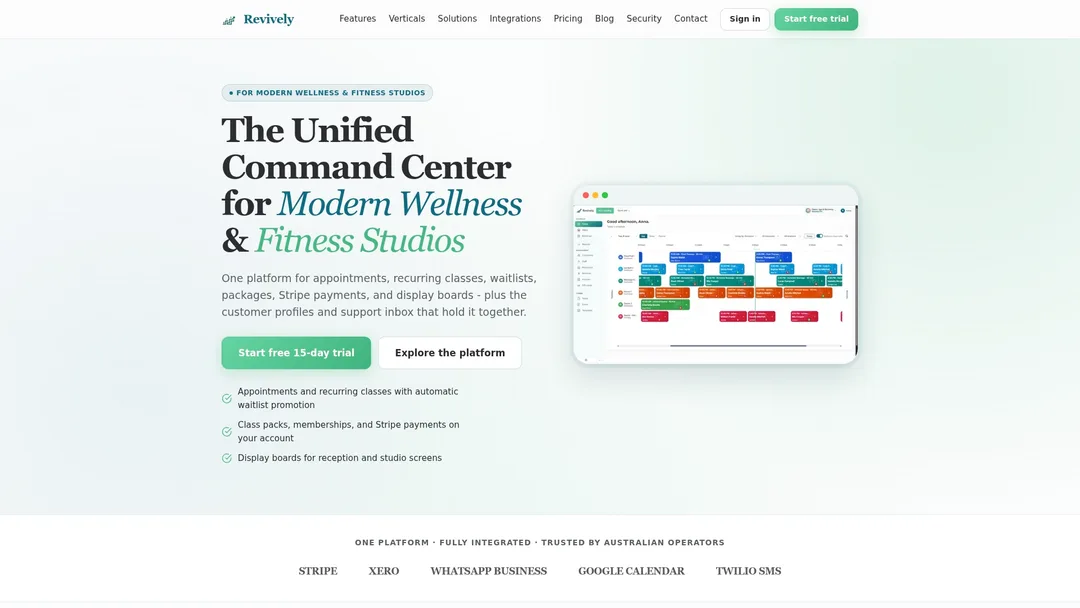
Revively handles Stripe-powered recurring billing for your membership tiers, sends perfectly timed post-visit reminders tailored to each treatment's cadence, and maintains every client's history, preferences, and digitised intake responses in a single, secure record accessible to your entire team. And crucially for Australian operators, our robust Xero integration ensures your membership revenue reconciles with GST automatically - meaning no more manual exports, no frantic end-of-month scramble, and no BAS surprises.
Whether you're running a single treatment room or managing a multi-resource day spa, Revively scales effortlessly with your operation. Start a free trial or book a demo today to discover how our platform empowers you to implement every retention tactic covered in this article, transforming your client base from transient visitors into loyal, recurring advocates.
Useful Sources
- Spas Lose 60% of Clients - Automated Rebooking Fix | US Tech Automations - Data on first-visit lapse rates and the undeniable impact of automated rebooking sequences.
- Spa Client Retention Strategies | Arch Amenities Group - Insights into membership revenue rationale, effective seasonal campaign tactics, and intelligent treatment plan design.
- How to Reduce Spa No-Shows by 70% | AgentZap - Practical advice on deposit structures, multi-channel reminder sequences, and benchmarks for no-show reduction.
- Client Retention Strategies for Salons & Spas | Zoca - A systems-first approach to retention, emphasising rebooking as a standard, integral process.
- 10 Spa Marketing Ideas | Reservio Blog - Data on online booking preferences and the growing trend of after-hours booking behaviour.
- The 8 C's of Customer Loyalty | Influence.io - A framework for understanding effective loyalty programme mechanics, visit-based rewards, and experiential perks.
- Three R's of Customer Loyalty | Hughes - Guidance on designing short, impactful surveys and optimising follow-up recovery rates.
- Spa Scheduling Software | Emitrr - A deep dive into the technology requirements for robust retention: self-scheduling, automated reminders, and comprehensive package management.