
Medical history forms for massage: templates & checklist
! Therapist preparing digital intake form
Use a four-part package for every new client: a clinical intake form, a comprehensive medical/health history, an informed consent document, and a SOAP notes template.
Your client just arrived, beaming, ready for their first massage. Great! Except... they're juggling a latte, their phone, and that scrunched-up intake form you emailed yesterday. "Oh, did I miss a page?" they ask, handing you a half-completed scribble. Suddenly, the serene studio vibe vanishes, replaced by a mad scramble to gather critical health data, explain your privacy policy, and get a signature - all while the clock ticks down.
Sound familiar? It's the messy, all-too-common reality for many Australian spa, yoga, Pilates, and dance studio owners. Trying to balance client experience with legal and ethical compliance shouldn't feel like a circus act.

The secret to a smooth, compliant, and professional intake process? A robust, four-part digital system. Think of it as your studio's unbreakable shield: a clinical intake form, a comprehensive medical/health history, an informed consent document, and a SOAP notes template. For any specialised modalities - like pregnancy or chair massage - simply bolt on the relevant addendum.
The quickest way to ditch the paper chase and gain instant peace of mind? Enable a digital intake form system. Your clients complete it online before they even step through your door, complete with e-signatures and a secure audit trail that's crucial for Australian compliance.
Why "Good Enough" Isn't Good Enough: The Stakes for Australian Studios
Running a wellness studio in Australia means navigating specific compliance landscapes. It's not just about ticking boxes; it's about protecting your clients, your therapists, and your business from serious professional and legal risks. Here's what you need to nail from day one:
- Your Core Documents: Absolutely every new client needs the four core documents completed before their first session. No exceptions.
- Modality-Specific Addenda: If your menu includes specific treatments like pregnancy massage or chair massage, ensure you have tailored addenda for those.
- Australian Privacy, Non-Negotiable: Health information is sensitive information under the Australian Privacy Principles (APPs). This means explicit consent for collection and electronic storage, especially if you're dealing with a multi-resource studio scheduling software.
- Data Stays Local: For full APP compliance and peace of mind, ensure your client data, booking histories, and sensitive health intake forms are stored securely in Australia. This isn't just a preference; it's a critical trust pillar for your clients.
Your Intake Arsenal: The Core Templates Every Australian Studio Needs
Every professional massage practice - whether it's nestled within a bustling dance studio, a tranquil day spa, or a dynamic Pilates and yoga centre - requires the same foundational set of documents. While the branding and a few specific fields might shift, the clinical, legal, and operational logic remains steadfast.
1. The Client Intake & Demographics Form
This is your client's first handshake with your administrative system. It captures essential identifiers: their full name, contact details, emergency contact, and critical GP information. You'll use it at their very first visit and then only update it if their contact details change.
2. The Comprehensive Medical/Health History Form
This is the clinical heart of your intake process. It dives deep into conditions, medications, surgeries, implants, allergies, pregnancy status, and lifestyle factors. This form must be completed in full at the initial visit and then formally reviewed and updated at defined, regular intervals. For a glimpse at standard fields, check out these public intake form examples. They typically cover client details, a detailed health history checklist, medications, allergies, pregnancy status, areas to avoid, and a clear informed consent statement.
3. The Informed Consent Form
This document isn't just a formality; it's a vital legal safeguard. It explicitly documents that your client understands the nature of massage therapy, its potential limitations, and, critically, their absolute right to withdraw consent at any time. This includes acknowledging your draping policy, a clear statement that massage is not a substitute for medical care, and specific written consent for any specialised modalities (think breast massage, for instance). While this US regulatory consultation document provides a useful checklist, remember to always adapt to Australian standards and local regulatory requirements.
4. The SOAP Notes Template
Your session-by-session clinical compass. SOAP notes provide a structured way for therapists to document each treatment: Subjective, Objective, Assessment, and Plan. This must be completed diligently by the therapist immediately following every session.
5. Modality-Specific Addenda
Some treatments require extra attention. Pregnancy massage, for example, demands a separate risk-disclosure and trimester checklist. A corporate or studio chair massage might need a shorter, more rapid-fire version. Keep incident report and GP referral/clearance forms handy for those crucial edge cases.
For environments like dance studios or spa/Pilates/yoga centres, your intake form might also capture class participation, specific fitness goals, or relevant performance history. However, the core clinical fields are non-negotiable for client safety and compliance.
Mandatory Fields for Your Australian Massage Intake Form: A Checklist
Consider this your copy-and-paste checklist. Integrate these fields into your digital form builder or existing practice management software, adapting the wording to perfectly suit your practice. Comprehensive intake form examples confirm these categories as the industry standard for covering cardiovascular, respiratory, musculoskeletal, neurological, and skin conditions.
Client Identifiers & Contact Details
- Full legal name, date of birth, current residential address
- Phone numbers (mobile and home), email address
- Emergency contact name, relationship, and phone number
Primary Healthcare Information
- General Practitioner (GP) name, practice name, and phone number
- Is the client currently under active medical care? (Yes/No, specify condition)
Medical Conditions Checklist (Please tick all that apply)
- Cardiovascular: Heart disease, high or low blood pressure, pacemaker, recent cardiac event
- Neurological: Epilepsy, stroke, peripheral neuropathy, numbness or tingling
- Musculoskeletal: Osteoporosis, recent fractures, joint replacements, implants (type and precise location)
- Skin: Open wounds, rashes, psoriasis, eczema, recent sunburn, fungal infections
- Respiratory: Asthma, COPD
- Endocrine: Diabetes (Type 1 or 2, insulin use)
- Oncology: Current or recent cancer diagnosis, radiation or chemotherapy (please specify dates)
- Bleeding disorders or current anticoagulant therapy
- Mental health indicators relevant to touch therapy (e.g., anxiety, PTSD, trauma history)
Pregnancy Status
- Are you currently pregnant? (Yes/No); if yes, please provide your estimated due date and current trimester.
- Any obstetric complications or high-risk status?
Medications, Supplements, & Allergies
- List all current prescription medications (name and dosage)
- List all over-the-counter medications and supplements
- Known topical product allergies (e.g., oils, lotions, latex)
- Known drug allergies
Recent Injuries, Surgeries, & Procedures
- Date and nature of any surgery within the past 12 months
- Details of any recent injuries, sprains, or fractures
- Injections (e.g., corticosteroid, Botox, filler) and precise location
Pain Chart & Body Map
- A client-marked diagram identifying current areas of pain, tension, or discomfort
- Pain scale rating (0 - 10), character of pain (sharp, dull, aching), and duration
- Specific areas to avoid or treat with extreme caution
- Any mobility limitations or restricted range of motion
Critical Consent Items
- Informed Consent Statement: "I understand that massage therapy is not a substitute for medical diagnosis or treatment. I consent to the treatment described and acknowledge my right to withdraw consent at any time without penalty."
- Draping Policy Acknowledgement: "I confirm I have read and understand the studio's draping policy."
- Specific Written Consent: For any specialised modalities where required (e.g., breast massage).
- Consent to Electronic Storage & Communication of Health Information: "I consent to my health information being stored electronically on Australian servers and used for treatment purposes. I understand my rights under the Australian Privacy Principles regarding access and correction of this data."
- Client signature and date; Therapist signature and date
Administrative Fields
- Date of form completion
- Form version or unique ID
- Dedicated therapist notes field
- Next scheduled review date for comprehensive health history
Australian Record-Keeping & Privacy: What You Must Know
For Australian studios, robust clinical record-keeping is mandatory under the National Code of Conduct for Health Care Workers. It's a cornerstone of professional guidance from bodies like Massage & Myotherapy Australia. Your records must be detailed enough to identify contraindications, document every treatment decision, and support any private health fund rebate eligibility. Skimping here exposes your clinic to significant professional and legal risk, particularly concerning informed consent and insurer obligations.
Crucial Compliance Alert: Health information is explicitly categorised as sensitive information under the Privacy Act 1988 (Cth) and the Australian Privacy Principles (APPs). This isn't just a suggestion; it's a legal obligation. You must obtain explicit, unambiguous consent before collecting, storing, or sharing any health information.
Australian Data Residency Mandate: When choosing a multi-resource studio scheduling software or any all-in-one spa booking software, always confirm that your provider stores client data, booking histories, and sensitive health intake forms on Australian servers. This ensures full compliance with the APPs, reinforces client trust, and reduces your operational risk profile. You must keep records secure, provide clients access upon request, and meticulously log any disclosures to third parties.
Retention Requirements: Industry guidance and private health insurer requirements generally dictate that records be kept for a clinically reasonable period. For adult clients, seven years is a common benchmark cited by professional associations. For clients who were minors at the time of treatment, records should be retained until the client turns 25 years of age. Always double-check your professional indemnity insurer's specific requirements, as they may be more stringent.
Versioning & Audit Trail: Every single time a client updates their health history, you need to record the date, precisely what changed, and who made the change. A digital system with robust version control makes this process automatic, creating an unassailable audit trail that's invaluable during an audit or dispute.
Red Flags: When to Escalate or Refuse Treatment
The following are critical red flags. They demand immediate GP referral or clear written medical clearance before proceeding with any treatment:
- Active systemic infection or fever
- Unstable cardiac condition or recent cardiac event (e.g., within 3 months)
- Recent major surgery (generally within 6-8 weeks, depending on the site and healing)
- Uncontrolled anticoagulation therapy or active deep vein thrombosis (DVT)
- Undiagnosed neurological symptoms (e.g., new onset of numbness, sudden weakness, or paralysis)
- Active cancer without explicit oncologist clearance
- Severe osteoporosis without specific GP guidance regarding positioning and pressure
Pro Tip: Massage & Myotherapy Australia positions the intake form as an ethical cornerstone for building rapport and mitigating risk, not merely an administrative chore. Use the form review as the natural opening to a deep clinical conversation, setting a tone of trust and professionalism.
Streamlining Your Studio Workflow: Intake Forms in Practice
A consistent, repeatable workflow is your studio's best friend. It safeguards your clients, empowers your staff, and liberates your front desk from frantic paperwork chases just before an appointment. Here's a practical sequence designed for busy Australian wellness centres:
- Pre-Appointment Dispatch: Send the digital intake form to your client 24-48 hours before their initial appointment. This allows them to complete it at home, sign electronically, and submit it. Your system should automatically timestamp the submission, creating that crucial audit trail.
- Therapist Pre-Review: Before the client arrives, the therapist should review the completed form. Flag any conditions, medications, or red flags that warrant clarification or potential GP clearance. This crucial step happens before the client is even on the table, ensuring preparedness.
- In-Person Confirmation: At the start of the session, dedicate two to three minutes to targeted verbal questions. Clarify anything flagged during the pre-review. Crucially, note the client's verbal responses directly into your session record.
- Immediate SOAP Notes: As soon as the session concludes, complete your SOAP notes. Document the techniques used, any modifications made due to health history findings, the client's response, and the plan for the next visit.
- Regular Health History Updates: A full review every 6-12 months is standard best practice. Update the health history sooner if the client reports a new diagnosis, surgery, medication change, or significant injury. For ongoing clients, a brief pre-session verbal check at each visit is good practice to catch immediate changes.
- Prompt Red Flag Triage: If a client discloses new chest pain, neurological deficits, an open wound, or uncontrolled bleeding at any point, immediately pause treatment. Document the disclosure, and refer them to their GP or emergency services as appropriate.
Always document every review, including the clinical decision made (e.g., "treatment provided," "modifications applied," or "referral given"). This meticulous record-keeping is your professional and legal protection.
The Art of After-Session Documentation: Mastering SOAP Notes
SOAP notes are the connective tissue that links session outcomes directly back to the medical/health history, building a vital longitudinal clinical picture. Keep them concise, specific, and, wherever possible, measurable.
- Subjective (S): What the client reports. This includes their pain level, precise location, character of pain (e.g., sharp, dull, aching), and any changes since the last visit.
- Example: "Client reports 6/10 neck tension, worse on right side, present for three days. No new medications or injuries."
- Objective (O): What you observe and measure. This covers posture, observable range of motion, palpation findings, and tissue quality.
- Example: "Restricted right cervical rotation (approx. 60° ROM). Significant hypertonicity in right upper trapezius and levator scapulae on palpation."
- Assessment (A): Your clinical impression and an evaluation of progress toward treatment goals.
- Example: "Chronic right-sided neck tension, likely exacerbated by postural stressors. Mild improvement in ROM and reported discomfort from last session."
- Plan (P): The techniques used during the session, any home care advice provided, and the next steps for future treatments.
- Example: "Applied Swedish and trigger-point therapy to right upper trapezius and suboccipitals. Advised client on targeted neck stretches twice daily. Scheduled review in two weeks."
Pro Tip: Always record measurable changes (e.g., range-of-motion degrees, specific pain scale scores) and explicitly link any session modifications directly to relevant health history fields. For instance, "Modified pressure to right shoulder due to reported rotator cuff repair (refer to intake form, Q14)" is far more professionally defensible and clinically useful than a vague or uncontextualised note.
The Digital Edge: Why Australian Studios Are Ditching Paper for Good
Paper forms are a notorious source of operational drag for Australian wellness studios. Think illegible handwriting, lost pages, nonexistent audit trails, and that dreaded front-desk panic when a new client arrives sans paperwork. Digital intake forms for Australian studios, however, systematically close those gaps at every stage of your workflow.
The practical benefits for your spa, Pilates, yoga, or dance studio are undeniable. Clients complete their health history for massage from the comfort of their home, allowing therapists to review it thoroughly before the client even arrives - shifting valuable in-session time from admin to clinical care. E-signatures are not just convenient; they are legally valid in Australia under the Electronic Transactions Act 1999 (Cth).
Secure cloud storage with robust version control seamlessly satisfies audit-trail requirements. Automatic population of client profiles eradicates time-wasting double-entry. Plus, native integration with essential Australian financial platforms like Xero and payment gateways like Stripe means a new client's record, their consent, and their first payment all reside within the same, unified ecosystem. This is critical for flawless GST calculations, automatically issuing legally compliant Australian Tax Invoices, and ensuring your quarterly Business Activity Statements (BAS) are audit-proof with accurate two-way mapping of tax codes, revenue accounts, and liabilities.
When evaluating a digital form solution for your Australian studio, prioritise:
- Australian Data Residency: Confirmation that data is stored on Australian servers or meets equivalent stringent security certifications.
- e-Signature Capability: Legally valid e-signatures for all forms and waivers.
- Version Control & Timestamps: An unassailable audit trail.
- Document Upload: The ability for clients or staff to upload GP referrals or other relevant documents.
- Native Xero & Stripe Integrations: Essential for streamlined financial management and BAS accuracy.
- Custom Modality Addenda Support: The flexibility to configure specific forms without needing to build them from scratch.
| Feature | Paper Forms | Digital Forms | Hybrid (Paper + Scan) |
|---|---|---|---|
| Audit Trail | None (prone to loss/alteration) | Automatic, timestamped, immutable | Partial (scan date only) |
| Client Convenience | In-clinic only, often rushed | Pre-visit, any device, at leisure | In-clinic only |
| Security | Physical lock only (vulnerable) | Encrypted, access-controlled, cloud-based | Physical + basic digital |
| Admin Time | High (manual filing, data entry) | Low (auto-populated profiles, search-ready) | Medium (scanning, indexing) |
| AU Data Residency | Physical location | Vendor dependent (critical check) | Physical + vendor dependent |
| GST & Tax Invoices | Manual calculation & issuing | Automated, compliant, integrated | Manual calculation |
| Xero/BAS Accuracy | Manual entry, prone to errors | Automated, audit-proof two-way sync | Manual entry |
Revively's digital intake forms and waivers are purpose-built for Australian spa, Pilates, yoga, and dance studio workflows. Our features include robust e-sign functionality, secure local storage, automatic client profile population, and native Xero and Stripe integrations for seamless GST reconciliation and payment processing. With custom form templates, you can easily configure modality-specific addenda - your pregnancy massage or chair massage consent forms are ready when you need them, without the hassle.
Pro Tip: Set your online booking system to block confirmation of a new appointment until the client's intake form is fully submitted. This single, simple workflow rule eliminates the most common compliance gap in even the busiest studios, saving everyone time and stress.
Ready-to-Use Snippets for Your Clinic Form
These snippets are designed to be copy-pasted directly into your preferred form builder, Word document, or practice management software. For returning clients, condense them into a one-page quick form; utilise the full set for every new client.
Intake Header Essentials
- Client Name: __________ | Date of Birth: __________ | Date: __________
- Residential Address: __________ | Mobile Phone: __________ | Email: __________
- Emergency Contact Name: __________ | Relationship: __________ | Phone: __________
- GP Name and Practice: __________ | GP Phone: __________
Medical Conditions Checklist (Please tick all that apply)
- ☐ Heart condition / pacemaker ☐ High/low blood pressure ☐ Diabetes (Type 1/2) ☐ Cancer (current/recent)
- ☐ Epilepsy ☐ Stroke ☐ Numbness/tingling ☐ Osteoporosis ☐ Joint replacement/implant (specify: ______)
- ☐ Skin condition (describe): ______ ☐ Bleeding disorder / anticoagulants ☐ Pregnancy (due date: ______)
Medications & Allergies
- Current prescription medications (name, dose): __________________________________________________
- Supplements (name, dose): __________ | Allergies (topical, latex, other): __________
Pain Chart Prompt
- Please mark your current pain/tension areas on the body diagram provided.
- Rate your pain 0 - 10: ____ | Character of pain: ______ | Areas to avoid or treat with caution: __________
Informed Consent Statement (Australian Compliant)
"I understand that massage therapy is not a substitute for medical diagnosis or treatment. I freely consent to the treatment described and acknowledge my right to withdraw consent at any time without penalty. I consent to my health information being stored electronically on secure Australian servers and used for treatment purposes as outlined in the Australian Privacy Principles. I confirm the information provided is accurate and complete to the best of my knowledge."
- Client Signature: __________ Date: __________ | Therapist Signature: __________ Date: __________
SOAP Note Skeleton
- S (Client's Subjective Report): ____________________________________________________________________________
- O (Objective Observations by Therapist): __________________________________________________________________________
- A (Therapist's Assessment): ____________________________________________________________________________
- P (Plan for Treatment/Next Steps): ________________________________________________________________________
To convert these into a PDF, paste them into a Word or Google Docs template, adjust margins to narrow for a concise look, and export. To seamlessly integrate them into Revively, use our intuitive intake form builder to recreate the fields, or contact the Revively support team for personalised assistance with template configuration.
For additional resources, the AMT practice templates library offers member-ready history and consent forms that you can adapt alongside these snippets.
What Consistent Intake Workflows Actually Changed in Our Studio
When we finally optimised and standardised our intake and SOAP workflows across our entire team of therapists, the first immediate impact was felt at reception. Clients started arriving having already completed their forms at home. This simple shift transformed the initial five minutes of every appointment from a frustrating paperwork scramble into a truly professional, meaningful clinical conversation. Our therapists felt far more prepared, more confident, and clients undeniably noticed the difference.
The second profound change was a surge in our referral confidence. With a comprehensive, digitally managed health history securely on file, therapists had an undeniable, objective basis for saying, "I'd like you to get GP clearance before we proceed," rather than making an on-the-spot, often anxious, judgment call. This newfound clarity reduced anxiety on both sides of the treatment table.
Perhaps the single most useful thing we implemented for staff onboarding was a brisk, practical 30-minute walkthrough of the red-flag triage list with every new therapist before their first client. This wasn't a dry policy document; it was a live, interactive conversation using realistic scenarios pulled directly from the intake form. It instantly repositioned the intake form from a mere compliance chore to an indispensable clinical tool.
Revively: Your Unified Command Centre for Australian Wellness Studios
Running compliant intake workflows across a bustling spa, dynamic Pilates studio, or energetic dance school demands more than just a handful of forms. It means seamlessly managing forms, e-signatures, client profiles, payments, and multi-resource scheduling - all from one intuitive platform. Revively does exactly that for Australian studios, eliminating the costly headache of stitching together disparate, clunky tools.
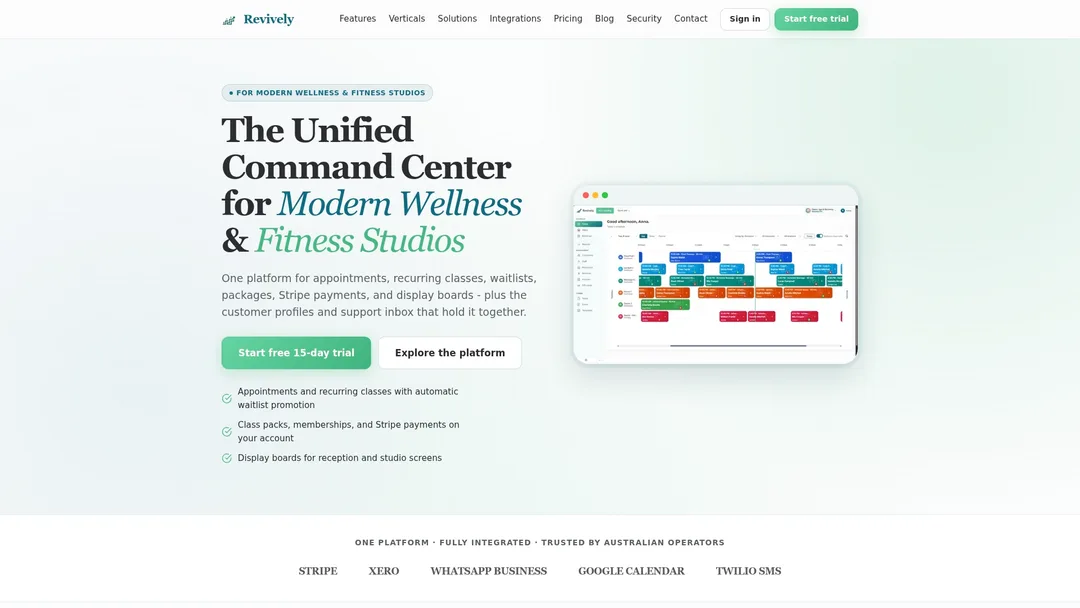
Revively's digital intake forms and waivers deliver e-sign functionality, secure Australian data storage, and automatic client profile population straight out of the box. Our native Xero integration effortlessly handles GST reconciliation, while Stripe powers your memberships and class packs. This means a new client's consent, their critical health history, and their first payment all flow through a single, intelligent dashboard. Custom modality addenda ensure your pregnancy massage or chair massage consent forms are always ready precisely when you need them. For studios managing multiple treatment rooms or locations, Revively's robust multi-resource scheduling keeps every aspect of your operation perfectly connected and optimised.
Ready to reclaim your time, boost your compliance, and elevate your client experience? Start your free trial at Revively today and have your digital intake forms live and ready before your next new client books in.
Sources
The following foundational sources underpin the guidance provided in this article. We encourage you to use them to verify requirements and access additional template resources for your practice.
- Clinical Record Keeping - Massage & Myotherapy Australia
- Practice Templates - Association of Massage Therapists (AMT)
- Massage Therapy Session Consultation - Texas Department of Licensing and Regulation (US - adapted for AU context)
- Client Intake Form - Therapeutic Massage (Example)
Recommended Reading from Revively
Dive deeper into optimising your studio operations and client experience with these insights from the Revively team: