
Class attendance rate for studios: a practical guide
! Hand checking in at studio reception
Your class attendance rate is the percentage of booked participants who actually show up to a scheduled class.
It's Tuesday morning. You're juggling a new client's intake form, an instructor just called in sick, and your booking system is pinging with a "late cancellation" from last night's reformer Pilates. Meanwhile, you glance at your schedule, and that 9 am Barre class, once a bustling hub, is looking decidedly sparse. Sound familiar?
Running an Australian wellness or fitness studio means a constant high-wire act. Every empty spot in a scheduled class isn't just a missed opportunity; it's a silent drain on your revenue, staff morale, and sanity. This isn't about just "bums on seats" - it's about the financial health and sustainable growth of your business.
At its core, your class attendance rate is the percentage of booked participants who actually show up. The formula is simple:
(Checked-in attendees ÷ Booked registrations) × 100
For instance, if 18 clients check in to a yoga class with 24 bookings, your attendance rate is 75%. That single number paints a clearer picture of your schedule's health than a raw headcount ever will. As KPI Depot's canonical definition points out, consistency is key: choose whether you count confirmed bookings, held reservations, or membership entitlements for your denominator, and stick to it across every class.

The Non-Negotiable Metrics for Australian Studio Success
Tracking your class attendance rate, weekly, with smart alerts and automated check-ins, is the single most impactful operational habit an Australian studio owner can build. It flags problems before they haemorrhage cash.
Here's the lowdown:
| Point | Details |
|---|---|
| Use the right formula | (Checked-in ÷ Booked) × 100; maintain a consistent denominator definition across all classes. |
| Set a 40% alert threshold | Flag any slot below 40% fill for three consecutive weeks for immediate review or restructuring. Don't let a class slowly die. |
| Track fill rate and check-in rate separately | Fill rate diagnoses demand issues; check-in rate flags no-shows. Each requires a different fix - marketing vs. operational. |
| Target blended fill | Consistently above 80%? You might be undercapacity. Below 55%? You've got a scheduling or marketing problem brewing. |
| Revively automates the workflow | From waitlist promotion to class packs, Stripe, and Xero integration, Revively gives Australian studios a unified dashboard for tracking and acting on critical attendance data, ensuring GST compliant studio software. |
Table of Contents
- Why a Half-Empty Class Costs You More Than You Think
- Beyond Attendance: The Key Metrics to Track
- Measuring Attendance Accurately in Your Australian Studio
- Setting Realistic Benchmarks and Targets for Your Studio
- Practical Tactics to Lift Your Attendance Rate, Fast
- Your Weekly Attendance Dashboard: What to Look For
- Crunching the Numbers: A Monthly Example
- Choosing the Right Multi-Resource Studio Scheduling Software
- Revively: Your Australian-Made Command Centre for Attendance & Growth
- What We See Consistently Working in Australian Studios
- Sources
- Recommended Resources
Why a Half-Empty Class Costs You More Than You Think
That half-empty mat or unused massage table still incurs the same instructor pay, room overhead, and utility costs. The chasm between "booked" and "checked-in" isn't just an inconvenience; it's lost margin that bites directly into your bottom line.
The business ramifications compound rapidly:
- Revenue Leakage: Imagine a studio running at 60% attendance for a 20-spot class priced at $25 per head. That's $100 left on the table every single session. Over a week, it adds up fast.
- Instructor Utilisation: If you're paying instructors per class regardless of turnout, low fill rates dramatically inflate your cost-per-attendee. You're effectively paying them to wait.
- Churn Signal: Clients who consistently book but repeatedly skip classes are often exhibiting early signs of disengagement - they could be weeks away from cancelling their membership.
- Room Utilisation: Low attendance in prime-time slots means you might be turning away eager, waitlisted clients while paying for a room that's not pulling its weight.
Tracking utilisation as spots booked ÷ total available spots offers a capacity-relative view that raw headcounts simply can't. A class with 12 attendees looks healthy, until you remember the room comfortably fits 20. That's 40% unused capacity.
Beyond Attendance: The Key Metrics to Track
Attendance rate is a crucial puzzle piece, but it rarely tells the whole story. These five companion metrics complete your operational picture and arm you with actionable insights:
| Metric | Formula | What it tells you |
|---|---|---|
| Fill Rate | Booked ÷ Capacity × 100 |
How effectively you're selling spots before the class begins. |
| Check-in Rate | Checked-in ÷ Booked × 100 |
The actual conversion rate of bookings to physical attendance. |
| No-Show Rate | (Booked − Checked-in) ÷ Booked × 100 |
The commitment gap between booking intent and follow-through. |
| Waitlist Conversion | Promoted from waitlist ÷ Waitlist entries × 100 |
Your effectiveness at recovering cancelled spots and maximising revenue. |
| Capacity Utilisation | Checked-in ÷ Capacity × 100 |
The true efficiency of your physical space on any given day. |
Think of it this way: Fill rate is a pre-class marketing signal, telling you if your promotions are hitting the mark. Check-in rate is an on-the-day operational signal, highlighting issues with reminders, cancellation policies, or client commitment. Tracking both provides a much clearer basis for strategic scheduling and marketing decisions than a single, blended number ever could.
Measuring Attendance Accurately in Your Australian Studio
Reliable insights demand reliable data capture. The most common data sources are your booking platform export, your actual check-in feed (app tap, QR scan, or front-desk confirmation), and your payment or class-pack records.
Common Pitfalls to Avoid (and Fix):
- Manual check-in sheets are a liability. Staff forget, clients slip through during busy changeovers, leading to undercounts and skewed data.
- "Auto-check-in" (triggered merely by booking confirmation, not physical arrival) inflates your rate and masks actual no-shows. Don't trust it.
- Mid-week capacity changes (a room swap, an instructor sub) invalidate your denominator unless updated before calculating rates. Be meticulous.
Your minimum viable data pipeline should look like this: export a CSV from your booking system, normalise it to one row per class instance, then calculate fill rate, check-in rate, and no-show rate as computed columns. Aggregate this up to slot and studio totals. This is the bedrock of any useful attendance report template.
Pro Tip: Handle cancellations and reschedules with precision. A client who cancels 24 hours in advance and is replaced by a waitlist promotion should count as one booking. Count the spot once, and credit the check-in to whoever actually attended. Your data will thank you.
Setting Realistic Benchmarks and Targets for Your Studio
Generic benchmarks offer a starting point, but your studio's specific targets should be derived from your own historical data, not plucked from thin air.
- Start with Industry Baselines: Independent studios in Australia typically see a 55-70% fill rate range, with underperforming slots often dipping below 50%. This is your reality check.
- Define a Blended Studio Target: Many successful operators aim for a substantial blended fill rate. If you consistently hit 80%+ across the board, you might be undercapacity. Consider adding another slot or expanding.
- Establish Slot-Level Alert Thresholds: Flag any specific class slot that falls below a low fill threshold (e.g., 40%) for multiple consecutive weeks. These are candidates for review, format change, or even cancellation.
- Differentiate Peak vs. Off-Peak: Prime-time fill rate is a dominant KPI for healthy studios, with top-tier operators hitting 80-92% in peak slots. Off-peak classes warrant more modest targets. Be realistic.
- Derive Your Own Baseline: Pull the last 8-12 weeks of data for each slot. Compute the median fill rate, and set your target 10 percentage points above that. Review quarterly to adjust.
- Build Instructor-Level Benchmarks: If one instructor consistently draws better numbers in the same slot compared to another, that's a powerful signal for scheduling adjustments or professional development.
Practical Tactics to Lift Your Attendance Rate, Fast
Ranked by their typical impact and speed of implementation:
- Optimise Your Reminder Cadence, First: A 48-hour and a 2-hour reminder via SMS or email is the single highest-return change most studios can make. This reduces accidental no-shows without needing new software.
- Embrace Class Packs and Memberships: Clients on class packs or memberships show up more consistently than casual drop-ins. Why? Sunk cost bias and the power of habit both work in your favour.
- Implement a Cancellation Policy with Teeth: A late-cancellation fee or a credit deduction discourages no-shows without alienating committed clients. Crucially, pair this with a generous early-cancel window so clients perceive the policy as fair.
- Target Underperforming Slots with Specific Marketing: A class limping along at 35% fill needs a direct intervention, not a blanket discount. Run a short-term intro offer or a themed series specifically for that weak slot.
- Test Instructor Rotation Before Cancelling: A low-demand Tuesday morning class might just need a different instructor, or a format refresh (e.g., "Beginner Flow" instead of "Advanced Vinyasa"). Only cancel a slot after testing at least one instructor rotation.
Pro Tip: When implementing any change, monitor the fill rate for that specific slot over four consecutive weeks before drawing conclusions. A single-week spike after a promotion is often noise; a sustained lift is a genuine signal.
Your Weekly Attendance Dashboard: What to Look For
A truly useful dashboard surfaces problems before they become financially crippling. Key elements every Australian studio owner should see at a glance:
- Per-slot fill rate and check-in rate for the current week.
- No-show trend over the trailing four weeks, broken down by slot.
- Your top five and bottom five performing slots by fill rate.
- Instructor averages for both fill and check-in rates.
- Waitlist conversion rate for the week.
- Any slots that have triggered your pre-defined alert (e.g., 40% fill for 3 consecutive weeks).
Recommended Reporting Cadence:
| Frequency | Who Reviews | What They Focus On |
|---|---|---|
| Daily | Front desk or Operations | Check-in completeness, same-day no-shows, immediate issues. |
| Weekly | Studio Manager | Fill rate summaries, alert flags, waitlist conversions, tactical adjustments. |
| Monthly | Owner/Director | Slot-level trends, instructor performance, strategic schedule changes, overall revenue impact. |
Automating this weekly workflow - pulling bookings, check-ins, computing rates, and flagging threshold breaches - condenses what used to be a quarterly manual slog into a crisp Monday-morning one-screen summary. Dying classes get detected in weeks, not months. This is how you optimise your studio's schedule and protect your revenue.
Crunching the Numbers: A Monthly Example
Let's imagine a single class instance in your export for a 30-day period:
- Capacity: 20
- Booked: 16
- Checked-in: 13
Here's how the key metrics break down:
- Fill rate per instance:
16 ÷ 20 × 100 = 80% - Check-in rate per instance:
13 ÷ 16 × 100 = 81.25% - No-show rate per instance:
(16 − 13) ÷ 16 × 100 = 18.75%
To get your slot-level trailing average, group by each specific class (e.g., "Monday 6 pm Vinyasa Flow") and compute the median fill rate across all instances in your chosen window (8-12 weeks is a solid timeframe). Median is more robust here than mean, as a single cancelled class (zero fill) can heavily skew an average.
For your studio blended fill, sum all checked-ins across all classes, then divide by the sum of all capacity, and multiply by 100. This gives you an overall health score.
Choosing the Right Multi-Resource Studio Scheduling Software
Your choice of all-in-one spa booking software or fitness studio CRM Australia is critical for accurate attendance tracking and compliance. Here's an implementation checklist and key questions for any vendor:
Configuration Checklist for Your Current System (or Future One):
- Automated check-in capture (app, QR, or front-desk tap) is active for every class. Manual systems are a data black hole.
- CSV or API export is available, providing bookings and check-ins as separate data points.
- Waitlist auto-promotion is enabled and thoroughly tested.
- Class packs and memberships are accurately tracked against attendance, not just purchases.
- Xero and Stripe connectivity is confirmed for GST reconciliation. This is non-negotiable for Australian studios.
- Slot-level alerts or filters can be configured in your reporting view.
Questions to Ask Any Software Vendor (Especially Mindbody Alternatives Australia):
- Does the system automatically promote waitlisted clients when a booking is cancelled?
- How does the platform treat cancellations in attendance reports - are they excluded from the denominator, or counted as no-shows?
- Can I set slot-level fill thresholds and receive automated alerts when a class falls below them?
- Does the export distinctly separate booked and checked-in counts, and track capacity?
- How does the system handle mid-week capacity changes in historical reports, ensuring data integrity?
- Crucially for Australia: Where is client data stored? Is it fully compliant with Australian Privacy Principles (APPs) and housed within Australia?
- How natively does the system handle 10% GST calculations and generate legally compliant Australian Tax Invoices for casual classes, memberships, and packages?
- Does your Xero integration offer true two-way mapping of tax codes, revenue accounts, and liabilities to ensure BAS accuracy, or is it just a basic export?
Governance Checklist for Your Studio:
- Assign one specific person to review the weekly fill rate summary every Monday morning.
- Clearly define who has the authority to restructure or cancel a class slot, and what the precise trigger threshold is for such decisions.
- Schedule a monthly owner/director review of instructor-level performance and overarching slot-level trends.
Revively: Your Australian-Made Command Centre for Attendance & Growth
Attendance tracking flourishes when booking, check-in, waitlist, and payment data all reside in one unified cloud command centre. Fragmented tools mean endless manual reconciliation, delayed alerts, and inevitable missed revenue opportunities.
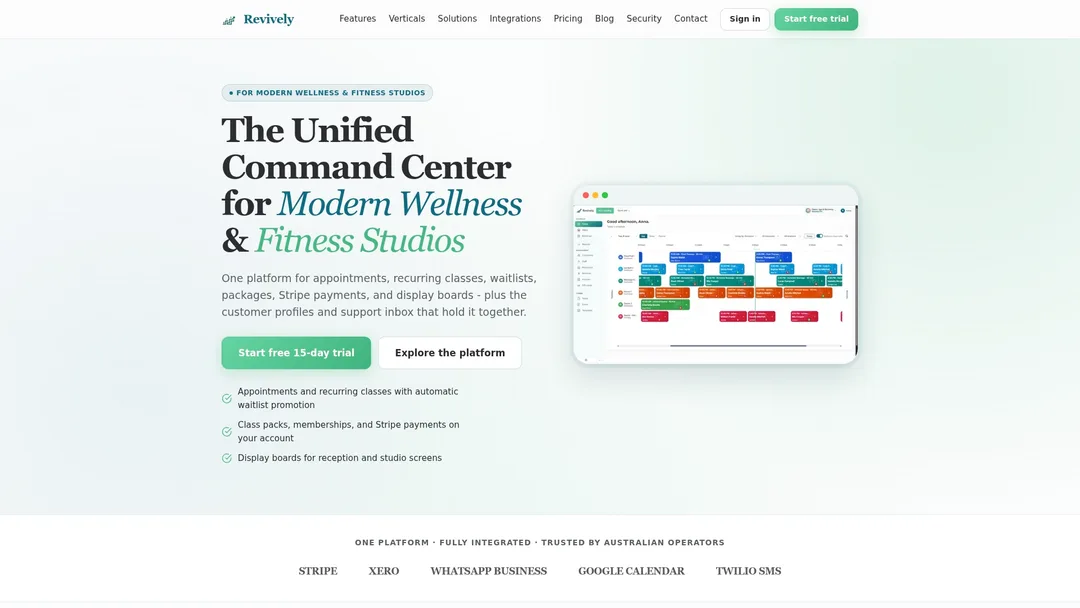
Revively is specifically built for Australian spas, yoga, Pilates, clinics, and dance studios that demand all these capabilities in a single, intuitive dashboard.
- Waitlist auto-promotion seamlessly fills cancelled spots, maximising revenue without any staff intervention.
- Class packs and memberships automatically track attendance against entitlements, simplifying client management.
- Stripe payments and our deep, 100% legal Xero integration manage 10% GST reconciliation flawlessly, removing the need for separate exports or manual spreadsheet gymnastics. Our two-way mapping of tax codes and revenue accounts ensures your quarterly BAS is audit-proof.
- Our robust class scheduling provides the precise slot-level fill and check-in data you need to act on trends proactively.
- And because we're Australian-made, we guarantee Australian data residency and privacy, meaning your client data, booking histories, and sensitive health intake forms are stored locally, in full compliance with the Australian Privacy Principles (APPs).
Start a free trial today and experience how quickly your weekly reporting transforms, giving you confidence, control, and precious hours back.
What We See Consistently Working in Australian Studios
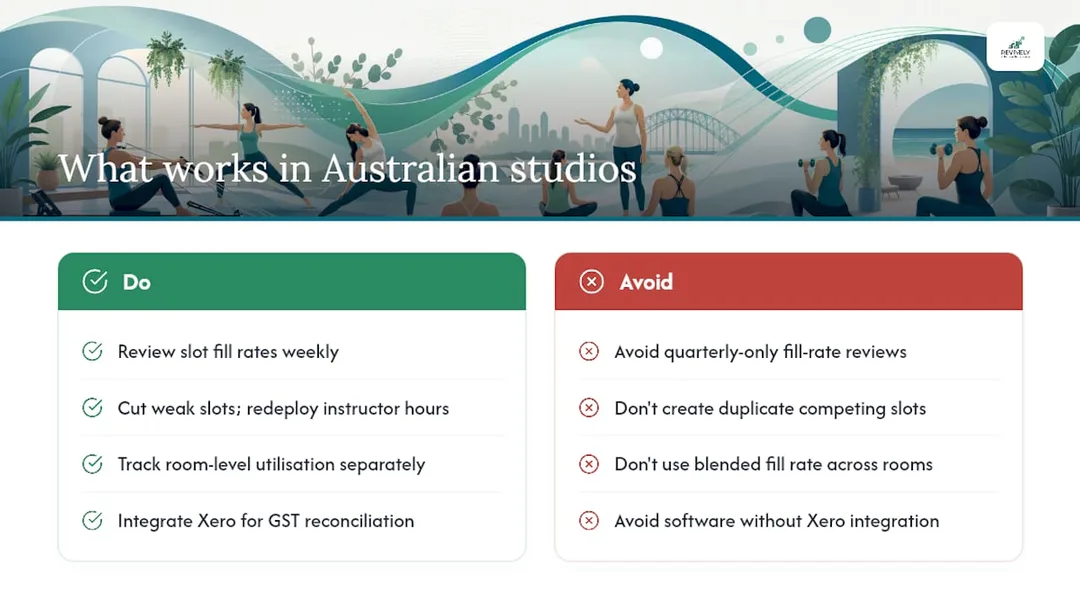
The studios that consistently excel at attendance management share one crucial habit: they review fill rate by slot every single week, not just quarterly. This cadence alone distinguishes operators who catch a dying class in week three from those who notice it in month four, often after the instructor has already moved on.
Schedule overfitting is a prevalent issue in our market. Studios add classes based on perceived demand, only to find themselves with 12 slots competing for the same few Tuesday-morning clients. Cutting the weakest slot and redirecting that instructor hour to a waitlisted, prime-time class is almost always the right financial call - but it requires the confidence that only consistent, granular reporting provides.
Multi-room operations, like a spa with three treatment rooms and a separate group class studio, face an amplified version of this challenge. A single blended fill rate won't cut it. Each resource needs its own utilisation target, and your reporting must surface these separately. This is precisely where a system offering multi-resource scheduling and room-level capacity tracking truly earns its subscription cost, moving you beyond basic yoga studio booking system AU capabilities.
Finally, Australian studios have a very specific accounting need that offshore software often fumbles. Accurate GST reconciliation on class packs, memberships, and casual payments demands impeccably clean transaction data tied to the correct tax codes. A robust Xero integration isn't a "nice-to-have" for a studio doing meaningful volume - it's the difference between a 20-minute month-end close and a two-day spreadsheet nightmare, ensuring your BAS accuracy.
Sources
- Class Attendance Rate - KPI Definition, Formula, & Benchmarks | KPI Depot
- Automate Fitness Class Attendance Analytics: 5 Steps Guide
- The Only 7 Numbers Your Studio Needs to Track (And What They're Actually Telling You)
Recommended Resources
Looking to further optimise your studio's operations and master the numbers? Check out these related articles from Revively:
- Beyond Spreadsheets: How Integrated Software Transforms Recurring Class Management for Australian Studios - Revively
- Seamless Studio Flow: Mastering Class Waitlists with Automation in Australia - Revively
- Top 4 Hapana Reviews Software Alternatives 2026 - Revively
- Australian Dance Studio Software: Master Your Timetable, Payments, and BAS (2026 Guide) - Revively