
GST on massage services: when it's taxable and when it's not
! Therapist setting up massage treatment bed
Most standalone massage services are taxable in Australia.
It's 8:30 PM. You've just wrapped up a packed day of appointments - physiotherapy, remedial massage, some relaxation sessions - and now you're wrestling with the books. Every transaction feels like a tightrope walk: Did I charge GST on that? Was that particular service actually GST-free? Is this invoice Xero-ready or an audit risk waiting to happen?
The Australian Taxation Office (ATO) has a knack for making things feel opaque, and GST on massage services is one of those classic grey areas that keeps Australian studio owners up at night. Forget the myths, the "everyone does it" whispers, or the general assumption that if a service is therapeutic, it's tax-exempt. That's a dangerous path.
The stark reality? Most standalone massage services in Australia are taxable. GST-free status only applies in tightly defined clinical scenarios, and the ATO is unequivocally clear that massage therapy alone isn't automatically listed as a GST-free health service.

It becomes GST-free only when three conditions align perfectly: the massage forms a crucial part of a listed health service, it's delivered by a recognised professional within that service, and it's genuinely accepted as clinically necessary for appropriate treatment. Miss one of those, and you're liable for 10% GST.
This isn't just about avoiding a slap on the wrist; it's about ensuring your Business Activity Statements (BAS) are flawless, your Xero integration isn't creating headaches, and your client data is handled with uncompromised Australian data residency and privacy.
Your First Move: Cut Through the Noise
Before you dive into the nuances, take a deep breath. Here's what you need to do, right now:
- Audit Your Service List: Go through every service you offer and explicitly mark it as either
clinicalorwellness. - Flag the Ambiguous: Items like "remedial massage" often sit in a grey zone. Identify these for a closer, critical look against the ATO's criteria.
- Tag in Your Software: Get these categories correctly assigned in your booking and accounting systems before your next BAS period. This is non-negotiable for GST compliant studio software.
The Core Confusion: When is Massage GST-Free?
The biggest trap? Believing a service is GST-free just because a qualified therapist performs it, or because it "feels" therapeutic. The ATO doesn't care about feelings; it cares about specific criteria.
| The ATO's Three-Part GST-Free Test (All Must Apply) | What It Means for Your Studio |
|---|---|
| 1. Part of a Listed Health Service | Is the massage a standard, recognised component of a service explicitly listed in the GST Act (e.g., physiotherapy, chiropractic, osteopathy)? |
| 2. Delivered by a Recognised Professional | Is the practitioner legally registered or accredited within that specific listed health service (e.g., a physiotherapist registered with AHPRA)? A general qualification isn't enough. |
| 3. Clinically Necessary for Treatment | Is the massage genuinely required as part of an assessment, treatment plan, or referral for a specific health condition? A general "feel-good" massage doesn't qualify. |
Studio Owner's Insight: If any of these three conditions are not met, that massage service is, by default, a taxable supply requiring 10% GST. It's that simple, and that strict.
Table of Contents
- Unpacking the ATO's GST-Free Criteria
- When Massage is Taxable & Your $75,000 Threshold
- Mastering Invoicing for Mixed GST-Free and Taxable Services
- Real-World Scenarios: Physiotherapy, Remedial & Relaxation
- Reconciling GST with Confidence: Revively, Xero & BAS
- Tidy Up Your GST Tagging Before Your Next BAS
- Trusted Resources & Why Studios Get It Wrong
Unpacking the ATO's GST-Free Criteria
Let's dissect the three conditions. Think of them as non-negotiable checkboxes. All three must be ticked.
1. It Must Be Part of a Listed Health Service
This isn't about being "healthy" in a general sense. The GST Act specifically lists certain health services. Think physiotherapy, chiropractic, osteopathy, podiatry, etc. If the massage you offer is an integral, standard, and recognised component within one of these listed services, you're on the right track for this first condition.
2. It Must Be Delivered by a Recognised Professional
This means the person providing the service must be legally registered or accredited to practice that specific listed health service. For example, a physiotherapist registered with the relevant national board. A generally "qualified" massage therapist who isn't also registered under one of the listed health services usually won't meet this. It's about the practitioner's specific accreditation within the listed service, not just their general skill set.
3. It Must Be Accepted as Clinically Necessary for Appropriate Treatment
This is where the "feel-good" factor gets debunked. A massage designed purely for relaxation, even if delivered by a highly skilled physio, doesn't qualify. The massage must be justified by an assessment, tied to a treatment plan, or linked to a referral for a specific condition. It's about genuine clinical intent and outcome, not general wellbeing.
Crucial Detail: The ATO also points out a nuance many practitioners miss: the recipient of a GST-free health service doesn't always have to be the patient directly. In certain employer-funded or third-party arrangements, another business can be the recipient, provided the core conditions still stack up for the actual service delivered.
When Massage is Taxable & Your $75,000 Threshold
If a massage service doesn't meet all three of the above conditions, it's a taxable supply. This includes standalone relaxation massages, day spa treatments, and most general wellness bookings. The claim "it's good for your health" simply doesn't create a GST exemption. The ATO's test is precise, not broad.
The $75,000 GST Registration Threshold
This is a critical benchmark for any wellness studio in Australia. Once your studio's annual GST turnover reaches $75,000 (or you expect it to), you are legally required to register for GST.
Once registered:
- Pricing: Every taxable service price must include 10% GST.
- Invoicing: You must issue legally compliant Australian Tax Invoices for all taxable supplies over $82.50, clearly stating your ABN and the GST component.
- Input Tax Credits: You can claim input tax credits on the GST paid for your business expenses (e.g., massage oils, towels, equipment, marketing services).
- Bundled Services: Be meticulous with memberships and class packs. If they include a mix of GST-free and taxable components, their GST treatment becomes complex and requires careful breakdown.
The most common mistake? Treating wellness massage as clinical simply because it's delivered by a qualified therapist. Qualification alone does not make a service GST-free. Context, documented intent, and adherence to the ATO's three-part test do.
Mastering Invoicing for Mixed GST-Free and Taxable Services
Many studios offer a blend of clinical and wellness services. When a client's visit includes both, your invoice becomes your frontline defence against ATO scrutiny. A vague, lumped sum invoice is an open invitation for ambiguity - exactly what the ATO flags during audits.
Best Practice for Mixed Services:
- Itemise, Itemise, Itemise: Each component of the service needs its own clear line item. For example:
- "Physiotherapy assessment & treatment, GST-free"
- "Relaxation massage add-on, taxable"
Apply GST only to the taxable portion. This ensures flawless GST and tax invoice handling.
- Attach Supporting Docs: Client data, booking histories, and sensitive health intake forms are stored locally in Australia, fully complying with the Australian Privacy Principles (APPs). So use that robust audit-ready trail. Treatment plans, referral letters, or clinical notes should be digitally attached or cross-referenced with the invoice number.
- Allocate Shared Costs Logically: If a treatment room or supplies serve both clinical and wellness clients, apportion the associated expenses based on actual usage, not just a guess.
- Tag Transactions in Software: Crucially, your accounting software needs to reflect this. Ensure GST-free and taxable income streams are tagged to separate ledger codes, not just one broad "services" category. This is where GST compliant studio software like Revively makes all the difference.
Straight Talk: Implement a quick front-desk checklist: Was this part of a documented treatment plan? Was it delivered by a recognised professional in a listed health service? Two "yeses" points towards GST-free. Any "no" or "maybe" means 10% GST.
Real-World Scenarios: Physiotherapy, Remedial & Relaxation
Let's look at how these rules play out in common studio situations:
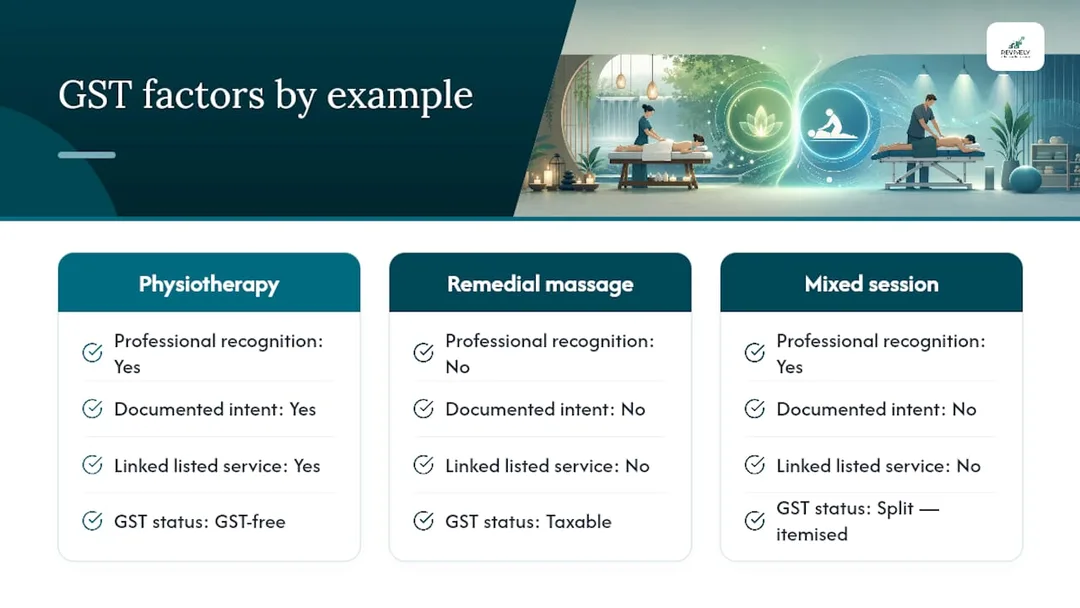
Example A: Clinically Justified Physiotherapy
A registered physiotherapist includes 15 minutes of soft tissue massage as part of a rehabilitation session for a client recovering from a shoulder injury. This is explicitly documented in the client's treatment plan. The service is delivered by a recognised professional (the physio) as part of a listed health service (physiotherapy), and it's clinically necessary for the injury.
Outcome: GST-free.

Example B: Standalone Remedial Massage
A skilled remedial massage therapist, operating independently (i.e., not working under a listed health service like a physio practice), treats a client for general muscle tension. There's no referral, no specific treatment plan for a diagnosed condition, and no link to a listed health service.
Outcome: Taxable (10% GST). Regardless of the therapist's skill or the client's perceived benefit. The context and intent are key.
Example C: Mixed Session - Clinical with a Relaxation Add-on
A client books a physiotherapy session. The physio treats their diagnosed back pain (GST-free). At the end, the client asks for an extra ten minutes of pure relaxation massage, completely unrelated to the original treatment plan.
Outcome: The invoice must be split. The clinical physiotherapy portion is GST-free. The ten-minute relaxation add-on is taxable (10% GST). Each must be itemised separately, with GST only applied to the taxable line.
Across all scenarios, the deciding factors remain consistent: professional recognition within a listed service, documented clinical intent, and a genuine link to a listed health service.
Reconciling GST with Confidence: Revively, Xero & BAS
Manually splitting invoices, cross-referencing clinical notes, and patching up spreadsheet errors is a colossal drain on your time and energy - especially once you're managing dozens of mixed appointments each week. This is precisely where having a unified cloud command centre like Revively, integrated with Xero, truly shines.
With Revively, your studio benefits from:
- Smart Service Tagging: Set up separate service categories for GST-free and taxable offerings. Every booking automatically posts with the correct tax code from the outset. No more guesswork or manual reclassification.
- Audit-Ready Digital Trails: Link digital intake forms, signed waivers, and treatment notes directly to each appointment. This gives you an audit-ready trail for any GST-free claims, stored securely with Australian data residency and privacy.
- Flawless Xero Integration for BAS Accuracy: Our native, two-way Xero integration is built for 100% legal tax compliance. Automated mapping of tax codes, revenue accounts, and liabilities ensures your quarterly Business Activity Statements (BAS) are flawless and audit-proof. This isn't just a sync; it's a guarantee that your BAS reflects what truly happened at the front desk, eliminating manual spreadsheet errors and saving you hours of reconciliation.
- Seamless Payments: Integrate with Stripe for smooth payment processing, ensuring all transactions are correctly categorised for tax purposes, from casual classes to multi-resource packages.
Revively significantly reduces the manual reclassification that causes most GST errors for Australian wellness and fitness studios offering both clinical and wellness services. We specialise in helping businesses like yours achieve GST compliant studio software with minimal fuss. For those genuinely borderline cases, always confirm the specific treatment with a registered tax agent.
Tidy Up Your GST Tagging Before Your Next BAS
Chasing down mismatched invoices and correcting tax codes after the fact is far more time-consuming (and stressful) than setting up correct tax codes now. Revively empowers you to configure each service - clinical or wellness - with the right tax treatment the moment a client books. This means your bookings, payments, and Xero reconciliation stay perfectly aligned, automatically.
If you're still navigating how to structure your service menu for GST purposes, Revively's robust multi-resource studio scheduling and online booking setup makes tagging service tax codes an intuitive part of your normal workflow, not an extra chore. Explore how Revively is becoming a leading Mindbody alternative Australia-wide, built for Australian compliance.
Trusted Resources & Why Studios Get It Wrong
Here are some authoritative links and common pitfalls to help you further optimise your studio's tax compliance:
Authoritative Links & Practical Resources:
- ANTA GST exemption guidance - an industry association's plain-English summary.
- Revively - practical software for tagging and reconciling GST-free versus taxable services.
What Studios Keep Getting Wrong About GST on Massage
The biggest misconception isn't legal; it's cultural. Practitioners often assume that because a service is delivered by someone qualified, or because it's genuinely therapeutic, it must qualify for GST-free treatment. That's simply not how the ATO test works. Treating "skilled" as a synonym for "clinical" is where most studios get exposed to non-compliance.
What's criminally underrated in this entire discussion is documentation. Everyone focuses on the legal test itself - the three conditions, tick the boxes, done. But the real risk, and where studios truly fall down, sits in the paper trail (or lack thereof). A physiotherapist who delivers genuinely necessary treatment but keeps no clear notes linking it to a plan is just as exposed as a wellness therapist who mislabels a relaxation rub as "remedial." The ATO doesn't take your word for it. It wants evidence.
If there's one thing studio owners should prioritise above all else, it's separating service categories in their booking and accounting systems. Get that underlying structure right, and the invoicing, the tax codes, and the BAS reporting largely take care of themselves. Get it wrong, and you're reconstructing months of mixed transactions by hand, usually right before a filing deadline - a nightmare scenario for any all-in-one spa booking software user.
Recommended for Your Studio:
- Navigating the BAS Beast: Does GST Apply to Your Australian Yoga, Pilates, or Wellness Studio? - Revively
- The Australian Studio Owner's Guide to Stripe Fees & GST Compliance - Revively
- Beyond Bookings: Choosing the Right Massage Therapy Software for Your Australian Studio in 2026 - Revively
- GST Compliance - Revively blog