
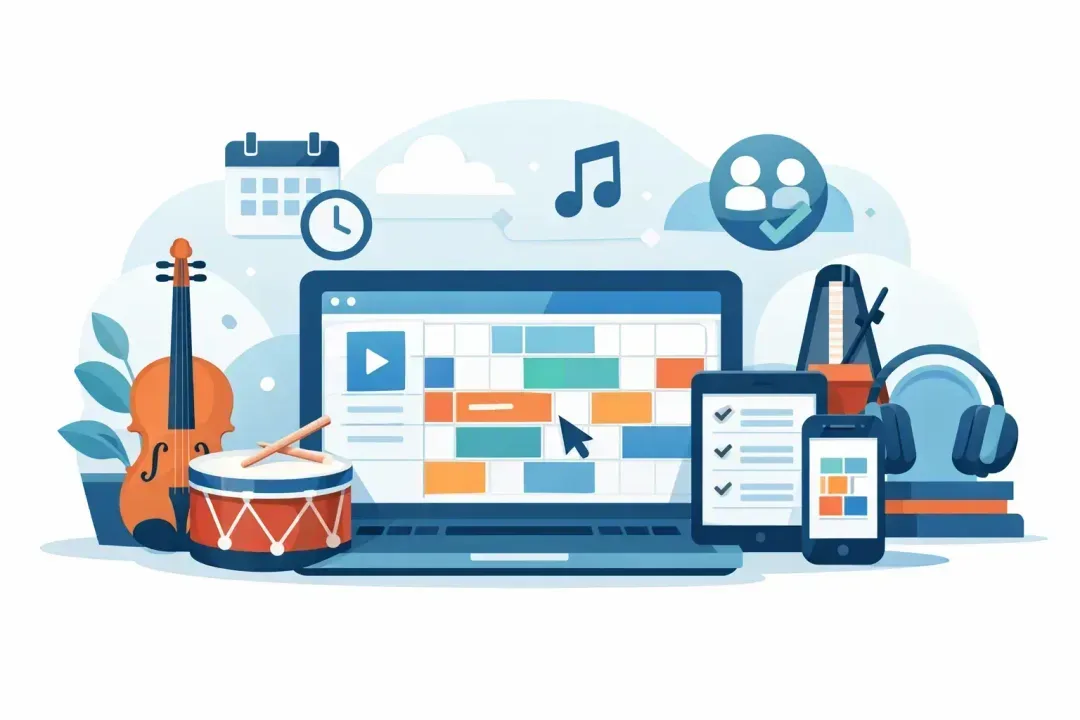
Music school scheduling software should cut admin, prevent clashes and simplify payments, classes and communication in one system.
It's 4:30 PM. Your busiest hour. A parent calls, confused about their child's make-up lesson. The new drum tutor can't find their room booking. And you just realised three invoices for last week's group class are still unpaid. Sound familiar?
For many Australian music school owners, these are not just "busy day" problems. They're symptoms of a deeper issue: a systems problem, not a growth problem. You're not dealing with a simple calendar; you're orchestrating teachers, rooms, instruments, recurring classes, private lessons, make-ups, student records, and payments - all at once. When these moving parts live in disconnected tools, admin tasks multiply faster than your student roster. That's when scheduling software stops being a 'nice-to-have' and becomes your core operational infrastructure.
Beyond the Basics: What Music School Software Must Solve
Most generic booking tools assume a simple service model: one staff member, one room, one appointment. That logic crumbles the moment you try to run a dynamic music school.
A robust system needs to handle one-to-one lessons and group classes without forcing clumsy workarounds. It should instinctively account for room availability, teacher schedules, and class capacity within the same booking flow. If the piano room is booked, the system should know it. If a guitar tutor is on leave, the timetable should reflect it instantly. And if a theory class fills up, the waitlist should kick in without your front-desk team manually juggling students.
Ignoring these nuances creates hidden labour. Your team wastes precious time confirming changes, fixing clashes, and fielding preventable questions from parents and students. The right software reduces these touchpoints; the wrong one creates more of them.
The Power of Integrated Operations: One Source of Truth
Scheduling is a critical piece, but the real operational gains come when bookings, client records, intake forms, payments, and communication all share the same data.
Consider a common scenario: a parent books a trial lesson, completes an intake form, receives an SMS confirmation, and pays a deposit. If this process involves multiple, disconnected apps, each step is an opportunity for error. Names are entered twice. Vital notes get misplaced. Payments don't automatically link to the booking. Your staff then spend valuable time double-checking if the student is actually confirmed.
With truly integrated music school scheduling software, the booking itself initiates the client record, stores all relevant details, triggers automated communications, and instantly links payment status to the session. This isn't a flashy "feature"; it's the bedrock of operational control.
For Australian schools running a mix of private tuition and recurring classes, integration is non-negotiable. Parents expect a seamless experience. Your team needs one reliable source of truth. And as an owner, you need to see what's booked, what's paid, and what needs attention - all without flipping between five different browser tabs.
Features That Actually Make Busiest Hours Easier
Forget endless feature lists. The real question is whether the system genuinely simplifies your most chaotic hours.
Look for scheduling logic that brings together recurring bookings, room allocation, and staff calendars. A clear, visual grid is essential; music schools often need to quickly assess availability across people and spaces. If your timetable is difficult to read, your team will inevitably revert to whiteboards and paper notes.
Class management also demands more than a basic group booking tool. Capacity limits, automatic waitlists, and clean attendance tracking make a tangible difference when running ensembles, theory sessions, or beginner programs. Parents should be able to book online without calling reception to ask what's still available.
Payments must be baked into the same workflow. This includes upfront payments, securely saved cards for recurring billing, flexible package handling, and crystal-clear invoicing. If staff are manually reconciling lesson bookings against separate payment records, the software is still costing you time and accuracy.
Finally, communication. Automated SMS confirmations, reminders, and booking updates slash no-shows and significantly reduce inbound admin calls. The goal isn't to send more messages, but to ensure the right messages are sent automatically, at the right time.
Where Many Australian Schools Get Caught Out
Many software demos look perfectly fine because they showcase a simplified booking flow. Real life in a music school is rarely simple.
Perhaps one tutor teaches violin privately on Mondays, runs a group strings class on Wednesdays, and shares a room with another teacher on Saturdays. Maybe some students attend casually while others commit to multi-lesson packages. Your front desk needs an instant view of daily arrivals, while management needs detailed reports on room utilisation and revenue. If a platform can't handle these complexities cleanly, you'll end up either buying expensive add-ons or twisting your operations to fit the software's limitations.
That's a bad trade-off. Software should support how a good school already runs, not force your team into awkward admin habits because the product was built for generic appointments.
Another common pitfall for Australian studios is branding. If your online booking page feels like a clunky, bolted-on widget, parents notice. This disjointed experience can inadvertently make a well-run school appear less professional than it is. Branded booking pages, clear class information, and professional confirmations all build crucial trust before a student even steps through your door.
The Revively Difference: Operational Control & Australian Compliance
When assessing music school scheduling software, start with your actual timetable, not a sanitised version. Map your real mix of private lessons, recurring classes, rooms, staff, and payment rules. Then, rigorously test if the software can handle it all without manual patches.
Ask highly specific questions:
- Can a single booking update room, tutor, and client records in one seamless step?
- Can classes operate with specific capacity limits and automatic, intelligent waitlists?
- Can your front-desk team view all daily activity without constantly switching screens?
- Can you collect essential intake forms and payments as an integral part of the booking process, not as an afterthought?
Beyond features, consider setup relevance. Industry-specific software typically gets you live faster because its core structure already mirrors your business model. A generic platform might claim flexibility, but it can prove expensive in time and resources once you start configuring every edge case yourself.
For Australian operators, local fit isn't a minor detail - it's a compliance cornerstone.
For Australian music schools, trust hinges on compliance. We understand the necessity of local data storage within Australia, adhering strictly to the Australian Privacy Principles (APPs), and ensuring all financial transactions are 100% GST-ready with compliant Australian Tax Invoices.
| Operational Aspect | Generic Software Headache | Revively's Integrated Solution |
|---|---|---|
| Resource Management | Manual clash checking for rooms, teachers, instruments. | Unified: Automatically optimises teacher and room allocation across private & group sessions. |
| Client Records | Fragmented client data, re-entering details across systems. | Centralised CRM: Single client profile stores bookings, forms, payments, and comms history. |
| Payments & Invoicing | Separate payment gateway, manual reconciliation, generic invoices. | Automated & GST-Ready: Handles deposits, packages, applies 10% GST, generates legally compliant Australian Tax Invoices. |
| Tax & Reporting | Spreadsheet-heavy reconciliation for BAS, risk of errors. | Xero Integration: Seamless two-way sync for accurate tax codes, revenue accounts, and effortless, audit-proof BAS preparation. |
| Communication | Manual SMS/email, generic templates, chasing no-shows. | Automated & Personalised: Smart reminders, updates, custom messages linked to bookings & attendance. |
The Commercial Case: Protecting Your Margin
Most music schools don't have an 'admin problem' because staff are careless. They have an admin problem because the system demands too many people to remember too many disparate things.
Good scheduling software significantly reduces preventable labour. It cuts booking errors, minimises no-show risks, streamlines payment collection, and gives your team a crystal-clear view of everything happening across your school. This doesn't just improve the client experience; it directly protects your studio's margins.
This is precisely why replacing a patchwork stack of apps often makes more sense than simply adding another. Stop paying for six tools that constantly argue with each other. If scheduling, CRM, payments, and class operations belong to the same workflow, they absolutely belong in the same system.
That's the practical value of a platform built for both appointment-based and class-based Australian operators. For music schools, the gain isn't just convenience; it's cleaner operations, faster admin, and dramatically fewer points of failure across your entire timetable.
If you're comparing options, be hard to impress. The right system should make your busiest day feel more controlled, not just look polished in a sales demo. Revively takes this approach seriously, with scheduling, client management, classes, payments, and front-of-house tools explicitly built to work together. Choose software that genuinely matches the reality of your school, because the timetable is where operational cracks show first.