27 yoga studio marketing ideas that fill classes faster
! Yoga instructor setting up mats and water
The fastest way to grow a yoga studio is to make discovery obvious and booking frictionless: complete your Google Business Profile, fix your booking flow, launch short-form video, and build a one-step referral system.
The clock's ticking, your class schedule is looking a bit sparse, and your to-do list for "marketing" just keeps growing. Sound familiar? Running a wellness or fitness studio in Australia means you're juggling a thousand things: teaching, managing staff, welcoming clients, and somewhere in there, trying to figure out how to get more bums on mats.
It's easy to feel like you're constantly hustling, piecing together bits of advice from a dozen different sources, hoping something sticks. But here's the sharp truth: the fastest way to grow your yoga, Pilates, or recovery centre isn't about doing more. It's about removing the friction points that stop people from discovering you and booking a class, then making sure your operations (like GST compliant studio software and 100% legal Xero integration) are humming along in the background.

Forget the generic "do everything" advice. Focus on four core areas that compound faster than anything else you'll try this year: perfecting your online presence, streamlining your booking experience, creating compelling short-form video, and building a simple referral system. Each of these takes days, not months, to set up properly.
Here's a rapid-fire seven-day action plan to kickstart your growth:
- Claim and complete your Google Business Profile: Photos, hours, services, attributes - make it shine.
- Film one 30-60 second class clip on your phone: Post it as an Instagram Reel or TikTok. No fancy equipment needed.
- Build a single landing page for your intro offer: One clear call to action, zero distractions.
- Set up a three-email welcome sequence for new bookings: Automate that crucial first impression.
- Ask five recent students for a Google review: Timing is everything.
- Create a one-step referral offer: "Bring a friend, you both get a free class." Keep it simple.
- Audit your booking flow on mobile: Count the taps to checkout. Aim for three or fewer.
Demand for wellness experiences in Australia is strong. Yoga Alliance's participation data globally reflects a sustained interest in yoga and similar practices. The problem isn't often a lack of interest, but rather a lack of visibility or friction in your processes. An integrated platform like Revively acts as your unified cloud command centre, pulling all these tactics into one dashboard instead of forcing you to stitch together five disparate tools. It's the Mindbody alternative Australia has been waiting for, designed for our unique market needs.
The Growth Blueprint: Core Pillars for Studio Success
| Point | Details |
|---|---|
| Fix booking friction first | Trim checkout to three taps or fewer. Every page needs one, unambiguous call to action. |
| Complete your GBP | Update it weekly. Expect initial ranking shifts in 60-90 days, with stronger gains by month four to six. |
| Automate your welcome | Confirm booking, send day-1 orientation, day-3 teacher story, and day-7 conversion prompt. |
| Keep referrals one-step | A straightforward class-for-class exchange consistently outperforms tiered or complex points-based programmes. |
| Track five core metrics | Monitor new clients by source, conversion rate, CAC, retention, and class fill rate monthly. |
Table of Contents
- Yoga studio marketing ideas start with defining your niche
- Website and booking flow: turn browsers into trial visits
- Google Business Profile and local SEO for yoga studios
- Social media and short-form video that actually drives bookings
- Email and SMS nurture sequences that convert trials into members
- Referral and loyalty programmes that run themselves
- Paid ads for intro offers: where a small budget actually works
- Events, workshops and local partnerships
- Content marketing and SEO that answers real questions
- Pricing, intro offers and conversion triggers
- Track your marketing performance: the metrics that matter
- Influencer collaborations and testimonials that feel genuine
- Targeted campaigns for different demographics
- Leveraging online classes and virtual events
- CRM systems for personalised marketing at scale
- Seasonal and holiday promotion strategies
- How integrated studio software makes these tactics actually happen
- Frequently asked questions
- Sources
Yoga Studio Marketing Ideas Start with Defining Your Niche
Before you spend a single dollar on ads or hours churning out content, take a breath and decide exactly who you're talking to. A studio marketing to "everyone who wants to feel better" ends up speaking to no one. You become background noise. Instead, segment by three crucial variables:
- Experience level: Are you chasing complete beginners or seasoned practitioners?
- Life stage: New parents, over 60s, corporate professionals with brutal schedules?
- Class style preference: Restorative, power, hot, aerial, reformer, clinical Pilates?
Run this three-question exercise with your team to bring clarity:
- Which two client types currently generate the most revenue and boast the best retention in your studio?
- Which class times or styles are consistently under-filled? Could a laser-focused niche fix this?
- What operational shifts (staffing, room setup, specific multi-resource studio scheduling) would occur if you truly leaned into one or two specific niches?
Your answers will shape every downstream decision. A studio specialising in prenatal yoga, for example, needs different partnerships (obstetricians, doula networks), different platforms (local Facebook groups over TikTok), and a different offer structure (a term-based program, not just a drop-in pack) than one chasing high-intensity power yoga for under-35s. Own your audience.
Website and Booking Flow: Turn Browsers into Trial Visits
Your website has one, solitary job during a first visit: to get a stranger to book a class before they close the tab. Most studio sites fail this fundamental test because the intro offer is buried, there are multiple competing calls to action, or checkout takes six painful taps on a phone.
Run through this brutal checklist yourself:
- Is your intro offer proudly displayed above the fold on both desktop and mobile?
- Do you have one primary call to action per page ("Book your first class"), not a confusing jumble of three?
- Can a new client complete mobile checkout in three taps or fewer?
- Do you have a dedicated landing page for each class style (e.g., Hot Yoga, Prenatal Flow, Dynamic Pilates) with its own compelling copy and imagery?
- Do your instructor bio pages build genuine trust before someone commits to a time slot?
- Are you using Google Analytics (or a similar tool) to track exactly where visitors abandon your booking flow?
Dedicated pages per class style aren't just good for user experience; they matter deeply for SEO. Search engines reward specific, well-matched content over generic "our classes" pages. Visitors convert better when the page speaks directly to the class they searched for. A page titled "Beginner Hatha Yoga in Bondi" will rank and convert differently than a page titled simply "Our Classes."
Once traffic is flowing, watch your booking funnel weekly. If people are clicking from your homepage but abandoning at payment, that's a friction problem, not a traffic problem. An all-in-one spa booking software with a streamlined guest checkout and saved payment details removes a surprising amount of this drop-off automatically.
Pro Tip: Test your own booking flow on your phone once a month, from a cold start with no saved logins. Most owners haven't done this in over a year and are genuinely shocked at how many extra steps have slowly crept in.
Google Business Profile and Local SEO for Yoga Studios
A well-optimised Google Business Profile (GBP) profile earns 7 times more clicks than an incomplete one. What's more, over half of all local search clicks go to the top three results in the map pack. If your profile is half-filled or hasn't been touched since you opened, you're leaving intent-ready searchers on the table - people who typed "yoga near me" because they're ready to book today.
Make this a non-negotiable weekly ritual:
- Upload two to three new photos (actual studio shots, classes in progress, not generic stock images).
- Post one GBP update featuring your current intro offer or an upcoming workshop.
- Respond to every single review - positive or critical - within 48 hours.
- Answer any new questions in the Q&A section promptly.
- Actively request reviews from students who've just completed their fifth or tenth class; they're your biggest fans.
- Double-check that your attributes (wheelchair accessible, free parking, LGBTQ+ friendly) are current and accurate.
On your website, support this local SEO effort with localised class pages, a robust FAQ section answering real search queries ("what should I wear to my first hot yoga class in Sydney?"), and internal links between your specific class pages and your location page.
Expect initial ranking movement in 60 to 90 days, with meaningful booking increases typically showing at the four to six month mark. Local SEO rewards consistency far more than intensity, so a profile updated weekly for six months will always beat one that's overhauled once and then ignored.
Social Media and Short-Form Video That Actually Drives Bookings
Short-form video is the highest-return content format available to studios right now, but only when it features real classes and real instructors, not generic stock footage or motivational quote graphics. Instagram Reels paired with authentic studio content consistently outperform polished, impersonal posts. With social media usage remaining high across most adult age groups, per Pew Research, your audience is already there, waiting.
Build a simple batching workflow instead of scrambling for content daily:
- Block one afternoon a month to film with your instructors and capture genuine studio moments.
- Capture short class clips, teacher spotlight interviews, and one 30-60 second beginner tutorial per style you teach.
- Schedule three to four grid posts a week and one Reel or Short a week from that footage.
- Ask two or three willing students on camera about their experience for authentic testimonial content.
- Always tag your studio location and relevant local hashtags on every post.
Once you've posted for a few weeks, dive into your insights. Whichever clip performs best organically - typically a teacher spotlight or a beginner-friendly tutorial - becomes your next paid ad creative and a segment in your email newsletter. Repurposing proven content this way saves you from constantly guessing what will resonate.
Email and SMS Nurture Sequences That Convert Trials into Members
Email consistently outperforms intermittent social posting for converting first-timers into returning students. Why? Because it's automated, predictable, and doesn't rely on someone scrolling past your post at the exact right moment. It's a direct line to their inbox.
Set up this crucial welcome sequence for every new booking:
- Immediate: Booking confirmation with parking details, what to bring, and arrival time.
- Day 1: A "what to expect" email covering studio etiquette, class pace, and common queries.
- Day 3: A short, personal story from the teaching instructor, building connection and trust.
- Day 7: A direct call to action to book their next class or explore a membership option.
Segment beyond this basic sequence. First-timers need orientation, frequent attendees respond well to milestone recognition (fiftieth class, one-year anniversary), and inactive students need a different tone entirely, often a simple "we miss you" with a small incentive to return.
Pro Tip: Automatically trigger a re-engagement email after 21 days of no bookings. This catches someone before they mentally file your studio as "something I used to do" and makes returning frictionless.
Referral and Loyalty Programmes That Run Themselves
Referral programmes work best when they're utterly simple. Complexity is the single biggest reason participation dies a quiet death. "Refer a friend, you both get a free class" will consistently beat any multi-tier points system that requires a flow chart to explain.
- Offer a simple class-for-class exchange rather than a discount that erodes your margin.
- Consider non-discount rewards: branded merchandise, a free workshop seat, or a guest pass for their loved one.
- Track referrals easily through a booking code or a dedicated referral link embedded within your studio software.
- Reward the referrer within days of their friend's first visit, not weeks later. Instant gratification fuels more referrals.
- Occasionally cap or monitor high-volume referrers to ensure the offer isn't being gamed.
Merchandise rewards, an approach Shopify's studio marketing guidance also highlights, work particularly well because they build brand visibility outside the studio walls without touching your core class-pack pricing. It's free advertising.
Paid Ads for Intro Offers: Where a Small Budget Actually Works
Small, tightly focused campaigns built around a single intro offer consistently convert better than broad awareness spend for driving actual bookings. Trying to build "brand awareness" with a generic ad rarely produces actual bookings. A specific offer with a dedicated landing page does. Every time.
- Build one landing page per campaign, precisely matching the ad's exact offer and imagery.
- Use Google Ads for people actively searching ("yoga classes near me", "Pilates studio Sydney").
- Use Meta (Facebook/Instagram) for local interest targeting and for retargeting warm audiences.
- Test with a modest daily budget in the $20 to $30 range before scaling anything. Don't blow your budget guessing.
- Watch cost per trial and landing page conversion rate as your two core KPIs. Optimise ruthlessly.
Layer in retargeting for three crucial audiences: people who visited your site but didn't book, people who engaged with your social posts, and people who started the booking flow but abandoned it. And when it comes to ad creative, amplify your best-performing organic post rather than commissioning something brand new. Paid social performs better when it's backing content that's already proven itself with a real audience.
Events, Workshops and Local Partnerships
Partnerships and events build trust faster than almost any digital tactic, because someone else is vouching for you before a prospect ever walks through your door. It's social proof on steroids.
- Prioritise partners whose customers naturally overlap with yours: local cafés, physiotherapists, massage clinics, corporate HR teams running wellness budgets, or even boutique retailers.
- Co-promote with a simple mechanic: a shared social post, a unique discount code for their customers, or a joint flyer at the counter.
- Run event formats that convert well: beginner-only workshops, a seasonal pop-up class in a park, or a charity class with a suggested donation.
- Crucially, collect attendee contact details at check-in, then follow up within 48 hours with a specific, time-sensitive offer to join your studio.
Measure ROI by tracking how many attendees convert to a paid class or membership within 30 days, not just the headcount on the day of the event.
Content Marketing and SEO That Answers Real Questions
Search traffic converts incredibly well because it arrives with intent already formed. Someone typing "what to expect at your first hot yoga class" is far closer to booking than someone idly scrolling past an ad. You're meeting them where they are in their journey.
- Write detailed "what to expect" guides for each class style you teach.
- Publish comparison content (e.g., "Restorative vs. Yin: Which is right for you?") to capture undecided searchers.
- Cover injury-safe modifications for common conditions - a topic with genuine, ongoing search demand and a chance to build authority.
- Localise pages with your suburb or region name where it matches how people actually search (e.g., "Best Pilates in Northcote").
- Internally link your class pages to your Google Business Profile and to each other, building a web of relevance.
Turn some of this rich content into a lead magnet - a downloadable beginner's guide or a printable modification sheet - gated behind an email address. This keeps growing your list even when someone isn't quite ready to book yet.
Pricing, Intro Offers and Conversion Triggers
Your intro offer is often the single biggest lever on first-visit conversion. Different offers suit different goals, so choose strategically:
- A free first class removes all risk and works exceptionally well for high-intent local search traffic.
- A discounted two-week trial builds a habit before asking for a full commitment, easing new clients in.
- A discounted first month suits studios prioritising immediate membership conversion over single drop-ins.
Display pricing transparently on your site. Show clear value comparisons (e.g., single class vs. a ten-class pack vs. unlimited membership) rather than hiding fees until the very end of checkout. For higher-touch offerings like teacher training or retreats, use genuine scarcity - a capped cohort size or a firm enrolment deadline - since it reflects real capacity constraints rather than manufactured urgency.
Track Your Marketing Performance: The Metrics That Matter
You simply cannot scale what you are not measuring. Owners running five marketing tactics at once without tracking any of them usually can't tell you which one is actually working, or where their precious budget is best spent. Stop guessing, start measuring.
- New clients by source (organic search, referral, paid, walk-in).
- Intro-to-member conversion rate.
- Customer acquisition cost (CAC) per channel.
- Retention rate at 30, 60, and 90 days.
- Class fill rate by time slot and instructor.
For aggregated channels like class-marketplace apps or directory listings, attribute bookings as a single line item rather than trying to split them further; the platform rarely gives you enough detail to do more.
| Metric | Suggested Review Frequency |
|---|---|
| New clients by source | Weekly |
| Intro-to-member conversion | Monthly |
| Customer acquisition cost | Monthly |
| Retention at 30/60/90 days | Monthly |
| Class fill rate | Weekly |
A reporting dashboard that pulls these numbers automatically saves hours compared to manually reconciling spreadsheets from three different tools every month. This isn't just about data; it's about giving you back time and clarity.
Influencer Collaborations and Testimonials That Feel Genuine
Micro-influencer collaborations work best when the person already practises yoga authentically, not when they're a general lifestyle influencer bolted onto your brand for a single post. Look locally first: a wellness-focused micro-influencer with 2,000 to 10,000 engaged local followers usually outperforms a larger, disconnected account for driving actual bookings. Authenticity trumps reach every time.
Structure the collaboration around an experience rather than a flat payment where possible. Invite them to a free month of classes in exchange for two or three honest posts - one during their first class and one after a few weeks of consistent practice. The second post matters more than the first because it shows real results and real commitment, not just a novelty visit.
Testimonials deserve the same authenticity standard. Film short, unscripted clips of real students describing what changed for them (better sleep, less stress, increased flexibility), rather than writing generic quotes and attaching a stock photo. Ask permission to use their name and a first initial of their surname, and feature these clips across your website, social grid, and email sequences rather than confining them to a single testimonials page nobody visits. Rotate testimonials every few months so returning visitors to your site see fresh voices, not the same three quotes from your opening month.
Targeted Campaigns for Different Demographics
A single generic campaign talking to "everyone interested in yoga" is a waste of precious budget. The message, imagery, and offer that convert a stressed corporate professional look nothing like what convinces a new parent or a retiree.
Build separate, smaller campaigns for your two or three core segments identified earlier.
- For corporate professionals: Lean into convenience messaging: early morning or lunchtime class times, quick booking, minimal commitment.
- For new parents: Prenatal or mother-and-baby class imagery and copy addressing sleep deprivation and gentle movement will outperform generic "find your flow" messaging by a wide margin.
- For older adults: Emphasise joint-friendly modifications, social connection, and instructor experience rather than aesthetics or intensity.
Each segment also warrants a different platform mix. Corporate audiences respond well to LinkedIn and lunchtime-timed Meta ads; parents cluster in local Facebook groups and Instagram; older adults are often still reached effectively through local print, community noticeboards, or Google search rather than short-form video. Matching platform to demographic prevents the common mistake of pouring an entire budget into TikTok when your ideal client barely opens the app.
Leveraging Online Classes and Virtual Events
Hybrid offerings extend your addressable market beyond people who can physically reach your studio, and they create a low-friction entry point for people not yet ready to walk in the door. A recorded or live-streamed class lets someone sample your teaching style and studio culture from their lounge room before committing to an in-person intro offer.
Run occasional virtual events with a specific purpose rather than streaming every class indefinitely: a free live workshop on a Sunday evening, a virtual "meet the instructors" session ahead of a new term, or an on-demand modification series for students recovering from injury. These formats generate email sign-ups and warm leads even from people outside your local delivery area, some of whom will convert once they relocate nearby or simply want the accountability of a live class from home.
Virtual formats also give you a way to keep lapsed local students engaged during periods they can't attend in person (illness, travel, a new baby) without losing the relationship entirely. A short-term virtual pass priced below your standard membership can bridge that gap and bring them back to in-person classes once life settles down.
CRM Systems for Personalised Marketing at Scale
Once you're running welcome sequences, referral tracking, and segmented campaigns simultaneously, spreadsheets stop being enough. A CRM (Customer Relationship Management) system built directly into your booking software lets you see a student's full history - first visit date, class preferences, referral source, and attendance pattern - all in one place. No more piecing it together from three different tools.
This matters most for personalisation at scale. A robust CRM can automatically flag a student who's hit their tenth class for a loyalty reward, or one who hasn't booked in three weeks for a re-engagement email, without you manually checking attendance sheets. Customer profiles that capture class-style preference also let you send genuinely relevant content: a student who only ever books restorative sessions doesn't need an email about your new power flow term.
Australian Mandate: Data Residency & Privacy
Critically for Australian studios, a local CRM solution like Revively ensures that all client data, booking histories, and sensitive health intake forms are stored locally within Australia. This means your studio is fully complying with the Australian Privacy Principles (APPs), offering peace of mind to both you and your clients. This isn't just a feature; it's a legal and ethical cornerstone of trust.
The efficiency gain compounds as your client base grows. A studio with 80 active students might manage segmentation manually for a while. A studio with 400 simply can't, not without either hiring extra admin support or letting personalisation quietly slide back into generic mass emails that convert poorly.
Seasonal and Holiday Promotion Strategies
Yoga and wellness demand shifts predictably across the year, and studios that plan around those shifts consistently outperform ones running the same offer in July as in January.
- New Year: The obvious spike, built around resolutions and fresh starts, but also the most competitive period. A distinctive angle (a 21-day challenge, a beginner-only cohort) works better than a generic discount everyone else is also running.
- Winter months: Often see attendance dip as darker evenings discourage travel. Combat this with a cosy, restorative-themed series or heated class promotion, rather than fighting the seasonal mood.
- Spring: Suits a "reset" narrative and pairs naturally with outdoor pop-up classes if your climate allows.
- End-of-year holiday periods: Ideal for gift vouchers and class packs marketed as presents - a genuinely underused revenue channel for most studios.
Plan these promotions on a rolling 12-month calendar rather than reacting to the calendar as it arrives. A studio that starts building its New Year campaign content and partnerships in November has weeks of lead time that a studio starting on January 2nd simply doesn't.
How Integrated Studio Software Makes These Tactics Actually Happen
Most of what's covered here fails in execution, not strategy, because it depends on an owner or a lone admin person manually sending emails, tracking referrals in a spreadsheet, and checking booking analytics across four separate logins. It's exhausting just thinking about it.
An integrated system with seamless bookings, waitlists, automated email triggers, and comprehensive reporting removes most of that crushing manual load.
- When a class fills, automatic waitlist promotion fills the gap without a staff member making a single phone call.
- When someone books their first class, a welcome sequence fires without anyone remembering to send it.
- Feature sets like class scheduling with built-in class packs and memberships, foyer display boards, and native Xero integration for GST reconciliation truly matter.
Australian Compliance Corner: Flawless GST & Xero Integration
For Australian studio owners, Revively isn't just a booking system; it's your financial peace of mind. Our system natively handles 10% GST calculations across casual classes, memberships, and multi-resource packages, automatically issuing legally compliant Australian Tax Invoices to your clients.
The built-in, two-way Xero integration guarantees 100% legal tax compliance. Automated mapping of tax codes, revenue accounts, and liabilities ensures your quarterly Business Activity Statements (BAS) are flawless and audit-proof, completely removing the dreaded manual spreadsheet errors and saving countless hours of reconciliation. It's the only way to genuinely optimise your back-end and free up your focus.
These are the operational details that remove the friction between "we have a great marketing idea" and "we actually shipped it and it's working." Case studies on how specific studios have implemented this live on the Revively site for owners wanting more detail.
Frequently Asked Questions
Ready for some quick answers to common questions about boosting your studio's bookings?
What are the most effective yoga studio marketing ideas for a small team?
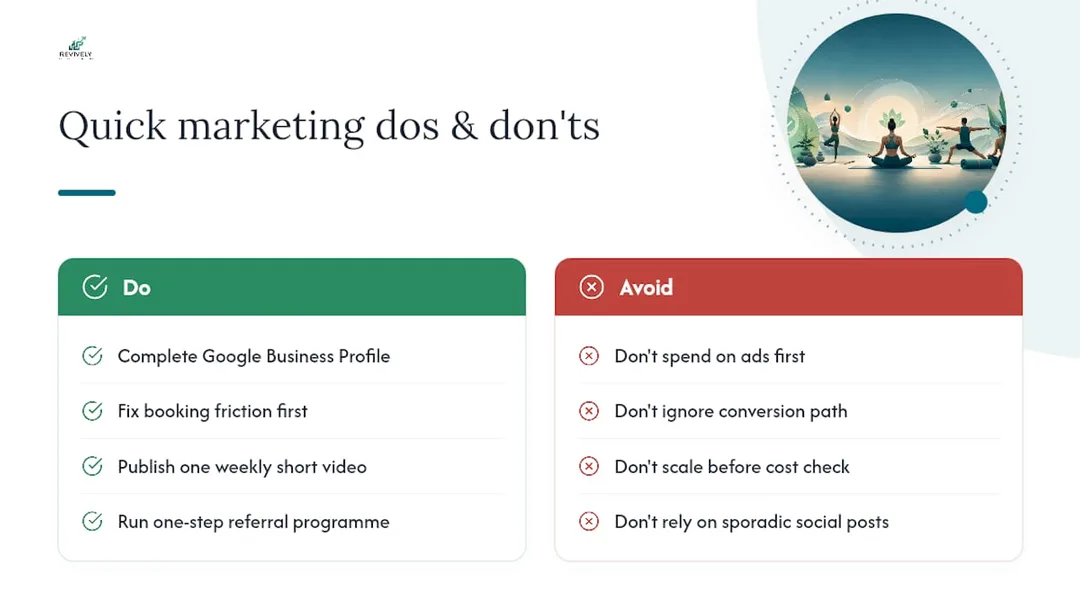
Focus on the highest-leverage moves first: a complete Google Business Profile, a frictionless booking flow, one weekly short-form video, and a one-step referral programme. These require the least ongoing admin relative to the bookings they generate.
How long does local SEO take to improve bookings for a yoga studio?
Expect initial ranking improvements in 60 to 90 days, with noticeable booking increases usually showing between four and six months of consistent activity. Consistency over intensity is key.
What should a yoga studio marketing plan prioritise in the first month?
Prioritise fixing booking friction and completing your Google Business Profile before spending on paid ads. Fixing the conversion path first means every other tactic you layer on afterward performs significantly better.
Is email or social media more effective for promoting yoga classes?
Email generally outperforms intermittent social posting for converting first-timers into returning students, largely because automated sequences reach people consistently rather than relying on fickle algorithm timing.
How much should a yoga studio spend on paid ads for intro offers?
Test with a modest daily budget, around $20 to $30, on a single intro offer with a dedicated landing page before scaling. Watch cost per trial closely and optimise ruthlessly before increasing spend.
Sources
Dive deeper into the data and insights that inform these strategies: