
Avoid BAS Errors: GST on Gym Memberships for Australian Studios
! Gym membership payment at studio reception
Yes.
Another month, another BAS deadline looms. You're knee-deep in class schedules, client enquiries, and making sure the new reformer arrived, only to be hit with that familiar wave of panic: "Did I get the GST right?"
It's a question that plagues many Australian wellness and fitness studio owners, from yoga and Pilates to dance and recovery centres. The rules around GST on memberships and class packs can feel like a minefield. Get it wrong, and you risk a visit from the ATO or, worse, a massive unexpected tax bill.
Let's clear the air. Yes. Most gym memberships, class packs, and fitness services in Australia are taxable supplies. That means registered businesses need to charge the standard 10% GST on top of the fee. Once your studio's turnover hits, or looks set to hit, $75,000 a year, GST registration becomes compulsory. Then, it's all about charging GST, lodging a Business Activity Statement (BAS), and keeping your books cleaner than your studio floors.

The ATO sets the rules. A smart system like Xero or, better yet, a unified platform like Revively, handles the reconciliation. Because really, you've got classes to run, clients to inspire, and a business to grow - not spreadsheets to wrangle.
Your Essential GST Snapshot
- Most fitness services and memberships in Australia are subject to 10% GST. Registration is mandatory once your business turnover reaches $75,000 annually (or you reasonably expect it to).
- Calculating GST on a GST-inclusive price? Simply divide the total by 11. This applies whether it's a casual class, a 10-pack, or a recurring membership.
- Registering for GST demands a valid ABN, choosing your BAS cycle, and critical separation of GST-free clinical services from taxable classes to avoid costly errors.
- Claiming input tax credits is only possible on eligible business expenses (equipment, rent, utilities). Crucially, GST collected isn't your money; it's the ATO's, and must be accounted for separately to ensure BAS accuracy.
- Employer-paid memberships can trigger Fringe Benefits Tax (FBT) unless specific, narrow exemptions apply. Always verify these arrangements carefully.
The GST Gauntlet: Are Your Classes Taxable?
For dance schools, yoga studios, Pilates centres, and recovery spaces, the default position is a resounding "yes." The ATO's guidance is clear: standard group classes, personal training, and general fitness club memberships are taxable supplies. If your business is GST-registered, a 10% GST component applies, regardless of whether a client pays weekly, monthly, or upfront for a term.
The exceptions are incredibly narrow. A service can only be GST-free if it strictly fits a specific listed health service and is delivered or assessed by a recognised health professional for a diagnosed condition.
- A physiotherapy-led rehabilitation class, individually assessed and billed under a recognised health service, might be GST-free.
- A general Pilates reformer class or a lively vinyasa flow session booked through your studio's public timetable is absolutely a taxable supply where GST applies in full.
- Running a hybrid business? Mixing genuine clinical work with standard classes means meticulously tracking them separately. The ATO assesses the substance of each supply, not your studio's overall branding.
Misunderstanding this distinction is a common trap. You'll either overcharge clients on genuinely exempt clinical work or, more critically, undercharge the ATO on your standard classes. Both scenarios lead to awkward, expensive reconciliations when BAS time rolls around.
When to Register: The $75,000 Turnover Threshold, Demystified
You must register for GST once your business turnover reaches $75,000 in a financial year, or, crucially, once you reasonably expect it will. That second part trips up many new studio owners. The ATO doesn't wait for you to cross the line retrospectively; it applies a forward-looking rule. A buzzing new studio with strong pre-sales or a blockbuster launch promotion could easily trip this threshold in just a few months.
To put it in perspective, $75,000 a year works out to roughly $6,250 a month. If a seasonal spike - think New Year sign-ups, a summer intensive for dancers, or a new wellness challenge - pushes you past that run rate for a sustained period, that's your cue to register early, not play a waiting game.
Here's a quick-fire checklist:
- Hold an ABN: You need a valid ABN before you can apply for GST registration.
- Register: Apply through the ATO's online services or via your accountant as soon as turnover looks likely to exceed $75,000.
- Choose Your Cycle: Decide on a monthly or quarterly BAS cycle based on your cash flow and how often you're comfortable reporting.
- Seek Advice: If your revenue streams mix taxable classes with any GST-free clinical work, speak to a qualified accountant immediately.
Crunching the Numbers: 10% GST on Memberships and Packs
Whether your pricing is GST-inclusive or GST-exclusive changes what your client sees, but not what you ultimately owe the tax man. Most Australian consumers expect the sticker price to include GST already, so displaying a single total (e.g., $99, not $99 + tax) is standard practice and prevents confusion at checkout. Savvy studios often explore alternative ways to package courses and memberships to optimise perceived value.

To extract the GST component from a GST-inclusive price, the magic number is 11. Divide by 11.
- A $110 monthly membership contains $10 of GST.
- A $1,200 annual pass contains $109.09 of GST, with $1,090.91 as your actual revenue.
Quick Reference: On any GST-inclusive price, GST always equals price ÷ 11. This rule holds true whether you're pricing a single drop-in class, a 10-class pack, or a 12-month recurring membership. No complicated percentages, just simple division.
Let's look at a few common scenarios:
| Scenario | GST Treatment |
|---|---|
| Prorated Sign-ups | GST applies on whatever amount is actually charged for the partial period. It's not a full-month calculation; it's on the prorated fee. |
| Free Trials | Zero GST. No payment changes hands. However, the moment a trial converts to a paid period (even if discounted), GST applies from that first dollar. |
| Gift Vouchers | Generally GST-free when sold. GST is only accounted for when the voucher is redeemed against a taxable class or membership. Treat the sale as deferred revenue, and the redemption as a standard taxable supply. |
| Membership Pauses | If the membership is truly paused with no payments made, no GST applies during the pause. If a reduced 'holding fee' is charged, GST applies to that fee. |
| Cancellation Fees | If a cancellation fee is charged for breaking a contract or missed class, GST applies to this fee just like any other service charge. |
Reporting GST on Your BAS & Claiming Input Tax Credits
Your Business Activity Statement (BAS) is where the rubber meets the road. This is where the GST you've collected on memberships (your output tax) meets the GST credits you can claim back on your business spending (your input tax). You report both figures for your chosen period (monthly or quarterly), and the difference is either what you pay to, or claim back from, the ATO.
Many common studio expenses carry claimable GST credits:
- Studio Equipment: Reformers, sound systems, sauna units, yoga props, ballet barres.
- Premises Costs: Rent, utilities, cleaning services, maintenance.
- Operational Expenses: Software subscriptions (like Revively!), marketing costs, payment processing fees, professional development.
The biggest, most common bookkeeping error studios make? Treating collected GST as income. It's not. It's money you're holding on behalf of the ATO. Spending it as if it were revenue is a surefire way to find yourself scrambling, or worse, short on funds when BAS time rolls around.
Pro Tip: Set up a separate ledger account (or even a dedicated bank account) for GST collected from day one. Reconcile this weekly against your Xero integration, rather than letting it pile up. This catches errors when they're small, not when they're a looming BAS disaster.
FBT on Employer-Paid Gym Memberships: Check First!
Offering to pay for staff gym access or studio memberships is a genuinely generous perk, fostering wellness and team morale. But it's also one of the more common ways employers accidentally trigger a fringe benefits tax (FBT) liability.
The basic principle of Fringe Benefits Tax (FBT) is simple: when an employer covers a private expense (like a gym membership) for an employee, FBT usually applies unless a very specific exemption is met. Relevant private binding rulings consistently show how narrow these exemptions truly are.
- On-Premises Facilities: Fitness facilities located on the employer's own premises can sometimes escape FBT.
- External Memberships: An external membership at a commercial studio or gym almost always falls within FBT scope.
The ATO's broader FBT guidance frequently flags employer-provided memberships as an area of scrutiny. This means diligent documentation matters just as much as the payment itself.
Before you offer memberships as a staff benefit, consider:
- Documentation: Clearly document who pays, who accesses the facility, and whether it's on your premises or an external provider.
- Salary Sacrifice: Investigate whether salary sacrifice arrangements change the FBT treatment in your specific circumstances.
- Professional Advice: Always get advice specific to your arrangement rather than relying on general rules of thumb. FBT outcomes are highly fact-dependent.
On the employee side, individuals generally can't claim gym fees as a tax deduction either, except in very tightly defined cases - think police or defence force roles where strenuous fitness is an essential and unavoidable job function. For most of your instructors and staff, it's a personal expense.
Turning Rules into Routine: Your GST Compliance Checklist
Good compliance isn't about being a tax expert; it's about embedding good habits. This means keeping the right records, setting up your membership products correctly once, and then letting your accounting system handle the repetitive matching.
Keep these records for at least five years: tax invoices, detailed membership terms and conditions, payment receipts, and copies of every BAS lodged.
Here's a practical, working GST checklist for your studio:
- Product Setup: Create each membership type (drop-in, class pack, recurring membership) as a distinct product within your booking and payment platform.
- Xero Mapping: Map each product directly to the correct GST code in Xero. This makes tax treatment automatic, not a manual guessing game.
- Regular Reconciliation: Reconcile your Stripe payouts against Xero weekly, not just before the BAS deadline. Small, frequent checks prevent large, painful discoveries.
- BAS Pre-Check: Run a BAS pre-check a few days before lodging to catch any mismatches or errors while there's still time to fix them.
This is where a truly unified platform like Revively shines. Because your membership products, class packs, and Stripe-powered billing all reside natively within one system and map directly to Xero, a client purchase flows seamlessly. From Stripe payment, to product record, to GST-coded Xero entry - all without a single manual journal entry or spreadsheet in sight.
This means:
- Australian Data Residency: Your clients' sensitive data, booking histories, and health intake forms are stored securely and locally in Australia, fully complying with the Australian Privacy Principles (APPs).
- Flawless GST & Tax Invoices: Revively natively handles 10% GST calculations across all casual classes, memberships, and multi-resource packages. It automatically issues legally compliant Australian Tax Invoices to your clients, every time.
- 100% Legal Xero Integration: Our deep, two-way Xero integration automates the mapping of tax codes, revenue accounts, and liabilities. This guarantees your quarterly Business Activity Statements (BAS) are flawless and audit-proof, eradicating those painful manual spreadsheet errors.
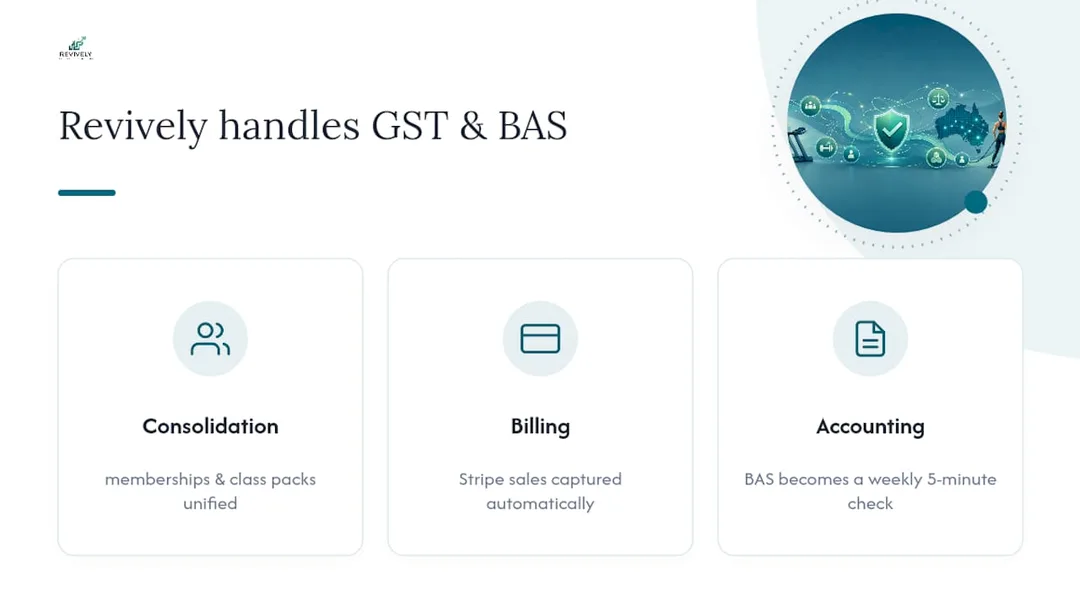
Revively provides powerful, Stripe-powered billing that captures the sale accurately, multi-resource and class management that keeps your pricing consistent, and a native Xero integration that transforms BAS reconciliation from a quarterly headache into a weekly five-minute check.
If you're still juggling separate booking software, a payment gateway, and a messy spreadsheet for accounting, our guide on choosing gym membership software walks through what proper GST mapping should look like before you switch.
Ready to reclaim your time and conquer BAS? Start a Revively trial today and set up your first membership product with the correct GST code from day one.
Disclaimer: This article provides general information and is not a substitute for personalised advice from a qualified financial advisor or accountant. Please consult a professional about your specific circumstances before acting on any information presented here.
Frequently Asked Questions
Do gym memberships charge GST in Australia?
Yes, for most. The vast majority of gym memberships, class packs, and general fitness services in Australia are considered taxable supplies. Registered businesses must charge 10% GST, with only very narrow exceptions for specific health services delivered by recognised medical professionals.
Is GST applicable on gym membership fees specifically?
Absolutely. GST applies to gym membership fees in the same way it does to any taxable fitness service. For GST-registered businesses, it's 10% of the fee. If the price is GST-inclusive, you calculate the GST component by dividing the total price by 11.
Can I claim gym membership on tax in Australia?
Generally, no, not for individuals. Personal gym fees are rarely tax deductible in Australia, except in extremely limited roles like police or defence force positions where intense, regular physical fitness is an essential and unavoidable job requirement.
Can I pay for staff gym memberships through my business?
You certainly can, but be aware: paying for staff gym memberships commonly creates a Fringe Benefits Tax (FBT) liability for the employer. This is unless a specific, fact-dependent exemption applies (e.g., an on-premises gym). Always consult with an accountant to check the specific arrangement before offering this as an employee benefit.
Recommended for Your Studio
- Navigating the BAS Beast: Does GST Apply to Your Australian Yoga, Pilates, or Wellness Studio?
- Pricing Yoga Classes in Australia: Master Memberships, Payments & BAS Compliance
- Ditching Spreadsheet Chaos: Your Australian Studio's Guide to Seamless Stripe Membership Billing
- The Australian Studio Owner's Guide to Stripe Fees & GST Compliance