
Membership Refunds Australia: Claim Within 14 Days (Members & Studios)
! Sending a studio membership cancellation email
You can claim a membership refund in Australia when the service has a major problem under the Australian Consumer Law, or when you cancel inside a cooling-off window, which usually triggers a refund within 14 days.
The dreaded membership cancellation email lands in your inbox. Is it a legitimate request, a change of mind, or something more serious? For Aussie studio owners, navigating membership refunds isn't just about customer service; it's about staying on the right side of the Australian Consumer Law (ACL), honouring state-specific cooling-off periods, and crucially, keeping your studio's finances and reputation intact.
Outside of those crystal-clear legal scenarios, a refund often hinges on your contract terms - and a good dollop of common sense. The ACCC and state fair trading offices draw a sharp line between what's legally guaranteed and what's discretionary. Understanding that line is your first defence against costly disputes and endless back-and-forth emails.
The Hard Truths for Aussie Studio Owners:
- Major Problem? Refund is Non-Negotiable: If your service has a "major problem" under the ACL (think inadequate skill, failure to meet purpose, or unreasonable delays), a refund is a legal entitlement, regardless of any "no refund" clauses.
- Cooling-Off Periods Are State-Specific: There's no blanket rule. These windows vary (often from a few days to seven), and you must honour them. Refunds in this window are typically processed within 14 days.
- Paperwork is Paramount: Every cancellation, every refund decision, every communication needs to be documented. Vague requests lead to disputes; clear records prevent them.
- Goodwill ≠ Legal Obligation (Usually): Outside the ACL and cooling-off rules, refunds for illness, relocation, or bereavement are often granted at your discretion with evidence, but change-of-mind refunds are rarely legally required.
- Automate, Don't Guess: Manual processes for cancellations and refunds are a ticking time bomb for compliance breaches, financial errors, and endless admin.
Table of Contents
- Your Non-Negotiable Rights: The Australian Consumer Law
- Cooling-Off Periods: The State-by-State Minefield
- How Members (Should) Cancel & Request a Refund: A Studio Owner's Checklist
- Notice Periods & Termination Fees: What's "Reasonable" in Australia?
- Exceptional Circumstances: Illness, Relocation, and the Art of Discretionary Refunds
- When Things Go Sideways: Evidence & Escalation for Studio Owners
- Building Bulletproof Policies: The Compliant Studio's Blueprint
- The Studio Owner's Advantage: Managing Memberships Without the Manual Chaos
- A Quick Word for Members and Studio Owners
- Where to Check Official Rules
- Sources
- FAQs for Studio Owners & Members
Your Non-Negotiable Rights: The Australian Consumer Law
Let's cut through the noise. A "major problem" isn't a minor gripe about a class or a personality clash with an instructor. Under the Australian Consumer Law, it means the service was delivered with an unacceptable level of skill or care, failed to meet a specific purpose the client articulated, or wasn't provided within a reasonable timeframe and they no longer want it.
Imagine your yoga studio promising a "state-of-the-art heated room" but the climate control is perpetually broken for months. Or a "6-week beginner Pilates program" that's consistently cancelled due to instructor shortages. These are precisely the scenarios where a client is legally entitled to choose their remedy: a full refund, a repeat of the service at no extra cost, or compensation for the diminished value. The ACCC is crystal clear: these consumer guarantees stand firm, regardless of any "no refunds" clause in your membership agreement.
Many studios mistakenly believe their terms and conditions trump the ACL. They don't. Standard-form contracts cannot exclude, restrict, or modify consumer guarantees. Businesses attempting to enforce unfair terms risk significant penalties from regulators, jeopardising both their finances and their reputation in the community. This is why having robust, transparent policies is crucial, especially for growing wellness and fitness studios looking for Mindbody alternatives Australia.
Cooling-Off Periods: The State-by-State Minefield
Here's where the waters get murky, and "membership refund rights in Australia" become genuinely regional. There isn't one universal cooling-off period for every type of membership.
- Queensland's fitness industry code, for example, grants a specific, short cooling-off window for new gym and fitness agreements.
- Western Australia's fitness code extends this to 7 days.
- Federal protections also apply to unsolicited sales - think memberships signed at your door or over an unexpected phone call.
If a client cancels within a valid cooling-off window, the financial outcome is generally consistent. As Queensland's government guidance confirms, you must refund their fees within 14 days of receiving notice. You can deduct a reasonable administration fee and the cost of any sessions or classes already used, but the bulk of their payment is due back.
Don't assume your Pilates studio's cooling-off period mirrors the gym down the road. Dance schools, yoga studios, spas, and clinics aren't always covered by the same fitness industry codes. Your signed agreement's terms often carry more weight here. Always advise clients to check their contract first, and cross-reference it against their state or territory's fair trading page.

How Members (Should) Cancel & Request a Refund: A Studio Owner's Checklist
As a studio owner, you know most disputes stem from unclear communication and missing records. Here's the ideal process you should guide your members through (and that your internal systems should support):
- Reread the Agreement: Advise members to find the notice period, preferred cancellation channel, and any refund clauses before they contact you.
- Send Written Notice: Emphasise sending cancellation requests through your studio's official channel - email, member portal, or formal letter. Face-to-face chats are lovely, but they don't create an audit trail.
- Include the Essentials: Full name, member ID, requested end date, and a clear statement requesting a refund (if applicable).
- Attach Evidence: If they're claiming an ACL major problem, illness, or relocation, supporting documents (medical certificates, lease agreements, screenshots of system failures) are non-negotiable.
- Request Written Confirmation: They should ask for a document stating their last billing date and membership end date.
- Keep Copies of Everything: The original agreement, their cancellation email, your studio's reply - every piece of correspondence.
- Monitor Bank Account: Advise them to check their bank statement to confirm direct debits have ceased.
Once a cancellation is confirmed and a refund approved, processing is typically completed within 14 business days. A robust, all-in-one spa booking software or wellness studio CRM should automate much of this.
Pro Tip for Studio Owners: Your system should always generate an automatic, timestamped email confirmation for every cancellation request received. This protects both parties and is invaluable if a dispute arises.
Notice Periods & Termination Fees: What's "Reasonable" in Australia?
Most membership agreements in Australia specify a notice period, typically between 14 and 30 days. Regulators generally accept this range, provided it's clearly disclosed during sign-up. Where studios hit trouble is when they hide a 90-day notice period in tiny print or demand cancellation through an arduous process (e.g., only in person, with specific forms, during limited hours) that's far more difficult than joining. ACCC guidance consistently expects subscription services to make leaving at least as easy as signing up. A significant mismatch between these two processes is a red flag for an unfair contract term.
Termination fees follow a similar logic. A fee is defensible if it reflects a genuine cost your studio incurs - perhaps recovering part of a sign-up discount or covering payment processing fees. However, a fee designed purely to punish a client for leaving early risks being deemed void or challenged as an unfair term. If a client queries an exit fee that seems disproportionate, it's reasonable for them to ask for a pro-rata refund instead and to reference the ACL if the figure seems inflated.
Exceptional Circumstances: Illness, Relocation, and the Art of Discretionary Refunds
Beyond the ACL and cooling-off windows, most refund decisions come down to a combination of goodwill and solid documentation. Serious illness, a genuine relocation, or a death in the family are the three primary grounds most organisations will consider for a pro-rata refund. The key is evidence - a medical certificate, proof of a new address, or a death certificate.
Change of mind is an entirely different beast. It's rarely a legal entitlement to a refund in Australia unless your specific contract explicitly promises one. We see this disparity play out across industries:
| Scenario | Legal Entitlement to Refund? | Conditions / Studio Discretion |
|---|---|---|
| Major Problem (ACL) | YES | Regardless of contract terms. Service substandard, unfit for purpose, or unreasonably delayed. |
| Cooling-Off Period | YES | Within state-specific timeframe. Studio can deduct reasonable admin fees/used services. |
| Serious Illness/Injury | NO (Generally) | Discretionary. Requires medical certificate. Often results in pro-rata refund or membership hold. |
| Relocation (Genuine) | NO (Generally) | Discretionary. Requires proof of new address outside service area. Often pro-rata refund. |
| Bereavement | NO (Generally) | Discretionary. Requires evidence. Typically full refund for unused portion. |
| Change of Mind | NO | Unless explicitly stated in contract. Studio not obligated. |
| Unfair Contract Term | MAYBE | If terms are demonstrably unfair or misleading, ACCC/Fair Trading may intervene. |
When a client submits a request under these "exceptional circumstances," encourage them to state their reason plainly, attach their evidence, and ask for a decision in writing. This protects both of you.
When Things Go Sideways: Evidence & Escalation for Studio Owners
Sometimes, despite your best efforts to build fair and compliant policies, a dispute arises. If a client believes they're legally owed a refund and you're refusing it, they'll likely escalate. Here's how they should proceed - and what you, as a studio owner, need to be prepared for:
- Maintain Impeccable Records: Every signed agreement, every transaction receipt, every written cancellation, and every confirmation email must be kept. This is your shield.
- Offer Internal Review: Give them a clear pathway for internal review first. Respond in writing, referencing your policies and the ACL where relevant.
- State or Territory Fair Trading: Advise them that their next step is often their state or territory Fair Trading office for individual dispute resolution. Engage professionally and provide all requested documentation.
- ACCC Report: If the conduct appears systemic, they might report your business to the ACCC. Remember, the ACCC focuses on patterns of non-compliance, not individual cases, but a growing number of complaints can trigger an investigation.
- Bank Dispute: If your system keeps charging them after a valid cancellation, they can dispute unauthorised direct debits directly with their bank. This is a massive headache for studios and signals a critical flaw in your operational processes.
Building Bulletproof Policies: The Compliant Studio's Blueprint
Studios that truly nail membership management and customer trust do a few things brilliantly:
- Plain Language, Not Legalese: Their terms are published in plain language at sign-up, easy for anyone to understand.
- Fair Notice Periods: Notice periods are capped at a reasonable timeframe (e.g., 14-30 days), not buried in fine print.
- Clear Cooling-Off Rights: They explicitly spell out cooling-off rights instead of hiding them.
- Transparent Refund Timing: A published policy clearly states refund processing times, ideally within 14 business days, and outlines the specific exceptions (illness, relocation) they'll consider.
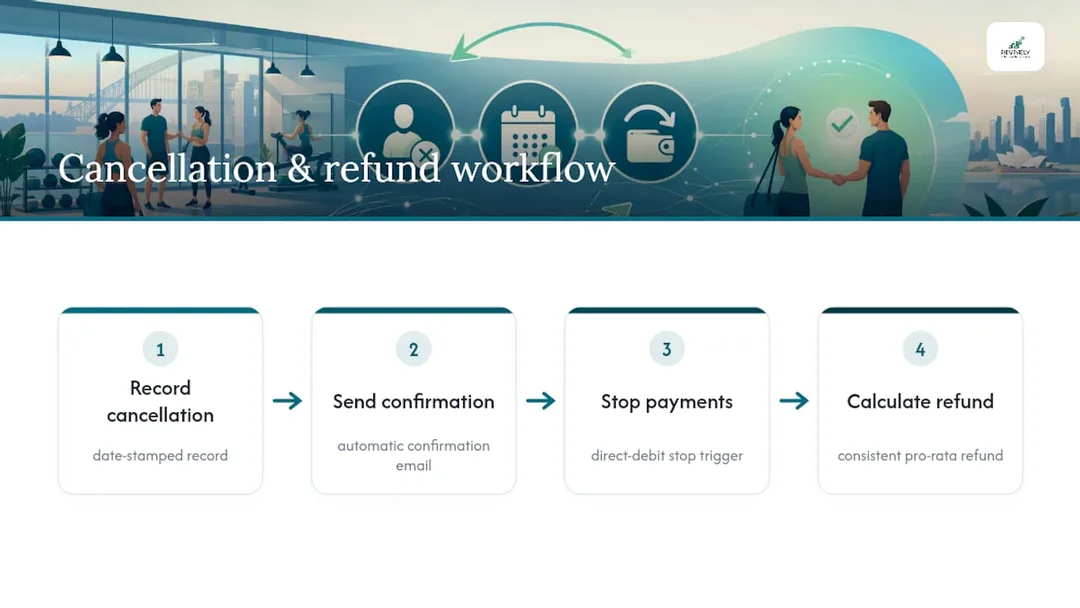
Automation is your ultimate ally here. Date-stamped cancellation records, automatic confirmation emails, and a direct-debit stop trigger create the robust paper trail regulators expect. An effective cancellation and refund workflow also calculates pro-rata refunds consistently, removing human error and bias. Just like compliance thinking for digital marketing applies to auto-renewal terms, so too does it apply to how your studio presents its membership agreement online.
Pro Tip: If you're still managing cancellations through a shared inbox and a spreadsheet, you're one staff turnover away from losing the evidence trail that protects you in a dispute. This isn't just inefficient; it's a significant compliance risk for your wellness or fitness studio.
The Studio Owner's Advantage: Managing Memberships Without the Manual Chaos
When it comes to membership management, especially for multi-resource studio scheduling across spas, yoga centres, or clinics, spreadsheets and generic CRMs just don't cut it for Australian compliance. Your business deserves better than manual chasing and guesswork.
Imagine a unified cloud command centre that handles every facet of your client lifecycle. Revively (Revively.app) is an Australian-made solution designed specifically for wellness and fitness studios seeking sophisticated Mindbody alternatives in Australia. It ensures your cancellation and refund processes are not just efficient, but legally bulletproof.
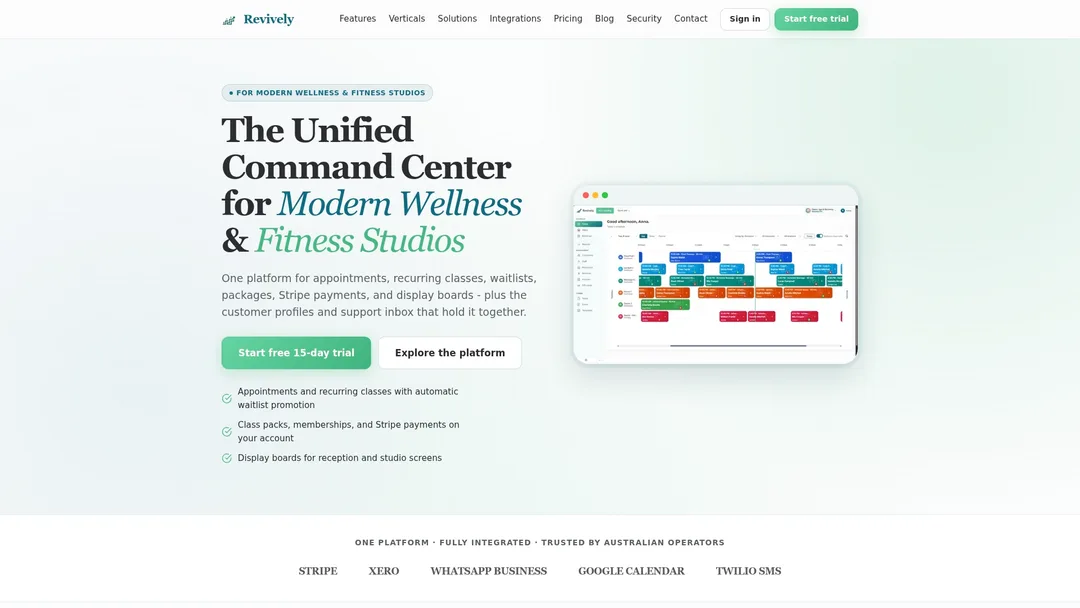
Here's how Revively solves your unique Australian compliance challenges:
- Australian Data Residency & Privacy: All client data, booking histories, and sensitive health intake forms are stored locally in Australia, fully complying with the strict Australian Privacy Principles (APPs). No more worrying about offshore data storage risks.
- Flawless GST & Tax Invoice Handling: Revively natively handles 10% GST calculations across casual classes, memberships, and multi-resource packages. It automatically issues legally compliant Australian Tax Invoices to your clients - a massive time-saver and compliance safeguard.
- 100% Legal Xero Integration for BAS Accuracy: Our two-way, automated mapping of tax codes, revenue accounts, and liabilities ensures your Xero reconciliation is always perfect. This means your quarterly Business Activity Statements (BAS) are flawless and audit-proof, completely removing manual spreadsheet errors that often plague other systems.
- Automated Cancellation Workflows: Every cancellation request gets a precise timestamp, confirmation emails go out automatically, and membership billing stops promptly when a member's notice period ends, preventing accidental extra charges and customer frustration.
- Consistent Pro-Rata Refunds: Revively accurately calculates pro-rata refunds and reconciles them directly into your accounting system, giving you transparent, accurate records instantly - crucial when a dispute requires clear data, fast.
If your studio is still handling refund requests case-by-case over email, it's time to upgrade your operations. Explore how Revively handles the entire membership and class pack lifecycle, or check current plans and pricing starting at $39 AUD per month on the Solo plan to find a solution that fits your growing studio.
A Quick Word for Members and Studio Owners
Every refund dispute I've witnessed boils down to one simple truth: who kept better records? Members must cite the ACL when a major problem is genuine and meticulously save every email. Studios must publish policies in plain language and let automation, not memory, handle confirmations and refund timing. It's not just good business; it's essential compliance.
- - Andreea*
Where to Check Official Rules
Always verify anything specific against the ACCC, your state's fair trading site, or Consumerlaw before acting on a dispute.
Sources
- Repair, replace, refund, cancel - ACCC
- Qld Government - Using a Fitness Service
- Membership investment refund policy - RACGP
FAQs for Studio Owners & Members
Can a member always cancel their studio membership and get a refund?
No. A refund is guaranteed if they're within a valid cooling-off period (which varies by state and industry) or if your service has a "major problem" under the Australian Consumer Law. Outside these specific situations, refund eligibility depends entirely on the terms outlined in your membership contract.
What is the "standard" refund policy in Australia for studios?
There isn't a single, uniform "standard" policy across all memberships and studios, as it depends on your specific industry code, the state you operate in, and your signed contract. However, in cases where a refund is legally required (e.g., within a cooling-off period), refunds are typically processed within 14 business days.
Am I entitled to a refund if I have a subscription with a studio?
Yes, you are entitled to a refund if the subscription service has a "major problem" as defined by the Australian Consumer Law, such as failing to deliver what was promised or being provided with an unacceptable level of skill. This applies regardless of any "no refunds" clause in your terms. Beyond this legal guarantee, eligibility for other refunds is governed by your specific subscription agreement.
Is it legal for a studio to not offer a refund for change of mind?
Yes, generally, businesses in Australia are legally allowed to refuse refunds for a simple change of mind, unless their own published policy or contract explicitly promises one. This is a critical distinction from a major problem under the ACL, where a refund is a legal entitlement.
How much does Revively cost for managing studio memberships and compliance?
Revively offers transparent pricing designed for various studio sizes. Our Solo plan starts at $39 AUD per month, Growth at $99 AUD per month, and Pro at $199 AUD per month. All pricing is listed on our pricing page, with annual billing also available at a reduced rate across all three plans.