
12 Spa KPIs to Predict Revenue and Retention, With Formulas and Actions
! Spa manager reviewing business performance dashboard
Track a small set of financial, operational and customer KPIs and you'll see clearer profit and capacity gains within weeks.
You've got a buzzing studio, clients walking through the door, therapists on the roster, and a calendar that looks full. On the surface, things seem fine. But beneath the daily whirlwind of bookings, cancellations, and product sales, how much revenue are you actually missing? Are your best therapists overworked while others are underutilised? Is your team leaving money on the table at checkout, or are your costs quietly eroding your hard-earned margins?

Most studio owners live in this operational grey zone, reacting to problems as they hit. But what if you could see the warning signs weeks - even months - in advance? What if you knew exactly which lever to pull to boost capacity, drive rebookings, or optimise your retail strategy? That's not magic; it's just smart KPI tracking.
Forget drowning in thirty obscure metrics. Focus on a select few financial, operational, and customer KPIs, and you'll pinpoint hidden profit opportunities and capacity gains within weeks. We're talking about numbers like RevPATH (revenue per available treatment hour), therapist utilisation, and client retention.
This isn't about rigid corporate reporting. It's about a clear, actionable snapshot of your studio's health. Below, you'll find practitioner-ready formulas, realistic Australian benchmarks, and the exact, no-nonsense moves to make when a number starts trending the wrong way.
The Fast Lane: Your Studio's Quick-Fire KPI Priorities
- Focus on the Fast Movers: Prioritise tracking occupancy, therapist utilisation, no-show rates, and average treatment rate (ATR) weekly. These metrics are the pulse of your daily operations; they respond quickly and guide your immediate scheduling and sales decisions.
- Know Your Baseline First: Resist the urge to chase external industry averages immediately. Instead, track your own studio's data for at least three months. This baseline gives you a realistic starting point before you set internal targets that genuinely reflect your unique studio model.
- Clean Data, Clear Decisions: Ensure your data sources - POS, booking system, payroll, and client databases - are talking to each other. Reconcile key figures weekly to prevent mismatches and inconsistent service codes that silently sabotage your KPI calculations.
- Less is More for Team Habits: Don't overwhelm your staff. Introduce and review no more than four KPIs at a time, making it a quick, weekly habit. Once those four are ingrained and consistently acted upon, then consider adding more.
- Season-Proof Your Targets: Use at least a year of historical data to adjust your KPI targets for Australia's seasonal demand fluctuations and holiday periods. This prevents false alarms during predictable slow spells and helps you staff smarter during peak times.
Table of Contents
- KPIs That Actually Matter: Your Studio's Early Warning System
- Cutting Through the Noise: Which KPIs to Prioritise (and When)
- Ditch the Spreadsheets: Tracking KPIs Without the Headache
- When the Numbers Talk: Your Signal-to-Action Playbook
- The Revively Advantage: Your Unified Command Centre for Australian Studios
- Australian Data Residency & Privacy: Beyond Compliance, It's Trust
- Flawless GST & Tax Invoices: Take the Headaches Out of Tax Time
- Xero Integration for BAS Confidence: Audit-Proof Your Finances
- The Nitty-Gritty: How to Collect & Calculate Your Data
- Reality Check: Setting Benchmarks That Make Sense for Your Studio
- Beyond Bookings: Client Satisfaction & Feedback You Can Act On
- Fueling Growth: Marketing KPIs That Don't Lie
- Silent Leaks: Mastering Inventory & Supply Costs
- The Unsung Hero: How Training Elevates Your Core Numbers
- Riding the Waves: Adjusting KPIs for Australia's Seasons
- Your Digital Front Door: Metrics for Online Success
- The Final Word: Start Small, Act Fast, See Results
- Stop Chasing Ghosts. Start Leading with Data.
- Sources
- Recommended
KPIs That Actually Matter: Your Studio's Early Warning System
Every wellness and fitness studio, from the single treatment room above a yoga centre to a multi-therapist medi-spa, runs on the same underlying numbers. The Spa Industry Association pinpoints essential KPIs that shift managers from reactive problem-solving to proactive strategic moves. Here's the practitioner-ready version, with formulas you can plug into your dashboard today.
-
Average Treatment Rate (ATR):
- Formula:
Total Service Revenue ÷ Number of Treatments Performed - What it tells you: Track this weekly. A falling ATR often signals that discounting has crept into your offers, or your service mix has unintentionally shifted towards cheaper treatments.
- Action: Audit your pricing and promotional strategies.
- Formula:
-
Revenue Per Guest:
- Formula:
Total Revenue (Service + Retail) ÷ Number of Unique Guests Served - What it tells you: Review monthly. If client visits are healthy but revenue per guest is low, your team might be missing opportunities for upsells or retail conversations.
- Action: Coach staff on consultative selling and product recommendations.
- Formula:
-
RevPATH (Revenue Per Available Treatment Hour):
- Formula:
Total Revenue ÷ Total Available Treatment Hours (across all rooms) - What it tells you: Measure weekly. This is your single best profitability snapshot. It combines pricing power and capacity utilisation into one crucial number.
- Action: If low, investigate pricing, occupancy, or service menu structure.
- Formula:
-
Treatment Room Occupancy:
- Formula:
(Booked Hours ÷ Available Hours Per Room) x 100 - What it tells you: Track weekly. If occupancy consistently sits below 60% for more than a month, it screams a scheduling or demand problem needing immediate investigation.
- Action: Adjust marketing, run targeted promotions, or optimise scheduling.
- Formula:
-
Therapist Utilisation:
- Formula:
(Hours Billed ÷ Hours Rostered) x 100 (per therapist) - What it tells you: Measure weekly. Consistently low utilisation for one therapist while others are booked solid points to a roster issue, not a marketing one.
- Action: Reallocate shifts, cross-train, or adjust roster patterns.
- Formula:
-
Treatments Per Guest Visit:
- Formula:
Total Treatments ÷ Total Visits - What it tells you: Review monthly. A number close to 1.0 suggests guests aren't being offered add-ons or upgrades during booking or check-in.
- Action: Implement add-on prompts and staff training.
- Formula:
-
Average Treatment Length:
- Formula:
Total Billed Minutes ÷ Number of Treatments - What it tells you: Track quarterly. If treatment times are creeping up without a corresponding price adjustment, it silently erodes your RevPATH.
- Action: Review treatment protocols and staff efficiency.
- Formula:
-
Cost Per Treatment:
- Formula:
(Product Cost + Direct Labour Cost) ÷ Number of Treatments - What it tells you: Measure monthly. This number should be well below your ATR. If the gap narrows, your profit margin is being squeezed from the service side.
- Action: Negotiate supplier costs, optimise product usage, review labour allocation.
- Formula:
-
Gross Profit Margin:
- Formula:
((Revenue - Direct Costs) ÷ Revenue) x 100 - What it tells you: Review monthly. Industry data suggests profitable spa segments typically report margins in the 10-20% range, but this varies sharply by studio type.
- Action: If low, scrutinise service pricing, product costs, or labour efficiency.
- Formula:
-
Retail-to-Service Ratio:
- Formula:
(Retail Revenue ÷ Service Revenue) x 100 - What it tells you: Measure monthly. A persistently low ratio, according to the Spa Industry Association, is almost always a training and incentive issue rather than a product problem.
- Action: Invest in retail training and consider staff incentives.
- Formula:
-
Client Retention Rate:
- Formula:
(Repeat Clients in Period ÷ Total Clients in Period) x 100 - What it tells you: Track quarterly. This is arguably the most important number in the set. Acquiring a new client costs significantly more than rebooking an existing one.
- Action: Implement rebooking prompts, follow up after visits, address feedback.
- Formula:
-
No-Show / Cancellation Rate:
- Formula:
((No-Shows + Late Cancellations) ÷ Total Bookings) x 100 - What it tells you: Measure weekly. Anything trending upward over consecutive weeks needs an immediate review of your confirmation process and deposit policy.
- Action: Strengthen booking confirmations, consider deposits for new clients.
- Formula:
A core five KPI framework from Startup Financial Projection echoes this: retention, utilisation, ATR, retail-to-service ratio, and cost per treatment form the backbone most operators should prioritise, before adding anything more granular.
Cutting Through the Noise: Which KPIs to Prioritise (and When)
You don't need thirty metrics to run a tight studio. You need the right ones, prioritised by what they let you change.
| KPI Category | KPIs to Track | Frequency | Why It Matters |
|---|---|---|---|
| Must-Track | Occupancy, Therapist Utilisation, No-Show Rate, Average Treatment Rate (ATR) | Weekly | These are your daily operational levers. They move fast and respond directly to scheduling and sales decisions. |
| Watch Closely | Client Retention Rate, Retail-to-Service Ratio, Gross Margin, Revenue Per Guest | Monthly | These reveal slower, strategic trends. They're worth a monthly review, not daily panic. |
| Strategic | Average Treatment Length, Cost Per Treatment, Payroll Percentage | Quarterly | These inform long-term pricing and staffing decisions rather than day-to-day fixes. |
Setting a target is a three-step job. First, pull three months of baseline data so you're working from your studio's actual numbers, not a generic industry average. Second, pick one KPI and commit to a specific, achievable lift - say, a 5 percentage point improvement in occupancy, rather than a vague "do better" goal. Third, assign a named owner and a deadline (typically 4 to 8 weeks), then re-measure before moving to the next KPI.
Pro Tip for Australian Studio Owners: Tracking too many KPIs at once is the fastest way to lose your team's attention. Pick four, review them weekly at a five-minute stand-up, and only add a fifth once the first four are habit. Also, inconsistent service codes across your booking system are a silent killer; if "Deep Tissue 60" and "Deep Tissue Massage" are logged as separate services, your ATR and utilisation numbers will lie to you. Ensure consistent service naming for accurate GST and revenue reporting.
Ditch the Spreadsheets: Tracking KPIs Without the Headache
Reliable KPIs start with reliable inputs. Your point-of-sale (POS) system gives you revenue and retail data. Your booking system provides occupancy, utilisation, and no-show rates. Payroll software delivers labour cost. Inventory records detail cost of goods sold. A CRM or client database tracks retention and repeat visits. Consistently export these, and you've got the raw material for every KPI listed above.
The cadence matters as much as the source. Track occupancy, utilisation, and no-shows weekly because they swing quickly and demand fast correction. Track retention, retail ratio, and gross margin monthly, as these trends need a bigger sample before they genuinely mean anything. Review payroll percentage and average treatment length quarterly; they shift slowly and react to structural decisions like pay rates or menu redesign.
A minimum viable dashboard needs just five columns: Data Source, Formula, Current Trend, Target, and Owner. That's it. Nothing fancier is required to start.
- Keep service codes, staff IDs, and payment categories identical across every system you export from. This is crucial for seamless GST reporting and BAS accuracy.
- Reconcile bookings against actual payments weekly, not monthly, to catch entry errors early and ensure your Australian Tax Invoices are always correct.
- Flag any KPI that moves more than 10% week-on-week for a manual check before you act on it.
The KPI Institute's guidance on measurement discipline plainly states: inconsistent field naming and mismatched attribution are the most common reasons dashboards mislead rather than inform. Most studios start with spreadsheet exports, move to a simple shared dashboard once two or more people need visibility, then graduate to purpose-built reporting once daily manual exports start eating more than an hour a week.
When the Numbers Talk: Your Signal-to-Action Playbook
KPIs are only useful if they trigger a decision. Here's the fast-response version for the six most common movements in an Australian studio setting:
-
No-shows Rising:
- Owner: Front desk / Studio Manager
- Action: Implement SMS confirmations 24 hours out, require a card on file (or a deposit for new clients, especially for high-value treatments).
- Recheck: After 4 weeks.
-
Utilisation Falling:
- Owner: Roster Manager / Studio Manager
- Action: Run a micro-promo to fill slack windows, add a shorter complementary service to fill gaps, or proactively contact waitlist clients.
- Recheck: After 2 weeks.
-
Retail-to-Service Ratio Low:
- Owner: Therapist Team Lead / Studio Manager
- Action: Conduct a short consultative-selling refresh session, tie a small incentive to retail sales, or ensure product knowledge is up-to-date.
- Recheck: After 6 weeks.
-
ATR Shrinking:
- Owner: Management / Studio Owner
- Action: Audit discounting practices, review the service menu mix, and ensure new staff are not under-pricing services.
- Recheck: After 4 weeks.
-
Payroll Percentage Climbing:
- Owner: Management / Studio Owner
- Action: Compare rostered hours against actual bookings and adjust shift lengths. Cross-check against award wages compliance if applicable.
- Recheck: After 4 weeks.
-
Retention Falling:
- Owner: Studio Manager / Client Experience Lead
- Action: Launch a rebooking prompt at checkout, review recent client feedback, and initiate a targeted 'we miss you' campaign.
- Recheck: After 6 weeks.
Cheap, fast experiments beat expensive overhauls almost every time here. Confirmations and coaching cost nothing but attention, but their impact can be massive.
The Revively Advantage: Your Unified Command Centre for Australian Studios
Imagine a platform purpose-built for multi-resource studios in Australia. Revively isn't just a booking system; it's an all-in-one spa booking software that acts as your unified command centre, designed to eliminate manual data entry and give you real-time insights for GST compliant studio software operations.
Multi-resource booking grids automatically capture room and staff usage, sharpening utilisation and occupancy data without manual logging. Native accounting integration with Xero reconciles payroll and profit figures with far fewer entry errors. Stripe-powered memberships track recurring revenue and lifetime value as bookings happen, shortening the gap between a KPI moving and you knowing about it. This means less time wrestling with spreadsheets and more time making data-driven decisions that grow your business.
Australian Data Residency & Privacy: Beyond Compliance, It's Trust
For Australian studio owners, client trust isn't just about a great service; it's about safeguarding their personal information. Revively understands this deeply. We ensure your client data, booking histories, and sensitive health intake forms are stored locally in Australia, not offshore. This isn't a vague promise; it's a commitment to full compliance with the Australian Privacy Principles (APPs), giving both you and your clients peace of mind. Your data stays on Australian soil, protected by Australian law.
Flawless GST & Tax Invoices: Take the Headaches Out of Tax Time
Navigating Australia's tax landscape can be a minefield. Revively takes the guesswork out of it. Our system natively handles 10% GST calculations across every aspect of your business - from casual classes and memberships to multi-resource packages and retail sales. When a client makes a purchase, Revively automatically issues legally compliant Australian Tax Invoices directly to them. No manual calculations, no missed details, just clean, auditable records that keep you on the right side of the ATO.
Xero Integration for BAS Confidence: Audit-Proof Your Finances
Your quarterly Business Activity Statements (BAS) should be a straightforward process, not a source of dread. Revively's 100% legal, two-way Xero integration makes it so. We automate the mapping of tax codes, revenue accounts, and liabilities directly into your Xero ledger. This deep integration ensures your financial data is always accurate, real-time, and perfectly aligned, making your BAS submissions flawless and audit-proof. Say goodbye to manual spreadsheet errors and welcome complete confidence in your financial reporting. This is a game-changer for Australian studios looking for Mindbody alternatives Australia can trust.
The Nitty-Gritty: How to Collect & Calculate Your Data
Start by mapping each KPI to its exact source before you calculate anything. Revenue figures come from your point-of-sale or booking system's payment records. Occupancy and utilisation come from the booking calendar itself, comparing booked slots to total available slots per room or per therapist. Payroll percentage needs your rostering software cross-referenced with actual payroll runs - not rostered hours alone - since unpaid overtime or last-minute shift swaps distort the picture.
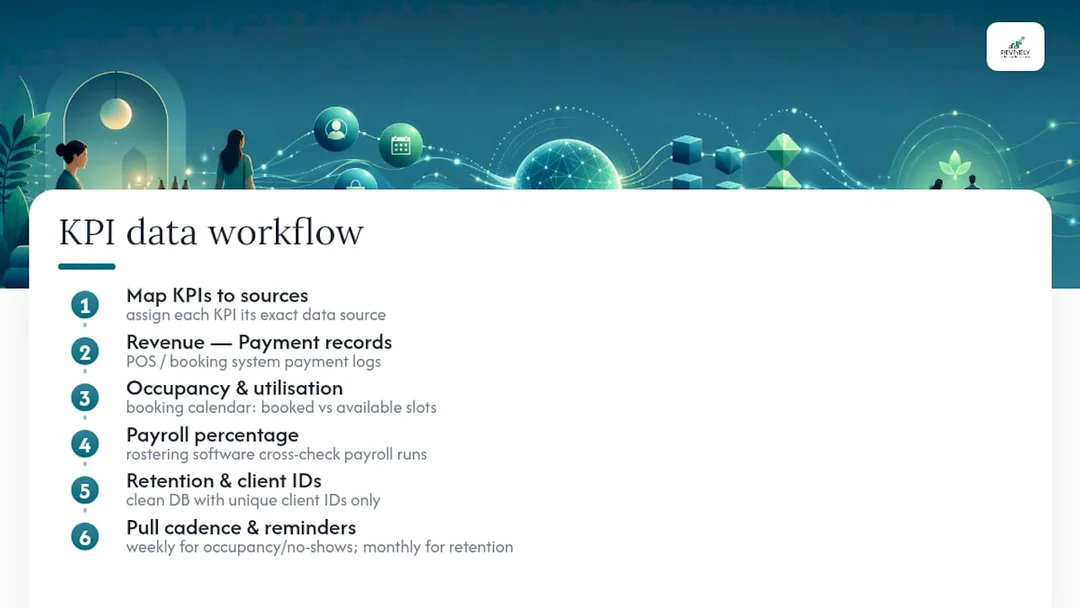
Retention rate calculation needs a clean client database with unique client IDs. Without that, "repeat" clients get miscounted whenever someone books under a slightly different name or email. Retail figures need product sales tagged separately from service revenue in your POS - a distinction some studios skip early on and regret later.
Frequency should match how fast the number moves and how costly a delayed response would be. No-shows and occupancy deserve weekly pulls because a bad week compounds quickly. Retention and gross margin are better measured monthly; pulling weekly data here just adds noise without adding insight. Set a recurring calendar reminder for each pull, ideally the same day and time every week, so nobody has to remember to do it and gaps don't creep into your trend lines.
Reality Check: Setting Benchmarks That Make Sense for Your Studio
Generic benchmarks are a starting reference, not a target to chase blindly. The 2026 US Spa Industry Study shows annual industry revenue climbing by US$1 billion - useful context, but a resort spa's revenue per visit and a suburban day spa's simply aren't comparable numbers.
Benchmarks vary meaningfully by studio type. Resort and hotel spas, standalone day spas, medi-spas, yoga studios, and Pilates centres each carry different cost structures, price points, and client expectations. A medi-spa with injectable services will show a very different retail-to-service ratio than a massage-focused day spa, and that's normal, not a red flag.
The safer approach: establish your own baseline from three months of clean data first. Then use published benchmarks only to sanity-check whether your numbers are wildly out of line. If your occupancy sits at 55% and the industry conversation suggests 70% to 75% is typical for comparable venues, that gap tells you where to focus. But chasing an external number without understanding your own capacity constraints, staff count, and local market usually leads to targets nobody can actually hit. Set the target internally, then let the external data confirm you're not miscalibrated.
Beyond Bookings: Client Satisfaction & Feedback You Can Act On
Net Promoter Score (NPS) gives you a single number for how likely clients are to recommend you. It's calculated by subtracting the percentage of detractors (those who score 0-6 out of 10) from promoters (those who score 9-10). Run it after treatment via SMS or email; quarterly is usually enough unless you're in the middle of a service change worth monitoring closely.
Post-treatment satisfaction surveys catch specific friction points NPS misses: was the room temperature right? Did the therapist explain the treatment? Was checkout smooth? Keep these to three or four questions; long surveys get abandoned and skew your response data towards extremes.
Watch the response rate as its own metric. A satisfaction score built on 5% of clients responding tells you far less than one built on 40%. If response rates are low, the survey is probably too long or arriving at the wrong moment. Delivering it straight after checkout, while the visit is fresh, usually beats a delayed email the next day.
Track complaint resolution time separately from satisfaction scores. A single unresolved complaint that sits for two weeks does more damage to retention than a slightly lower NPS score ever will.
Fueling Growth: Marketing KPIs That Don't Lie
Lead conversion rate - enquiries that convert to booked appointments - tells you whether your front desk or online booking flow is doing its job. If your website traffic is healthy but conversion is low, the friction is usually in the booking process itself: too many steps, unclear pricing, or no visible availability. This is where a seamless multi-resource studio scheduling platform makes all the difference.
Campaign ROI needs a simple formula: (Revenue Generated by Campaign - Campaign Cost) ÷ Campaign Cost. Tag bookings from a promotion with a unique code or link so you're not guessing which revenue came from where. Cost per new client acquired (Total Marketing Spend ÷ Number of New Clients in the Period) tells you whether a channel is worth repeating.
New client rate (New Clients ÷ Total Clients in a Period) should sit in a healthy balance against your retention rate. A studio with strong new client numbers but weak retention is running a leaky bucket - no amount of marketing spend fixes that on its own. Marketing agencies like Align and local operators such as HarbourSide Digital both emphasise tagging every campaign at the source so KPI attribution doesn't turn into guesswork after the fact.
Silent Leaks: Mastering Inventory & Supply Costs
Inventory turnover (Cost of Goods Sold ÷ Average Inventory Value) shows how efficiently retail and treatment stock convert to revenue. A low turnover rate means capital sitting on shelves rather than working for you, and product expiring before it sells is a direct hit to gross margin.

Track supply cost as a percentage of service revenue monthly. Rising percentages without a corresponding price increase usually mean either supplier costs have crept up or therapists are over-using product per treatment - both fixable once you spot them. Set minimum and maximum stock levels for high-turnover items to avoid emergency reordering at higher unit costs.
Retail shrinkage - the gap between recorded and actual stock - deserves its own quarterly check. Even small, consistent discrepancies compound into a meaningful gross margin leak over a year.
The Unsung Hero: How Training Elevates Your Core Numbers
Therapist skill directly moves at least three KPIs: retail-to-service ratio, treatments per guest, and retention rate. A therapist confident in consultative selling naturally lifts retail attach without feeling pushy about it, while an undertrained one either avoids the retail conversation entirely or handles it awkwardly enough to put clients off.
Cross-training therapists across services also improves utilisation. A therapist who can only perform one treatment type has a narrower booking window than one who can flex across three or four. Track utilisation by therapist skill set, not just by individual, to spot where a training gap is capping your scheduling flexibility.
Run a short before-and-after comparison whenever you introduce new training. Retail ratio and treatment-per-guest numbers for the four weeks before versus the four weeks after usually show the impact clearly, if the training actually worked.
Riding the Waves: Adjusting KPIs for Australia's Seasons
Studio demand isn't flat across the year, and treating every month's KPI against the same fixed target sets you up for false alarms. Compare each month against the same month last year rather than against last month; this strips out predictable seasonal dips and highlights genuine problems.
Occupancy naturally softens in slower periods (hello, January!) and spikes around gifting seasons (Mother's Day, Christmas) and school holidays. Build a seasonal index from at least twelve months of historical data, then apply it to your monthly targets so a normal seasonal dip doesn't trigger unnecessary panic or an unwarranted staffing cut.
No-show rates often shift seasonally too. Holiday periods tend to see higher last-minute cancellations as client schedules become less predictable. Adjust your confirmation cadence accordingly; an extra reminder around peak travel or holiday weeks costs little and protects your occupancy numbers.
Your Digital Front Door: Metrics for Online Success
Website traffic feeding into actual bookings matters more than raw visitor counts. Track booking conversion rate by channel - direct website, social media, Google search - so you know which channel is actually filling your calendar rather than just generating clicks.
Online booking share - the percentage of total bookings made through your online portal versus phone or walk-in - is worth watching over time. A rising share generally means less admin time spent on the phone and fewer errors from manual entry. Abandoned booking rate - people who start the booking flow but don't complete it - often points to friction: too few visible time slots, unclear pricing, or a clunky mobile experience.
Review volume and rating trends across Google and your booking platform double as both a marketing and a satisfaction signal. A sudden dip in average rating deserves the same urgency as a KPI moving in your internal dashboard.
The Final Word: Start Small, Act Fast, See Results.
Pick four KPIs, run one test a month, and share the trend with your team every week. The habit matters more than the tooling, and momentum builds fast once staff see their actions move a number they actually understand.
Stop Chasing Ghosts. Start Leading with Data.
Manual exports from your booking calendar, payroll system, and POS eat hours every week, and every manual step is another chance for a service code mismatch to quietly wreck your utilisation numbers. A platform built to capture occupancy, therapist utilisation, and payroll data at the source can slash reconciliation work, enabling faster updates of key numbers without manual report pulls.

Revively's online booking system tracks occupancy and no-shows as bookings happen, while native Xero integration keeps payroll and gross margin figures reconciled without a spreadsheet in sight. If you're running class-based sessions alongside treatments, our class scheduling tools apply the same logic to group utilisation, all while ensuring GST compliant studio software practices.
Ready to gain real control over your studio's performance? Start a trial and watch your first real KPI dashboard build itself within a week.
Sources
- 10 Essential Spa KPIs You Should Be Tracking this Summer - Spa Industry Association
- Spabusiness
- KPI Institute - Performance Magazine (Business excellence edition)
Recommended
- Stop the Revolving Door: Real-World Spa Retention Strategies for Australian Studios
- Stop the Monthly Mayhem: How Australian Spas Use Memberships to Predict Revenue (and Sanity)
- Stop the No-Show Bleed: How Deposits (Done Right) Protect Your Studio's Revenue
- Fill Every Spot: How Smart Waitlists Boost Studio Revenue (Without the Admin)