
Class Pack Revenue Recognition for Australian Studios: GST at Sale
! Studio owner discussing class-pack accounting with accountant
Treat class pack proceeds as deferred revenue under AASB 15 and recognise revenue as each class is delivered, not when the pack is sold.
Picture this: You're juggling client bookings, managing instructors, probably teaching a class or two, and then BAM! It's BAS statement time. Suddenly, those seemingly straightforward class pack sales transform into a tangled web of revenue recognition, deferred income, and GST rules. Do you account for it when they buy the pack, or when they actually show up? And what about those expiry dates?
If the thought of auditing your class pack income makes your stomach clench, you're not alone. The line between what the ATO wants (GST at sale for most packs) and what accounting standards (like AASB 15) demand (revenue at delivery) is a tightrope walk. Get it wrong, and you risk a nasty surprise from the taxman or, worse, an inaccurate view of your studio's actual financial health.

This isn't about dry accounting theory. This is about real-world cash flow, staying compliant, and reclaiming your evenings from spreadsheet hell. We're breaking down how Australian wellness and fitness studios can confidently navigate class pack revenue and GST, ensuring your books are tidy, your BAS is accurate, and your business is built on a solid financial footing.
The Quick Scan: Your Class Pack Revenue & GST Checklist
- Revenue Recognition (AASB 15): Don't count the cash until the class is delivered. Class pack sales sit as deferred revenue until your client sweats it out in your studio.
- GST Timing (ATO Rules): For most class packs (considered 'non face value vouchers'), you owe the 10% GST at the point of sale, not when the client redeems the session. Yes, that means revenue and GST often follow different timelines.
- Allocation: If all classes are identical, spread the pack price evenly. If you've got a mix (e.g., group + 1-on-1), allocate based on their individual standalone prices.
- Mixed Packs: Selling packs with both taxable (e.g., yoga class) and GST-free (e.g., some health services) components? Split the sale and only apply GST to the taxable bits.
- Refunds: Reverse the unused portion of deferred revenue and any related GST liability.
- Breakage: Unused sessions that expire? Recognise this revenue after expiry, or earlier only if solid historical data proves a reliable estimate is possible. (Most studios will wait).
- Modifications: Pack top-ups or transfers aren't new sales; adjust the existing contract liability.
- Documentation: Keep clear records of your recognition policies and any breakage assumptions. When in doubt, call your accountant - especially for complex scenarios.
- Australian Data & Xero: Modern studio software should handle this seamlessly, storing data securely in Australia and syncing flawlessly with Xero for BAS peace of mind.
Table of Contents
- Untangling AASB 15: How the Five-Step Revenue Model Works for Class Packs
- GST for Australian Studios: Navigating Voucher Rules and BAS Timing
- The Nitty-Gritty: Journal Entries for Sale, Redemption, Refund, and Expiry
- When Things Get Tricky: Measuring Progress and Handling Pack Modifications
- Putting It All into Practice: Essential Controls for Accurate Accounting
- Know When to Call a Pro: Where Your Judgement Ends and Your Accountant Begins
- A Smarter Way to Master Class Pack Accounting for Australian Studios
- FAQ: Your Burning Class Pack Accounting Questions Answered
- Sources
Untangling AASB 15: How the Five-Step Revenue Model Works for Class Packs
Think of AASB 15 (Australia's equivalent of IFRS 15, the international standard) as a set of rules designed to ensure you only recognise revenue when you've actually earned it. For a busy studio owner, this means ensuring your reported income truly reflects the services you've delivered, not just the cash that's landed in your bank account.
Here's how the five-step model unpacks for your class packs:
- 1. Identify the Contract: The moment a client pays for a class pack, even through your booking portal, you've got a legally enforceable contract. You promise classes; they promise payment. Simple.
- 2. Identify Performance Obligations: Each individual class your client can attend from that pack is usually a distinct "performance obligation." Why? Because they can benefit from one session (e.g., a single yoga class) without needing to use the entire pack.
- 3. Determine the Transaction Price: This is the exact amount your client paid for the pack, after any discounts. If you charge an upfront joining fee directly tied to accessing these classes, factor that in too.
- 4. Allocate the Price to Each Obligation: For most standard class packs with identical sessions (e.g., a 10-pack of reformer Pilates), you just divide the total price evenly across the number of classes. It's a pragmatic way to determine the standalone value of each session. If you've got a combo pack (say, 5 group classes and 2 private sessions), you'll need to allocate the price based on the relative standalone value of each different service.
- 5. Recognise Revenue: This is the critical step. Revenue moves from your balance sheet (as deferred revenue, a liability) to your profit and loss statement (as actual revenue) each time a client attends a class. Why? Because that's when you've delivered the service, and control has passed to the client.
The compiled AASB 15 standard details this, but for most studios, per-class recognition is perfectly adequate. It ensures your income statements accurately reflect your operational activity.
GST for Australian Studios: Navigating Voucher Rules and BAS Timing
Now for the twist. While your internal accounts follow AASB 15, the Australian Taxation Office (ATO) has its own rules for when GST is due, especially for class packs. This is where things can get confusing, as GST and revenue recognition often operate on different clocks.
The ATO's voucher guidance draws a clear line:
- Face Value Vouchers: These entitle the holder to a stated dollar amount (e.g., a $100 gift voucher). For these, GST is usually accounted for on redemption.
- Non Face Value Vouchers: These entitle the holder to a specific supply (e.g., "10 yoga classes" or "5 recovery sessions"). And here's the kicker: GST is accounted for at the time of sale.
Most class packs fall squarely into the "non face value voucher" category. Why? Because you're selling a defined number of specific services, not a general dollar credit.
Critical Takeaway for Australian Studios:
If you're selling a "5-pack of Pilates," you're typically on the hook for the 10% GST in the BAS period the pack was sold, even if the client doesn't use a single class until next quarter. This is a fundamental difference from revenue recognition, where the income is only recognised upon delivery. This means your BAS and your profit & loss statements are moving to different beats.
What if your studio offers a mix of taxable and GST-free services in the same pack (e.g., a physiotherapy session bundled with yoga classes)? You'll need to split the sale and only apply GST to the taxable components.
Claiming Input Tax Credits: On the flip side, any input tax credits on costs directly tied to servicing that pack (like instructor wages or rent) are claimed in the period those costs are incurred, regardless of when the client attends. It helps to understand the full BAS mechanics, which we delve into more deeply in our guide to GST on memberships.
The Nitty-Gritty: Journal Entries for Sale, Redemption, Refund, and Expiry
Understanding the theory is one thing, but making sure your bookkeeper (or Revively!) gets the entries right is another. Here's a streamlined sequence for a typical class pack, ensuring deferred revenue, GST, and your cash flow stay perfectly aligned.
- At Sale: The cash hits your bank. You debit 'Bank' for the full amount. Then, you credit a 'Contract Liability' account (which is your deferred revenue) for the GST-exclusive amount, and a 'GST Payable' account for the 10% GST component.
- At Each Redemption: When a client attends a class, you've earned that portion of the pack. You debit the 'Contract Liability' (reducing your outstanding obligation) for one class's worth and credit 'Revenue' for the same amount.
- On a Refund: If a client cancels and gets a refund for unused sessions, you reverse the relevant portions of the 'Contract Liability' and 'Bank' entries. Crucially, you also adjust 'GST Payable' to reflect the reduced supply, deducting any non-refundable cancellation fees.
- On Expiry (Breakage): If a pack expires with unused sessions, that's breakage. While some accounting standards allow for early recognition if historical data is robust, most studios will simply recognise this as revenue once the pack has actually lapsed. This is the safest, least complex approach.
Let's see this in action:
| Transaction | Bank | GST Payable | Contract Liability | Revenue |
|---|---|---|---|---|
| Sale of 10-class pack @ $300 (inc. GST) | +$300 | +$27.27 | +$272.73 | $0 |
| Redemption of Class 1 | $0 | $0 | -$27.27 | +$27.27 |
| Redemption of Class 2 | $0 | $0 | -$27.27 | +$27.27 |
| Refund of remaining 8 unused classes | -$218.16 | -$19.83 | -$198.33 | $0 |
This table illustrates a client buying a multi-class pack, with GST and GST-exclusive amounts precisely allocated per session. As they attend, the corresponding revenue shifts from deferred liability to recognised income. A refund for unused classes reverses the relevant contract liability and GST. If the pack simply expires, that 'breakage' revenue can be recognised once the pack's validity period is truly over.
When Things Get Tricky: Measuring Progress and Handling Pack Modifications
While most class pack accounting is straightforward (one class, one attendance, one chunk of revenue), some scenarios call for a bit more finesse:
- Measuring Progress: Attendance counts are your best friend here. They're concrete. Only switch to more complex methods (like expected usage) if attendance data is genuinely unreliable or if your sessions drastically vary in value within a pack.
- Pack Top-Ups: A client adding more sessions to an existing pack? That's a contract modification. Add the new payment and the additional classes to the existing contract liability. No need to start a whole new accounting entry.
- Transfers: If a pack is transferred between family members or a group, but the total number of sessions and the original price remain the same, it's not a new sale. It's just a change in who is satisfying the obligation.
- Variable Consideration: Offering loyalty credits or conditional refunds? Only recognise revenue from these if you're highly probable it won't later be reversed. Play it safe.
- Disclosure Checklist: Keep a clear internal record of your opening and closing contract liability balances, the value of remaining obligations, and especially the assumptions behind any breakage estimates. Standards like IFRS 15 expect this to be thoroughly documented.
Putting It All into Practice: Essential Controls for Accurate Accounting
The most sophisticated accounting standards mean nothing if your day-to-day operations are a chaotic mess. Accurate financial reporting starts with rock-solid operational data.
- Crystal-Clear Terms: Before a client even clicks 'buy', publish precise terms and conditions for your packs. Cover validity, expiry, transferability - everything. Ambiguity here is a fast track to accounting headaches and client disputes.
- Automated Attendance: Ditch the manual tally sheets. Your client management software should automatically validate attendance at check-in. This real-time data is the trigger for revenue recognition.
- Standardised Expiry Rules: Apply one consistent expiry rule across all packs of the same type. Maintain an unshakeable audit trail for every single sale, redemption, refund, and expiry event.
- Regular Journal Export: Don't wait until tax time to reconstruct your attendance-linked journal entries. Regularly export them from your studio management software directly into your accounting system.
This is where Revively shines. Our class pack and membership tools automatically tag each sale as deferred revenue, record attendance against the pack in real-time, and seamlessly sync your Stripe payments through to Xero. This means the contract liability balance in your ledger actually matches what clients have left on their packs. No more end-of-year scramble, just clean, auditable data.
Pro Tip: Reconcile your contract liability account to outstanding class pack balances at least monthly. Don't wait until year-end. Catching discrepancies early means your attendance records are fresh and reconciliation is far less painful.
Know When to Call a Pro: Where Your Judgement Ends and Your Accountant Begins

For most Australian studios running straightforward class packs with identical sessions, managing revenue recognition and GST isn't rocket science. You don't necessarily need a specialist on retainer. However, there are definite red flags signalling it's time to bring in your qualified accountant:
- Complex Breakage Estimates: If you're looking to recognise breakage before expiry based on historical patterns, your accountant needs to review your methodology and assumptions.
- Mixed Taxable/GST-Free Packs: If your packs include a significant mix of GST-inclusive and GST-free supplies, getting the allocation right for BAS purposes can be tricky.
- Significant Contract Modifications: Any substantial changes to a pack (especially if it impacts the total consideration received) should be run past your accountant.
Before you hand over your books, take the initiative. Document your recognition policy and all underlying assumptions. This includes how you measure progress and estimate breakage. Your accountant will thank you, and it will make their review far more efficient.
A Smarter Way to Master Class Pack Accounting for Australian Studios
Chasing attendance records, manually tagging deferred revenue, and rebuilding journal entries at tax time drains hours you simply don't have. This is precisely why we engineered Revively. It's an Australian-made, unified cloud command centre (CRM + multi-resource scheduler) designed to handle this complex sequence automatically.
- Australian Data Residency & Privacy: Revively ensures all your client data, booking histories, and sensitive health intake forms are stored locally in Australia, fully complying with the Australian Privacy Principles (APPs). This isn't just a feature; it's a fundamental trust pillar for your studio and your clients.
- Flawless GST & Tax Invoice Handling: Our system natively handles 10% GST calculations across casual classes, memberships, and multi-resource packages. It automatically issues legally compliant Australian Tax Invoices to your clients, every single time. No more manual calculations or worries about ATO compliance.
- 100% Legal Xero Integration for BAS Accuracy: Forget spreadsheet errors. Revively offers a seamless two-way Xero integration. Automated mapping of tax codes, revenue accounts, and liabilities ensures your quarterly Business Activity Statements (BAS) are flawless and audit-proof, removing the manual headache entirely.
A sale instantly creates a contract liability entry, each attendance moves the correct amount into revenue, and Stripe payments flow directly through to Xero as redemption happens - not in a chaotic year-end scramble.
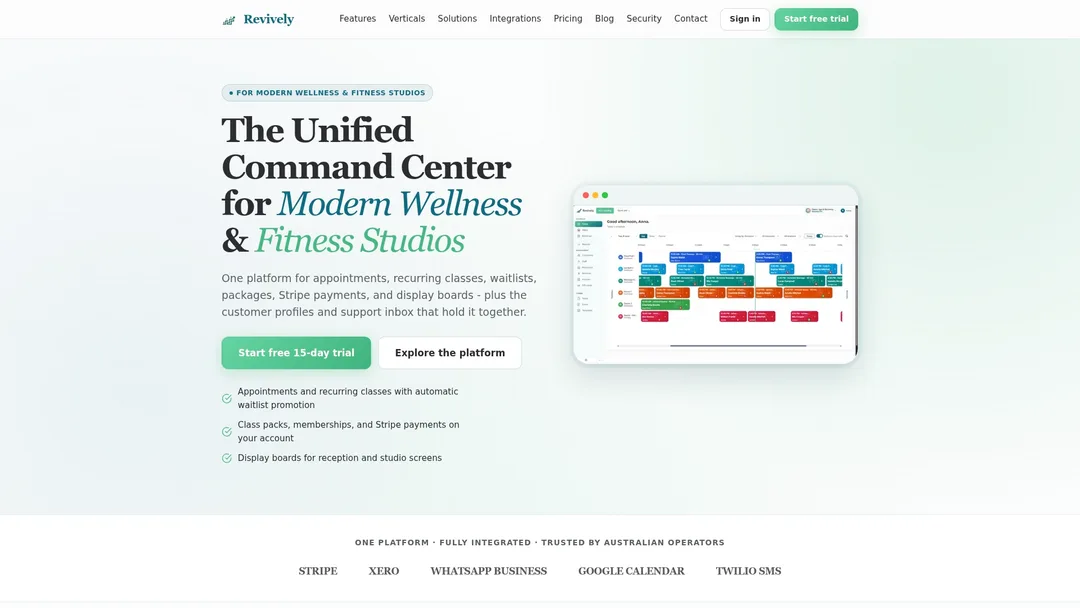
Revively plans start with Solo at $39 AUD per month, with Growth at $99 AUD per month and Pro at $199 AUD per month. All plans are also available billed annually. If your studio's timetable and class packs are part of a broader marketing push, Music Teacher Pros offers complementary resources for teaching studios building out their own lead generation. Visit our pricing page to compare plans and start a trial. Stop fighting your books and start revitalising your business.
This article is general information, not a substitute for advice from a qualified financial advisor. Consult a qualified financial professional about your own circumstances before acting on anything here.

FAQ: Your Burning Class Pack Accounting Questions Answered
What are the 5 criteria for revenue recognition?
AASB 15 and IFRS 15 don't use five separate "criteria" but rather a comprehensive five-step process to recognise revenue. These steps are: identifying the contract, identifying distinct performance obligations, determining the transaction price, allocating that price to each obligation, and finally, recognising revenue as each obligation is satisfied. For a class pack, this boils down to recognising revenue class-by-class, as each session is delivered, not when the pack is initially purchased.
What are the 5 steps in the revenue recognition process?
The five critical steps are:
- Identify the contract with the client.
- Identify the separate performance obligations within that contract (e.g., each individual class in a pack).
- Determine the transaction price (the total amount the client paid).
- Allocate the transaction price to each performance obligation.
- Recognise revenue as each performance obligation is satisfied (i.e., when each class is attended).
Is there an ASC 606 course available?
ASC 606 is the US equivalent of AASB 15 and IFRS 15. You can absolutely find dedicated courses through various accounting bodies, professional training providers, and even online platforms. Payment providers like Stripe also publish practical five-step implementation guides that walk through the model with real-world examples, which can be very helpful for practical application.
What are some examples of revenue recognition?
A common example for studios is a ten-class yoga pack sold for $300. At the point of sale, that $300 (minus GST) is recorded as deferred revenue. Then, as each class is attended, $27.27 (if GST is excluded) is moved from deferred revenue into your recognised income. Another typical example is a monthly studio membership, where the revenue is usually recognised evenly across the month as the ongoing service (e.g., access to facilities or unlimited classes) is provided, rather than all at once on the billing date.
Sources
- Revenue from Contracts with Customers (AASB compiled standard)
- GST and vouchers | Australian Taxation Office
- IFRS 15 Revenue from Contracts with Customers (IFRS Foundation)
- ASC 606 how-to guide: Revenue recognition in five steps (Stripe)
Recommended for Your Studio
- BAS Panic? Master GST on Memberships (and Nail Your BAS) for Australian Studios
- Stop the Silent Client Drain: Why Unused Class Packs Are Costing Your Australian Studio More Than You Think
- Stop the Revenue Drain: Are Your Class Packs Undermining Your Memberships?
- Mastering Class Packs: Essential Software for Australian Wellness Studios