
Stop Revenue Leaks: Class Packs vs Memberships for Studio Owners
! Studio owner adjusting class booking rules
Memberships should be the backbone of your pricing, with class packs working alongside them as a flexible entry point.
Picture this: it's 3 PM on a Tuesday. You've just finished teaching a packed Pilates class, the booking system is buzzing with cancellations, new enquiries, and waitlist shuffles, and your accountant just called about a BAS query for last quarter. You're juggling client care, staff rosters, and facility maintenance, all while trying to decipher why your monthly revenue projections keep doing the cha-cha.
You know memberships are the gold standard for predictable income - that steady pulse of cash flow that actually lets you sleep at night, knowing rent and payroll are covered. But then there are class packs: brilliant for onboarding, for capturing casual clients, for testing new offerings. The problem? When they're not set up just right, those packs can silently siphon clients away from your high-value memberships, turning a revenue stream into a leak.
This isn't about picking sides. It's about designing a pricing structure that works together, not against itself. It's about leveraging both models intelligently, without creating an admin nightmare or accidentally training your most loyal clients to choose the cheaper, less committed option.

The Quick Scoop for Busy Studio Owners
TL;DR: Don't let your pricing structure inadvertently sabotage your studio's financial health.
- Memberships: The bedrock for consistent revenue, enabling solid financial forecasting and fostering client loyalty. They're your stability.
- Class Packs: Excellent for immediate cash injection and flexibility, but they require iron-clad expiry dates and careful credit management. They're your gateway.
Hybrid is Smart: Start clients on packs, then strategically nurture them into loyal members.
Software is Your Secret Weapon: Your multi-resource studio scheduling software must handle pre-paid credits, auto-renewals, waitlist automation, and critically, compliant Australian GST and Xero integration for flawless BAS.
Review, Review, Review: Regularly audit your pricing, expiry terms, and capacity controls to ensure packs and memberships complement each other, rather than compete.
Table of Contents
- Memberships vs. Class Packs: The Real-World Impact on Your Studio
- Choosing Your Model: When to Prioritise Memberships, Packs, or a Hybrid Approach
- Optimising Pricing, Expiry, and Booking Rules in Your System
- What to Demand from Your All-in-One Studio Booking Software in Australia
- Introducing New Pricing: A Client-Centred Rollout Plan
- Navigating the Day-to-Day Trade-Offs
- Revively: Your Unified Command Centre for Packs and Memberships
- Sources
- FAQ
Memberships vs. Class Packs: The Real-World Impact on Your Studio
The difference between these two pricing models isn't just theoretical. It hits your bank account and your admin load the moment a client clicks "buy."
Memberships mean predictable income. Picture it: consistent debits landing in your account on the same days each month. This level of financial foresight allows you to forecast payroll, marketing spend, and even future expansion with genuine confidence. It builds routine for your clients too; once they've committed, they're more likely to show up, building consistent attendance habits. As the Wharton School's research on tiered pricing highlights, rewarding commitment transforms casual attendees into habitual, high-value members.
Class Packs, on the other hand, deliver an upfront cash injection. Great for immediate liquidity, but that lump sum can be tricky to spread across future months, especially when clients use credits sporadically. Pack holders love the flexibility, which suits those with erratic schedules, but makes their attendance harder to predict and plan around.
Administratively, memberships demand robust auto-renewal logic, intelligent dunning for failed payments, and clear, Australian Consumer Law compliant cancellation rules. Class packs need precise expiry dates, accurate remaining credit tracking, and seamless waitlist management for those popular sessions.
Here's a quick overview of how they stack up:
| Feature | Memberships | Class Packs |
|---|---|---|
| Revenue Flow | Predictable, recurring monthly income | Upfront lump sums, less predictable over time |
| Client Commitment | High, encourages routine attendance & loyalty | Flexible, caters to casual or irregular attendance |
| Admin Focus | Auto-renewals, failed payment dunning, churn management | Expiry dates, credit tracking, waitlist allocation |
| Cash Flow | Stable, easier for forecasting | Immediate boost, harder to project |
| Ideal for | Covering fixed costs, building a loyal community | New client acquisition, testing new classes, casuals |
Choosing Your Model: When to Prioritise Memberships, Packs, or a Hybrid Approach
There's no universal "right" answer. Your studio's stage, your ideal client, and your unique offerings should guide your decision.
1. Membership-First Approach
Best for: Established studios with a loyal client base and significant fixed costs (rent, instructor wages, specialised equipment like recovery baths or reformer maintenance) that demand guaranteed monthly cover.
Example: A busy inner-city Pilates studio running three classes daily, with a dedicated community of regulars, is a classic membership business. They thrive on the stability of recurring revenue.
2. Pack-First Approach
Best for: New studios still finding their rhythm, or those with high casual/tourist traffic.
Example: A beachside yoga studio during peak holiday season, or a dance school introducing a brand new style. Packs allow you to test new schedules or offerings without locking clients into a long-term commitment for something unproven.
3. The Smart Hybrid Model
Best for: Most studios aiming for sustainable growth. This model leverages the accessibility of packs to draw clients in, then strategically converts them into members.
How it works: Sell packs as an initial entry point. Once clients have attended a few sessions and shown consistent interest, use targeted, automated campaigns to nudge them towards a membership. As we've explored on the Revively blog, automated follow-up and clear onboarding paths are far more effective than generic upsell emails at converting casual buyers into recurring members.
Pro Tip for Australian Studios: Never price a class pack so that its per-session cost is cheaper than your membership. If a 10-pack costs less per class than your monthly unlimited option, you're inadvertently training your most engaged clients to avoid the very product that gives your studio financial predictability. This is a common revenue leak you can plug instantly.
Optimising Pricing, Expiry, and Booking Rules in Your System
A well-structured pricing ladder is essential. Think of it as a clear path:
- Drop-in classes: Highest per-class price. This is your premium, no-commitment option.
- Class packs: Offer a moderate discount for bulk purchase.
- Memberships: Deliver the absolute best value per class, rewarding genuine commitment.
This tiered structure, as advocated by Wharton, ensures your most loyal clients feel valued and incentivised, while protecting your stable membership base from being undercut.

Expiry Rules: Not an Afterthought
Expiry dates aren't just an arbitrary setting; they're a critical tool for managing cash flow and encouraging attendance.
- A 30 to 60-day expiry window is ideal for fast-paced fitness, yoga, or dance classes, encouraging consistent attendance.
- 90 days or more might be better suited for multi-session spa packages, recovery treatments, or therapy sessions where clients intentionally space out their visits.
- Good studio software, like those reviewed for class pack management, allows you to set granular expiry, rollover, and override rules for each product.
Smart Booking Restrictions
Careful configuration of booking rules prevents overcrowding and enhances member value:
- Prioritise members: Give unlimited members first access to peak-time classes before opening them up to pack holders. This is a powerful membership perk.
- Restrict by class type: Ensure a dance pack isn't accidentally valid for a hot yoga session, unless that's your explicit intention.
- Sharing policies: Clearly define whether packs can be shared among family members or if they're tied to a single profile.
Your cancellation and refund policy needs to be transparent and automated, not a frantic front desk negotiation. And for Australian studios, ensuring your software correctly aligns session limits and billing periods is crucial for preventing allotment errors that lead to disputes and headaches.
Finally, you need to track the right metrics: revenue by category (packs vs. memberships), remaining credits per client, churn rate, and average visits per member. These tell the real story of your pricing health.
What to Demand from Your All-in-One Studio Booking Software in Australia
The right software isn't just a convenience; it's the difference between a thriving, compliant Australian studio and one drowning in manual admin. For Revively customers, these features aren't "nice-to-haves"; they're non-negotiable foundations for success.
- Prepaid credits tied to member accounts: With clear expiry controls and a transparent balance visible to both staff and clients.
- Auto-renew subscriptions: Must include an intuitive, client-facing cancellation flow - no phone call required.
- Automatic waitlist promotion: A cancelled spot should fill itself instantly, without a staff member needing to text the next person in line. This is paramount for multi-resource studio scheduling.
- Stripe payment support: For both one-off pack purchases and seamless recurring membership billing.
- Native Xero Integration for GST & BAS Reconciliation: This is an absolute must for Australian studios. Your system needs to automatically handle 10% GST calculations, generate legally compliant Australian Tax Invoices, and seamlessly map tax codes, revenue accounts, and liabilities to Xero. This guarantees your quarterly BAS is 100% accurate and audit-proof, eliminating manual spreadsheet errors and saving countless hours. This is how you achieve GST compliant studio software.
- Reporting dashboards, foyer displays, and digital intake forms: Everything needs to keep front desk staff working from the same live data as your books, reducing errors and improving client experience.
- Australian Data Residency & Privacy: Your clients' sensitive information (booking histories, health intake forms) must be stored locally within Australia, fully complying with the Australian Privacy Principles (APPs). This is not optional; it builds trust and ensures legal compliance for your Australian wellness centre. Look for Mindbody alternatives Australia that offer this critical local compliance.
Revively was purpose-built with this exact list in mind. Our platform features native class packs and Stripe-powered memberships, automatic waitlist promotion, and robust Xero reconciliation - all unified on one dashboard. No more duct-taping disconnected tools together; just one powerful, all-in-one spa booking software designed for Australian studios.
Introducing New Pricing: A Client-Centred Rollout Plan
Changing how you sell classes isn't a flip of a switch; it's a strategic project. Treat it like one to avoid client disruption and staff confusion.
- Audit Your Attendance First. Before you even touch pricing, segment your existing client list: who are your frequent attenders, your casual bookers, your lapsed clients? Understand real behaviour to design a new structure that truly fits your community, not just a guess.
- Build and Test in Staging. Create your new pack and membership templates within your software. Crucially, test the expiry, rollover, and billing logic thoroughly before anything goes live. Vendor guidance consistently recommends testing billing period alignment in a staging environment to catch allotment errors before they become client complaints.
- Carefully Migrate Existing Credits. Have a clear plan for existing clients. Map their old packs to new products, communicate the exact launch date, and clearly explain what happens to their remaining balance. Transparency is key.
- Train Your Front Desk Staff. This is often overlooked. Your front-line team needs to be fully confident with the new rules before launch day. Then, closely monitor reporting at 7, 30, and 90 days post-launch to catch any unexpected churn or pricing issues early.
Navigating the Day-to-Day Trade-Offs
Memberships genuinely reduce founder stress over time - but only if you manage capacity properly. An "unlimited" membership tier priced too cheaply can lead to a nightmare scenario: your busiest 6 AM classes are full of people paying less per visit than a casual drop-in. That maths always catches up to you.
Class packs are fantastic for immediate cash flow and testing a new offering. But price them too generously, and you'll inadvertently train clients to avoid your membership options altogether.
Consider both packs and memberships as dynamic settings you continuously tune using real attendance and revenue data. The most successful studios aren't those who found the "perfect" price on a forum in 2019 and never touched it again. They're the ones meticulously checking their numbers monthly, optimising and adjusting as their market evolves.
"A well-oiled pricing strategy isn't static. It's a living, breathing part of your business that needs constant attention and optimisation. It's the difference between merely surviving and truly thriving."
- The Revively Team*
Revively: Your Unified Command Centre for Packs and Memberships
Imagine a single platform where scheduling, payments, and reporting all talk to each other. That's Revively. We eliminate the need for separate spreadsheets, fragmented payment processors, and manual waitlists, replacing them with an intuitive, all-in-one solution designed specifically for wellness and fitness studios across Australia.
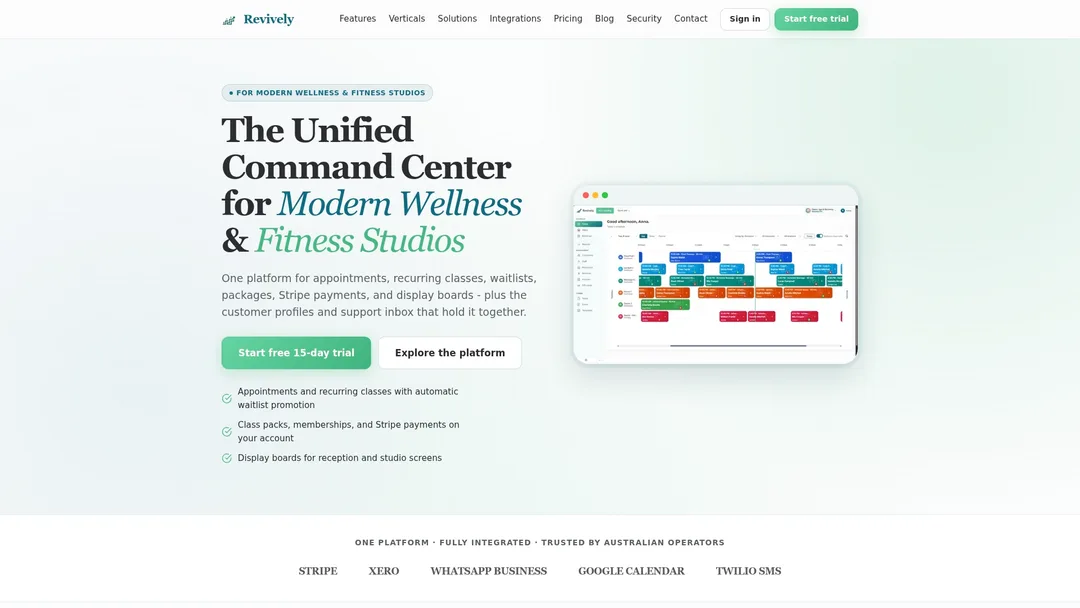
Revively handles your class packs with flexible expiry and credit tracking, and manages your memberships with seamless auto-renew and client-friendly cancellation features. Add to that automatic waitlist promotion, real-time foyer display boards syncing your front desk and studio timetables, and our robust, native Xero integration for flawless GST reconciliation and BAS compliance.
If you're weighing up which pricing ladder best suits your client base, our memberships and class pack solution page walks you through how the settings work in practice. We offer flexible plans, from an affordable Solo tier for individual practitioners to Growth and Pro tiers for larger teams. You can find full details on our pricing page. Don't commit to a costly rebuild until you've booked a look at how your own pack and membership structure would run inside Revively.
Sources
A few sources to dive deeper on the specifics touched on above:
FAQ
Should I offer class packs or memberships first for my Australian studio?
If you're a brand-new studio still fine-tuning your schedule, start with class packs. They require less commitment for both you and your clients. Transition to a membership-first structure once you've built a reliable base of frequent attenders and need to cover fixed operating costs with predictable income.
Do class packs expire in Australia?
Yes, most Australian studios set expiry dates for class packs, typically between 30 and 90 days. Shorter windows are common for fast-paced fitness or dance classes, while longer durations might suit therapy-style or spa packages. Robust studio software allows you to set these expiry rules per product, not as a blanket policy.
How do I stop memberships and class packs from undercutting each other?
Implement a clear pricing hierarchy: drop-in classes are the most expensive per session, packs offer a moderate discount for buying in bulk, and memberships deliver the best value per class. If a class pack's per-session cost is ever lower than your membership, your clients will logically choose the pack, undermining your subscription base.
Can software automatically convert class pack buyers into members?
Absolutely. Modern studio management software, especially those with CRM capabilities, can track attendance and trigger targeted offers once a pack buyer reaches a certain usage threshold, signalling routine interest. Automated follow-up and clearly defined onboarding paths are the most reliable way to grow your membership numbers from your existing casual client base.
What does Revively cost for an Australian studio selling both packs and memberships?
Revively offers several flexible plans designed to cover both class pack and membership sales, with pricing scaled to suit different studio sizes and needs. You can find full plan details and annual pricing transparently laid out on the Revively pricing page.