Cleaning Buffer Time: 10 - 60 Minutes Per Service, Enforced
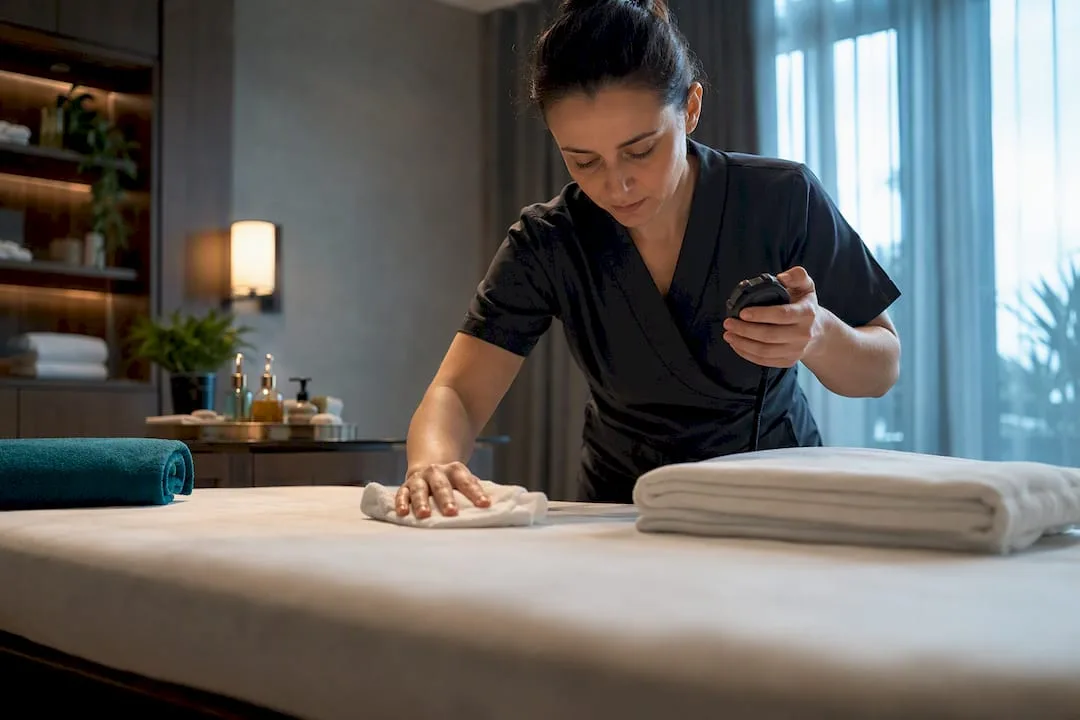
! Staff timing a spa treatment room reset
Cleaning buffer time is the gap you build into every booking so a room, mat space or treatment table can be reset before the next client arrives.
Picture this: your 2 PM client is hovering, the reformer room still smells faintly of the last session, and your staff are frantically wiping down equipment, stripping sheets, and trying to look composed. Meanwhile, your 2:15 PM client for a quick mat class is already waiting outside. Sound familiar?
That frantic scramble, the whispered apologies, the feeling that you're always playing catch-up - it all stems from one often-overlooked detail: your cleaning buffer time. It's not just a nice-to-have; it's the quiet hero that dictates your studio's rhythm, staff sanity, and client experience.
It's that crucial gap built into every booking, ensuring a room, mat space, or treatment table is pristine and perfectly reset before the next client even walks through the door. But here's the kicker: one flat number for every service is a recipe for disaster. A 10-minute buffer might fly for a speedy yoga class, but a deep-tissue massage or a hydrotherapy session? You're looking at 30, 45, even 60 minutes of meticulous reset.
This isn't about guessing. It's about precision. And the right scheduling platform doesn't just suggest these buffers; it enforces them.
The Fatal Flaw: Why One-Size-Fits-All Buffers Sink Your Schedule
The appeal of a single, business-wide buffer is strong: it sounds simple, easy to manage. But the moment your studio offers more than a single type of session, it falls apart.
Think about it:
- A pilates reformer class might need equipment wiped down and mats sanitised.
- A hot yoga session demands a good floor clean, prop organisation, and possibly even ventilation time.
- A facial or body treatment requires stripping linens, deep sanitisation of surfaces, refilling consumables, and preparing the room for an entirely different vibe.
Applying a uniform 15-minute buffer across all these scenarios is like trying to use a spanner as a hammer - it'll do a bad job at both. Experts and experienced studio owners alike recommend defining buffers by appointment type or service type. Why? Because the actual tasks required for turnover are profoundly different. Your buffer isn't an arbitrary number; it's a direct reflection of what your team genuinely needs to achieve in that precious window.
Get this calculation wrong, and you're bleeding money or reputation:
- Too Generous: Rooms sit empty for longer than necessary. That dead time is un-bookable, un-sellable revenue, straight out of your pocket.
- Too Tight: Staff are under pressure, rushing through cleans, potentially missing crucial sanitisation steps. The next client walks into a less-than-perfect space, or worse, waits impatiently outside a room that isn't ready. Your client experience takes a hit.
- One-Size-Fits-All: Your quick, high-volume mat classes get unnecessarily long buffers, costing you peak-time slots, while your complex, high-ticket treatments are constantly running behind, creating client friction.
Tailored, appointment-type buffers solve all these problems. A snappy 10-minute buffer for a mat class works. A considered 45-minute reset for a treatment room that's just hosted an oil-based therapy involving heated stones and specialised linens is entirely justified. This approach isn't just about efficiency; it's about delivering a consistently premium experience.
Nail the Numbers: Calculating Buffer Minutes with a Task-Based Breakdown
"Set it and forget it" usually means "set it wrong and struggle." Guesswork leads to buffers that are either wasteful or completely unreliable. The smarter, more robust method involves breaking down the actual tasks involved in turnover, assigning realistic times, and then adding a sensible margin for the unexpected. This task-based approach means you can defend every minute of that buffer to staff who think it's too long, and to clients who wonder why their session isn't starting precisely on the dot.
Start with a detailed checklist for each service type, then assign a realistic minute range for each step.
| Turnover Task Category | Estimated Time (Minutes) | Key Considerations |
|---|---|---|
| Clear & Reset | 3-8 | Mats, props, towels, small equipment. More items = more time. |
| Linen Change | 4-6 | Massage tables, treatment beds. Single vs. multiple layers. |
| Surface Sanitisation | 5-10 | Tables, benches, high-touch areas. Specialist products might need dwell time. |
| Floor Clean (Spot) | 3-5 | Sweep, quick mop, vacuum small area. |
| Amenity Check | 2-4 | Replenish towels, soap, toilet paper if room includes ensuite. |
| Tech/Equipment Check | 2-5 | Reformers, sound systems, lighting, temperature. |
| Next Booking Setup | 3-6 | Prop arrangement, playlist, intake forms ready. Creating the "vibe." |
| Contingency/Buffer | 5-10 | For overruns, client chats, unexpected spills, or interruptions. |
Let's look at a worked example for a mid-complexity treatment room:
- Clear and reset (5 mins)
- Linen change (5 mins)
- Surface sanitisation (7 mins)
- Tech check (3 mins)
- Next booking setup (5 mins)
- Contingency (10 mins)
Total: 35 minutes.
If you're running something like a hydrotherapy or infrared sauna session that needs additional equipment reset, that number easily climbs towards the 60 to 75-minute range - a figure well-supported by industry methods for complex turnovers. The reality is, even simpler studio turnovers are rarely instantaneous. Typical setup and teardown buffers documented across various scheduling guides often land between 10 to 30 minutes depending on complexity, which aligns neatly with the lower end of your task sums for less intensive services.
Remember to scale your total by headcount or package complexity. A private Pilates reformer session needs less contingency than a bustling group class, where more mats, props, and towels mean more clearing and sanitising.

Hardcoding Buffers: Integrating with Your Scheduling Software
You've got your precise, task-based buffer minutes. Fantastic. Now, those numbers need to leap out of your spreadsheet and into your actual scheduling platform. This is where your system truly becomes a guard dog, preventing rooms or equipment from being accidentally double-booked.
Start with location-level defaults, then fine-tune per service. Many booking platforms, particularly those designed for spas, smartly recommend setting a buffer before for preparation and a buffer after for turnover. Sensible defaults at the location level mean every new service you add inherits a reasonable starting point, rather than starting at zero and inviting scheduling nightmares.
From there, get granular:
- Establish a strong default: Set your studio's standard buffer (e.g., 15 minutes before and after) as the automatic fallback for all new services.
- Override strategically: For services demanding more, like hot stone massages or multi-step facial treatments, increase the buffer beyond the default.
- Resource everything: This is critical. Create a resource in your system for every individual room, reformer, sauna pod, or any piece of shared, bookable equipment. Your staff are resources, but so are your physical assets.
- Lock it down: Crucially, ensure your scheduling software treats that resource as "in use" for the full appointment duration plus the buffer. A reformer simply cannot be booked into its reset window. This is the mechanism that prevents overlapping bookings across your entire calendar.
- Group class logic: For classes, apply the buffer to the room resource itself, rather than trying to individually manage each attendee's booking.
- Waitlist intelligence: Confirm how your waitlist promotion functions with active buffers. You don't want a promoted client to suddenly be slotted into a room that's mid-clean.
Pro Tip for Australian Studios: Keep your buffers invisible to clients during online booking - they'll simply see accurate, ready-to-book availability. But make them clearly visible to staff as hatched blocks or distinct colour codes on the internal calendar. Your team needs to see exactly how much reset time they've got to work with, without confusing clients.
Beyond the Clock: Staff SOPs and a Turnover Checklist for Reliability
Even the most meticulously calculated buffer is only as good as the person executing the cleaning. Your staff need absolute clarity on what that buffer time covers. Transform your task-based breakdown into a concise, easily accessible checklist. Think laminated cards in each room or an app-based checklist linked to your scheduler. Assign clear ownership for who signs off a room as "ready" before the next client glides in.
A simple, effective before/during/after checklist for a treatment room might look like this:
Before Session Ends:
- Confirm next booking details (service type, client name, any special requests).
- Prep fresh linens and necessary consumables nearby, ready for rapid changeover.
Immediately After Session:
- Strip all used linens and place them in the laundry receptacle.
- Wipe down all surfaces (massage table, benches, trolleys) with appropriate sanitiser.
- Adjust lighting and room temperature for a neutral state.
Mid-Buffer Tasks:
- Perform floor spot-clean or quick vacuum.
- Restock any used consumables (tissues, water, oils).
- Thoroughly sanitise all high-touch equipment (door handles, product bottles, tools).
- Check and empty any small bins.
Final Check & Sign-Off:
- Load the next client's intake form or profile on the system.
- Set up props, music, or specific ambient lighting required for the next service.
- Crucially: Mark the room "ready" in the scheduling system. This should be done by the person who completed the final check, replacing vague verbal handovers.
What if a turnover runs long? Your SOP needs a clear fallback. Notify the front desk immediately. Equip your team with a simple, empathetic scripted line for the waiting client ("We're just perfecting the room for you, it will be just five more minutes") rather than leaving them in the dark. Transparency goes a long way.
Refine and Thrive: Measuring, Testing, and Optimising Your Buffers
Buffers aren't a static "set it and forget it" feature. They're a living, breathing part of your operational flow. Regular monitoring and refinement are essential to ensure they're always working for you, not against you. Track a few key metrics monthly and be ready to adjust:
- On-time start rate: For each service type, how often do sessions start precisely on schedule?
- Overrun frequency: How often does a room turnover exceed the allocated buffer time?
- Staff idle time: How much downtime do staff consistently have between bookings when a room is ready and waiting, but no client is present? This signals buffers that might be too generous.
- Client feedback: Are clients ever mentioning wait times or rooms not feeling "ready"?
Approach changes as small, controlled tests, not immediate business-wide overhauls. Try adjusting the buffer on a single service template or for one specific room. Monitor your KPIs for two to four weeks. Then decide whether to roll out the change more broadly. This iterative approach, as recommended by many studio operations guides, minimises disruption while allowing for safe, data-driven improvements.
The decision rule is simple: if overruns consistently plague a particular service type, add a few minutes to its buffer. If staff are repeatedly idle with a pristine room and no waiting client, trim it back. This isn't just about efficiency; it's about continuously optimising your client experience and staff workflow.
Getting Buffers Right: A Real-World Studio Shift
The truly successful studios often arrive at optimal buffers the same way: an owner, fed up with the chaos, grabs a stopwatch during a frantic Saturday and meticulously times every step of a treatment room reset. The revelations are often eye-opening. That 20-minute default buffer often turns out to be 12 minutes too short for a complex hot stone treatment and 10 minutes too generous for a quick reformer session.
The shift to precise, appointment-type buffers, properly tracked, quickly shows up in your studio's on-time start rates. Rooms that were perpetually running behind suddenly hit their schedule. Those annoying idle gaps for simpler services shrink, freeing up valuable time that can be used for training, admin, or even just a breather for your hard-working team.
For deeper insights into streamlining your operational flow, check out Revively's scheduling software guide for Australian studios for real-world setup examples. You might also find value in our piece on why allied health studios need a truly unified command centre - it makes a compelling operational case for getting fundamental systems like buffers dialled in.
Revively: The Scheduling Platform That Enforces Your Expertise
Working out the right buffer minutes is only half the battle. The other half is having a system that actually puts them into practice, preventing human error and ensuring seamless transitions.
Revively is engineered to stop a room, reformer, treatment table, or even a massage therapist from being booked into its own cleaning time. No more relying on your front desk to manually police every calendar entry.
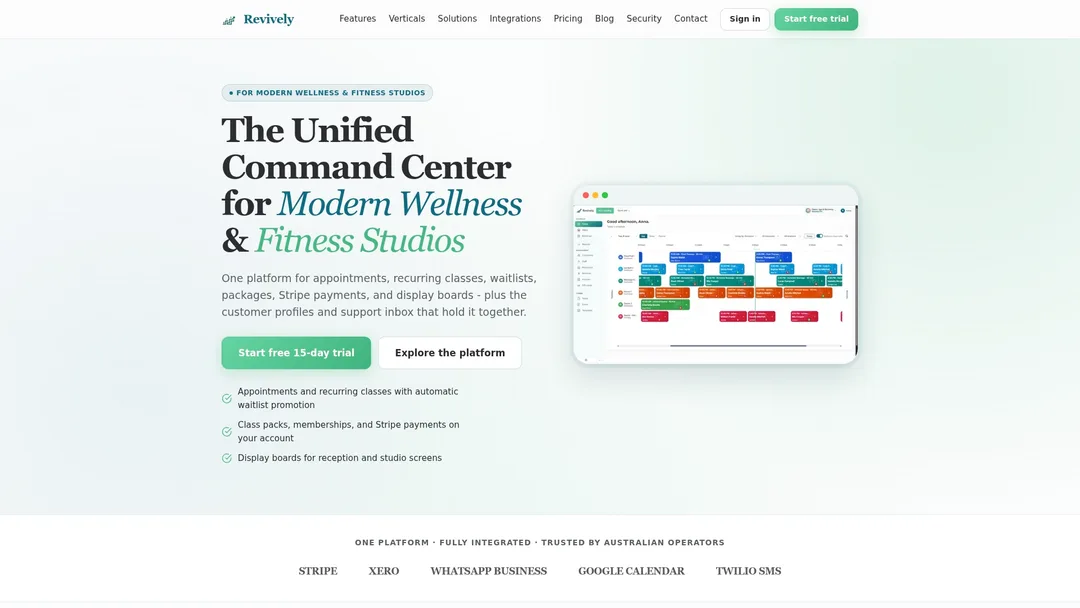
Here's how we ensure your studio runs like a well-oiled machine:
- Granular Buffer Control: Set your default buffer (before and after) at the location level, then effortlessly override it per service type. Your massage rooms and mat classes finally get the precise turnaround time they actually need.
- Smart Resource Management: Every room, every piece of shared equipment, every practitioner becomes a designated "resource" in Revively. This means it stays blocked for the full appointment duration plus your custom buffer, ensuring no overlap. Even waitlist promotions respect these critical blocks, so a client is never slotted into a room that's mid-clean.
- Unified Australian Operations: Revively isn't just a scheduling tool; it's a unified cloud command centre. Manage bookings, memberships, and payments from one intuitive dashboard. We integrate seamlessly with Stripe for secure payment processing, and our native Xero integration handles 10% GST calculations across all casual classes, memberships, and multi-resource packages. This ensures flawless, legally compliant Australian Tax Invoices are automatically issued to your clients. Crucially, this automated, two-way mapping of tax codes, revenue accounts, and liabilities guarantees your quarterly Business Activity Statements (BAS) are accurate and audit-proof, eliminating manual spreadsheet errors and giving you back precious time.
- Australian Data Residency: We understand the critical importance of data privacy. All client data, booking histories, and sensitive health intake forms are stored locally in Australia, fully complying with the Australian Privacy Principles (APPs). This gives both you and your clients peace of mind.
Explore class scheduling built for Australian studios and set your first location defaults today. Experience how Revively takes the guesswork and the chaos out of managing your studio's essential turnover times.
Sources
- How many cleaning minutes should you leave between parties? A venue guide | FastCore
- How to Avoid Double Bookings in Podcast Studios (2026)
- Buffer Time for Day Spas | Bella Booking
- Use resources to limit bookings - Acuity Scheduling Help Center