
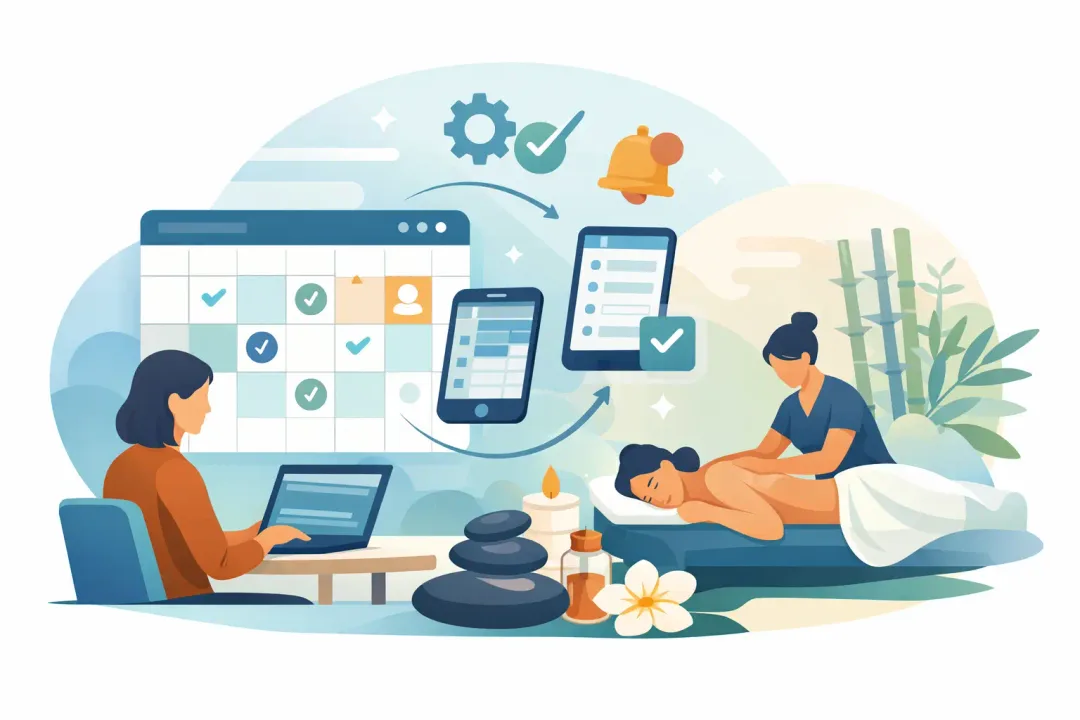
Learn how to manage spa bookings efficiently with scheduling rules, resource control, automated messages and payments that reduce admin and lost revenue.
The frantic dash to find an available therapist for a walk-in. The double-booked float tank. The client expecting a discount your front desk knows nothing about. These aren't just minor headaches for Australian wellness studio owners; they're the daily reality of operational chaos, silently leaking revenue and eroding client trust.
A calendar that looks full on paper can still be bleeding money. A treatment room sits empty because a practitioner is tied up. A couples' massage is booked without two rooms allocated. These aren't small admin issues. They are symptoms of operational failure. Learning how to manage spa bookings efficiently means ditching the fragmented systems and building a unified command centre that controls time, people, rooms, payments, and client communication - all in one seamless workflow.
For studio operators, the goal isn't just to fill every square on the calendar. It's to ensure every confirmed booking is deliverable, profitable, and effortlessly managed by your team.
Build Your Booking Defences: Rules That Reinforce Reality
Most booking problems start long before a client clicks "Book Now." They emerge when services are treated as simple time blocks, rather than operational products with a specific blueprint.
Every treatment needs clear booking logic: its true duration, any necessary clean-up or turnaround time, the required practitioner skills, eligible treatment rooms or equipment, and any specific client preparation. A 60-minute massage, for instance, might need 15 minutes for room reset. A bespoke facial might require a particular machine. A floatation session often demands a longer buffer between guests for sanitisation and serene setup. If these critical details are left to verbal instructions or a forgotten spreadsheet, your entire calendar is running on staff memory and good luck.
The Fix: Set these rules once, within your booking platform. This ensures that the available times presented to clients accurately reflect what your team can actually deliver. It protects the client experience and frees your front desk from manually untangling clashes all day.
There's a trade-off here, of course. Tighter buffers can create more apparent availability, but they also leave precious little room for late arrivals, thorough cleaning, or nuanced consultations. Start with realistic turnaround times, then review utilisation after a few weeks. A calendar that runs calmly at 85 per cent capacity can often outperform one that's constantly scrambling at 100 per cent.
Treat Everything as a Bookable Resource: Beyond Just People
Spa and wellness studio scheduling is far more complex than simply assigning a client to a practitioner. A single booking might require one massage therapist, a specific treatment room, a heated bed, a sauna bay, or even two practitioners simultaneously for a specialist service. If your system only tracks staff availability, double-bookings are almost inevitable.
The Fix: Configure every essential resource separately. When a client books a service, the system should automatically reserve the correct practitioner and the right room. For a couples' treatment, it should only show times where both staff and both rooms are available. For a recovery centre, it must prevent two clients from being assigned to the same infrared sauna or float room at once. This is the essence of multi-resource studio scheduling.
This fundamentally shifts your front desk's role. Instead of acting as air traffic control, constantly patching up scheduling holes, they can focus on client arrivals, retail, rebooking, and genuine service recovery when something truly needs their human touch.
Is Your Service Menu Operationally Honest?
A sprawling menu isn't always a better menu. Every variation adds more scheduling logic, training requirements, and opportunities for errors. If two services use the same room, practitioner skill set, and duration, consider if they truly need separate bookable options, or if one can be an add-on selected during checkout.
The same applies to upgrades. Hot stones, LED therapy, or a scalp massage should only be offered where there's genuinely enough time, equipment, and trained staff available. Selling an add-on that cannot be delivered is far worse than not offering it at all.
Automate the Obvious, Keep Exceptions Visible
Online booking should handle straightforward, high-volume work without constant staff intervention. Returning clients should effortlessly choose an approved service, practitioner, and time, complete their details, and pay a deposit or in full where appropriate.
This doesn't mean every booking must be open to the public free-for-all. First-time consultations, complex treatment combinations, medical-adjacent services, or large group bookings may still necessitate a call or a staff review. The efficient approach is to automate the predictable bookings and keep exceptions clearly visible and managed.
Use clear, concise service descriptions that pre-empt practical questions before clients even book: treatment duration, what to bring, arrival time expectations, any contraindications, and your transparent cancellation terms. Vague descriptions lead to avoidable phone calls and frustrating last-minute surprises for everyone.
A branded booking page is paramount here. It should feel like an integrated extension of your spa or studio, not a generic widget that shunts clients elsewhere and leaves them questioning whether their booking even went through. The entire experience must work flawlessly on mobile, where a significant chunk of your clients will book between meetings or during their commute.
Silence the No-Show Scramble: Payments & Proactive Communication
No-shows are rarely solved by simply sending more reminder emails. They're significantly reduced by setting clear expectations at the moment of booking and creating a financial commitment where it makes commercial sense for your business.
For high-value treatments, limited-capacity sessions, or peak times, take a deposit or full prepayment through the same system that holds the booking. Crucially, make your cancellation window clearly visible before payment, not buried deep in a confirmation message. Your policy needs to be firm enough to protect your revenue, yet reasonable enough that your staff can apply it consistently without awkward confrontations.
Automated SMS confirmations and reminders are highly effective because they reach clients where they're most likely to see them - right on their phone. Send an immediate confirmation, then a reminder far enough ahead for the client to genuinely change or cancel if needed. Include the time, location, preparation instructions, and a simple, intuitive path to manage their booking.
If a client does cancel, that newly freed slot shouldn't become another manual chore. An automatic waitlist can instantly notify suitable clients and give them a fair chance to claim the time. This is exponentially faster than calling down a handwritten list and far more effective than a last-minute scramble to post an opening on social media.
Australian Mandate: Unifying Client Data, Invoicing, & BAS with Revively
A spa appointment isn't just a calendar entry. It's a critical touchpoint within an ongoing client relationship. Intake forms, consultation notes, contraindications, package balances, past services, and communication history should all reside securely against the client's profile - not scattered across disparate inboxes, paper folders, and isolated spreadsheets.
This provides your practitioners with essential context before the client even steps into the room, ensuring a personalised experience. It also prevents those awkward front-desk moments where a guest has to repeat information they've already provided online.
Crucial for Australian Studio Owners: Revively ensures all client data, booking histories, and sensitive health intake forms reside securely on Australian servers, fully compliant with the Australian Privacy Principles (APPS). This commitment to local data residency builds trust and provides peace of mind for both you and your clients.
Be disciplined about who can see and edit sensitive information. Staff need sufficient access to perform their roles effectively, but not every team member requires access to every record. Robust operational control includes finely-tuned permission settings and a clear process for keeping client details current and compliant.
Goodbye Spreadsheet Chaos, Hello Audit-Proof Australian Accounting
For Australian operators, having invoices and payment records natively configured for GST from day one is non-negotiable. Chasing transactions across a booking tool, a payment terminal, and separate accounting exports is precisely the kind of fragmented workflow that creates errors and headaches at month-end.
This is where Revively truly shines as a leading Mindbody alternative Australia-wide:
| Feature | Traditional / Disjointed Systems | Revively's Unified Approach (Australian-Built) |
|---|---|---|
| GST Handling | Manual calculation, prone to errors, requires external tools. | Native 10% GST calculation for all services, memberships, packages. |
| Tax Invoices | Requires manual creation or export; often generic. | Automatic, legally compliant Australian Tax Invoices issued to clients. |
| Xero Integration | Manual data entry, CSV imports, high risk of discrepancies. | 100% Legal Xero Integration for BAS Accuracy. Automated, two-way mapping of tax codes, revenue accounts, and liabilities. |
| BAS Preparation | Time-consuming, manual reconciliation; high risk of audit flags. | Flawless, audit-proof Business Activity Statements (BAS) via Xero sync. No more manual spreadsheet errors. |
| Data Residency | Unknown, potentially offshore, unclear privacy compliance. | Client data securely stored on Australian servers, compliant with APPs. |
Revively's Xero integration is a game-changer for BAS. Our automated, two-way mapping of tax codes, revenue accounts, and liabilities directly into Xero ensures your quarterly Business Activity Statements (BAS) are flawless and audit-proof. Say goodbye to manual spreadsheet errors and welcome complete peace of mind, knowing your financials are compliant.
One Live View: Empowering Your Front Desk, Not Overwhelming Them
Your daily schedule should answer critical operational questions in seconds: Who is arriving next? Which room is occupied? Who is running late? Which clients haven't completed their forms? What payments are still outstanding?
A live display board can make this information instantly visible without turning your front counter into a mountain of printouts. Practitioners can see their next client and room allocation at a glance. Reception can spot gaps, late arrivals, and potential schedule pressure early. Managers gain real-time insight into whether the day is tracking as planned.
This is where truly integrated software earns its keep as an all-in-one spa booking software. Revively brings bookings, client records, forms, payments, rooms, and staff schedules into one cohesive operating view, so your team isn't bouncing between disconnected systems that constantly disagree with each other. This is about delivering a seamless experience for your clients, powered by an efficient wellness studio management Australia can rely on.
Uncover the Hidden Leaks: Reviewing the Numbers That Matter
Efficiency isn't a feeling; it's a metric you track. Look at your no-show and late-cancellation rates, room utilisation, practitioner utilisation, average booking value, lead time, rebooking rate, and the number of appointments filled from your waitlist.
Don't use these numbers to punish staff or chase vanity targets. Use them to identify and address operational constraints. If Saturday afternoons are always fully booked but Tuesdays are consistently quiet, adjust your offers or staffing. If one room is constantly blocking availability, rethink which services use it. If a particular service has persistently high cancellations, investigate its deposit policy, booking lead time, or description.
Also, critically review the workload behind the calendar. If your staff spend hours every week confirming appointments, manually moving bookings, chasing package credits, and reconciling payments, the issue isn't staff productivity. It's a process that hasn't been properly optimised and configured.
Efficient spa and wellness booking is about control, not complication. Set rules that genuinely match your real-world operations, automate routine administrative actions, and keep exceptions visible to the right people. When your calendar truly reflects the way your studio runs, your team can stop managing booking chaos and start spending more time doing what they do best: looking after your clients.
Recommended Resources:
- How Revively helps Australian Studios
- Client management software for wellness businesses
- The complete guide to online booking systems