
Fill More Classes: 4 Studio Class Timetable Templates That Run Themselves
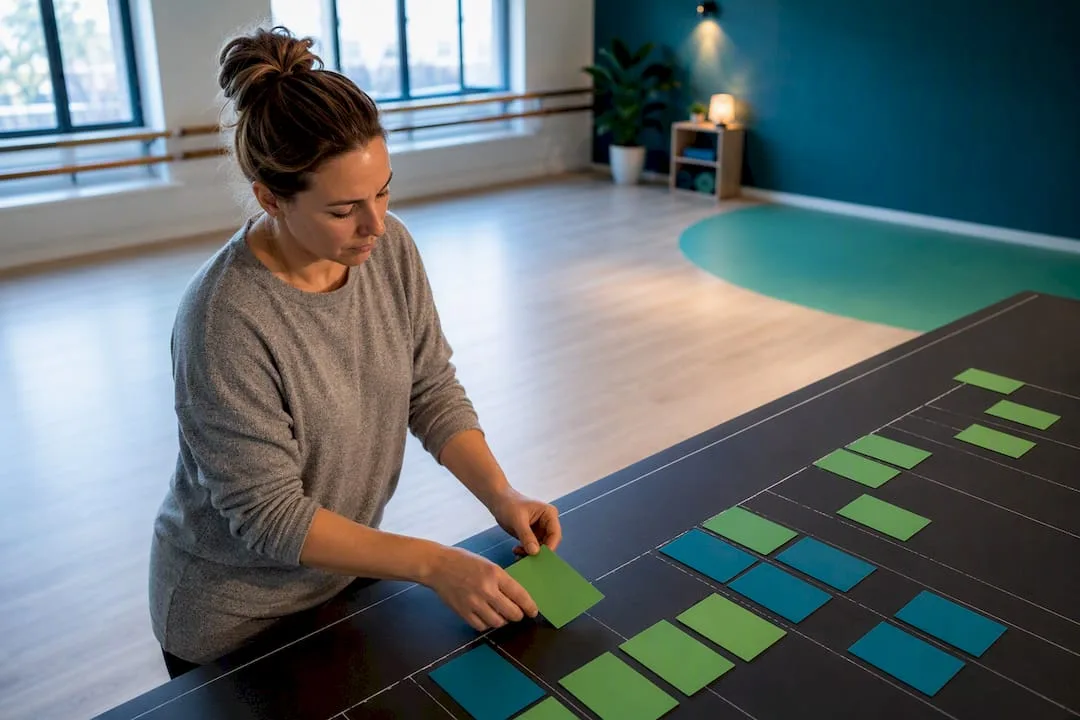
! Color-coded studio timetable planning board
Start with three software-ready templates: multi-resource recurring, single-room weekly recurring, and term or seasonal templates.
The studio floor is buzzing, clients are arriving, the music's pumping, but behind the scenes? You're juggling spreadsheets, frantic calls about double-bookings, and the nagging fear that you've somehow messed up this quarter's BAS. It's a familiar chaos for many Australian studio owners, where manual timetabling turns potential profit into pure admin headache.
But what if your timetable didn't just exist, but actively worked for you? What if it filled classes, managed resources, and even handled the dreaded GST calculations, all without your constant intervention?
It's time to shift from reactive booking management to proactive, automated scheduling. We're talking about smart, software-ready templates that convert into a live, self-running schedule instead of a static document you constantly babysit. These aren't just grids; they're the blueprints for a smoother, more profitable studio operation.
Let's unlock four powerful studio timetable templates, built with critical Australian compliance in mind, ready to slot seamlessly into your Revively multi-resource scheduler. Each one built with capacity set by modality (not just room size), fixed buffers, assigned instructors, and crystal-clear waitlist rules. Once these fields are locked, your template transforms into recurring rules within your system - a living, breathing schedule that practically runs itself.
The Hard Truth: Relying on manual spreadsheets for multi-resource scheduling, GST tracking, or even basic waitlist management is a ticking time bomb for your Australian studio. Errors cost time, money, and your hard-earned reputation. Automated, localised software is no longer a luxury; it's an operational imperative.
Four Timetable Templates: Pick Your Powerhouse
Not every studio is built the same. A solo yoga teacher running a single room faces different challenges than a Pilates studio juggling reformers and mat classes, or a dance school managing multiple genres across several spaces. Choose the template that aligns with your operational realities, then fine-tune it to perfection.
1. The Single-Room Weekly Recurring Template
This is your baseline workhorse, ideal for studios with one primary space and a consistent weekly rhythm. Think: a small yoga studio, a personal training space, or a focused meditation centre.
Key elements needed for each row:
- Time & Duration: Obvious, but often rushed.
- Capacity by Modality: Crucial. A room fitting 25 mats for Vinyasa might only hold 10 with bolsters for Restorative.
- Assigned Instructor: And a backup, always.
- Buffer: Non-negotiable time before and after for changeover.
- Waitlist Rule: Automated promotion is your best friend.
It's the simplest template to construct, yet the easiest to derail if you skimp on details like adequate buffers.
2. The Multi-Resource Scheduling Template
This is where many Australian studios hit a wall with generic software or spreadsheets. Once you're mapping saunas, reformers, treatment rooms, heated studios, or specialised equipment alongside general floor space, a simple single-room grid unravels rapidly.
This template demands you map every fixed resource, calculate the specific buffer each one needs for cleaning or reset, and - most importantly - forces you to schedule constrained resources first. This avoids the common pitfall of filling flexible classes only to discover your core, high-value reformer slots are now impossible to fit.
3. The Multi-Week or Term Enrolment Template
Dance schools, Pilates studios running structured programs, and clinics offering multi-session courses will recognise this one. Sessions are grouped into enrolment blocks rather than drop-in slots, simplifying bookings and ensuring commitment.
This template requires specific consideration for:
- Series Pricing: Clear, upfront costs for the entire block.
- Attendance Tracking: Crucial for monitoring progress and compliance.
- Defined Start & End Dates: So renewals don't slip through the cracks.
- GST-Compliant Invoicing: Automatically generate tax invoices for term fees, a must for Australian businesses.
4. The Seasonal or Peak Demand Template
Australia's wellness industry sees predictable demand surges: new year's fitness resolutions, pre-summer prep, or school term rhythms (for dance and kids' yoga). This template is essentially a copy of your base timetable, pre-loaded with extra slots at these known peak times. It's ready to switch on instantly, eliminating the last-minute scramble to build a new schedule under pressure. It's the ultimate proactive move to capture increased demand efficiently.
Practical Template Differences at a Glance
| Feature | Single-Room | Multi-Resource | Term-Based | Seasonal/Peak |
|---|---|---|---|---|
| Resource Mapping | Rarely needed | Crucial | Basic room/staff | As per base |
| Bottleneck Focus | Capacity/Staff | Equipment/Space | Enrolment spots | High-demand slots |
| Pricing Model | Casual/Packs | Casual/Packs | Block enrolment | As per base |
| Attendance Tracking | Per class | Per class | Per block/series | Per class |
| Buffer Requirement | Essential | Critical | Essential | Essential |
| GST Handling | Standard | Standard | Automated for blocks | Standard |
| Best Use Case | Yoga, PT, small clinics | Pilates, Spas, Hot Yoga, Recovery | Dance, Kids Programs, Course Clinics | Any studio with predictable demand spikes |
Tailoring Your Template: Capacity, Bottlenecks, Buffers, and Instructors
A template copied blindly is a template set up to fail. Your studio has unique constraints and opportunities. Here's the order of operations to ensure your template truly reflects reality:
- Audit Your Bottlenecks First. Identify what's genuinely limited in your studio: is it that single heated room, your set of eight reformers, or perhaps your only certified aerial instructor? Schedule constrained resources first and fit flexible classes around them. This sidesteps the common mistake of locking in easy-to-fill classes only to find no space left for the high-value session that needs specific equipment.
- Set Capacity by Modality, Not Just Room Size. A room that comfortably fits 25 mats for a dynamic flow class might only accommodate 12 for a restorative session requiring bolsters, blankets, and ample personal space. Capacity should reflect props, equipment, and movement space for that specific format, not a generic number stamped on every session in that room.
- Build in Real Buffers. A minimum of 15 to 20 minutes between back-to-back classes in the same room is the absolute baseline. Hot rooms, reformer resets, or treatment room sanitisation often demand more. A 10-minute gap might look efficient on paper, but it consistently leads to late starts, rushed cleaning, and burnt-out instructors by mid-afternoon.
- Assign Primary & Substitute Instructors. Every class needs both. Crucially, your system must offer automatic client notification for instructor swaps. No more manually messaging twenty people because of a last-minute change.
- Set Waitlist Triggers, Not Overbooking Habits. Consistent waitlists signal genuine demand for an additional slot at a similar time or format. Overbooking a popular class simply to catch a few extra bookings almost always backfires on client experience, space, and safety.
Pro Tip: Don't chase a single spike. A waitlist that holds steady with five or six people for a month usually justifies adding a new slot. A single busy Tuesday? Not so much.
Publishing & Automating Recurring Timetables in Your Studio Software
A template only truly earns its keep when it's live, running, and managing itself without daily manual input. This means converting it into recurring rules within your Australian studio management software, not endlessly re-typing the same week.
Start with a clear publishing horizon - a four-week rolling window is a popular choice. This allows clients to plan ahead and frees your front desk from constant "when's the next class?" queries. Your recurring rules then need a frequency (weekly, fortnightly, termly) and clear exception handling for Australian public holidays or blackout dates. This is similar to how robust scheduling platforms separate recurring classes from one-off workshops that require their own distinct ticketing.
From there, the automation does the heavy lifting:
- Waitlist automation and capacity enforcement ensure bookings never exceed the caps you've meticulously set in your template.
- Class packs and membership rules are linked directly, so clients can only book classes their payment plan allows, eliminating manual checks.
- Resource and instructor conflict detection instantly flags a double-booked room or teacher before it becomes a frantic Saturday morning scramble.
- Flawless GST & Tax Invoice Handling: Revively natively handles 10% GST calculations across casual classes, memberships, and multi-resource packages, automatically issuing legally compliant Australian Tax Invoices to clients.
This is precisely where integrated scheduling software makes its case against a spreadsheet: the rules apply themselves, every single week, without your personal oversight.
A Sample Timetable Template & Australian Readiness Checklist
Here's a grid structure you can adapt directly into your studio software. Fill in your own formats, but keep every column - they're all there for a reason.
| Time Slot | Room/Resource | Class Name | Modality | Capacity | Equipment | Instructor | Buffer | Waitlist Rule |
|---|---|---|---|---|---|---|---|---|
| 6 - 8am | Studio A | Sunrise Flow | Vinyasa Yoga | 20 | Mats, blocks | J. Ward | 15 min | Auto, 2nd slot at 5+ triggers |
| 12 - 1pm | Reformer Room | Reformer Express | Pilates | 8 | Reformers (8) | S. Nair | 20 min | Auto, notify on cancel |
| 5:30 - 6:30pm | Studio A | Power Hour | HIIT Yoga | 20 | Mats, light weights | J. Ward | 15 min | Auto, waitlist cap 10 |
| 5:30 - 7:30pm | Treatment Rm 1 | Deep Tissue Massage | Remedial Therapy | 1 | Massage Bed, Oils | A. Chen | 30 min | Manual review (pre-screening req) |
Peak demand tends to sit at 6 - 8am, 12 - 1pm, and 5:30 - 7:30pm on weekdays, and 8 - 11am on weekends. Strategically place your flagship formats in these slots. Use quieter, off-peak windows to trial new formats without risking your busiest, most profitable times.
Before you hit "publish" on your new timetable:
- Bottleneck resources scheduled first (reformers, heated rooms, specific therapists).
- Capacity set per modality, not just per room.
- Buffers applied to every single same-room/same-resource transition.
- Recurring rules created with all Australian public holidays and exception dates handled.
- Waitlist automation switched on and configured to promote clients or trigger new class creation.
- Australian Privacy Principles (APPs) compliance considered for all client data, especially sensitive health intake forms, with data stored locally in Australia.
- GST calculation and Tax Invoice generation confirmed for all pricing structures.
Why Integrated Australian Software Crushes Spreadsheets for Recurring, Multi-Resource Timetables
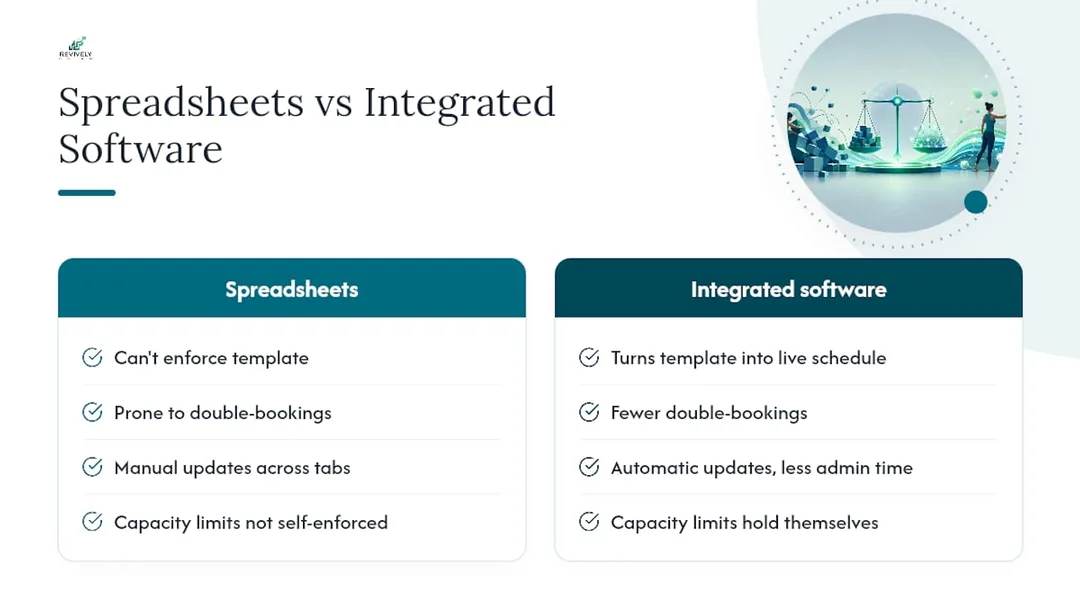
A spreadsheet can hold a template. It can't enforce it. The moment a reformer class overlaps a sauna booking, or a substitute teacher forgets to update three separate tabs, your meticulously planned template stops matching reality. This is where an Australian-made, all-in-one spa booking software like Revively shines.
Revively's multi-resource grids, automatic waitlist promotion, class pack management, digital intake forms, and public display boards close that critical gap by transforming your template into the actual, live schedule - not just a reference document sitting beside it.
And for Australian businesses, the 100% legal Xero integration is a game-changer. It ensures automated two-way mapping of tax codes, revenue accounts, and liabilities directly from your studio bookings. This guarantees your quarterly Business Activity Statements (BAS) are flawless and audit-proof, completely removing manual spreadsheet errors and saving you from compliance headaches.
As Andreea explored in Beyond Spreadsheets, the real gain isn't just aesthetics. It's fewer double-bookings, less admin time chasing changes, capacity limits that hold themselves, and the peace of mind that your financial compliance is rock-solid.
Your Quarterly Timetable Review: Optimise, Don't Just Observe
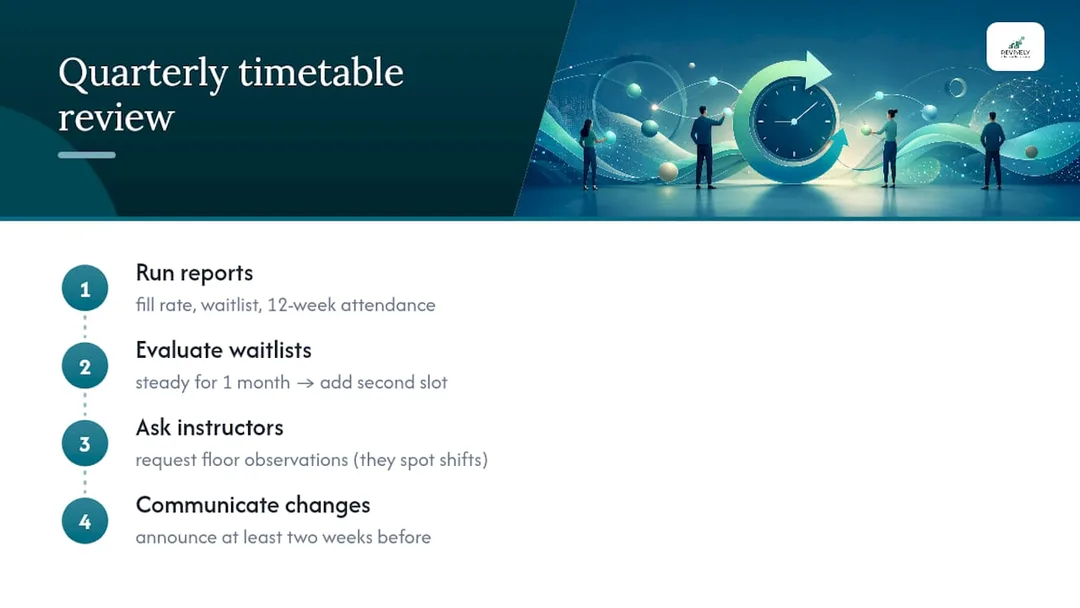
Every quarter, make it non-negotiable to check three key reports within your system:
- Fill rate by slot: Which classes are consistently full, and which are lagging?
- Waitlist size by class: A waitlist that's held steady for a month (not just spiked once) is your clearest signal to add a second slot at that time.
- Attendance trend: Review over the preceding twelve weeks. Are there seasonal dips or surges you can leverage or mitigate?
Communicate any changes early - at least two weeks out. And crucially, don't just rely on data. Ask your instructors directly what they're noticing on the floor. They often spot a demand shift or an operational snag long before it appears on a report.
Putting These Templates into Practice with Revively
Revively transforms every template discussed in this article from a concept into a running schedule you don't have to babysit. Our Australian-made multi-resource studio scheduler natively handles rooms, reformers, and heated studios together. Waitlists promote automatically the instant a spot opens, and class packs or memberships apply their own booking rules without any manual checking from your team. Plus, with Australian data residency and privacy compliance, you can rest assured your clients' sensitive information is handled with the utmost care, fully adhering to the Australian Privacy Principles (APPs).
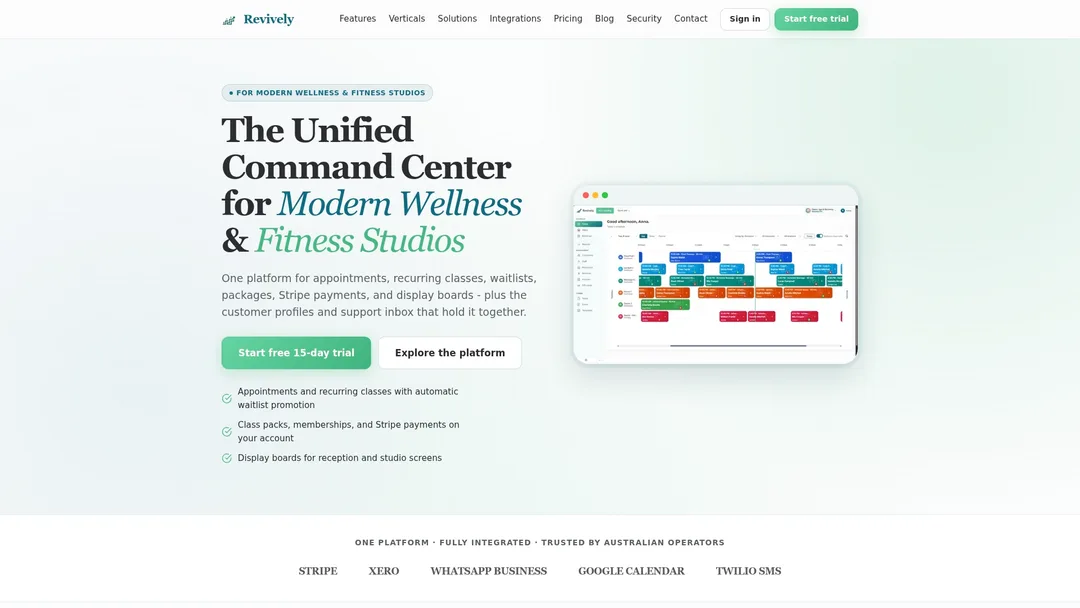
If you're still rebuilding your timetable by hand each week, or constantly searching for Mindbody alternatives Australia that truly understand local compliance, it's time to experience a truly unified cloud command centre. Start with the all-in-one spa booking software built for Australian studios and see how quickly a smart template becomes a self-managing schedule. Pair it with seamless online booking so clients book straight into the rules you've set, and check out our display boards feature if your foyer still relies on a printed sheet.
A free trial gets you far enough to test one full week of your own timetable before you commit to anything. Take control, gain efficiency, and stop the scramble.
Sources
- Studio Class Scheduling Best Practices | Who's In
- Multi-Style and Level Scheduling for Yoga Studios | AMES Resources
- The Harmony of Balance: A Guide to Intelligent Class and Resource Scheduling | AI Shift Planner
Recommended Reading from Revively
Ready to dive deeper into optimising your studio operations? Check out these related articles from Revively:
- No More Double-Bookings: The Australian-Made Multi-Resource Studio Scheduler That Stops Operational Chaos Cold
- The Real Cost of Half-Empty Classes: Why Australian Studios Need to Master Attendance Rates
- Master Your Space: Why Multi-Resource Scheduling is Non-Negotiable for Australian Wellness Studios