
Australian Studios: Fold Card Surcharges Into Prices With Stripe Xero
! Studio manager accepting card payment
From 1 October 2026, businesses cannot apply card payment surcharges on transactions processed through the designated eftpos, Visa and Mastercard networks.
Picture this: you've just wrapped up a bustling Saturday morning at your studio. Clients are energised, equipment is tidied, and you're already fielding calls for next week's bookings. But then, you glance at your payment terminal, or even worse, your accounting software. That familiar pang of dread hits: are you really charging the right card surcharges? Are you even allowed to? And what the heck is changing in 2026 anyway?
For too long, Australian studios have been stuck in a chaotic dance of compliance, trying to decipher payment processing costs and pass them on without copping a fine or annoying a client. Well, the music's about to change. A significant shift is coming to how you can apply card payment surcharges, and if you're not prepared, it could hit your bottom line and your reputation.
This isn't just about avoiding a penalty. It's about leveraging these changes to optimise your pricing, streamline your operations, and build deeper trust with your clients. Let's cut through the noise and get your studio ahead of the curve.

The Clock's Ticking: Why 1 October 2026 is a Game-Changer for Australian Studios
Mark your calendars, because from 1 October 2026, Australian businesses, including every fitness, wellness, and dance studio, will generally no longer be able to apply card payment surcharges on transactions processed through the designated eftpos, Visa, and Mastercard networks. Yes, that means most of those small, friction-inducing fees you currently pass on will be a thing of the past.
Until 30 September 2026, the existing cost-based surcharge limits still apply. This means you must continue to charge within your actual acceptance costs - no more, no less. The RBA (Reserve Bank of Australia) set this policy in motion, and the ACCC (Australian Competition and Consumer Commission) is the force keeping everyone honest.
The upshot? A blanket end to surcharges for the payment types your clients use most. Card schemes have even signalled they'll extend the same treatment to American Express, making this a near-universal shift.
What Every Australian Studio Owner Needs to Know, Fast
Running a studio means juggling a million things. Here's the executive summary of what these changes mean for your daily grind:
- Until 30 September 2026: You must document your actual card acceptance costs for each card type and ensure your surcharges never exceed them. No "flat 2%" if your debit costs are lower.
- From 1 October 2026: Card surcharging will be broadly prohibited across eftpos, Visa, Mastercard, and likely American Express. This isn't a suggestion; it's a rule enforced by the card networks themselves.
- Common Traps: Watch out for applying generic surcharges to all cards, or trying to disguise a banned surcharge as a new "processing fee." Both risk breaches of consumer law.
- Your Payment Providers are Key: Your payment service providers (PSPs) will be updating their merchant agreements and terminal settings to comply. Stay in touch with them.
- Legitimate Fees Remain: You can still charge for genuine add-ons, late cancellations, or unique services - just not disguised card processing costs.
Why the RBA Is Pulling the Pin on Surcharges
Remember when surcharging was meant to encourage cheaper payment methods and help businesses recover genuine costs? Yeah, that narrative got messy. The RBA's conclusions paper highlighted that surcharging had devolved into a source of friction and confusion at the checkout. Think about it: a client's about to sign up for a 10-class pack, then sees an unexpected fee. It kills the vibe.
This isn't just a punitive measure. The RBA is pairing the ban with lower interchange caps and a push for stronger fee transparency from banks. This means your underlying card acceptance costs should actually fall even as your ability to pass them on disappears. It's a rebalancing act, aiming for a simpler, fairer system for everyone.
The enforcement mechanism is critical here. It's not just the government stepping in; it's primarily through the card schemes and your payment service providers (PSPs).
- Card scheme rules will explicitly prohibit surcharging from the effective date.
- Your PSPs and acquirers will adjust merchant agreements and terminal settings accordingly.
- If you keep surcharging post-October 2026, you risk breaching both scheme rules and Australian consumer law. That's a headache no studio owner needs.
Navigating the Now: Your Surcharging Rules Until September 2026
You've got a window. Until the new rules fully land, the ACCC's existing framework still dictates what you can charge. The golden rule: your surcharge must not exceed your actual cost to accept that specific card type. You can't just slap a flat 2% on everything if your debit costs are significantly lower than credit.
To keep your studio compliant in the interim:
- Get Your Data: Request your annual statement from your PSP or acquirer. This should detail the average percentage cost of acceptance for each card scheme (e.g., Visa Debit, Mastercard Credit, eftpos).
- Rate by Card Type: Set your surcharge at or below that percentage, per card type, not as a blended, catch-all rate. This is where most studios trip up.
- Crystal Clear Disclosure: Ensure your surcharge is displayed prominently before payment is taken. No burying it in the fine print.
- Avoid Flat Dollar Surcharges: A flat dollar fee can easily exceed the percentage cap on smaller transactions, making it unlawful.
- Keep Records: Document your calculations. If the ACCC comes knocking, you'll be glad you did.
The biggest pitfall for studio owners? Applying a uniform surcharge without verifying if it aligns with the actual acceptance costs for each network. eftpos, for example, often costs far less to accept than a premium credit card.
Pro Tip: If your current booking software automatically applies one surcharge rate to all cards, dive into those settings now. A rate that was acceptable for credit might be unlawful when applied to eftpos or debit.
What Stays & What Goes: Beyond Card Surcharges
The ban on card surcharges isn't a blanket prohibition on all additional fees. Genuine, transparently disclosed charges are still perfectly acceptable:
- Service fees for add-ons like private one-on-one sessions, equipment hire, or bespoke workshops.
- Delivery or postage charges for any retail products sold through your online store or booking portal.
- Late cancellation or no-show fees, provided they are explicitly outlined in your terms and conditions upfront.
- Booking fees charged directly by a third-party platform (though be wary if these look suspiciously like a re-labelled card surcharge).
Think about hospitality businesses that apply weekend or public holiday surcharges. These are unaffected because they relate to staffing costs on specific days, not the cost of accepting a card. Your studio can also implement similar, clearly defined operational surcharges if justified.
However, a critical warning: you absolutely cannot simply rename your old card surcharge as a "processing fee," "administration fee," or "convenience fee" and keep charging it. The ACCC has flagged this as a high-risk area. Attempting to disguise a banned surcharge can amount to misleading conduct under the Australian Consumer Law, and that's a compliance headache you absolutely want to avoid.
Your Studio's Roadmap: Optimising Pricing and Payments Post-2026
This shift is more than just a regulatory update; it's an opportunity to re-evaluate and optimise your entire pricing and payment strategy. Studios thrive on recurring billing, so getting this right is paramount.
Here's a checklist to guide your transition before 1 October 2026:
- Audit Your Current Costs: Pull your PSP statements now. Reconcile your actual card acceptance costs against your current surcharging practices, particularly how these flow into your Xero accounting.
- Talk to Your PSP: Ask your payment service provider how their annual statements will change to reflect the new rules and any updated cost structures.
- Strategic Pricing Decision: Decide whether to absorb processing costs by slightly increasing your base class pack and membership prices, or explore offering specific surcharge-free payment options (e.g., direct debit for memberships).
- Update All Client-Facing Info: Revamp your online booking portal, in-studio signage, and receipts. The price displayed must be the final price charged, in line with Australian Consumer Law disclosure requirements.
- Automate Reporting: Leverage robust Stripe and Xero integrations to automate transaction-level reporting. Ditch manual spreadsheets for tracking processing costs - it's a recipe for errors and BAS nightmares.
- Communicate Early: Proactively inform your members and staff about the upcoming changes. Transparency builds trust, especially if prices need to adjust slightly to absorb former surcharge costs.
- Test, Test, Test: Once your changes are live, run end-to-end test transactions through every payment method and membership type your booking system supports. Don't overlook recurring membership payments - an incorrect charge here can sour a client relationship quickly.
Pro Tip: Before 1 October 2026, conduct a test transaction for every payment method your booking system supports, including new and existing recurring membership charges. It's easy to miss an edge case until a client's card is billed incorrectly.
Bringing It All Together: Old Rules vs. New Compliance
To help you visualise the operational shift, here's a comparison of pre- and post-October 2026 scenarios for your studio:
| Feature/Action | Current Approach (Pre-Oct 2026) | Compliant Approach (Post-Oct 2026) |
|---|---|---|
| Card Surcharges | Permitted, but capped at actual cost of acceptance per card type. | Generally Prohibited for eftpos, Visa, Mastercard, and likely Amex. Costs must be absorbed into base prices or handled via legitimate service fees. |
| Pricing Strategy | Base price + visible surcharge for card payments. | All-inclusive pricing. Displayed price is the final price. Processing costs are internalised. |
| Client Transparency | Surcharge disclosed at checkout. | Clear, upfront pricing with no hidden surprises. This builds stronger client trust and reduces friction. |
| Financial Reporting | Reconciling surcharge income and card processing expenses in Xero (often manual and complex). | Seamless two-way integration with Xero where processing costs are tracked as business expenses, simplifying BAS preparation and guaranteeing legal tax compliance with 10% GST calculations across all services (casual classes, memberships, multi-resource packages). |
| Data & Privacy | Varied compliance depending on PSP and software location. | Crucial focus on Australian Data Residency. Client data, booking histories, and sensitive health forms must be stored locally, fully complying with Australian Privacy Principles (APPs). |
| System Configuration | Managing different surcharge rates for various card types in booking software. | Deactivating surcharge functionality. Optimising pricing in your CRM/scheduler to reflect absorbed costs. |
| ACCC/RBA Scrutiny | Focus on ensuring surcharges don't exceed actual cost of acceptance. | Focus on preventing disguised surcharges (e.g., renaming a card fee as an "admin fee"). |
The Revively Advantage: Seamless Compliance, Simplified Operations
This transition isn't just about avoiding trouble; it's about making your studio's operations smoother, more transparent, and ultimately, more profitable. This is where a unified cloud command centre like Revively truly shines, especially for Australian studios grappling with the new rules.
Revively isn't just another booking software. It's an Australian-made, all-in-one CRM and multi-resource scheduler designed for wellness and fitness studios (spas, recovery centres, yoga/pilates studios, clinics, and dance schools). Its integrated approach means you're not juggling separate payment gateways, accounting software, and spreadsheets to track processing costs and GST.
Here's how Revively helps your studio handle the pricing shift with confidence:
- Flawless GST & Tax Invoice Handling: Revively natively handles 10% GST calculations across casual classes, memberships, and multi-resource packages. It automatically issues legally compliant Australian Tax Invoices to your clients, every single time. No more manual adjustments or tax headaches.
- 100% Legal Xero Integration for BAS Accuracy: Our deep, two-way integration with Xero is designed for audit-proof BAS statements. Automated mapping of tax codes, revenue accounts, and liabilities ensures your quarterly Business Activity Statements are flawless, removing manual spreadsheet errors that often creep into payment reconciliation. This is crucial for confidently absorbing processing costs into your pricing.
- Australian Data Residency & Privacy: You can rest easy knowing that all your client data, booking histories, and sensitive health intake forms are stored locally in Australia. This ensures full compliance with the strict Australian Privacy Principles (APPs), a non-negotiable for wellness businesses handling personal information.
- Holistic Reporting: Revively's robust reporting gives you crystal-clear visibility into your total payment processing fees across every payment type. This empowers you to set new, all-inclusive prices based on real numbers, not guesswork, ensuring your margins stay healthy after the surcharge ban.
- Optimised Client Journey: By eliminating the visible surcharge, your checkout process becomes frictionless. Revively helps you present a clean, clear price that fosters trust and encourages conversions, making your studio more attractive to potential members.
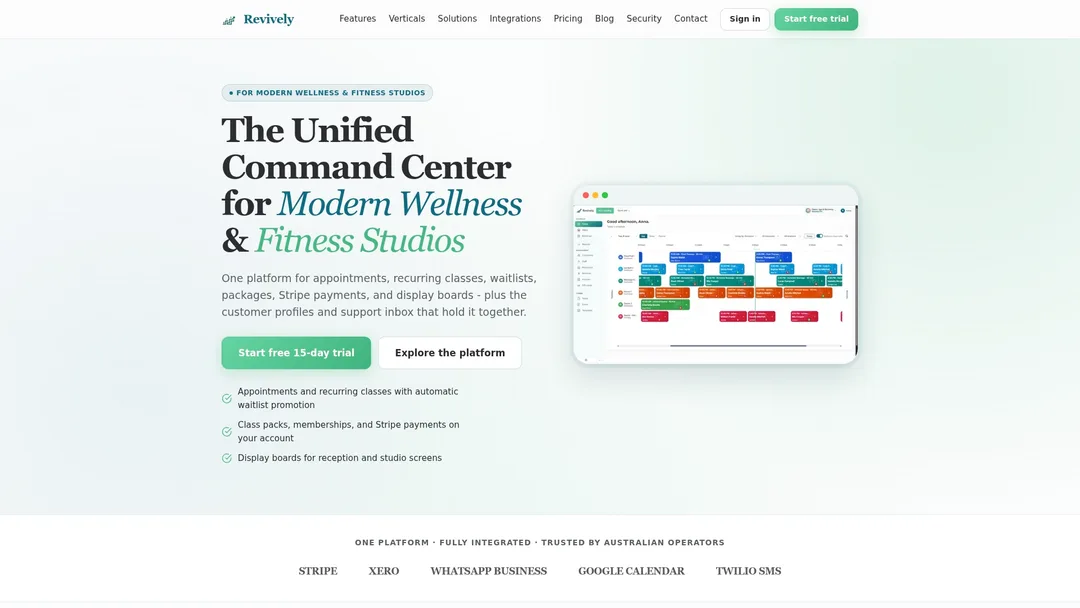
If your current booking portal still displays a separate surcharge line, that's a fix you need to prioritise before the transition. Revively helps you simplify your pricing structure and implement changes swiftly across all your services and packages.
Want to dive deeper into understanding your PSP costs? Consult a resource like Webby's guide to e-commerce gateway fees. Then, explore Revively's online booking and payments features to see how a single dashboard can replace the disconnected tools most studios are currently patching together.
Don't Just Comply, Optimise: A Final Word
The 2026 card surcharge ban isn't a burden; it's a catalyst for operational excellence. It forces Australian studios to embrace transparent, streamlined pricing that clients will appreciate. By taking proactive steps now to understand your costs, adjust your pricing, and leverage integrated solutions like Revively, you won't just comply with the new rules - you'll empower your studio for sustainable growth and a far less chaotic future.
Resources & Further Reading
For detailed information on card surcharging regulations in Australia, refer to these authoritative sources:
- Review of retail payments regulation - conclusions paper (RBA)
- Card surcharges (ACCC)
- Card surcharging ban resources (ASBFEO)
Recommended Articles from Revively
Dive deeper into how Revively can transform your studio's financial and operational health:
- The Australian Studio Owner's Guide to Stripe Fees & GST Compliance
- Ditching Spreadsheet Chaos: Your Australian Studio's Guide to Seamless Stripe Membership Billing
- When Cashflow Can't Wait: A Savvy Studio Owner's Guide to Stripe Instant Payouts in Australia
- Drowning in Spreadsheets? Why Australian Studios Need Xero Integration That Actually Works (2026 Guide)