
$75,000 or $150,000? GST on Australian Studio Memberships
!
You're a studio owner. Your days are a dizzying blur of class bookings, client enquiries, instructor rosters, and making sure the magic happens on the mat, treatment table, or dance floor. The last thing you need is a surprise audit from the ATO because your GST calculations are off. Especially when it comes to memberships - the lifeblood of most thriving Australian wellness and fitness businesses.
The truth is, those regular payments from your dedicated clients aren't just revenue; they're often "taxable supplies" once your studio hits a certain turnover. For most commercial ventures, that critical threshold is $75,000 in GST turnover. If you're a qualifying not-for-profit, it jumps to $150,000. Miss this, and you're not just behind; you're on the hook for back-taxes and penalties.
Let's cut through the noise and get clarity on GST for your Australian studio's memberships. We're talking about the 10% rate that needs to be included, accounted for, and correctly remitted. Ignore the chatter; the ATO and business.gov.au are your ultimate guides.

Table of Contents
- The Hard Truth: Are Your Memberships GST-Taxable?
- Your Studio's GST Trigger Points: $75,000 or $150,000?
- Donations vs. Memberships: What Counts as a Taxable Supply?
- Bundled Memberships: Unpacking the GST Trap
- Pricing, BAS, and GST Credits: Getting it Right
- Your Studio's Proactive GST Compliance Checklist
- Revively: Simplifying GST for Australian Studio Memberships
- Don't Get Caught Out: Common Missteps & Why Early Action Pays Off
- Stop the Spreadsheet Stress: Make BAS Easier with Revively
- Frequently Asked Questions
- Essential Resources
The Hard Truth: Are Your Memberships GST-Taxable?
In almost all scenarios for Australian studios, yes, membership fees attract GST once your business is registered (or required to be registered). Forget the old "mutuality rules" you might have heard about for income tax; GST operates on its own set of principles. It's a 10% tax on most goods and services, and your membership payments are firmly in the "services" category.
Think about it:
- Unlimited class access for a monthly subscription.
- Priority booking and exclusive perks with a rolling Pilates membership.
- Discounted treatments included in a spa recovery centre membership.
Each of these is a payment for a clear right or service provided by your studio. The ATO considers these "supplies," and if you're a registered entity, that 10% GST rate is baked right into the price. Many studio owners, especially those with not-for-profit status, mistakenly believe their memberships are exempt. The ATO is clear: not-for-profit status does not automatically make ordinary memberships GST-free.
Your Studio's GST Trigger Points: $75,000 or $150,000?
This is where the rubber meets the road. Knowing your threshold isn't just important; it's legally binding.
Most commercial studios - your typical yoga, Pilates, dance, or spa centre - must register for GST once your GST turnover hits $75,000.
If you're a qualifying not-for-profit carrying on an enterprise, that threshold doubles to $150,000 or more. Regardless of your status, every dollar from your membership fees counts towards these figures.
It's not just about what you earned last year. The ATO looks forward too. Your projected GST turnover includes your current month's turnover plus the next 11 months. A popular launch promotion, a seasonal rush of new sign-ups, or simply steady growth can push you over that line faster than you anticipate.

Key takeaways for studio owners:
- Mandatory registration: You have 21 days from when you meet the threshold to register. Don't drag your feet.
- Voluntary registration: Below the threshold? You can register voluntarily. This allows you to claim GST credits on business expenses, but then you must charge GST on your services and lodge a BAS.
- NFP status isn't a free pass: Not-for-profits still include membership fees (for goods, services, or rights) when calculating their turnover.
- Growth is a double-edged sword: Rapid success is fantastic, but it's also when studios most commonly miss their GST registration deadline.
Donations vs. Memberships: What Counts as a Taxable Supply?
This is a common grey area. A genuine voluntary donation, where the donor receives absolutely nothing in return, is generally not subject to GST. It's a pure gift.
However, a payment that buys access, rights, services, or even a tangible benefit is a different story entirely. Membership fees and tickets are direct "consideration for a supply," making them taxable if your studio is registered.
Let's look at some studio scenarios:
| Payment Type | Description | GST Treatment (if studio is registered) |
|---|---|---|
| Parent Contribution | A parent adds extra funds to the studio's costume fund, no perks offered. | Likely GST-free (a genuine gift) |
| "Founding Member" Payment | Payment unlocks early class access, priority booking, and discounted rates. | Taxable supply (a membership) |
| Local Business Sponsorship | Sponsor receives visible promotion on the studio's website and social media. | Taxable supply (advertising service) |
| "Pay What You Can" Class Fee | Client chooses to pay a higher amount for a standard class. | Taxable supply (for the service) |
While some GST concessions exist for not-for-profits, they typically apply to specific gifts or particular types of funding. They absolutely do not magically transform your regular membership income into a GST-free supply.
Bundled Memberships: Unpacking the GST Trap
This is where many Australian studios inadvertently slip up. When a single membership fee covers not just classes but also uniforms, merchandise, workshops, or even a course component, you might need to split that price. The ATO's ruling GSTR 2000/30 outlines when you must "disaggregate" or "apportion" the cost into its taxable and GST-free components.
Imagine these common bundles:
- Membership + Studio T-shirt: The t-shirt is a separate supply of goods. You need to price and tag it distinctly from the service component (the membership).
- Dance Membership + Accredited Course: If a portion of the fee relates to an accredited course, that component might be treated differently for GST. This is a complex area; always double-check the ruling or consult your accountant.
- Membership + Workshop Pass: Two distinct supplies. Each should ideally be itemised and taxed on its own line.
Skipping this crucial step can lead to under-reporting GST, which only morphs into a significant liability come BAS time. It's infinitely simpler to configure correct splits in your booking and billing system from day one than to unpick months of improperly attributed receipts.
Pricing, BAS, and GST Credits: Getting it Right
Once your studio is registered, you're officially part of the GST ecosystem. This means you include 10% GST in the price of your taxable supplies (like memberships) and report this to the ATO via your Business Activity Statement (BAS). The ATO provides clear guidance on how registered organisations should price, collect, and remit GST.
The upside? GST credits. You can claim back the GST embedded in your legitimate business expenses, provided you hold a valid Australian Tax Invoice. This includes your studio rent, software subscriptions (like Revively!), equipment purchases, and even marketing services.
Let's simplify the flow:
- A $110 membership fee includes $10 of GST that you'll collect and eventually remit to the ATO.
- That $550 invoice for your studio's premium scheduling software includes $50 GST, which you can claim back as a credit.
- Displaying prices as GST-inclusive simplifies things for your clients and aligns with consumer expectations.
Pro Tip for Australian Studios: Decide early whether your public-facing prices will be GST-inclusive or exclusive. Then, stick to that rule across your entire business: website, booking system, invoices, and any promotional materials. Consistency is key for clarity and compliance.
For a deeper dive into streamlining your financial processes, particularly around membership revenue, explore our comprehensive guide on mastering GST on memberships for BAS.
Your Studio's Proactive GST Compliance Checklist
Staying on top of GST doesn't require a full-time accountant (though a good one is invaluable!). Most of it can be managed with a quick, consistent routine.
- Monthly Turnover Check: On the first business day of each month, calculate your projected GST turnover (this month + next 11 months). This ensures you register within the crucial 21-day window if you cross a threshold.
- Tax Invoice Discipline: Issue legally compliant Australian Tax Invoices when requested (within 28 days). Crucially, meticulously store all supplier tax invoices for your business purchases so you can claim those valuable GST credits.
- Accurate Supply Tagging: If you offer bundled services, ensure your accounting software correctly splits and tags each component. Reconcile your membership receipts against your BAS lines regularly.
- Automate for Accuracy: Implement a robust membership billing and scheduling system (like Revively!) that natively integrates with your accounting software (like Xero). This automates GST tagging, reconciliation, and reduces manual errors, making BAS a breeze.
Compliance Critical: Set a recurring calendar reminder for the first working day of each month for your GST turnover review. This tiny habit can save you significant headaches, penalties, and back-payments down the line.
If you're currently grappling with Stripe and spreadsheet chaos, our guide to seamless Stripe membership billing offers practical steps to cut the administrative burden.
Revively: Simplifying GST for Australian Studio Memberships
As an Australian-made, unified cloud command centre (CRM + multi-resource scheduler), Revively was purpose-built to navigate the unique operational and compliance landscape facing local wellness and fitness studios. This includes taking the stress out of GST reconciliation.
Here's how Revively strengthens your GST compliance:
- Integrated Billing: We support robust Stripe-powered memberships and recurring billing. This means payments are processed securely and consistently, ready for accurate GST calculation.
- Native Xero Integration for BAS Accuracy: Our two-way integration with Xero isn't just a basic sync. It automates the mapping of tax codes, revenue accounts, and liabilities directly from Revively to Xero. This virtually eliminates manual spreadsheet errors, ensuring your quarterly Business Activity Statements (BAS) are flawless, audit-proof, and always reflect 100% legal tax compliance.
- Australian Data Residency & Privacy: Crucially, all your sensitive client data, booking histories, and health intake forms are stored locally in Australia. This ensures full compliance with the Australian Privacy Principles (APPs), giving you and your clients peace of mind.
- Automated Tax Invoicing: Revively natively handles 10% GST calculations across casual classes, memberships, and multi-resource packages. It automatically generates and issues legally compliant Australian Tax Invoices to your clients, saving you time and ensuring legal adherence.
You can dive deeper into how our system works on our memberships features page. We also unpack the specifics of whether GST applies to yoga, Pilates and wellness studios in more detail.
Don't Get Caught Out: Common Missteps & Why Early Action Pays Off
The most frequent missteps we observe among Australian studio owners usually boil down to two core issues: missing projected turnover changes and insufficient record-keeping. Many studios focus solely on historical income, forgetting that the ATO's trigger point looks forward. Small, dynamic teams and volunteer committees feel this pressure most acutely, as administrative burdens often fall to whoever has a spare moment.
The Solution: Implement those monthly turnover checks we talked about. And critically, empower your operations with software that handles the intricate GST tagging and reconciliation for you. If your studio has a particularly complex structure, perhaps with unusual bundled courses or a mixed not-for-profit enterprise model, engage with a qualified Australian accountant before any deadlines loom. Proactive engagement saves stress, money, and reputation.
"Battling spreadsheets and chasing down tax invoices shouldn't be part of your studio's unique client experience. Get the fundamentals right, and let your software do the heavy lifting. Your peace of mind (and your accountant) will thank you for it."
- The Revively Team*
Stop the Spreadsheet Stress: Make BAS Easier with Revively
Billing memberships and ensuring GST compliance shouldn't consume your precious time or mental energy. Revively's robust membership billing runs seamlessly on Stripe and integrates natively with Xero, taking real friction out of preparing your Business Activity Statement.
Imagine reclaiming hours each month - hours you could spend enhancing client experiences, developing new programs, or simply enjoying the fruits of your passion. That's the Revively difference for Australian studios. We're a powerful Mindbody alternative for Australia, designed to be your unified cloud command centre, simplifying multi-resource studio scheduling and acting as your all-in-one spa booking software. We are the GST compliant studio software you've been looking for.
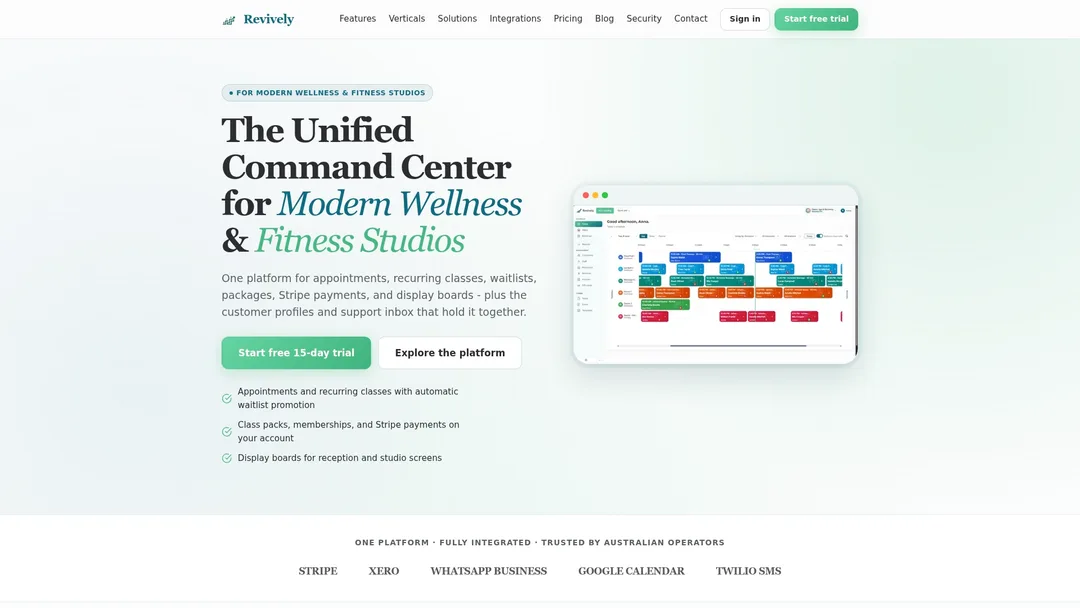
Explore our intuitive membership and class pack software, then review our transparent pricing to find the perfect plan for your unique studio.
Frequently Asked Questions
Is GST applicable on membership fees in Australia?
Yes, if your studio is registered, or legally required to be registered, for GST, then membership fees are considered taxable supplies. The ATO states that payments for membership rights or access to services are "consideration for a supply," meaning GST at 10% applies.
Should my Australian studio register for GST if revenue is under $75,000?
Registration isn't compulsory below the $75,000 (or $150,000 for qualifying NFPs) threshold, but you can choose to register voluntarily. Doing so allows you to claim GST credits on business purchases, but then you must also charge GST on your services and diligently lodge a BAS. Always assess your projected turnover first, as rapid growth can quickly trigger mandatory registration.
Do genuine donations attract GST in Australia?
Generally, no. A genuine voluntary donation, where the donor receives no goods, services, or rights in return, is typically not subject to GST. However, if any benefit, access, or service is provided to the payer, the payment is likely a taxable supply, not a donation.
How much is GST in Australia in 2026 for studios?
The current GST rate in Australia is 10%. Registered studios must include this 10% GST in the price of their taxable supplies and remit it to the ATO through their BAS. There are no announced changes to the GST rate for 2026.
Essential Resources
Need more clarity on navigating GST and BAS for your Australian studio? These resources will help:
- BAS Panic? Master GST on Memberships (and Nail Your BAS) for Australian Studios
- Stop the BAS Panic: Master Class Pack Revenue & GST for Your Australian Studio
- The Australian Studio Owner's Guide to Stripe Fees & GST Compliance
- Pricing Yoga Classes in Australia: Master Memberships, Payments & BAS Compliance