
How to Share Class Packs Across Studio Locations
! Dance studio owner writing shared pack rules
You can share class packs across locations by making the pack a business-level product, not a location-level one.
Every studio owner knows the feeling: that delicate ballet of balancing client needs, staff logistics, and financial realities. Now, multiply that by two, three, or even five locations. Suddenly, a simple class pack becomes a multi-site headache. Clients buy a 10-pack at your city centre studio, then show up at your beachside retreat expecting it to work - only to find a blank stare from your receptionist, or worse, a confused system. Cue the frantic calls, the manual overrides, and the creeping dread of reconciliation at the end of the month.
It doesn't have to be this way. Imagine offering your clients the ultimate flexibility: a single class pack that works seamlessly across all your locations, letting them flow between studios as effortlessly as their busy lives demand.
The secret? Shifting your perspective from individual studio products to a unified, business-level offering. Sell it once, decide which locations accept it, and let one credit balance follow your client wherever they choose to sweat, stretch, or recover. Your software should handle the intricate tracking; your job is to define the rules first.

This guide isn't just about settings; it's about mastering the strategy. We'll walk through deciding those crucial rules, the essential setup steps, how to communicate it clearly to your clients, and the vital reports that keep your books honest and your Business Activity Statements (BAS) audit-proof.
Table of Contents
- [Why Unifying Your Class Packs Isn't Just "Worth It" - It's Essential](#why-unifying-your-class-packs-isnt-just-worth-it - its-essential)
- Before You Click a Single Setting: Define Your Shared Pack Rules
- Which Locations Are In?
- What Classes and Services Does It Cover?
- How Long Do Credits Last?
- Who Can Use the Pack?
- Setting Up Your Unified Class Pack: A Step-by-Step Approach
- How Credits and Bookings Flow Across Multiple Sites
- Pre-Launch Checklist: What to Double-Check Before Go-Live
- No Surprises: Clear Communication for Your Clients
- Reporting for Sanity: Reconciling Pack Use and Revenue by Location
- Our Revively Perspective: Built for Australian Studio Reality
- Power Your Multi-Site Operations with Revively
- FAQ
- Sources
- Recommended
Why Unifying Your Class Packs Isn't Just "Worth It" - It's Essential
In our experience working with Australian wellness and fitness studios, the lines between "home studio" and "work studio" are blurring. Your clients don't think in locations; they think in opportunities. They might live near your yoga centre but work next to your Pilates studio, or visit family near your recovery spa. A class pack that only works where they bought it? That feels like a trap. The unused credits and ensuing frustration are a fast track to losing a client to a competitor offering more flexibility.
The payoff for you? Significant. A quiet Tuesday morning session at your secondary studio can suddenly fill with pack holders from your busiest location. This means a more even spread of class utilisation, maximised resource allocation, and a stronger incentive for clients to stay loyal to your brand, rather than drifting to the nearest alternative that offers less friction.
Sure, there's an operational risk. Without clear rules and robust reporting, you could end up with one studio handling a disproportionate share of redemptions while another holds the initial revenue. This isn't just messy; it's a reporting problem that can throw your quarterly BAS completely off balance. The good news? It's entirely solvable with the right system and foresight.
Before You Click a Single Setting: Define Your Shared Pack Rules
Before you even think about touching your software settings, grab a pen and paper. Seriously. Map out the answers to these critical questions. These rules will become your team's playbook for every client conversation, ensuring consistency and preventing confusion.
Which Locations Are In?
Not every pack needs to be a free-for-all. Some studios strategically exclude a premium location from a standard pack due to higher operational costs, unique facilities, or specialist instructors. Reputable software, much like Pabau's package documentation outlines, should allow you to select the locations where a package is sold and can allow redemption at any of those locations. Plan to separate "where it's sold" from "where it's used" in your strategy. This flexibility is key to maintaining different value propositions across your centres.
What Classes and Services Does It Cover?
This is where you specify the scope. For a bustling yoga or Pilates studio, this often means choosing between:
- Any group class across all participating locations. Ideal for broad accessibility.
- A specific class type only, such as Reformer Pilates, due to limited equipment or higher cost.
- Excluding specific sessions like private one-on-one sessions or specialised workshops, which often require separate pricing.
Spa and treatment businesses face similar decisions. A pack for general massage sessions might work across all sites, but a pack including a specific sauna or cryotherapy chamber will require those particular resources to be bookable and available at each redemption location.
How Long Do Credits Last?
Pack validity becomes even more critical when clients have multiple places to use their credits. They might buy a larger pack because of the increased flexibility. As the same Pabau page confirms, a validity period can be set on a package. The golden rule here: pick one expiry period and stick to it across all locations. Don't let your inner-city studio offer a three-month validity while your suburban branch offers six. Consistency is paramount to client trust and operational simplicity.
Who Can Use the Pack?
Keep it simple. Our recommendation: one pack, one client. Unless you have a very clear, pre-defined reason for allowing gifting or family sharing, avoid the additional administrative complexity. Whatever you decide, make sure it's clearly communicated upfront in your terms and conditions.
Setting Up Your Unified Class Pack: A Step-by-Step Approach
While the exact click path varies slightly between booking software, the core sequence remains consistent. This is how you'll build your multi-location friendly pack.
- Craft the Pack as a Business-Wide Product: Name it clearly (e.g., "All-Access 10-Class Pack"), assign a credit count, set your pricing, and define its expiry period. Remember, this isn't tied to a single location yet.
- Pinpoint Participating Locations: Select precisely where this pack can be purchased and, crucially, where its credits can be redeemed.
- Link to the Right Classes: Instead of attaching it to individual sessions, connect it to class types or categories. This ensures that new timetable entries are automatically covered without manual updates.
- Define Cancellation & Late-Cancel Behaviour: Decide whether a late cancellation results in forfeiture of the credit. Apply this rule universally. No surprises for clients who book at one site and cancel at another.
- Rigorous Testing with a Dummy Client: This step is non-negotiable. Create a test client, purchase the pack, book a class at Location A, then another at Location B, and finally, cancel one of those bookings. Verify the credit balance after each action. This sanity check catches most issues before launch.
- Publish and Promote: Make it live on your client booking portal. Ensure the description explicitly lists all participating locations and any specific exclusions.
Avoid the temptation to create duplicate packs for each individual location. This fractured approach leads to reporting nightmares, mismatched balances, and a flurry of client confusion. A single, unified pack is the cleaner, more efficient path.
How Credits and Bookings Flow Across Multiple Sites
The bedrock of a successful multi-location class pack system is a single client profile tied to a single, unified credit balance. When a client books any class at any of your participating locations, a credit is deducted from that same balance. The system then records the specific location, class type, and time of redemption. Critically, your staff at every single site should see the exact same remaining credit balance for that client.
To ensure this seamless flow, verify these three pillars with your chosen software:
- One Profile Per Client: Duplicate client profiles are the most common culprit when a client's credit balance appears to "vanish" at a secondary location. Prioritise merging any duplicates before you roll out shared packs.
- Deduction at Booking, Not Just Attendance: Most sophisticated class pack software for Australian studios will deduct a credit the moment a class is booked, automatically refunding it upon a timely cancellation. Choose one approach and maintain absolute consistency across all sites.
- Waitlists Respect Credits: If a client is promoted from a waitlist into a class, ensure the credit is deducted immediately upon that promotion. Double-check that this logic aligns perfectly with your pack rules to avoid oversights.
For a deeper dive into credit logic, check out our guide on class pack software for Australian studios. If you're grappling with booking conflicts, our piece on eliminating double bookings across sites offers further insights into keeping your scheduling harmonious.
Pre-Launch Checklist: What to Double-Check Before Go-Live
Before you throw open the doors to multi-site pack redemptions, gather your managers. This checklist helps you iron out potential wrinkles that could lead to operational friction or financial imbalances.
| Check | Why it matters |
|---|---|
| Capacity at Receiving Location | If classes are typically small, a sudden influx of pack holders from another site could overwhelm local clients or staffing. |
| Equipment & Room Availability | Specific resources like Reformers, sauna facilities, or dedicated treatment rooms are limited. Ensure your pack only grants access to what each site can genuinely supply and book. |
| Teacher Pay Structures | Clarify if teachers are paid per class or per head. Remember, pack credits have no immediate cash value at the door, so ensure your payroll model accounts for these redemptions fairly. |
| Pricing Per Credit Discrepancies | If your studios have different drop-in rates (e.g., inner-city vs. suburban), a single pack price means one site might effectively "subsidise" redemptions at the dearer location. Plan to monitor this closely. |
| Consistent Cancellation Rules | A client cancelling at a different location shouldn't face a different policy. Maintain a unified, published cancellation policy for shared packs across all branches. |
| Pack vs. Membership Cannibalisation | Overly cheap packs can divert clients away from your recurring membership plans. Ensure your pricing strategy maintains a clear value hierarchy. See our insights on whether class packs undermine memberships. |
That pricing point deserves a second thought. If your city studio typically charges more per class than your suburban centre, consider setting your shared pack price based on an average. Then, meticulously track the redemption split for the first few months. If the numbers consistently drift, you might need to adjust the pack pricing or, if necessary, exclude the higher-cost location from that particular shared pack.
No Surprises: Clear Communication for Your Clients
A shared pack, no matter how perfectly set up in your system, only truly works if your clients understand its rules. Over-communicate, concisely. Ensure the same short, punchy summary appears in at least four key places:
- The pack description on your client booking portal.
- The confirmation email sent after purchase.
- Your studio website's FAQ section.
- The front desk script for your team.
Make sure these communications cover:
- Where it works: List each participating location by its specific name.
- What it covers: Clearly state which classes/services are included and, just as importantly, which are excluded.
- The expiry date: Confirm how long it lasts and if extensions are possible under specific circumstances.
- Cancellation policy: Explain what happens to credits for both timely cancellations and no-shows.
If each of your locations has its own webpage (which it should for robust multi-location local SEO), ensure that shared packs are clearly listed and linked between them. This strategy, as detailed in guides on multi-location local SEO, is crucial for clients finding the correct address, timetable, and understanding their options.
Reporting for Sanity: Reconciling Pack Use and Revenue by Location
Here's the million-dollar question every multi-site owner asks within the first month: where did the revenue actually land? A client buys a pack at Location A, then burns most of the credits at Location B. Without robust reporting, tracking revenue attribution and ensuring your financials reflect reality is a nightmare. This is especially critical for flawless GST and tax invoice handling and ensuring your Xero integration for BAS accuracy is 100% legal.
You need reports that provide clarity without resorting to messy spreadsheets and manual calculations. Here are the essential reports to set up:
- Packs Sold by Location: This shows precisely where the initial revenue (the cash receipt) for each pack originated.
- Credits Redeemed by Location: This report details where and when the services were actually delivered. This is vital for allocating revenue internally and for understanding operational load.
- Outstanding Credits: Gives you the total value of unused credits across all active packs. This figure is crucial for end-of-month and end-of-year financial reviews, especially for accurately tracking liabilities.
- Expiring Credits: A proactive list that allows you to contact clients before their credits lapse, offering extensions or encouraging bookings, which is great for client retention.
- Pack versus Membership Attendance: This report helps you gauge whether your shared packs are successfully bringing in new clients or potentially drawing existing members away from recurring revenue plans.
Australian Compliance Mandate: Your chosen software must natively handle 10% GST calculations on all casual classes, memberships, and multi-resource packages. When a pack is sold, it should automatically generate a legally compliant Australian Tax Invoice for the client. For your end-of-quarter Business Activity Statements (BAS), a 100% legal Xero integration is non-negotiable. This means automated two-way mapping of tax codes, revenue accounts, and liabilities directly from your studio software to Xero. This ensures your BAS is flawless, audit-proof, and eliminates the manual spreadsheet errors that often plague multi-site operations. Talk to your accountant before you launch, not at tax time!
If your "Packs Sold" and "Credits Redeemed" reports show a significant imbalance for one site, you have the data to make informed decisions - whether that's adjusting pack pricing, internally allocating revenue, or even re-evaluating which locations participate in certain packs.
Our Revively Perspective: Built for Australian Studio Reality
At Revively, we're purpose-built for Australian spas, yoga, Pilates, clinics, and dance studios. We intimately understand the unique challenges of managing multiple locations, especially when it comes to client data, finances, and compliance. Our philosophy is simple: your client should experience one unified business, and you should manage every single site from one intuitive dashboard.
This is precisely why Revively unifies class packs, rolling memberships, multi-resource scheduling, payments, and comprehensive reporting onto a single platform. A pack system that's detached from your timetable invites mismatched balances and client frustration. A pack system disconnected from your accounting leads to monthly guesswork and BAS anxieties. By integrating Stripe payments, ensuring robust Xero reconciliation for GST, and consolidating all your reports in one place, we eliminate those gaps and give you complete financial clarity.
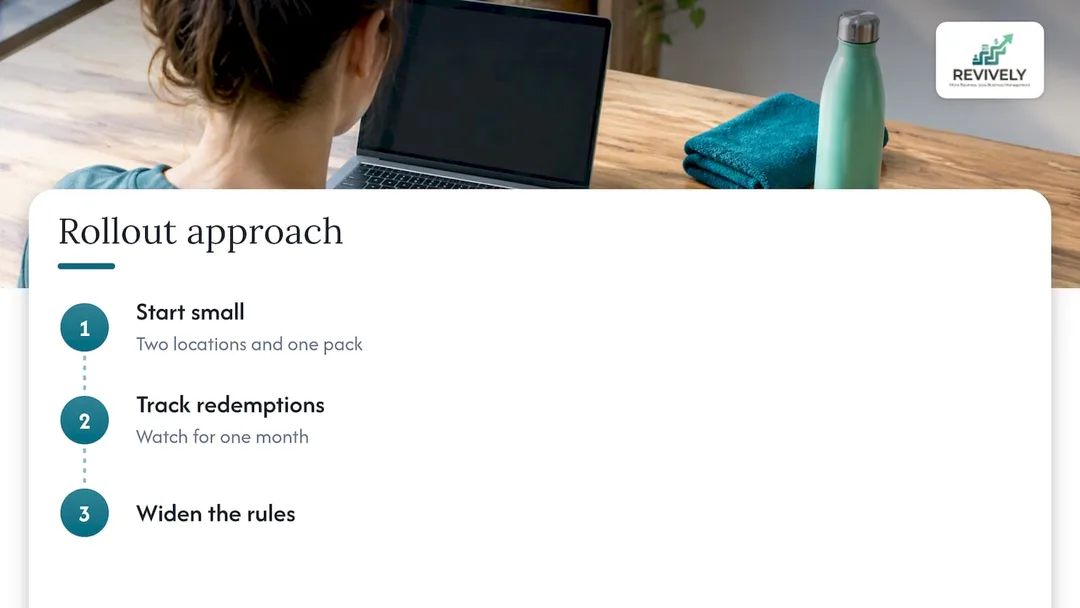
Our advice? Start smart. Launch with two locations and one well-defined shared pack. Track redemptions for a month. Observe, learn, and then gradually expand your rules and offerings. Studios that jump straight to five pack types across three sites often spend their first quarter untangling a self-imposed web of complexity. - Andreea, Head of Product, Revively
Power Your Multi-Site Operations with Revively
Revively provides a unified cloud command centre (CRM + multi-resource scheduler) designed to simplify your operations. Our platform supports class packs, rolling memberships, group class waitlists, and comprehensive multi-location management from a single, intuitive dashboard. With seamless Stripe payments and robust Xero integration, you're equipped for growth.
Crucially, with Revively, all your client data, booking histories, and sensitive health intake forms are stored locally in Australia, fully complying with the Australian Privacy Principles (APPs). This means your client's information stays secure and within Australian borders, building trust and ensuring legal compliance.
Explore how our sophisticated membership and class pack software works, or compare plans directly on our pricing page. Our plans are transparently published, starting at just 39 AUD per month for Solo, 99 AUD per month for Growth, and 199 AUD per month for Pro. Additional locations can be added for just 79 AUD per month. Pair it with our class scheduling software to ensure every timetable across every studio remains perfectly in sync.
FAQ
Can a class pack be limited to certain locations?
Absolutely. World-class software, like Revively and as referenced in Pabau's documentation, allows you to precisely choose where a pack can be purchased and, separately, where its credits can be redeemed. For example, you can use this feature to exclude premium sites or those with limited equipment from standard packs, maintaining differentiated offerings across your studios. Pabau's documentation, for instance, describes selecting locations and enabling redemption at any selected location.
Should every location use the same pack price?
Only if your per-class pricing is consistent across all your centres. If one studio charges noticeably more per class (e.g., due to overheads or specialist instructors), a single, flat pack price means the more expensive site will generate less revenue per pack credit redeemed there. Monitor redemption patterns by location for a month or two, and be prepared to adjust the pack's overall price or, if necessary, exclude the dearer location from that specific pack.
What happens to credits if a client cancels at a different location?
The cancellation rule for shared packs must be uniform across all your locations. Whether it's a timely cancellation that returns the credit to the shared balance, or a late cancellation that forfeits the credit, the policy should be identical everywhere. Ensure this clear rule is published prominently in the pack description and your terms and conditions so clients understand it before they buy.
Do shared packs hurt memberships?
They certainly can, if your shared packs are priced too closely to your recurring membership rates. The key is strategic pricing: ensure the effective per-class price of a pack remains higher than what a regular, committed member pays. Regularly review the attendance mix of pack holders versus members each quarter to ensure your packs are complementing, rather than undermining, your recurring revenue streams.