
Automated Class Cancellation Policy for Studios, Enforced by Software
! Studio owner configuring cancellation software
A correct cancellation policy treats three events differently: an early cancel with no penalty, a late cancel that forfeits a credit or triggers a fee, and a no-show that costs the most.
Your reformer Pilates instructor just showed up to a half-empty class. Another yoga session had 5 late cancellations, yet your waitlist was packed. Sound familiar? The ripple effect of client no-shows and last-minute bails isn't just frustrating; it's a silent killer of revenue, staff morale, and your carefully planned schedule.
It's time to put an end to the chaos. Implementing an automated, clearly defined class cancellation policy isn't about penalising clients; it's about respecting your instructors' time, protecting your precious capacity, and optimising your studio's profitability. Done right, with the right booking software, it transforms the conversation from awkward confrontations to seamless, predictable operations.

A well-crafted policy differentiates between an early cancellation (no fuss), a late cancellation (a credit forfeited or a small fee), and a no-show (the biggest hit). The secret? Make those rules crystal clear from booking to reminder, and let your software do the heavy lifting of enforcement, complete with an audit trail. Get that trinity dialled in, and watch disputes fade, fees feel fair, and your class fill rates stabilise.
Why This Matters to Your Bottom Line:
- Tailored Rules: Configure specific cancellation cutoffs based on class size, type, or even instructor, giving smaller, high-value sessions longer windows (e.g., 24-48 hours).
- Purposeful Fees: Use fees (typically $10-$25) to protect capacity, not just punish. Higher fees for premium classes or private sessions discourage last-minute drops.
- Crystal Clear Communication: Ensure cancellation rules are visible at every touchpoint - booking, confirmation, and reminders - drastically reducing "I didn't know" disputes.
- Automated Muscle: Leverage booking software for real-time fee enforcement, waitlist auto-promotion, and secure card-on-file storage. This eliminates manual errors and saves your team hours.
- Smart Rollout: Pilot your new policy for 30-60 days, track metrics weekly, and refine as needed before full implementation. It's about data, not gut feelings.
Table of Contents
- What should a class cancellation policy actually say?
- How do I set this up correctly in my booking software?
- What fee amount actually changes behaviour?
- Where should clients actually see the cancellation rule?
- How do I handle exceptions and disputed charges fairly?
- Which metrics tell me the policy is working?
- Rolling out the policy without a fight
- Setting up automated enforcement without the manual chasing
- Sources
- FAQ
Crafting Your Studio's Cancellation Policy: What Needs to Be Said?
Let's be blunt: most cancellation kerfuffles start because the studio never actually defined "late." A clear policy that separates early cancels, late cancels, and no-shows provides a concrete, checkable standard for both your team and your clients. This eliminates those awkward, subjective calls at the front desk and puts everyone on the same page.
Here's a practical, plain-english framework you can adapt for everything from group classes to workshops and private sessions:
- Group Classes (e.g., Yoga Flow, Barre): "Cancel more than 12 hours before class, and your credit or booking is fully refunded. Cancel within 12 hours, and the credit is forfeited, or a $10 late-cancel fee applies. No-shows lose the credit and incur a $15 fee."
- Premium or Small-Group Sessions (e.g., Pilates Reformer, small dance cohorts): "Cancel earlier than your specified cutoff time (e.g., 24-48 hours), and there's no penalty. Cancel inside that window, and the credit is forfeited. No-show, and you forfeit the credit plus an additional fee, reflecting the smaller class size and higher per-head operational cost."
- Private Sessions and 1:1 Treatments: "Cancel earlier than your specified cutoff time, and there's no penalty. Cancel inside that window, and the full session fee may apply, as the instructor's dedicated time often cannot be rebooked or resold on short notice."
The ideal cutoff time should directly reflect how difficult that particular spot is to refill. A 20-person group yoga class can often absorb a 12-hour window because a waitlist is usually ready to jump in. In contrast, a four-person reformer class or a solo dance rehearsal slot demands a longer 24 to 48-hour window - there's often no one waiting to fill that specific, high-value spot. Keep your fee language straightforward. "Late cancellations forfeit the class credit" is far more effective and digestible than dense, legalistic jargon, and it's precisely what your client will see at checkout.
Implementing Your Policy: Software Settings That Save Sanity
A beautifully written policy is just words on a page if your multi-resource studio scheduling software doesn't enforce it consistently, every single time. This means actively configuring specific settings, not relying on staff memory or last-minute judgment calls.
- Tailor Cutoffs by Service Type: Class packs, unlimited memberships, and private sessions rarely need the same cancellation window. Map each service to its own specific rule rather than attempting a one-size-fits-all approach across your entire studio.
- Enable Secure Card-on-File: Without a stored card, a late-cancel fee becomes little more than a polite suggestion on a client's file that no one ever actually collects. Ensure your all-in-one spa booking software securely captures and stores card details, ideally with Australian data residency for privacy compliance, before a chargeable booking.
- Separate Late-Cancel & No-Show Reporting: These are distinct behaviours with different operational impacts. Lumping them together in reports obscures crucial insights into which one is genuinely costing you class spots and revenue.
- Automate Fee Charges & Credit Forfeiture: Manual enforcement is the breeding ground for inconsistency, and inconsistency is the root cause of client complaints and friction. Let the software handle it.
- Activate Waitlist Auto-Promotion: The instant a spot opens up, the next person on your waitlist should receive an automatic offer, not be left waiting for staff to notice the vacancy. This is critical for optimising your fill rates.
- Mandate Booking Acknowledgement: A simple tick-box or confirmation step at checkout, clearly stating the cancellation terms, pre-empts the vast majority of "I didn't know" disputes.
Before pushing go, run through an admin checklist: Confirm every service type has its correct cutoff. Test that card capture actually fires for chargeable bookings. Verify waitlist notifications send correctly. Crucially, decide which staff roles can waive a fee within the system without requiring manager approval.
Pro Tip: Empower your front-desk team with a one-click waiver button directly within your booking system, rather than a clunky manual refund process. It keeps the exception logged, tracks who waived what, and prevents "just this once" from becoming an untracked, costly habit.
When evaluating Mindbody alternatives Australia or any new booking platform, always check vendor documentation. Does it support different late-cancel windows per service? Can it forfeit a credit instead of charging a card? Does the waitlist auto-offer spots without manual intervention? These features are non-negotiable for a truly automated system.
Manual vs. Automated Cancellation Enforcement: A Reality Check
| Feature | Manual Enforcement (Old School) | Automated Enforcement (Revively Way) |
|---|---|---|
| Policy Visibility | Buried in T&Cs, verbally explained (inconsistently) | Displayed at booking, confirmation, reminders, checkout acknowledgment |
| Fee Collection | Staff chase clients, manual invoicing, prone to errors | Automatic card charge / credit forfeiture, audit-logged |
| Waitlist Management | Staff manually call/text, leads to missed opportunities | Instant auto-promotion, fills spots immediately |
| Dispute Resolution | Subjective, "he-said-she-said," inconsistent outcomes | Based on clear, logged audit trails and documented exceptions |
| Staff Time | Significant time spent on admin, chasing, disputes | Time freed up for client engagement, sales, and studio experience |
| Reporting | Hard to separate late cancels/no-shows, inaccurate | Granular, real-time data on no-shows, late cancels, recovered revenue |
| Compliance (GST) | Manual GST calculations, risk of non-compliant invoices | Automatic 10% GST calculation, legally compliant Australian Tax Invoices |
What Fee Amount Actually Changes Client Behaviour?
Frame your fees as protecting class capacity and instructor time, not as a punishment. This shifts the narrative and makes them far more palatable. Typically, flat fee bands for an Aussie studio booking system sit around $10 to $25, depending on class type and demand (source). Standard group classes land at the lower end, while premium or small-cohort sessions justify a higher fee.
- Standard Group Classes: Consider a $10-$15 late-cancel fee, with credit forfeiture for outright no-shows.
- Premium Sessions (e.g., Reformer, Small Dance Groups): A $15-$20 fee is justifiable, given the much smaller headcount per lost spot and higher operational cost.
- Private Bookings: Often, the full session value is applied, as there's no waitlist to absorb the loss and instructor time is directly impacted.
When a client has an existing class pack or membership, credit forfeiture is usually the smoothest approach. Reserve direct card charges for casual drop-ins or no-shows where there's no existing credit to claim.
Always pilot any new fee level for 30 to 60 days. Monitor your no-show rate and fill rate weekly. Adjust the window or fee amount only after this pilot period closes, rather than reacting to a single bad week. Data-driven decisions prevent overreactions.
Maximising Visibility: Where Should Clients See the Cancellation Rule?
A policy buried in a terms-and-conditions page that nobody ever reads isn't a policy; it's a liability shield. For genuine impact, it needs to be prominent everywhere a booking decision is made.
- Booking Widget: A concise banner like "12-hour cancellation window applies to this class."
- Checkout Acknowledgement: A simple tick box reading, "I understand that late cancellations forfeit my credit or incur a fee."
- Confirmation Email: A one-line reminder of the cutoff time, stated as a specific time and date, not just "12 hours before."
- Reminder Texts or Emails: "Can't make it? Cancel by 6:00pm today to avoid a fee."
- Waitlist Notifications: When a spot is offered, confirm the booking and immediately restate the same cutoff that applies to any confirmed booking.
- Receipts and Account History: Clearly label any charge as "late cancellation fee" rather than a generic line item. Transparency builds trust.
Pro Tip: A well-timed, empathetic reminder often does more to cut no-shows than simply raising the fee. Clients genuinely forget more often than they deliberately skip. Make it easy for them to do the right thing.
Making the policy highly visible and simple to act on before the cutoff does far more to reduce fee generation than making the penalty harsher.
Fair Play: Handling Exceptions and Disputed Charges
Even the most robust policy needs a clear, documented exceptions list. Without one, staff end up making inconsistent, subjective calls under pressure, which erodes trust and fairness.
- Define Accepted Exceptions in Writing: Outline specific scenarios like medical emergencies (with evidence), instructor-cancelled classes, or confirmed technical failures within the booking system. Crucially, ensure staff log the reason and any supporting notes directly onto the client's file.
- Equip Staff with a Script: Train your team on a clear communication process: acknowledge the client's request, ask for the specific circumstance, and then check whether it matches a documented exception before offering a waiver. This keeps the conversation calm, consistent, and avoids case-by-case negotiations.
- Implement a 3-Step Escalation for Disputes:
- Step 1: Front-desk staff review the booking record, the policy, and the client's stated reason.
- Step 2: If unresolved, a manager checks the studio's official exception list and the system's audit log.
- Step 3: If still contested, the manager makes a final, documented decision, ensuring it's logged for future reference and consistency.
Proving Its Worth: Which Metrics Confirm Your Policy is Working?
Don't just set it and forget it. Track your no-show rate, late-cancel rate, recovered fee revenue, fill-rate changes, and - yes - repeat offenders, separately. Each metric points to a different potential fix. A 30 to 60-day pilot, with weekly monitoring before strict enforcement, gives you a clean, data-backed read on whether the policy is actually changing behaviour or just generating complaints.
- No-Show Rate is Climbing: Tighten up your reminder cadence and messaging before touching the fee amount.
- Late-Cancel Rate is High, but Fill-Rate is Stable: Your waitlist is successfully absorbing the loss. The fee might be doing its job without needing adjustment.
- Recovered Fee Revenue is High with Rising Complaints: This suggests your cancellation window might be too tight for that specific class type or price point.
- The Same Names Keep Appearing as Repeat Offenders: This isn't a policy problem; it's a relationship one. Move to a documented, one-on-one conversation, not a studio-wide policy change.
Rolling Out Your Policy Without a Fight
Nobody likes surprises, especially when money's involved. Sequence your rollout strategically:
- Define the Rule: Get it in writing, clear and concise.
- Configure the Software: Ensure your wellness studio management software Australia is perfectly set up for automated enforcement.
- Soft Launch with Grace Period: Announce the new policy widely. For the first few weeks, send courtesy warnings instead of immediate charges, allowing clients to adapt.
- Measure and Adjust: Monitor metrics for 30 to 60 days.
- Enforce Fully: After the pilot, apply the policy consistently.
Train staff thoroughly on the escalation script and three core communication templates: the checkout acknowledgement, the reminder text, and the waiver response. Reserve discretion for genuine, one-off disruptions (like a local transport shutdown), rather than routine excuses.
- Andreea
Automated Enforcement: The Revively Way (No More Manual Chasing)
Everything in that checklist - separate late-cancel and no-show flags, secure card capture, waitlist auto-promotion, staff waiver permissions, and detailed audit logging - is precisely what Revively is built to run on a single, intuitive dashboard. Forget wrestling with three disconnected tools.
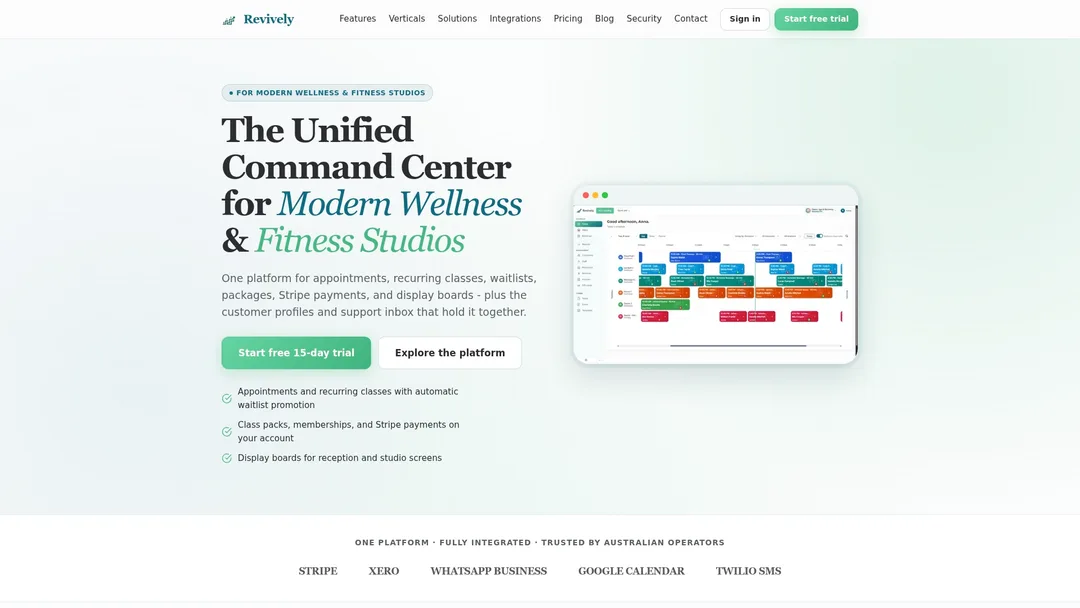
With Revively's robust class scheduling, you can map different cutoffs to class packs, unlimited memberships, and private sessions individually. This means a 12-hour rule on your group yoga and a 48-hour rule on your private Pilates sessions can run side-by-side, flawlessly, without any manual overrides.
Our waitlist auto-promotion instantly fills a spot the moment a client cancels, recovering more capacity than chasing a fee ever will. Secure card-on-file storage and comprehensive audit logging live inside the very same online booking flow, ensuring every late cancel and no-show is tracked with a complete record your staff can pull up instantly during a dispute.
Australian Compliance Built-In:
- Local Data Residency & Privacy: Rest easy knowing your client data, booking histories, and sensitive health intake forms are stored securely right here in Australia, fully complying with the Australian Privacy Principles (APPs).
- Flawless GST & Tax Invoices: Revively natively handles 10% GST calculations across casual classes, memberships, and multi-resource packages, automatically issuing legally compliant Australian Tax Invoices to your clients - without you lifting a finger.
- 100% Legal Xero Integration for BAS Accuracy: For your quarterly Business Activity Statements (BAS)? Our two-way Xero integration guarantees audit-proof accuracy. Automated mapping of tax codes, revenue accounts, and liabilities means no more manual spreadsheet errors, just flawless compliance that removes the BAS headache.
Before you lock in fee amounts, run your current no-show numbers through our no-show cost calculator to set a conservative starting band. Then, take the leap: start a free trial of Revively and configure your first 30-day pilot. It's time to transform your studio's operations, for good.

Sources
For further reading on structuring and enforcing effective cancellation policies for Australian fitness and wellness studios, see the StudioSoftwareAdvice guide to late cancellations and no-shows, the Fitness GM no-show charge guide, and Revively's automated cancellation policy guide.
- How to Manage Late Cancellations and No-Show Fees - StudioSoftwareAdvice
- No Show Charge: A Gym Owner's How-To Guide | Fitness GM
FAQ
What's the difference between a late cancellation and a no-show?
A late cancellation occurs when a client cancels after your specified cutoff time but before the class actually starts. This typically results in a credit forfeiture or a fee. A no-show means the client never cancelled at all and simply didn't turn up, which usually carries a stronger consequence as your staff had no warning or opportunity to fill the spot.
How much should a late cancellation fee be for my studio?
Typical flat fees for standard group classes in Australia sit around $10 to $25, depending on the class type, demand, and your studio's pricing structure. Premium or small-cohort sessions often justify fees at the higher end of this range.
Should I charge a card or forfeit a credit for a late cancellation?
Generally, forfeit a credit when the client already has a paid pack or membership. Reserve a direct card charge for casual drop-ins or no-shows where there's no existing credit to claim. Your booking software should offer both options.
How long should I test a new cancellation policy before enforcing it strictly?
Run a 30 to 60-day pilot period with weekly monitoring of your no-show and fill rates. This allows you to gather data and adjust your communication reminders first, and fee levels second, before moving to strict, automated enforcement.
Can booking software handle different cancellation rules for different class types?
Absolutely. Modern booking platforms like Revively are designed to let you set a separate, customisable cancellation cutoff for class packs, unlimited memberships, and private sessions, rather than applying one blanket rule across your entire studio. This flexibility is key for effective multi-resource studio scheduling.