
Gift Voucher Expiry in Australia: What Studios Must Know
! Studio owner and visitor checking a gift voucher
Most gift vouchers and gift cards sold in Australia on or after 1 November 2019 must stay redeemable for at least three years from the day they were bought.
Picture this: it's a busy Saturday morning. The reformer Pilates class is buzzing, the aroma of essential oils drifts from the recovery centre, and your front desk is a whirlwind. Then, a client presents a faded, crumpled gift voucher. It's for a remedial massage, issued... checks notes... before the Olympics came to Sydney. Okay, maybe not that old, but close enough to send a shiver down your spine.
Sorting out gift voucher expiry dates can feel like navigating a legal minefield blindfolded, especially with Australia's specific consumer protections. Get it wrong, and you risk not just an unhappy client, but potential fines and a serious dent in your studio's hard-earned reputation.

For Australian spas, yoga or Pilates studios, dance schools, and wellness clinics, understanding the national gift card rules isn't just good practice - it's a legal imperative. We're talking about the minimum three-year expiry, clear display requirements, and the outright ban on sneaky post-purchase fees.
This guide isn't just a breakdown of the rules; it's your roadmap to implementing them without the admin headache. We'll show you how to protect your business, keep your clients happy, and even streamline the whole process, so you can focus on what you do best: transforming lives.
Table of Contents
- The 3-Year Rule: No Wriggle Room for Aussie Studios
- What Your Vouchers Must Display (And Where)
- Banishing Post-Sale Fees: Keep it Clean
- When the Rule Doesn't Apply: Exemptions for Studio Owners
- Gift Vouchers vs. Class Packs: A Crucial Distinction
- Beyond Expiry: Handling Lapsed Vouchers & Studio Sales
- The Cost of Non-Compliance: More Than Just Fines
- Your Studio's Gift Voucher Compliance Checklist
- The Revively Difference: Seamlessly Compliant, Painlessly Profitable
- Ready to Revive Your Studio Operations?
- Frequently Asked Questions (FAQs)
- Further Reading
- Related Articles
The 3-Year Rule: No Wriggle Room for Aussie Studios
Let's cut straight to it: most gift cards and vouchers sold in Australia on or after 1 November 2019 must remain valid for at least three years from the date they were purchased. No ifs, no buts.
This isn't some obscure state-based regulation - it's a federal mandate. The ACCC's gift card guidance makes it crystal clear, stemming directly from the Treasury Laws Amendment (Gift Cards) Act 2018, which came into effect on 1 November 2019.
A few key points for your studio:
- It's National: Forget older articles about varied state rules. For any voucher sold since late 2019, the three-year minimum is the unwavering national standard.
- The Clock Starts on Purchase: If you accidentally print an earlier expiry, or a client gets confused, the buyer still gets the mandatory three years from their purchase date.
- Services Are Covered: Whether it's a $120 massage, a term of Pilates classes, a private dance lesson, or a recovery float session - if it's a pre-paid amount or entitlement gifted to someone, it's a gift card and subject to these rules.
What about older vouchers? Anything sold before 1 November 2019 isn't bound by this specific rule. While you're not legally obliged to honour ancient vouchers, consider a goodwill gesture. A little flexibility costs you next to nothing and earns a lot of client loyalty.
What Your Vouchers Must Display (And Where)
Beyond the three-year minimum, transparency is paramount. The expiry information needs to be as prominent as your studio's logo. No tiny print on the back, no obscure terms in a lengthy online policy.

The ACCC states the expiry can be a full date (e.g., 12 March 2030) or a period of time (e.g., "Valid for 3 years from issue date"). If you opt for the latter, you must also clearly show the date of supply/issue so the end date can be easily calculated. If your voucher has no expiry (a brave move!), it must clearly state "No expiry" on the card itself.
Here's an example of clear, compliant wording:
Valid for 3 years from the issue date.
Issued: 12 March 2027. Expires: 12 March 2030.
Where should this go?
- On the printed voucher itself.
- On the emailed PDF version.
- In the checkout confirmation email.
Burying critical terms or using vague language can lead to Australian Consumer Law issues if clients feel misled about their rights. Keep it simple, clear, and unmissable.
Banishing Post-Sale Fees: Keep it Clean
Here's another non-negotiable: you cannot charge post-supply fees on gift cards covered by the three-year rule. Full stop.
This means no activation fees, no balance enquiry fees, and no monthly account-keeping charges. If your studio's old voucher terms included these, it's time to remove them entirely. The ACCC guide for businesses explicitly prohibits such charges. The value a client pays for should be the full value they can redeem, without hidden deductions.
When the Rule Doesn't Apply: Exemptions for Studio Owners
While the three-year rule casts a wide net, not every voucher falls under its strict gaze. Understanding these exemptions can save you a headache (and ensure your promotional offers are still compliant).
The ACCC lists specific situations where the minimum three-year expiry doesn't apply. Here's how they relate to a typical wellness or fitness studio:
| Exemption Category | Studio Example |
|---|---|
| Reloadable Cards | A digital wallet or physical card where clients add credit themselves. |
| Donated for Promotion | "Free Trial Class" vouchers given out at a local school fete. |
| Specific Period Offers | Tickets for a one-off special event, like an "End-of-Year Dance Showcase." |
| Genuine Discount | A voucher sold for $60 but redeemable for a $100 massage. |
| Employee Reward Scheme | Vouchers given to your instructors or staff as a bonus. |
| Customer Loyalty Program | A free yoga class earned after ten visits through your rewards program. |
| Second-hand Sales | A voucher bought from another individual (e.g., via a marketplace). |
(This list is directly from the ACCC's rules for gift cards, and also includes cards given to charities or government agencies as exempt under the ACCC business guide.)
A couple of crucial cautions:
- "Genuine Discount" is Key: Don't label a regular-priced voucher as a "special discount" to circumvent the rule. The discount needs to be substantial and real.
- Clarity Still Counts: Even if exempt, always state the expiry period clearly. Surprises rarely lead to positive client experiences. Avoid ambiguity to head off disputes before they begin.
Gift Vouchers vs. Class Packs: A Crucial Distinction
This is a common point of confusion for studio owners. Let's clarify:
- A gift voucher is generally a pre-paid amount or entitlement purchased by one person (the giver) for another (the recipient) as a gift. It's meant to be a flexible currency for services. This is what the three-year rule applies to.
- A class pack (or membership, or package) is typically a bundle of classes or services bought by a client for their own use, often at a discounted rate or as part of a recurring commitment.
The expiry rules for class packs are different and raise a separate set of considerations around fairness, sales terms, and refunds. We've covered these extensively in our guides to class pack expiry in Australia and package expiry rules.
The crossover point: If you sell a voucher that can be redeemed against a class pack or a membership, treat the voucher itself as the gift card, and apply the three-year rule to its validity. Once the client uses the voucher to purchase a pack, that pack's specific expiry terms then apply (within fair and reasonable limits).
Beyond Expiry: Handling Lapsed Vouchers & Studio Sales
So, the three years are up. What then?
Legally, once the minimum period has passed, a business isn't obliged to honour the card unless they've explicitly agreed to a longer term. However, "not obliged" doesn't mean "you shouldn't."
Many savvy studios choose to implement a simple, consistent policy:
- A short grace period (e.g., 3-6 months past expiry).
- Offering credit for a fresh class or a partial value towards a new service.
The key is consistency. Decide your studio's approach once, document it, train your team, and apply it fairly to everyone. A clear, consistent approach helps resolve disputes swiftly and protects your studio's reputation. Your clients will remember how you handled a slightly expired voucher far more than the negligible cost to you.
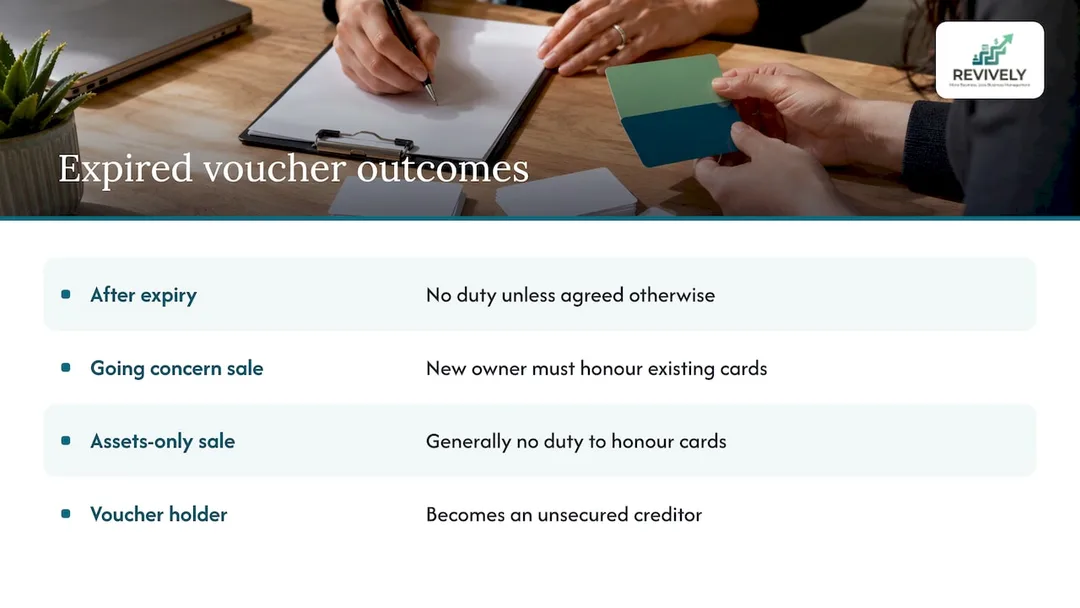
What if you sell your studio?
- If your studio is sold as a "going concern" (i.e., the business continues with a new owner), the new owner must honour existing cards. Make sure you provide a clean, accurate list of all outstanding vouchers to the buyer.
- If the business goes into liquidation and only assets are bought, the new owner is generally not obliged, and voucher holders become unsecured creditors (a less desirable outcome for everyone).
The Cost of Non-Compliance: More Than Just Fines
Ignoring the gift card rules isn't just bad form; it carries tangible risks. Non-compliance can lead to penalties of up to $30,000 for a body corporate and $6,000 for an individual.
But for a small wellness studio or dance school, the financial fine is often the least of your worries. The bigger cost is typically:
- Customer complaints: Time-consuming, draining, and often public (hello, Google reviews!).
- Forced refunds: Eating into your hard-earned revenue.
- Lost trust and reputation damage: The hardest thing to rebuild.
It's far easier (and cheaper) to get it right from the start.
Your Studio's Gift Voucher Compliance Checklist
Ready to whip your gift voucher process into shape? Here's a quick checklist to ensure your Australian studio is compliant:
- Minimum 3-Year Expiry: Set all new vouchers to expire at least three years from the date of supply.
- Clear Display: Prominently print the full expiry date, or the period plus the issue date, on every physical voucher, emailed PDF, and confirmation.
- No Post-Sale Fees: Remove all activation, balance enquiry, or admin fees after the initial purchase.
- Exemptions Labelled: Clearly define and label any promotional or genuinely discounted vouchers that fall outside the three-year rule.
- Grace Period Policy: Document a consistent policy for handling expired vouchers and train your front-desk team thoroughly.
- Robust Record-Keeping: Implement a reliable system to track every voucher sold, its balance, and its redemption status. A voucher acting like credit towards a class or treatment needs careful tracking.
This last point is often where studios unravel. Manual paper vouchers or clumsy spreadsheets quickly become unmanageable chaos, especially during peak seasons like Christmas or Mother's Day. This is precisely why a unified system built for Australian studios is a game-changer.
The Revively Difference: Seamlessly Compliant, Painlessly Profitable
Most voucher problems we see aren't complex legal puzzles. They're admin nightmares. A voucher is sold at the desk, hastily scribbled in a notebook, and then two years later, a client shows up with no code, no receipt, and a faint memory of who bought it for them.
We built Revively to bring order to that chaos. With Revively.app, your gift vouchers, client bookings, and payments all live in one central, intuitive platform. Your client books a class or treatment, the balance comes off automatically, and every transaction is recorded for you and your staff - completely transparent, completely trackable. Our gift card booking guide details how this works seamlessly for wellness venues like yours.
Beyond just vouchers, Revively is designed to be your all-in-one spa booking software and wellness studio management system. This means automating complex compliance tasks. For instance, our native integration with Xero ensures your payments and 10% GST reconcile flawlessly, removing the need for tedious re-keying. Our system's two-way mapping of tax codes, revenue accounts, and liabilities guarantees 100% legal tax compliance, making your quarterly Business Activity Statements (BAS) audit-proof and accurate.
We also know Australian data residency and privacy are paramount. That's why all client data, booking histories, and sensitive health intake forms stored in Revively are held locally in Australia, fully complying with the Australian Privacy Principles (APPs).
When your expiry terms are clear, your multi-resource studio scheduling is intuitive, and your system tracks balances automatically, you spend your time on clients, not chasing paperwork. That's the Revively promise.
- Andreea, Co-founder, Revively.app*
Ready to Revive Your Studio Operations?
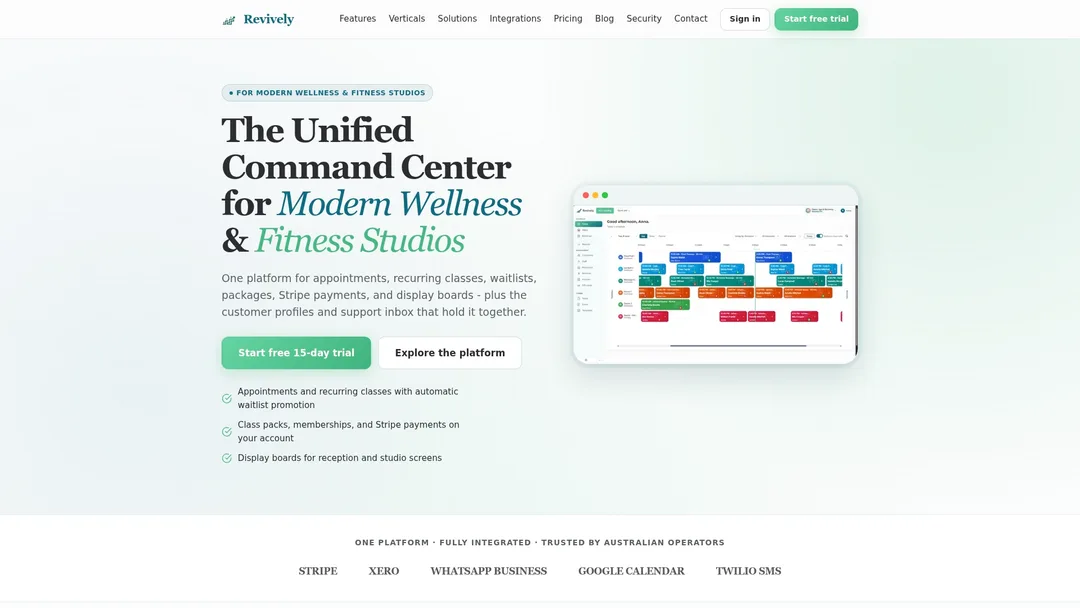
Tired of juggling spreadsheets and praying your gift voucher process is compliant? Revively is an Australian-made, unified cloud command centre (CRM + multi-resource scheduler) designed specifically for Australian wellness and fitness studios - spas, recovery centres, yoga/Pilates studios, clinics, and dance schools.
You get online booking, class timetables with waitlists, Stripe payments, memberships and class packs, and robust Xero integration, all on one dashboard. See Revively pricing to find the perfect fit for your studio, or explore how we handle recurring classes and waitlists to keep your schedule packed.
If you're also looking to optimise your policies for class packs and memberships, our guide to ACL-compliant refund and cancellation policies offers the next layer of protection for your studio.
Frequently Asked Questions (FAQs)
How long is a gift voucher valid in Australia?
Most gift vouchers and cards sold on or after 1 November 2019 must be valid for a minimum of three years from the date of purchase. Certain exemptions apply, such as reloadable cards, genuinely discounted cards, and promotional giveaways. Always check the ACCC's rules for a complete list.
Can a business refuse an expired gift voucher?
Once the legal minimum validity period has passed, a business is not legally obliged to honour the card unless it has explicitly agreed to an extended period. Many businesses, however, choose to offer a grace period or credit as a gesture of goodwill. If a voucher expired before the minimum three-year period ended, first contact the business, then consider consulting your state or territory consumer protection agency.
Can a studio charge a fee to use a gift card?
No. On cards covered by the three-year rule, post-supply fees such as activation, balance enquiry, or monthly account-keeping charges are prohibited, as clearly outlined in the ACCC business guide.
Does a discounted voucher have to last three years?
Not if it is supplied at a genuine discount (e.g., a $60 card for a $100 massage service). Even with an exemption, it is always best practice to clearly display the expiry on the card to avoid any confusion or disputes.
Further Reading
For a deeper dive into the legal sources and consumer protection guidelines, explore these resources:
- ACCC: Rules for gift cards
- ACCC: Sales practices guide for businesses and legal practitioners
- Consumer Affairs Victoria: Gift vouchers and gift cards
- Treasury Laws Amendment (Gift Cards) Act 2018, Schedule 1
- Sprintlaw: Expired gift cards and legal obligations
Related Articles
Explore more Revively insights designed for Australian studio owners:
- Class Pack Expiry in Australia: Your Definitive Guide to Fair Rules and Flawless Compliance
- Don't Let Expired Packs Explode: An Aussie Studio Owner's Guide to ACL-Compliant Policies & Seamless Tech
- Package Expiry Rules: How Australian Studios Can Protect Revenue (Without the Front-Desk Fights)
- Ditching the Refund Headaches: An Aussie Studio Owner's Guide to ACL-Compliant Cancellations & Fair Policies