
Avoid ACL Disputes: Class Pack Expiry Policy for Australian Studios
! Studio manager discussing class pack expiry
A class pack expiry policy is the rule set your studio software uses to remove or block class credits after a set period or date.
Picture this: It's 7 AM, you're juggling last-minute instructor swaps, a leaky tap in the change rooms, and then, the dreaded email. "My 10-class pack expired last week! I only used three classes! This isn't fair!"
Sound familiar? For wellness and fitness studio owners across Australia, class pack expiry policies are a tightrope walk between protecting revenue and keeping clients happy (and loyal). Get it wrong, and you're not just losing a client; you're staring down the barrel of a potential Australian Consumer Law (ACL) dispute.
It's not enough to just have an expiry policy. You need one that's clear, fair, transparent, and crucially, backed by software that handles the heavy lifting - from GST-compliant invoicing to tracking every single extension. That's where smart studio management comes in.

A class pack expiry policy is simply the system your software uses to manage how long a client's credits are valid. The safest bet? Pick one, make it crystal clear everywhere your clients look, and bake in a streamlined process for case-by-case extensions. Because life happens, and rigid rules without an ounce of empathy are a one-way ticket to client churn.
The Quick & Dirty on Class Pack Expiry (for Busy Aussie Studio Owners):
- Disclosure is King: Clearly state the expiry mode and length at checkout, in emails, and in the client's account. This prevents headaches and ACL run-ins.
- Automate Reminders: Set up friendly nudges at 30, 14, and 7 days before expiry. Prompt usage, build goodwill.
- Pending Activation Window: If you offer "first-use activation," cap the pending window at 6-12 months. It's fair, protects revenue, and aligns with general consumer expectations.
- Log Everything: Every manual extension, hold, or override needs a reason, staff name, and timestamp. This creates an audit trail, your best friend in a dispute.
- Balance & Flexibility: Automate the basics, but always retain the ability to grant exceptions for legitimate reasons (studio closures, client emergencies) without manual spreadsheet gymnastics.
Table of Contents
- How expiry settings work in your studio software
- Navigating Australian Consumer Law: Your Expiry Policy Checklist
- Operational Reality: Handling Real-World Scenarios with Your Tech
- Wording it Right: Crafting Clear Policies & Display Best Practices
- Revively's Approach: Flexible Expiry Workflows for Aussie Studios
- The Sweet Spot: Revenue Protection Meets Client Trust
- Optimise Your Expiry Management with Revively
- Sources
- FAQ
- Recommended Articles
How Expiry Settings Work in Your Studio Software
Most decent studio platforms offer a couple of core ways to manage pack expiry. Think of them as the two main levers you can pull:
- Fixed Period Mode: This counts a set number of days from the moment a pack activates. So, a 10-class pack might be valid for 90 days from its start date. Simple, straightforward.
- Fixed Calendar Window Mode: This ties the pack to specific start and end dates. Perfect for term-based programmes, 8-week challenges, or seasonal specials.
But the "when" of expiry is only half the story. The activation trigger is just as crucial. Does the pack's clock start ticking the moment it's purchased, or when the client attends their first class?
The second option - pending activation until first use - is a game-changer for client satisfaction. It protects those who buy in advance (maybe during a sale!) but aren't ready to start immediately. It's a common feature in software that supports pending activation states and can significantly reduce those "my pack expired!" disputes.
Smart platforms also let you define a purchase cut-off date (essential for term packs) and even restrict packs to specific class types or tags. Think: a dance pack can't accidentally be redeemed for a Pilates session.
What your team and clients see on a day-to-day basis is paramount for dispute prevention:
- For Staff: They should see credits remaining, activation status, and the precise expiry date on the client's profile - no digging required.
- For Clients: The same crystal-clear details should be visible in their personal client's account portal, not just buried in a confirmation email they received months ago.
- Pending Status: If a pack is awaiting activation, it should be clearly labelled as such, not appear as a confusing error or blank field.
Navigating Australian Consumer Law: Your Expiry Policy Checklist
This isn't just about good customer service; it's about legal compliance. Under the Australian Consumer Law (ACL), contract terms must be easily understood and shouldn't create an unfair imbalance. A policy that lets you cancel classes but locks your client into a rigid expiry with zero flexibility? That's ripe for an unfair term challenge.
The ACCC's guidance on gift cards and vouchers provides a useful benchmark, even if class packs aren't strictly gift cards. Since 1 November 2019, most gift cards and vouchers must be redeemable for at least three years. While your class packs might not require this lengthy validity, it sets a clear expectation for transparent disclosure. The message is simple: no hidden expiry dates, no nasty surprises.
The ACCC has also pulled up gym operators for misleading "no contracts" claims when underlying terms, including expiry or cancellation conditions, tell a very different story. Don't be that studio marketing "never expires" packs that quietly reset based on a system default. Transparency builds trust.
Here's your practical compliance checklist for your settings and receipts:
- Crystal-Clear Disclosure: State the expiry mode and length in plain English on your product pages, at checkout, and on receipts.
- Activation Logic: Clearly show when the pack activates (on purchase or on first use) right next to the expiry date.
- Symmetrical Rights: Ensure cancellation, extension, and renewal rights are reasonably balanced for both you and your client.
- No Blanket "No Refunds": Never rely on a "no refunds" clause to override a client's right to a remedy if a service genuinely wasn't delivered or if the terms are unfair.
- Australian Financials: Ensure your system natively handles 10% GST calculations for all casual classes, memberships, and multi-resource packs, automatically issuing legally compliant Australian Tax Invoices. This isn't just good practice; it's essential for your BAS accuracy.
- Secure Data: Confirm your client's sensitive information (booking history, payment details, health intake forms) is stored locally in Australia, fully complying with Australian Privacy Principles (APPs). This is vital for trust and legal integrity, especially when reviewing dispute details.
Expiry Policy: The Good, The Bad, and The Compliant
| Feature/Practice | ACL-Compliant & Customer-Friendly | Risky & Potentially Non-Compliant |
|---|---|---|
| Disclosure | Clear expiry date/period & activation trigger at point of sale and in client portal. | Expiry details hidden in fine print or only on a discarded receipt. |
| Reminders | Automated email/SMS nudges before expiry. | Zero reminders, clients only discover expiry after the fact. |
| Extensions | Documented, case-by-case extensions for valid reasons (illness, studio closure). | Rigid "no extensions" policy, even for legitimate unforeseen circumstances. |
| Pending Activation | Packs activate on first use; clear max pending window (e.g., 6-12 months). | Packs activate on purchase, punishing early buyers who delay starting. |
| Record Keeping | All overrides/extensions logged with staff, reason, and timestamp. | Verbal agreements, no digital trail for disputes. |
| Financial Transparency | Issues Australian Tax Invoices with clear 10% GST on all pack sales. | Generic invoices, unclear tax breakdown. |
| Data Residency | Client data (booking history, personal info) stored in Australia, adhering to APPs. | Client data stored overseas, lacking explicit AU privacy compliance. |
Operational Reality: Handling Real-World Scenarios with Your Tech
Studio closures, unexpected illness, or a cancelled programme - these things happen. Your expiry settings shouldn't crumble under pressure; they should have a clear, defensible answer ready.
When a studio closes for reasons outside a client's control (think government-directed shutdowns or an instructor pulling out of a term), automatically extending every affected pack is the fairest and least friction-filled response. Your software needs to make this mass update easy.
When a client requests an extension for a personal reason, a manual review process keeps things consistent without opening the floodgates to blanket exceptions. This needs to be a structured workflow, not a frantic chat at the front desk.
Pause and hold workflows need structure, not just a button. Define who can approve a pause (front desk vs. manager), make a "reason" field mandatory, and ensure every action is automatically timestamped. This creates a clear digital record, turning a "he said, she said" dispute into a two-minute lookup.
Packs left in pending activation also deserve their own rule. A client who buys a pack and never books shouldn't hold that credit indefinitely. A sensible window, often 6 to 12 months from purchase, strikes a fair balance without punishing someone who paid in good faith.
- Automate extensions for studio-side disruptions; review client requests manually.
- Require a reason and timestamp on every pause, hold, or override.
- Set a maximum pending activation window rather than leaving it open-ended.
- Keep a record of every refund and override for at least as long as your local record-keeping rules require. This also impacts your BAS reporting, making a robust Xero integration indispensable.
Pro Tip: Your studio management software should also integrate seamlessly with Xero, automatically mapping revenue accounts, tax codes, and liabilities. When extensions or refunds occur, this ensures your quarterly Business Activity Statements (BAS) are audit-proof and accurate, removing manual spreadsheet errors and financial headaches.
Wording it Right: Crafting Clear Policies & Display Best Practices
Clear, concise wording at the point of sale prevents more disputes than any legalistic refund clause buried deep in your terms and conditions. Be upfront, be human.
Here are three simple templates, ready for you to adapt to your studio's specific pack lengths:
- Strict (but Fair): "This 10-class pack activates on your first booking and expires 60 days later. No extensions apply except as required by Australian Consumer Law."
- Balanced: "This pack activates on purchase and expires 90 days later. Extensions may be granted for documented illness or studio closures. Please contact us to discuss."
- Customer-Friendly: "This pack activates on your first booking and is valid for 6 months. We understand life happens - contact us if you need extra time, we review requests case-by-case."
Crucially, every version needs one clear line spelling out the activation logic. This is the detail most likely to cause confusion if left vague.
The expiry date itself needs to be visible in multiple places. Think omnichannel transparency:
- At checkout
- In the emailed receipt
- On the client's class pass page
- Within the client's account portal
- (Optionally) on any digital foyer display board showing active passes
Good software automates all five from one central setting, saving you from repetitive, error-prone manual updates. And those automated reminders? They're gold.
- Send Automated expiry reminders sent via SMS or email at 30, 14, and 7 days before expiry.
- Sample Reminder Text: "Heads up! You have 3 classes left on your pack, valid until 12 March 2026. Don't let them go to waste - book now to use them!"
Revively's Approach: Flexible Expiry Workflows for Aussie Studios
At Revively, we know that Australian studios need sophisticated, yet simple, tools to manage class packs without the daily drama. Our software builds flexible expiry logic right into the class pack setup. You can easily define:
- Activation on purchase or on first use.
- Per-tag restrictions (e.g., specific packs for yoga vs. Pilates).
- Clear display of pending activation status on client profiles, so no one's confused.
Our system goes beyond basic settings, offering robust features for managing expiry:
- Choose between fixed days or calendar window expiry for each pack type.
- Manually extend expired packs with a few clicks, complete with logged reasons and staff timestamps for full accountability.
- Automated expiry reminders sent via SMS or email, keeping clients engaged and proactive.
- Seamless integration with accounting software like Xero for accurate receipts, revenue recognition, and BAS-ready tax tracking - all natively handling 10% GST.
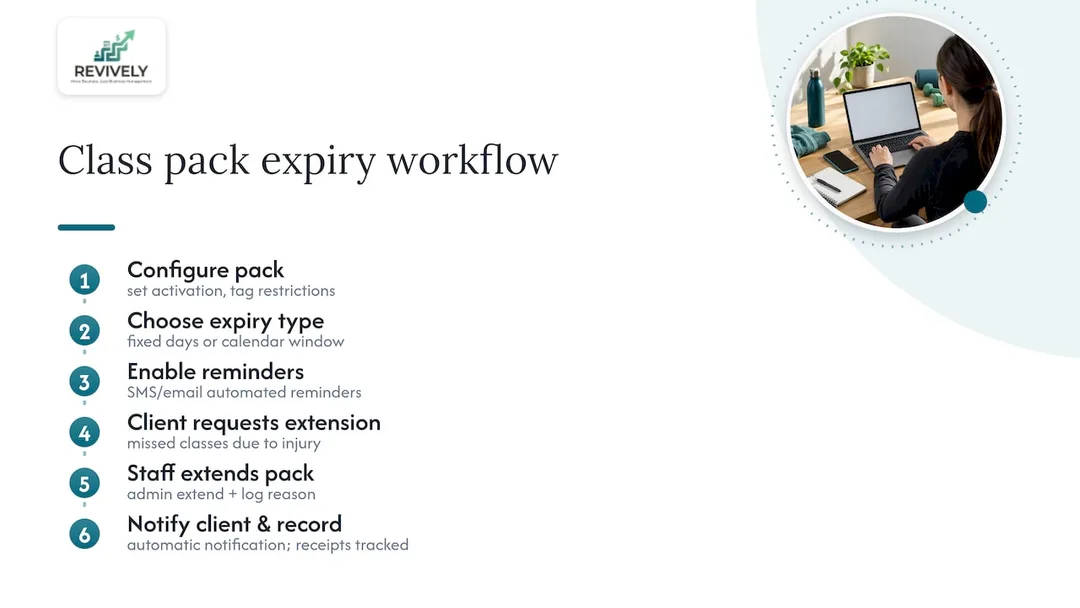
Imagine this typical staff workflow, simplified by Revively: A client calls, explaining they missed classes due to injury. Your staff member quickly navigates to the client's profile in Revively, extends the pack from the admin screen, notes "injury extension" in the required reason field, and the client automatically receives a notification confirming their new expiry date. No fuss, no spreadsheets, just clear, auditable action.
For even deeper configuration guidance, check out our insights on class pack software for Australian studios and our detailed piece on package expiry rules and revenue protection.
The Sweet Spot: Revenue Protection Meets Client Trust
Rigid, poorly explained expiry rules often cost studios far more than they protect. Clients who feel ambushed by a lapsed pack don't complain loudly; they simply leave. They'll often churn quietly, leaving you wondering why. Clear rules, openly communicated, coupled with a transparent and documented path to extensions, build trust that directly translates into higher retention and positive word-of-mouth.
My recommendation is simple:
- Disclose the activation logic plainly.
- Set a reasonable validity window appropriate for your class format.
- Automate overrides and extensions where possible, so your staff aren't left negotiating exceptions on the spot.
Platforms like Commas demonstrate similar thinking in how they surface pack validity in client-facing storefronts - it's a standard worth studying, regardless of what software you currently run.
Ultimately, it's about treating your clients like valued members of your community, not just revenue streams. Empower them with clear information and your team with the tools to respond with empathy, and watch your studio thrive.
- - Andreea, Revively.app
Optimise Your Expiry Management with Revively
Seamless studio management software centralises your expiry settings, giving you the power to define fixed calendar windows or day-based validity for every pack type. Paired with automated reminders and efficient support channels for manual queries, it transforms a potential headache into a smooth, professional process.
Want to cut down on manual follow-ups even further? Consider pairing your scheduler with a smart booking agent tool like 42Voice's booking agent. Revively's dedicated membership and class pack solutions page details our full feature set. Ready to compare options for your studio? Our pricing page lists current plans, all designed to ensure your Australian studio operates smoothly, profitably, and always in compliance.
Sources
- Gift cards and discount vouchers | ACCC
- Australian Consumer Law and your business | business.gov.au
- Packages | Groovio Pty Ltd Help Center
FAQ
Do class packs need an expiry date under Australian law?
There's no blanket requirement that class packs must expire. However, if you do set an expiry, the Australian Consumer Law requires that the terms be disclosed clearly and not create an unfair imbalance against the client. Hidden or confusing expiry conditions carry significant compliance risk, regardless of pack length.
What's the difference between activation on purchase and on first use?
Activation on purchase starts the expiry countdown the day the client buys the pack. Activation on first use holds the pack in a pending state until the client books their very first class. The pending activation approach is generally more client-friendly, suiting those who buy in advance but aren't ready to start immediately.
Can an Australian studio refuse to extend an expired class pack?
A studio can certainly set a general "no extensions" policy. However, you cannot use a blanket "no refunds" or rigid expiry setting to avoid consumer remedies when a service genuinely wasn't delivered, or if your policy creates an unfair term under the ACL. Documented, case-by-case extensions for studio closures, client illness, or other unforeseen circumstances significantly reduce disputes and build trust without undermining your core policy.
How long should a pending activation pack remain valid before it expires?
There's no fixed legal minimum, but a window of 6 to 12 months from purchase is a practical balance. It protects your studio's revenue while giving clients a fair, ample chance to redeem what they've paid for. Whatever window you choose, it must be clearly disclosed at the point of sale.
Does Revively let me extend an expired class pack for a client, and how does it handle GST?
Yes, Revively absolutely allows staff to extend an expired pack directly from the admin screen. You can log the reason for the extension, and the client will automatically receive a notification confirming their new expiry date. All initial class pack purchases processed through Revively automatically generate legally compliant Australian Tax Invoices with accurate 10% GST calculations, ensuring your financial records are always in order, which is crucial for BAS accuracy and seamless Xero integration.
Recommended Articles
- Stop the Silent Client Drain: Why Unused Class Packs Are Costing Your Australian Studio More Than You Think
- Package Expiry Rules: How Australian Studios Can Protect Revenue (Without the Front-Desk Fights)
- Mastering Class Packs: Essential Software for Australian Wellness Studios
- Ditching the Refund Headaches: An Aussie Studio Owner's Guide to ACL-Compliant Cancellations & Fair Policies