
Class Pack Expiry Rules in Australia: What Studios Can Set
! Studio owner reviewing class pack expiry terms
There is no single national rule that sets how long a class pack lasts.
Another client at the desk, pack expired, and the familiar "but I was sick for weeks!" debate begins. You know the drill. Managing class pack expiry can feel like walking a tightrope: you need to protect your studio's revenue and encourage client commitment, but you also want to be fair, flexible, and, crucially, compliant with Australian consumer law. It's a fine line, and often, it's a manual headache.
The truth? There's no single, nationwide rule dictating how long your class packs must last. Instead, the power is in your hands - but so is the responsibility. As an Australian studio owner, you set the terms, but they must be crystal clear, reasonable, and enforceable. For your clients, this means they need to actually read the terms before they buy. For you, it means crafting a policy you can stand by, automate, and legally defend.

Forget the guesswork and the spreadsheet juggling. This guide is your no-nonsense look at how to navigate class pack expiry, ensuring both your clients and your books are happy, all while staying audit-proof in the Australian market.
The Australian Landscape: What 'Typical' Class Pack Expiry Looks Like
When you peek at public pricing and terms pages from wellness and fitness studios across Australia, a clear pattern emerges. Expiry periods aren't random; they're strategically tied to pack size and designed to foster consistent client engagement.
| Pack Type | Example Expiry | Clock Starts |
|---|---|---|
| 5 classes | 3 months at a Sydney Pilates studio | Purchase |
| 10 classes | 6 months at the same studio | Purchase |
| 5 / 10 / 20 classes | 6 weeks, 12 weeks and 26 weeks at another Pilates studio | Purchase |
| 5 / 10 / 20 / 100 credits | 45 days, 90 days, 180 days and one year at a studio offering class credits | Purchase |
| 5 and 10 classes | 4 and 6 months, with 12 months on some specialty packs | Varies by pack |
The takeaway? Larger packs typically grant a longer usage window. Shorter windows are a strategic nudge, encouraging clients to commit to a regular schedule. Some studios, of course, opt for "no expiry" packs - a tempting marketing hook, but one that carries its own set of administrative and financial implications. We'll dive into those costs later.
The Critical Starting Point: When Does the Clock Actually Begin?
This seemingly small detail is often where client confusion (and subsequent front-desk friction) starts. There are two primary models Australian studios employ:
- From the date of purchase: This is straightforward, easy to explain, and simpler to track in your booking system. Most studios, particularly those in the table above, operate this way.
- From the date of the first booking or attended class: More forgiving for clients who buy a pack as a gift or before a holiday. However, without automated software, this model can quickly become a manual tracking nightmare, opening the door for inconsistencies.
The golden rule: Whichever model you choose, it must be explicitly stated before payment. The expiry date a client sees in their account or on their receipt must precisely match your published terms. No surprises, no ambiguity.
Beyond the Sale: Navigating Extensions for Injury and Illness
Life happens. Clients get injured, fall ill, or face unexpected travel. How you handle extension requests can significantly impact client loyalty and your reputation. Extensions are typically a courtesy, not an automatic right, but a well-defined policy ensures consistency.
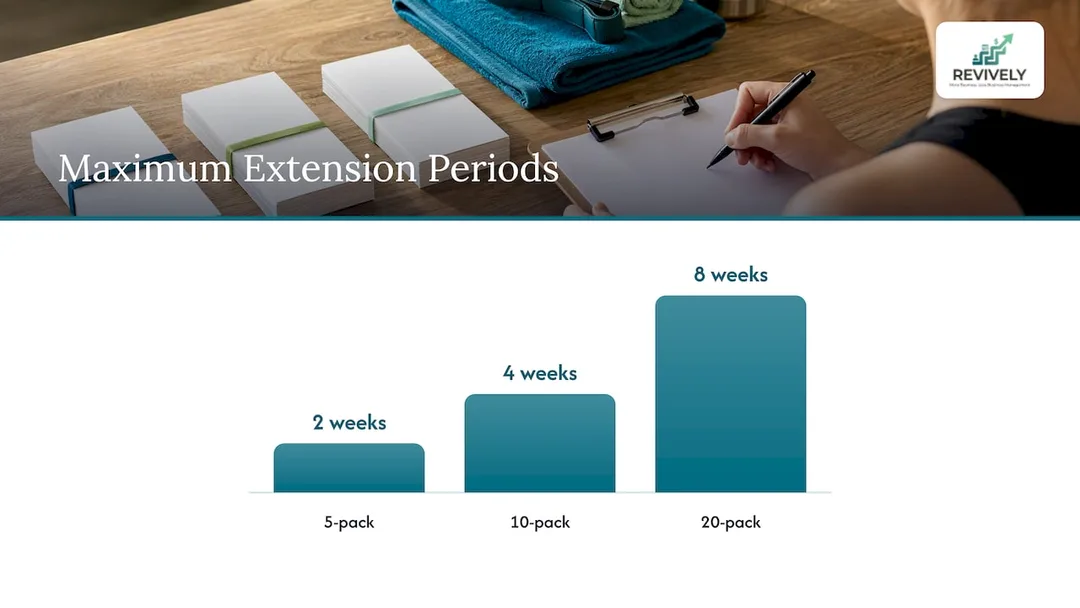
Take this example from an Australian Pilates studio: extensions may be considered case-by-case for illness, injury, travel, pregnancy, or postpartum recovery. They stipulate requests must be made before the original expiry and often require a doctor's note. Their listed maximums offer a pragmatic guideline: 2 weeks for a 5-pack, 4 weeks for a 10-pack, and 8 weeks for a 20-pack.
Other studios might be stricter. A credit-based studio, for instance, states unused credits generally cannot be extended unless a request is submitted via their form within two weeks of expiry. They also clearly communicate that injury or a change of mind doesn't qualify for a refund, though a transfer might be possible for an administration fee.
Your best advice to clients (and policy for your team): If an injury or illness prevents a client from using their pack, they must contact the studio before the pack expires. A written request, ideally with a medical certificate from their GP or treating practitioner, provides clear documentation and simplifies the process for everyone.
The Australian Consumer Law (ACL) & Your Expiry Terms: Staying Compliant
Here's the critical bit: the Australian Consumer Law (ACL) doesn't forbid expiry dates on class packs. What it does do is set strict boundaries around how you implement and enforce them.
- Consumer Guarantees: Remember, clients are automatically protected by consumer guarantees that a business cannot simply contract out of. A "no refunds" sign, while common, doesn't override these fundamental rights if your service isn't fit for purpose or provided with due care and skill.
- Unfair Contract Terms: A standard-form term (which most class pack terms are) can be deemed unfair if it creates a significant imbalance in rights and obligations, isn't reasonably necessary to protect your legitimate business interests, and causes detriment to the customer.
- Serious Penalties: Don't underestimate the weight of the ACL. Consumer Affairs Victoria highlights that fines for corporations can reach a staggering $50 million for unfair contract terms.
ACL Compliance Heads-Up: A clearly disclosed, reasonable expiry period that's proportionate to the pack size (e.g., a 10-pack lasting 3-6 months) is generally easy to defend. A 5-pack that expires in a few days with no allowance for a documented illness? That's a harder hill to climb in an ACCC review.
For a deeper dive into refunds and cancellations, check out our guide to ACL-compliant cancellations and fair policies.
Disclaimer: This article provides general information and is not legal advice. If you're updating your studio's terms and conditions, always consult with a lawyer specialising in consumer law.
Class Packs vs. Gift Cards: A Crucial Distinction for Australian Studios
This is a common point of confusion that can lead to missteps. Are class packs subject to the same rules as gift cards? Absolutely not.
Gift cards, when purchased on or after 1 November 2019, must be redeemable for a minimum of 3 years. However, this rule has exceptions for things like genuine promotional offers (e.g., a $60 card for a $100 service) or reloadable cards.
A class pack, by definition, is a bundle of pre-purchased sessions or credits, usually sold with a specific validity period. It's not a stored-value gift card. Therefore, the 3-year minimum typically doesn't apply.
The risk lies in your labelling. If you sell a dollar-value voucher and call it a class pack, or market a gift card as a pack, you could inadvertently fall under the gift card regulations. Always name your products accurately and clearly state the expiry in the product description. When in doubt, review the ACCC's guidance or seek legal counsel.
Crafting Air-Tight Expiry Rules for Your Australian Studio
Don't let policy-making become a game of chance. Here's how to set robust, fair, and easily manageable expiry rules:
- Tailor Validity Periods by Pack Size: Common sense dictates a 20-pack needs more time than a 5-pack. A client attending once a week needs roughly 10 weeks for a 10-pack - build in a buffer for holidays or sick days.
- Define a Clear Start Point: Stick to either "from purchase" or "from first booking/class." State it once, clearly, and apply it consistently across all your materials.
- Implement a Humane Extension Policy: For documented illness or injury, consider offering one extension. Crucially, require the request before the original expiry, along with a medical certificate.
- Outline Transfer and Refund Terms: Be explicit about what is and isn't allowed. Can a pack be transferred to another client for an admin fee? Under what (if any) circumstances are refunds offered?
- Automate Reminders: Proactively email clients before their credits lapse. Expiry should never come as a surprise; it builds goodwill and can prompt re-engagement.
The "No Expiry" Dilemma: A Word of Caution
Advertising "no expiry" packs can be a powerful marketing tool. However, consider the implications:
- Open Obligation: Those unused credits sit on your books as a perpetual obligation, making financial forecasting murky.
- Membership Cannibalisation: Clients might perpetually stick to packs rather than upgrading to recurring memberships, potentially costing your studio steady revenue. Our post on class packs and memberships delves deeper into this trade-off, and why unused packs cost studios money.
Beyond Spreadsheets: Automating Your Expiry Policy
When you're comparing studio management tools, a non-negotiable feature is automated expiry configuration per product. Manually tracking expiry in spreadsheets is a fast track to inconsistent exceptions, client complaints, and administrative burnout. An automated system applies the rules universally, freeing your team and protecting your reputation.
Revively's Approach: Your Partner in Clarity & Compliance
We've seen it countless times: studio owners pour effort into drafting sensible policies, only to have them unravel at the front desk. One client gets an extension, another is denied, and there's no digital trail to explain why. This isn't fairness; it's chaos.
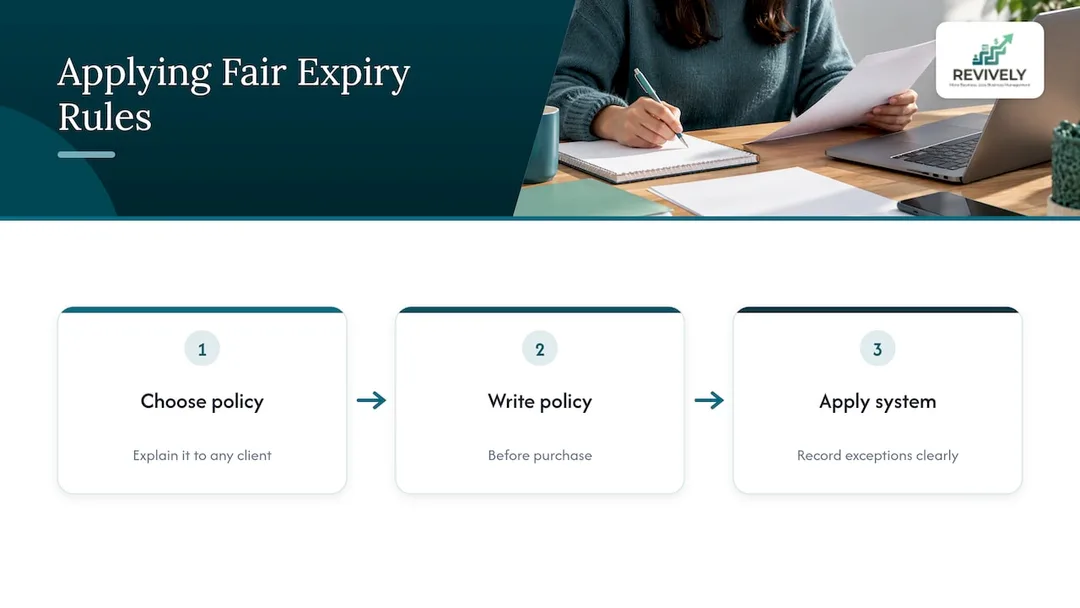
Our view at Revively is straightforward: Choose a policy you're genuinely comfortable explaining to any client, any time. Put it in writing before purchase. Then, let your software handle the heavy lifting. A robust system like Revively doesn't just enforce rules; it provides a clear, immutable record of every transaction and exception. This protects your clients, empowers your front-desk team, and ensures your revenue reporting is bulletproof. Fairness is inherently simpler when the rules aren't subject to who's rostered on that day.
Powering Your Australian Studio: Setting Expiry & Ensuring Compliance with Revively
Revively isn't just another booking system; it's an Australian-made, unified studio command center designed specifically for wellness and fitness studios. We remove the operational chaos, allowing you to focus on what you do best. And when it comes to class pack expiry and the unique demands of the Australian market, we've got your back.
Key Revively Advantages for Australian Studio Owners:
- Native 10% GST Handling: Revively seamlessly integrates 10% GST calculations across all casual classes, memberships, and multi-resource packages. When a client purchases, our system automatically generates and issues legally compliant Australian Tax Invoices, simplifying your financial administration and ensuring transparency.
- Audit-Proof Xero Integration for BAS: Our deep, two-way integration with Xero isn't just about syncing data; it's about guaranteeing 100% legal tax compliance. We automate the mapping of tax codes, revenue accounts, and liabilities directly from Revively to Xero. This means your quarterly Business Activity Statements (BAS) are accurate, hassle-free, and audit-proof, eliminating the risk of manual spreadsheet errors and saving you precious time and stress.
- Australian Data Residency & Privacy: Sleep easy knowing your sensitive client data is secure. All client profiles, booking histories, and health intake forms are stored locally in Australia. Revively adheres rigorously to the Australian Privacy Principles (APPs), ensuring your clients' personal information is protected under Australian law - a crucial trust signal for your community.
- Unified Command Centre: Say goodbye to juggling disparate tools. Revively brings class packs, memberships, waitlists, client profiles, and multi-resource scheduling onto one intuitive dashboard. Whether you're a yoga studio, Pilates centre, recovery clinic, or dance school, managing everything from a single, reliable platform is a game-changer.
- Automated Expiry Enforcement: Configure expiry periods precisely for each class pack or membership type. Revively automatically enforces these rules, sends pre-expiry reminders, and tracks all usage, so you never have to manually calculate expiry dates again.
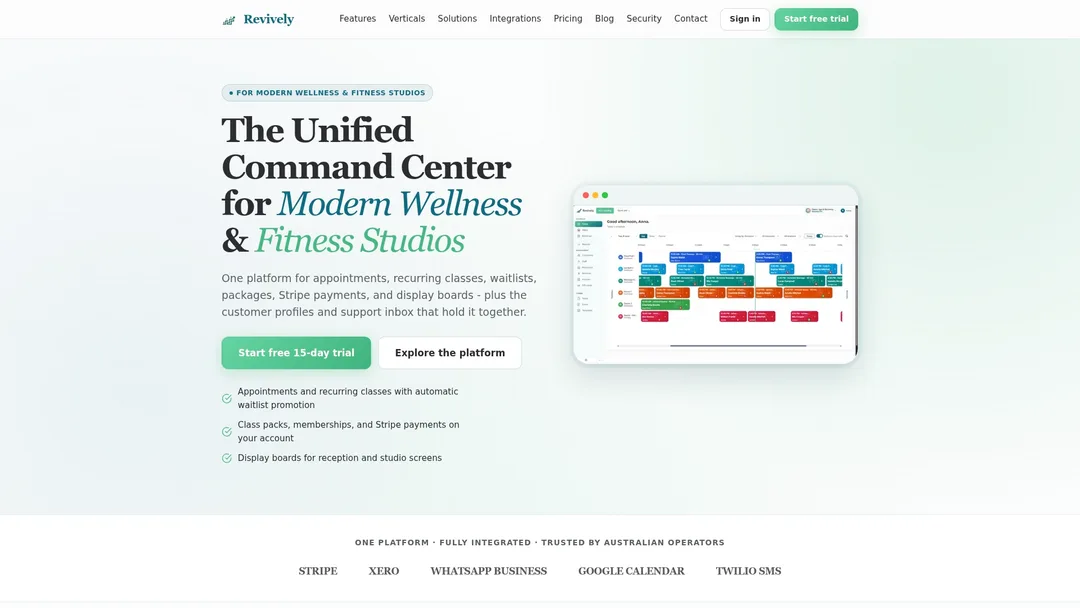
Empower your studio with an all-in-one spa booking software and CRM that understands the nuances of the Australian wellness industry. Plans start at $39 per month for Solo, $99 per month for Growth, and $199 per month for Pro. Explore the details on our pricing page. Ready to ditch the refund headaches and manual tracking? Learn more about class pack software for Australian wellness studios and discover why we're a leading Mindbody alternative Australia.
If you offer pauses on recurring plans, our guide to Stripe membership pauses explains how they affect bookings and BAS compliance in Australia.
Frequently Asked Questions (FAQ)
Do class packs expire in Australia?
Generally, yes. Most Australian studios set a validity period for their class packs, often ranging from a few weeks to 12 months, depending on the pack size. The specific terms at the time of purchase will dictate the expiry rules. Some studios do offer packs with no expiry, but this is less common.
Can I get a refund on an expired class pack?
Typically, no. Many studios' terms state that unused classes are forfeited upon expiry and class packs are non-refundable. However, your consumer guarantees under the Australian Consumer Law (ACL) still apply - for instance, if a service wasn't provided with due care and skill. If you believe a term is unfair, first contact the studio, then your state or territory consumer protection agency.
Can I extend my class pack if I'm injured or unwell?
Often, yes, but it's usually at the studio's discretion. It's crucial to make the request before your pack expires, ideally in writing and with a medical certificate from your GP or treating practitioner. Some studios have policies capping extensions at a few weeks or months, depending on the pack size.
Do class packs have to last three years like gift cards in Australia?
No. The 3-year minimum validity rule applies specifically to gift cards purchased on or after 1 November 2019, with certain exceptions. A class pack is considered a bundle of sessions with a stated validity, not a stored-value gift card. However, it's vital to accurately label your products to avoid confusion; if a product is truly a dollar-value voucher, different rules may apply.
Sources
- Zen Pilates pricing
- Agape Pilates terms and conditions
- Bodhi & Ride credit and class pack details
- Scout Studios pricing
- ACCC: consumer rights and guarantees
- ACCC: unfair contract terms guide
- Consumer Affairs Victoria: health and fitness centres, unfair contract terms
- ACCC: gift cards and discount vouchers
Recommended for Australian Studio Owners
- Package Expiry Rules: How Australian Studios Can Protect Revenue (Without the Front-Desk Fights)
- Don't Let Expired Packs Explode: An Aussie Studio Owner's Guide to ACL-Compliant Policies & Seamless Tech
- Stop the Silent Client Drain: Why Unused Class Packs Are Costing Your Australian Studio More Than You Think
- Stop the Revenue Drain: Are Your Class Packs Undermining Your Memberships?