
Australian Studio Waivers: Collect and Audit Signatures with Revively
! Client accepting digital studio waiver
A well-drafted client waiver can reduce your studio's legal exposure in Australia, but it cannot lawfully exclude core Australian Consumer Law guarantees or cover reckless conduct.
It's 6 AM. The studio lights are on, music's cued, and your first reformer class is about to begin. Then, a new client sheepishly admits they "forgot" to sign the waiver. Panic. Do you hold up the class? Scramble for a paper form? Or worse, let them join, knowing you're walking a legal tightrope?
This isn't just about a forgotten signature. It's about protecting your thriving wellness or fitness business in Australia. A well-crafted client waiver can significantly reduce your studio's legal exposure, sure, but it's no magic shield. It cannot lawfully exclude core Australian Consumer Law guarantees or excuse reckless conduct. It's one part of a much larger, carefully constructed risk-management puzzle. Get the wording wrong, bury it in fine print, or mess up the collection process, and that protective document becomes little more than a piece of paper.
This guide dives into the nitty-gritty of Australian waivers: what they really mean, how to make them enforceable, and how to seamlessly integrate them into your studio's workflow - without the early morning panic.

The Studio Owner's Cheat Sheet on Australian Waivers:
- Specificity is Key: Generic "exercise carries risk" won't cut it. Your waivers need specific risk disclosures tied directly to the activity (e.g., muscle strain in reformer Pilates, bruising from deep tissue massage).
- ACL is King: You cannot exclude fundamental Australian Consumer Law guarantees. Any clause attempting to do so is void. Know its limits.
- The Magic Words: For recreational services, enforceability often hinges on including the prescribed warning notice from the Competition and Consumer Act. Miss it, and your protection vanishes.
- Digital Done Right: Digital collection isn't just convenient; with timestamps, IP logs, and clear display, it provides robust evidence that paper can't easily match.
- Minors & High-Risk: Activities involving under-18s or high-risk disciplines demand tailored waivers with explicit guardian consent and detailed disclosures.
Table of Contents
- What is a client waiver in Australia?
- Are waivers enforceable in Australia?
- What should an Australian client waiver include?
- How to create and use a waiver for your studio
- How should you present and collect waivers?
- When does your studio actually need a waiver?
- Revively: From Waiver Headaches to Seamless, Compliant Collection
- The Art of Trust: Balancing Protection with a Welcoming Studio Vibe
- Sources
What is a Client Waiver in Australia?
Think of a client waiver (sometimes called a release, assumption of risk form, or an indemnity agreement) as a transparent handshake between your studio and your client. It's a document a participant signs before diving into an activity that carries a degree of physical risk. It formally acknowledges they understand the risks involved and agree, within the bounds of Australian law, not to hold your business liable for certain outcomes.
For anyone running a yoga, Pilates, dance, spa, or recovery centre, waivers are a constant companion, whether you explicitly call them that or not:
- High-energy group fitness or dance classes involving jumps, lifts, or partner work.
- Hands-on treatments like remedial massage, cupping, or facials utilising active ingredients.
- Equipment hire, from aerial silks and reformers to resistance bands clients take home.
- Workshops and one-off events led by guest instructors.
A waiver rarely stands alone. It's typically part of a bigger digital puzzle, sitting neatly alongside your terms of trade, a comprehensive digital intake form capturing health information, and your privacy policy. Together, these documents form the audit trail that demonstrates a client made an informed choice to participate, and that your studio met its obligations. For a deeper dive into these interlinked components, Sprintlaw's outline of core waiver elements offers a solid foundation.
Are Your Waivers Just Fancy Paper? The Truth About Enforceability in Australia
Here's the rub: waiver enforceability in Australia is far narrower than many operators assume. And that "assumption gap" is precisely where studios get caught out.
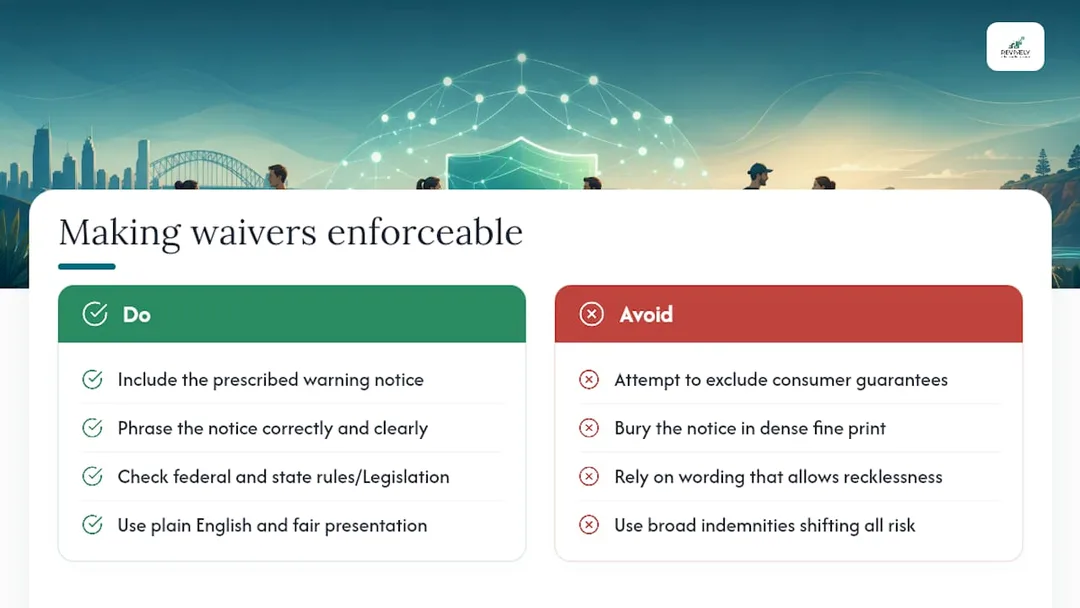
First and foremost, the Australian Consumer Law (ACL) sets the baseline. Businesses simply cannot exclude fundamental consumer guarantees, such as the guarantee that services will be provided with due care and skill. Any clause in your waiver attempting to override this is legally void, no matter how strongly worded or how prominently your client signed it. The ACCC clearly states that businesses cannot exclude these guarantees.
Crucial Detail: The Recreational Services Exception
Section 139A of the Competition and Consumer Act 2010 provides a specific, albeit limited, exception for recreational services. It allows a business to exclude liability for personal injury, provided the contract includes a prescribed warning notice. However, this protection does not extend to reckless conduct, and any incorrect wording can render the entire exclusion useless.
This statutory basis is detailed in the Competition and Consumer Act's recreational services schedule, and the current text is maintained on Legislation. Always consult these official sources before finalising any recreational services clause.
The devil is in the detail. One specific statutory phrase - the prescribed warning notice - dictates whether your recreational services exclusion works at all. Miss it, phrase it even slightly incorrectly, or position it somewhere a court deems unfair, and that layer of protection collapses.
Adding another layer of complexity, individual state and territory rules can introduce their own nuances. Some jurisdictions may expect particular language or specific signature formats for recreational services notices. What works perfectly for a Pilates studio in Melbourne might need adjustment for a recovery centre in Brisbane.
Courts also scrutinise standard-form waivers under unfair contract term rules. Broad indemnities that attempt to shift all risk onto the client, or clauses buried in dense fine print, can be struck out. As Sprintlaw's liability waiver guidance points out, plain English and fair presentation aren't just good practice; they're often what keeps your clause legally standing.
Beyond the Basics: What a Bulletproof Australian Waiver Must Include
Forget generic templates copied from overseas. A waiver designed to protect your Australian studio needs specific, localised elements. Here's your non-negotiable checklist:
- Clear Identification: Name your business, the client, and precisely describe the class, treatment, or activity it covers. Ambiguity is your enemy.
- Specific Risk Disclosures: Ditch vague generalisations like "physical activity carries risk." Instead, list the actual, specific risks inherent to the activity - muscle strain in a reformer class, potential bruising from deep tissue work, falls during aerial arts.
- Assumption of Risk & Release Language: State clearly what the client accepts, always operating within the lawful limits set by the ACL and recreational services provisions.
- ACL Acknowledgement: Explicitly confirm that the waiver does not exclude guarantees protected by Australian Consumer Law. Include any permitted remedy-limitation wording, particularly if you're dealing with another business rather than a consumer directly.
- Health Declarations & Emergency Consent: Capture any relevant medical conditions your client should disclose. Include consent for emergency treatment if an incident occurs mid-session.
- Minors & Guardian Consent: For participants under 18, a parent or legal guardian must sign the waiver, with their own clear acknowledgement of the risks involved.
- Execution Details: Ensure space for a signature (or clear e-signature evidence), date, a severability clause (if one part is invalid, the rest stands), and specify the governing law of your state or territory.
This structure largely aligns with the elements Sprintlaw recommends for Australian waiver forms, tailored for the unique operations of studios and spas.
Pro Tip: Always draft your risk disclosures for the exact class or treatment, not your entire business. "This Pilates reformer class involves resistance-based exercise that can cause muscle strain, joint stress, and falls if equipment isn't used correctly" is far more robust than a blanket "exercise involves risk."
It's precisely these critical elements - the ACL acknowledgement or the mandatory recreational services warning - that free, generic templates often miss. This is exactly where generic forms fall short for Australian operators, leaving you exposed.
Crafting Your Waiver: From Blank Page to Legal Peace of Mind
Building a waiver that genuinely protects your business demands more than just downloading a template and slapping your logo on it.
- Map Your Activities, Identify Your Risks: Take a forensic look at every service you offer. A reformer Pilates class has different risks than a hot yoga session, which differs again from a hands-on facial. List them out, activity by activity, avoiding one-size-fits-all statements.
- Draft in Plain English, Then Get It Reviewed: Feel free to draft the initial document yourself. But then, pay a qualified lawyer to meticulously check the ACL wording, the prescribed warning notice, and any recreational services clauses against your specific activities and state-specific requirements. This isn't a DIY job for legal protection.
- Choose Your Collection Points Strategically: Decide when and where the waiver gets signed. Is it at booking checkout? Emailed to new clients before their first session? Or completed on a tablet at check-in? Each method needs a reliable way to capture iron-clad proof of acceptance.
- Train Your Team & Schedule Reviews: Your front-desk staff and instructors are your first line of defence. They need to understand why the waiver matters and be able to guide new clients through it. The waiver itself isn't set-and-forget; it requires a legal check-up whenever your services change or Australian law shifts.
A studio offering aerial arts, remedial massage, and infrared sauna sessions under one roof absolutely needs distinct risk language for each. Trying to squeeze this into a single, generic form will inevitably break down. Studios juggling multiple activity types often find it much simpler to manage this alongside broader wellness studio operations rather than treating compliance as a separate, isolated project.
Paper or Pixel? Presenting & Collecting Waivers the Right Way
It's not just that a client signed; it's how it was presented and collected that determines if a waiver holds up as admissible evidence. This is why working with local businesses on clear statutory warnings and explicit display of key terms is crucial for your digital booking flows.
When collecting waivers online, best practice looks like this:
- A separate, clear tick-box for the waiver, distinctly separate from general terms and conditions acceptance.
- Automatic timestamp and IP address logging securely attached to each acceptance.
- An embedded copy of the exact wording the client agreed to, plus an option for them to download their own copy.
For on-premise collection, the same principles apply, but with different execution:
- A hard-copy signature or tablet-based e-signature captured before the client commences the activity.
- Staff scripts that explicitly draw attention to the waiver, ensuring it's not simply slid across the counter without comment.
Electronic signatures are legally recognised in Australia, provided the acceptance is properly evidenced. As Sprintlaw's guidance on waiver collection highlights, this means meticulously keeping the exact text the client viewed, a timestamp, an IP address, and a stored copy securely tied to their client record. It's far more than just a checkbox without an audit trail behind it.
<br>
| Feature | Traditional Paper Waivers | Digital Waivers (e.g., via Revively) |
|---|---|---|
| Collection Method | Manual handover, clipboard, pen. | Online during booking, pre-class email, tablet at check-in. |
| Proof of Consent | Handwritten signature (can be illegible, disputed). | Timestamped digital signature, linked to user account, IP address logged. Highly auditable. |
| Storage | Physical filing cabinets, boxes (fire, flood risk). | Secure cloud storage (e.g., Australian data residency), instantly retrievable. |
| Retrieval Speed | Slow, manual search through archives. | Instant, search by client name, class, date. Critical in an incident. |
| Version Control | Hard to track if client signed outdated version. | System ensures clients sign the current version; previous versions often archived digitally. |
| Client Experience | Perceived as cumbersome, outdated. | Streamlined, professional, can be completed at client's convenience. |
| Compliance Risk | Higher risk of missing signatures, poor evidence. | Lower risk with automated checks, clear audit trail helps meet legal requirements (e.g., proving prescribed warning notice was presented). |
| Environmental Impact | Paper waste. | Paperless, eco-friendly. |
| Integration | Disconnected from booking/CRM. | Seamlessly integrated with CRM + scheduler. Client cannot book/attend without signing, ensuring compliance for "all-in-one spa booking software" or "multi-resource studio scheduling" solutions. |
<br>
Pro Tip: Store waiver records where you can pull them up in under a minute. If an incident happens and you're fumbling through email attachments or dusty filing cabinets to find proof of acceptance, the record's existence matters less than its retrievability.
Do You Really Need a Waiver for That? When to Use Them (and When Not To)
Not every service warrants the same level of waiver detail. It's about a measured approach based on risk. Weigh these factors:
- Physical Risk Level: A gentle stretch class demands lighter wording and less extensive disclosure than an aerial silks workshop or a HIIT session.
- Equipment Involved: Reformers, aerial silks, specialised gym equipment, and heated rooms all inherently raise the risk profile and necessitate more specific language.
- Off-Site or Outdoor Activity: Outdoor yoga sessions, boot camps, or off-site retreats introduce unique environmental risks that a standard studio waiver may not adequately cover.
- Minors in the Room: Any participant under 18 immediately triggers specific guardian consent requirements that are far more stringent.
A breathwork class might only need a short health disclosure and a general risk acknowledgement. An aerial arts programme, however, requires intricate risk disclosure alongside equipment-specific language. A massage intake form needs comprehensive medical history details in addition to the waiver itself, which is where dedicated intake documentation tends to work better than a single, combined form.
Sometimes, a waiver isn't the right tool at all. If the real gap is workplace safety compliance or inadequate insurance coverage, a signed waiver won't bridge that gap.
Revively: From Waiver Headaches to Seamless, Compliant Collection
Getting a waiver signed is one thing. Proving it later - quickly, accurately, and with a clean audit trail - is an entirely different beast. It's a problem most studios solve poorly, creating unnecessary stress and compliance risks. This is where a unified cloud command centre like Revively transforms operations.
Revively streamlines your waiver workflow:
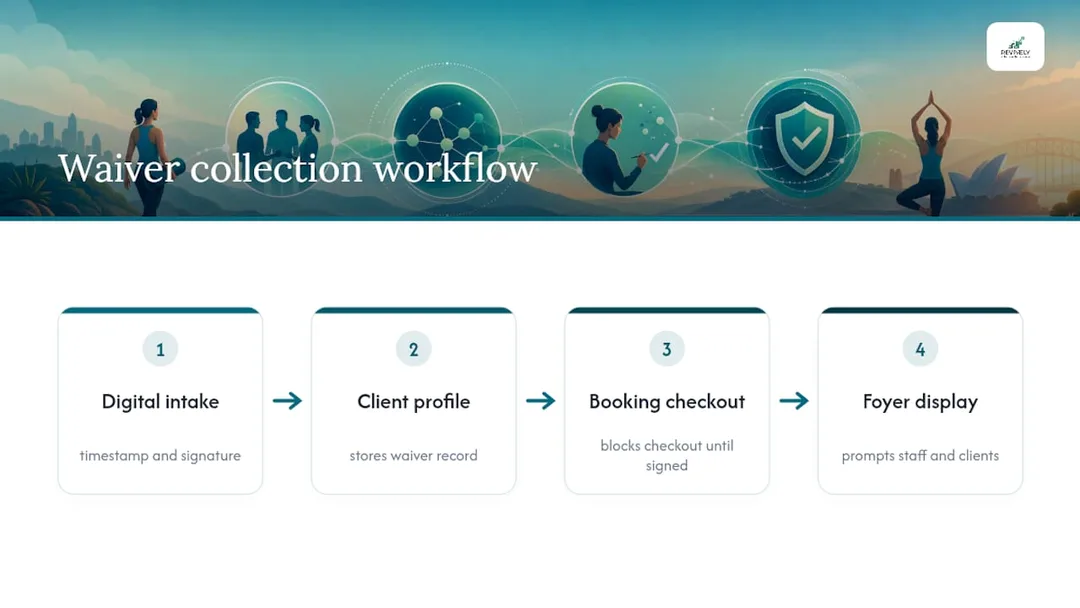
- Digital Intake Forms: These can be directly attached to each client's profile, capturing a precise timestamp and digital signature at the point of acceptance. No more missing paperwork.
- Booking-Integrated Workflows: Our system can be configured to require a waiver before checkout confirms a class or treatment. This ensures 100% compliance for every client, every time.
- On-Premise Prompts: Utilise Revively's display boards to prompt both staff and clients about outstanding waivers before a session starts, eliminating last-minute scrambles.
- Robust Data Storage: Your clients' sensitive health intake and waiver data is stored securely on Australian soil, fully compliant with the stringent Australian Privacy Principles (APPs). This ensures you meet local legal obligations and build client trust.
- Integrated Compliance (Beyond Waivers): While this article focuses on waivers, Revively is designed as a comprehensive "Mindbody alternatives Australia" solution. It natively handles 10% GST calculations across casual classes, memberships, and multi-resource packages, automatically issuing legally compliant Australian Tax Invoices. Furthermore, our 100% legal Xero integration ensures automated, two-way mapping of tax codes, revenue accounts, and liabilities. This guarantees that your quarterly Business Activity Statements (BAS) are flawless and audit-proof, removing manual spreadsheet errors and giving you peace of mind. For an "all-in-one spa booking software" or "multi-resource studio scheduling" platform, this level of integrated financial and legal compliance is non-negotiable.
It's crucial to remember: Revively eases collection, storage, and retrieval, providing the robust audit trail you need. However, it does not draft your legal wording. A qualified lawyer still needs to check your ACL acknowledgement and any recreational services clause against your specific activities and local regulations.
The Art of Trust: Balancing Protection with a Welcoming Studio Vibe
In the end, clear, concise waivers work far better than dense, impenetrable walls of legal text. When clients can genuinely read and understand what they're agreeing to, that honesty in disclosure fosters trust and is worth more than the perceived "protection" of a longer, unread document.
A signed waiver backs up good practice; it doesn't replace it. If your instructors aren't checking reformer settings, your massage therapists aren't reviewing intake forms before treatment, or your spa isn't maintaining strict hygiene, no waiver will save you when something goes wrong. This is a point LegalVision makes clearly for gym operators, and it applies just as directly to any wellness or fitness studio.
Don't hesitate to get a lawyer involved when you're introducing a new activity type, expanding into a state with different recreational services rules, or running anything with genuinely elevated risk, like aerial work or off-site retreats. Generic templates might handle the bare basics, but they rarely handle your actual liability exposure.
- Andreea*
Sources
- Australian Competition & Consumer Commission - consumer guarantees
- Waiver forms explained: essential guide for Australian businesses - Sprintlaw
- What is a waiver? Legal meaning, uses & business applications - Progressive Legal
- Consolidated Act references - AustLII (classic)
- Legislation
Recommended for Your Australian Studio
- Spa Consent Forms: A Complete Guide for Australian Studios
- Stop the Studio Scramble: Why Crisp, Compliant Email Confirmations Are Your Secret Weapon
- Taming the Paper Dragon: Your Australian Studio's Guide to Bulletproof Massage Intake Forms
- The Aussie Studio Owner's Guide to Automated Cancellation Policies (and Why Yours Isn't Working)