
Avoid Room Conflicts in Couples Massage Scheduling for Studios
! Therapists preparing shared couples massage room
The reliable way to run couples bookings is software that creates linked appointments, which reserve paired staff and a shared room in one action.
Picture this: It's Saturday morning, your busiest time. Two therapists are ready, fresh towels are stacked, and a lovely couple is smiling at reception, eager for their joint massage. The only problem? Another booking is already set for that exact room. Your reception team is frantic, the clients are confused, and your studio's reputation takes a hit. Sound familiar?
This isn't a rare glitch; it's the chaotic reality for many Australian wellness and fitness studios (spas, recovery centres, yoga/pilates studios, clinics, and dance schools) trying to manage complex paired services manually. The good news? It doesn't have to be your reality.
The key to unlocking seamless, stress-free couples bookings lies in software that creates linked appointments, automatically reserving paired staff and a shared room in one elegant action. This isn't just about convenience; it's about banishing those dreaded manual double-checks that lead to overlaps, no-shows, and seriously grumpy clients. Some scheduling platforms are purpose-built for this kind of sophisticated, multi-resource management.
This guide will walk you through the non-negotiable features, the crucial setup steps, essential tests to run before you launch, and how to safeguard your studio with robust Australian data and tax compliance.
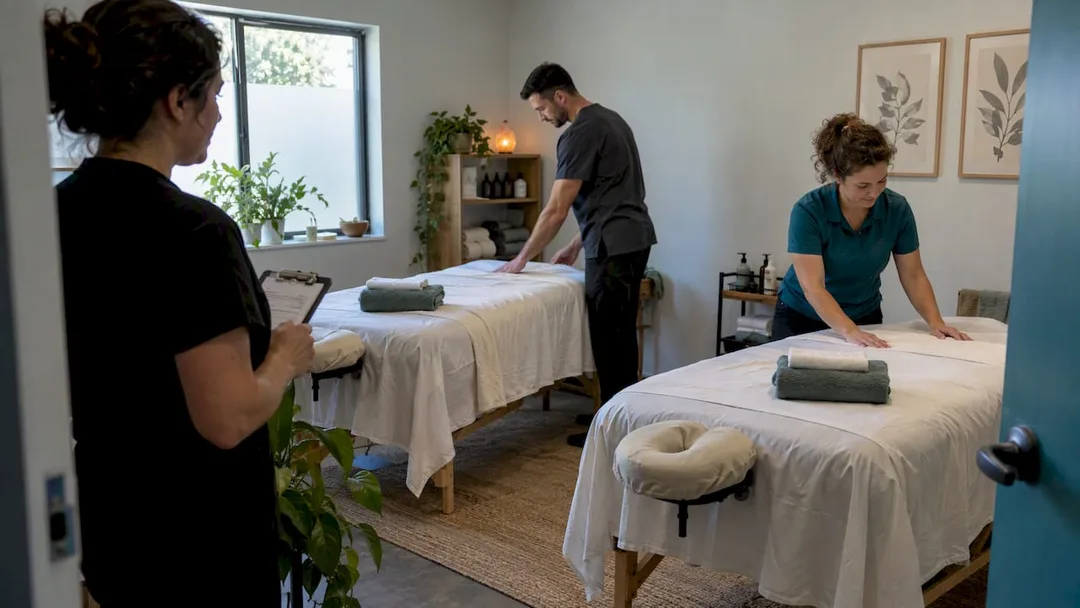
Table of Contents
- Beyond the Basics: Essential Features for Couples Booking Software
- Your Operational Playbook: Setting Up Couples Workflows
- Stress-Testing Your System: What to Check Before You Trust It
- Subscription Costs & Setup Timelines: What to Expect
- The Client Journey: From Click to Couples Session
- Pricing, Deposits, and Clear Cancellation Policies
- The Australian Mandate: Legal & Privacy for Paired Bookings
- Seamless Payments: Joint, Deposits, and Occasional Splits
- Why Smart Pairing Rules are Your Studio's Best Friend
- Revively: Your Partner in Flawless Couples Scheduling
- Need More Help? Resources for Configuration
- FAQs
Beyond the Basics: Essential Features for Couples Booking Software
Before you commit to any software, or worse, try to cobble together a manual workaround, scrutinise its capabilities. Missing even one of these features means your reception team will inevitably be stuck double-checking bookings by hand - which defeats the entire purpose of having a scheduler in the first place.
- Paired or Linked Appointments: This is the non-negotiable. The system must book two practitioners and any necessary shared room in a single entry, not two separate ones that could easily clash.
- Multi-Resource Grid View: Staff and rooms need to appear on the same calendar. A conflict should be glaringly obvious at a glance, not hidden across different tabs or screens.
- Service-Level Turnover Buffers: Cleaning and reset time isn't an afterthought. It's automatically attached to the couples service itself, guaranteeing enough time between appointments and removing the burden of staff remembering to block it out.
- Clear Edit and Cancellation Rules: Your system needs to intelligently define what happens to the paired half of a booking when one side is changed, cancelled, or refunded. No silent mismatches allowed.
- Role-Based Permissions: Empower your reception team to reschedule or swap staff within pre-defined limits, while ensuring broader changes to pricing or policy remain with management.
- Booking Portal Flexibility: Offer a single, streamlined checkout for both attendees, or allow two linked bookings that display as one cohesive entry on the staff calendar.
- Waitlist Behaviour for Limited-Capacity Offers: If you run popular couples classes or offers, the system should gracefully handle what happens if only one half of a paired slot frees up - preventing solo clients from inadvertently booking a couples experience.
Pro Tip: Don't just take a demo at face value. Test the edit and cancellation rules yourself before launch, not after the first real couples booking unravels.
The synchronicity of room and staff pairing is as critical as the booking itself. A studio that books two therapists but forgets to lock down the shared room resource will inevitably double-book that room during a peak weekend. Revively's multi-resource scheduling is engineered precisely to close that gap, tightly tying staff, rooms, and those essential buffers to the same booking record.
Beyond the backend, the design of your public booking portal significantly impacts conversion. A single booking flow where both attendees' details are captured in one seamless checkout tends to slash abandoned bookings. Why? Because the customer only needs to fill in details once, rather than trying to coordinate two separate transactions.
Your Operational Playbook: Setting Up Couples Workflows
Once you've confirmed your chosen software boasts the essential features, configuring your couples services follows a fairly fixed sequence. Skipping steps here is the most common reason paired bookings become unpredictable.
- Create a Bundled Couples Service: This service should automatically reserve two practitioner slots and the shared room resource as a single, indivisible booking unit.
- Set a Service-Level Turnover Buffer: Attach a turnover buffer directly to the service rule itself (typically 10 to 20 minutes, depending on treatment length). This ensures it applies every single time, regardless of which staff members are rostered on.
- Configure Staff Pairing Rules: Designate a primary and secondary therapist, or enable auto-assign with a clear manual override for those inevitable roster changes.
- Lock Room & Resource Availability: Implement multi-resource blocking across every location where the service runs, explicitly stopping overlapping reservations.
- Decide the Client-Facing Flow: Will it be one simple checkout for both attendees, or two synced bookings that appear as a single entry on staff calendars? Choose what works best for your clients and your team.
- Define Robust Cancellation & Partial-Reschedule Policies: Map these directly to your refund rules and any digital intake forms the couple needs to complete beforehand. This clarity prevents disputes down the line.
- Activate Automated Notifications & Develop a Clear SOP: Turn on automated confirmations and reminders. Crucially, write a concise Standard Operating Procedure for your reception team covering common edits and staff swaps.
Pro Tip: Always mark one therapist as primary and one as secondary on every couples service. Auto-assign handles the everyday, but the manual override covers those last-minute roster changes that always pop up.
Attaching the turnover buffer directly to the service rule, rather than relying on staff memory, is arguably the single most impactful change you can make to prevent scheduling gaps. A calendar can appear fully available, yet a room still requires resetting. That small gap is where late starts, client irritation, and operational headaches often originate. Revively's guide to multi-resource booking dives deep into this exact configuration for Australian studios managing shared rooms and equipment.

Stress-Testing Your System: What to Check Before You Trust It
A shiny demo only shows you the calendar working when everything goes perfectly. It's the exceptions that truly reveal whether your configuration holds up under pressure. Don't skip these critical tests:
- Single-Side Edit: Change one attendee's time. Does the other half of the booking intelligently move with it, or at least flag for review, instead of silently becoming mismatched?
- Staff Swap: Replace the primary therapist. Does the room and the second therapist's slot remain perfectly intact?
- Room Change: Move the entire appointment to a different room. Does the old room release immediately, becoming available for new bookings?
- Early Finish & Overlap: Pretend one treatment finishes early. Does the system prevent the room from being opened up before the buffer period properly ends?
- Single No-Show: One attendee doesn't arrive. Confirm the booking, payment, and refund logic correctly handle just that half without automatically cancelling the entire session.
Don't forget the waitlist test. If you offer couples classes or limited-capacity couples deals, and a cancellation occurs, check what the system does if only one seat in a paired slot becomes free. Promoting a solo customer into a couples slot can lead to a booking neither party wanted.
Australian Insight: Reducing no-shows through better reminders and clearer cancellation policies is a well-documented lever for service businesses here in Australia. One local playbook reported reductions of a massive 19% to 34% depending on the tactics used. For paired bookings, a clear no-show policy matters twice as much, as one absence still impacts a room and a second therapist's time.
After launch, rigorously track conflict counts, manual overrides, reschedule rates, and room utilisation for 30 to 90 days. Equip your reception with a concise written SOP: when an edit does create a conflict, who fixes it, and exactly what the client is told while it's being sorted.
Subscription Costs & Setup Timelines: What to Expect
The good news? Most Australian studios can configure a new couples service, along with its buffers and staff pairing rules, within a single day - provided the underlying scheduler natively supports multi-resource bookings. The bulk of your time will actually be spent deciding your studio's specific policies (like cancellation windows and refund rules), rather than on the technical setup itself.
Studio scheduling software is typically billed monthly or annually, with tiers based on team size and feature depth, not the number of couples bookings you run. Expect entry-level plans to cover core scheduling and paired appointments, with higher tiers offering advanced automations, additional locations, or more staff seats. Opting for annual billing often works out cheaper per month, a smart move if you're embedding a service structure you plan to keep long-term.
Since a couples service is simply one service type within your broader scheduling system, there's no separate "couples booking" fee to budget for. The cost seamlessly integrates into your existing scheduling subscription, with add-ons only if you need more staff seats or locations than your base plan includes.
The Client Journey: From Click to Couples Session
A typical couples booking kicks off when clients discover the service on your studio's public booking portal and select an available time. In a single-checkout flow (which we highly recommend), they enter both attendees' details and complete payment in one smooth transaction. If you're using a two-booking flow, clients either book twice, or your staff manually links the two bookings behind the scenes.
Confirmation and reminder notifications should then automatically wing their way to both clients, ideally including any digital intake forms they both need to complete before arrival. Studios that mandate forms in advance generally enjoy far smoother check-ins; your reception team won't be scrambling with paperwork while an eager couple waits in your foyer.
On the day, both practitioners and the room should be seamlessly reserved, eliminating the need for your reception to cross-check separate calendars. Should a last-minute change occur - a staff swap, a room reassignment - your booking system must reflect it immediately, removing any reliance on hurried phone calls between reception and the treatment room.
Pricing, Deposits, and Clear Cancellation Policies
Couples services are typically priced as a single line item covering both attendees, rather than as two individual treatment prices added together. This reflects that the room and staff time are booked as one cohesive package. Some studios even price the couples service at a slight premium over two combined individual treatments, acknowledging the enhanced coordination and room exclusivity involved.
Deposits are particularly common for couples bookings, and for good reason: a no-show impacts two staff members and a shared room, not just one. A percentage-based deposit or a fixed amount taken at the time of booking is the most common approach, with the balance settled upon arrival or automatically after the appointment.
Cancellation fees usually apply on a sliding scale: a full refund for cancellations outside a set window, a partial refund or credit closer to the appointment, and no refund for same-day cancellations or no-shows. Any discounts, when offered, are best structured as a fixed percentage off the bundled couples price, rather than stackable discounts on each individual treatment. This keeps the pricing logic refreshingly simple for both your reception team and your booking system.
The Australian Mandate: Legal & Privacy for Paired Bookings
This section is non-negotiable for Australian studios. Couples bookings involve the personal, and often sensitive health-related, information of two individuals tied to the same booking record. This amplifies your existing privacy obligations under Australian law.
Here's what you must consider:
- Australian Data Residency & Privacy: Revively ensures that all client data - booking histories, payment details, and sensitive health intake forms - is stored locally within Australia. This guarantees full compliance with the strict Australian Privacy Principles (APPs) outlined in the Privacy Act 1988 (Cth). You need peace of mind that your clients' sensitive information isn't floating offshore.
- Consent and Data Capture: When one attendee books on behalf of both, your booking portal must capture explicit consent and contact details for the second attendee directly, where possible. Never rely on the first person to relay crucial information accurately. This is especially vital for medical intake forms, where an allergy or contraindication for the second person needs to reach the treating therapist directly and officially.
- Clear Terms: Refund and cancellation terms must be stated clearly and conspicuously at the point of booking. Since paired appointments often involve a deposit covering two people, disputes are far harder to resolve if the policy wasn't plainly visible before payment.
Crucial Compliance Blockquote:
"For Australian wellness and fitness studios, ensuring client data is stored locally within Australia and fully complies with the Australian Privacy Principles (APPs) is not optional. It's fundamental to building client trust and maintaining legal integrity. Your software choice must guarantee this level of data security and residency."
If you're ever unsure how a specific privacy or consumer law obligation applies to your studio, consult a professional adviser familiar with your state's requirements. Don't assume a generic policy from overseas software covers your specific needs here in Australia.
Seamless Payments: Joint, Deposits, and Occasional Splits
Most couples bookings are paid as a single transaction, using one card or payment method to cover both attendees. This should be seamlessly integrated through your studio's existing payment processor, not a clunky, separate system for paired services. Stripe-based payment integrations, common across many modern studio scheduling platforms like Revively, support this naturally because the booking is already treated as one holistic record.
Deposits work the same way: a single deposit charge at the time of booking, securely held against the combined appointment, with the balance settled on the day of service. This avoids the administrative overhead of chasing two separate partial-payments for what is, functionally, one booking.
Split payments, where each attendee pays their own half, are less common but do get requested occasionally. If your booking system supports splitting a single invoice between two payment methods, you can offer this as an option. However, be aware that it introduces a small amount of complexity at checkout that most studios choose to avoid unless specifically asked by clients.
Why Smart Pairing Rules are Your Studio's Best Friend
Here's the blunt truth: manual pairing almost always fails the same way. Someone books the room, someone else books the therapist, and nobody cross-checks both at once until there's a frustrating clash on the day. The fix isn't "more diligence" from your already busy reception team; it's a booking engine that enforces these crucial constraints automatically.
Once pairing rules are configured properly, the transformation is immediate: double bookings plummet, your reception team spends significantly less time frantically cross-checking calendars, and staff schedules read clearly without scribbled side notes explaining who's covering for whom. Keep a close eye on the system for the first few weeks after launch. This initial period will reveal any edge cases that real bookings uncover, allowing you to fine-tune buffer times or pairing rules.
| Manual Couples Booking Woes | Automated (Revively) Benefits |
|---|---|
| Room Conflicts | Simultaneous resource locking |
| Staff Overlaps | Linked practitioner assignments |
| Client Frustration | Seamless, single checkout flow |
| Admin Headaches | Automated buffer & policy enforcement |
| BAS/GST Errors | Native Xero integration, auto GST |
Revively: Your Partner in Flawless Couples Scheduling
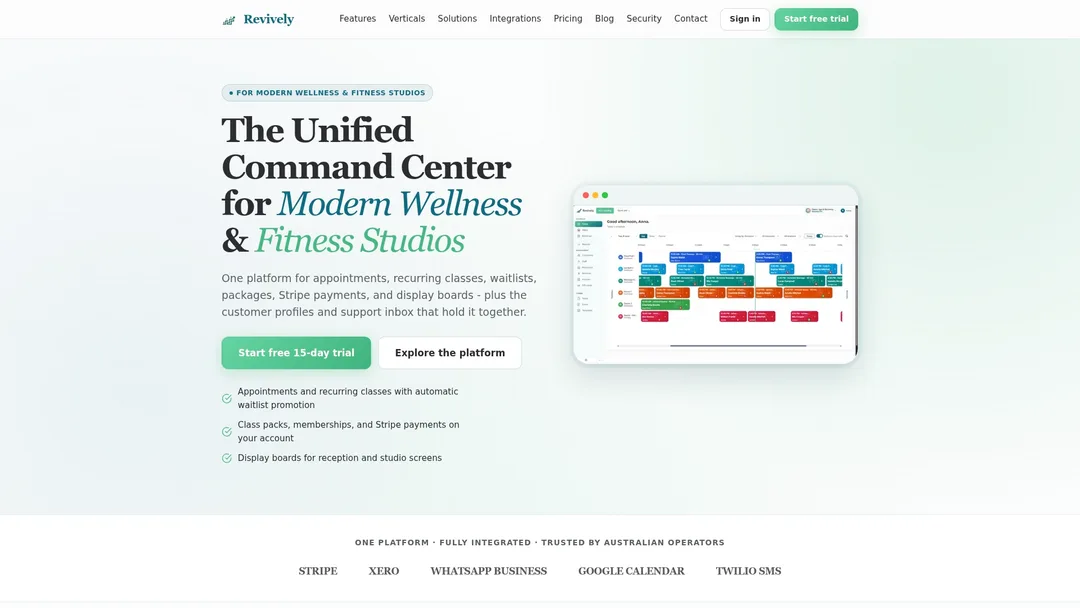
Revively is engineered to map directly onto the comprehensive checklist above. Paired appointments, intuitive multi-resource grids, and precise service-level buffers are fundamentally built into how bookings are structured. This means a couples service in Revively seamlessly reserves both therapists and the room in one entry, eliminating the need for three separate, error-prone checks.
Automated waitlist promotion gracefully handles limited-capacity couple offers, while our native Xero integration keeps your GST and tax reconciliation perfectly aligned with the bookings your Australian studio actually runs - guaranteeing BAS accuracy and audit-proof financial records.
Here's how Revively empowers your Australian studio:
- Paired Appointments & Multi-Resource Grids: Core to our scheduler, ensuring no double bookings.
- Service-Level Turnover Buffers: Set once per service, applied every single time, without fail.
- Automated Waitlist Promotion: Manages couple-class capacity changes without manual intervention.
- Australian-Made Compliance: Client data stored locally (APPs compliant), 10% GST calculations, and legally compliant Australian Tax Invoices.
- Flawless Xero Integration: Automated two-way mapping of tax codes and revenue accounts for perfect BAS.
| Checklist Item | Revively Capability (Australian Context) |
|---|---|
| Paired Staff and Room Booking | Multi-resource appointment grid |
| Turnover Buffers | Service-level cleaning and reset rules |
| Waitlist Handling | Automatic waitlist promotion |
| Australian Tax Reconciliation | Native Xero integration for flawless BAS & GST |
| Australian Data Residency & Privacy | Client data stored locally, APPs compliant |
| Legally Compliant Tax Invoices (AU) | Automatic 10% GST calculation & invoice generation |
Revively plans start at $39 AUD per month for Solo, $99 for Growth, or $199 for Pro, billed monthly or annually. If your studio offers group couple-class experiences alongside one-on-one treatments, our robust class scheduling solution integrates perfectly with the core scheduler. We strongly recommend running the testing checklist from this guide during your trial period to confirm your specific configuration holds up before you rely on it for real bookings.
Need More Help? Resources for Configuration
For deeper setup guidance, explore Revively's comprehensive multi-resource booking guide and our detailed pricing page. For after-hours booking automation, 42Voice's booking agent can handle 24/7 scheduling exceptions with intelligent precision.
FAQs
What software features are absolutely essential for couples massage bookings in Australia?
You need linked or paired appointments that book two practitioners and a shared room in one entry, a multi-resource calendar view, and critically, service-level turnover buffers that don't rely on staff memory. For Australian studios, robust Xero integration for GST and BAS, plus local data residency (APPs compliance) are also non-negotiable.
How should cancellations work for a paired booking?
Define a sliding cancellation policy explicitly tied to a deposit. Offer fuller refunds further from the appointment, with reduced or no refunds for late cancellations or no-shows. The system must allow you to cancel one half of a paired booking without automatically cancelling the entire session unless that's your specific policy choice.
Should couples book through one checkout or two separate bookings?
A single, unified checkout for both attendees generally leads to fewer abandoned bookings and keeps the record much simpler for your reception team. While some studios prefer two linked bookings that display as one entry on staff calendars, the single-checkout flow significantly enhances the client experience.
How much does scheduling software for couples appointments typically cost for an Australian studio?
Couples bookings typically don't carry a separate fee; they're usually a standard service type within your overall scheduling software. Revively's plans, for example, start at $39 AUD per month for Solo, $99 for Growth, or $199 for Pro, with couples scheduling fully included.
How long does it typically take to set up couples massage scheduling?
Most studios can configure the service, its buffers, and staff pairing rules within a single day. The majority of that time is usually spent deciding on your specific cancellation and deposit policies, rather than the technical setup itself.
Recommended Resources
- How to Avoid Double Booking: A Studio Owner's Checklist
- Master Your Space: Why Multi-Resource Scheduling is Non-Negotiable for Australian Wellness Studios
- Stop the Scheduling Chaos: How Australian Studios Can Master Multi-Resource Scheduling (and Stay BAS-Ready)
- Stop the Studio Mayhem: How to Really Reduce Double Bookings (Without More Admin Headaches)