
Make Every Session Pay: 4 Steps to Revenue per Class for Studios
! Instructor leading a full studio class
Revenue per class is total class revenue divided by the number of sessions delivered in a period, and it tells you which slots earn their keep and which don't.
Ever stared at your studio's weekly schedule, knowing some classes are cash cows and others are barely breaking even? That nagging feeling isn't just in your head. Understanding your Revenue per Class (ARC) is the sharpest tool in your kit for optimising profitability, setting smart pricing, and even fairly compensating your instructors. It's not just a number; it's the truth about which slots truly earn their keep.
But here's the kicker: to get an ARC you can actually trust, you need to correctly allocate every dollar from memberships, class packs, and drop-ins to the specific sessions clients attend. Miss this, and you're making decisions based on fuzzy numbers.

Quick Takeaway for Australian Studio Owners:
- Your Revenue per Class (ARC) isn't just a number; it's your early warning system. Benchmark it against local figures (think $150+ per session, but adjust for your unique format and postcode).
- Accuracy is Non-Negotiable: Flawed allocation of membership fees, especially ignoring no-shows or refunds, gives you a dud number. Get this right from the start.
- Automation is Your Ally: Tools that seamlessly connect attendance, payments, and your accounting system (hello, Xero!) are crucial for generating GST-compliant reports and BAS-ready totals, saving you endless reconciliation headaches.
- Size Matters (but not how you think): Smaller studios often see higher ARC due to premium pricing, while larger operations chase volume. Know your model.
- Act Fast, Don't Dither: Weekly monitoring and swift adjustments based on your ARC data empower you to optimise scheduling, pricing, and even refine instructor agreements, keeping your Australian studio thriving.
Table of Contents
- 1. How to calculate revenue per class: formulas and allocation rules
- 2. Step-by-step workflow: spreadsheets and reports you can run right now
- 3. Benchmarks and target revenue-per-class: what good looks like
- 4. Use ARC to prune schedules, set pricing anchors and forecast break-even
- 5. How integrated studio software can automate accurate revenue-per-class reporting
- 6. Comparing revenue per class across studio types and sizes
- 7. Operator perspective: check ARC weekly and act on it fast
- 8. How Revively automates the same calculations and reconciles to Xero
- 9. Primary sources and where to read further
- Sources
- FAQ
1. How to calculate revenue per class: formulas and allocation rules
The raw formula for Revenue per Class (ARC) seems straightforward: Total Class Revenue / Number of Classes Delivered. Easy, right? Not quite. The real magic (and misery) is in the allocation. A reformer Pilates class earns differently to a yoga mat session. Your superstar instructor who consistently packs the room impacts your ARC differently to one building their following.
The Allocation Headache: Unpacking Membership & Class Pack Revenue
Here's where it gets fiddly. Membership fees land as a lump sum, not tagged to individual sessions. You need to convert this. Take a member's weekly or monthly fee, divide it by their typical visits, and voila - you have a per-visit figure to assign. For class packs and workshops, the rule changes: revenue allocates as credits are redeemed, not when the pack is sold. Multi-week workshops? Prorate that fee across each session in the series.
Instructor pay splits? Often a choice: revenue assigned by sessions taught, or a weighted split based on attendance. Pick your method, then stick to it rigidly for consistency.
Common Pitfalls That Tank Your ARC Accuracy
Get this wrong, and every decision about pricing, staffing, and forecasting is built on shaky ground. Watch out for:
- Assuming full capacity: Your studio might have 20 spots, but if only 8 turn up, that's your actual attendance.
- Double-counting memberships: Don't count the fee at sign-up and again at each visit. That's inflating your books.
- Ignoring no-shows & refunds: These silently erode your true revenue. Account for them.
- Inconsistent allocation: Mixing methods between class types? You're comparing apples to kangaroos, not apples to apples.
2. Step-by-step workflow: spreadsheets and reports you can run right now
Before we talk about smart software, let's be real: you can wrestle this data manually. It's more "hard yakka" than elegant, but it works in a pinch. Start by pulling these raw fields from your existing booking system:
- Date, Class ID, Class Name, Instructor
- Attendance Count, Payment Type
- Membership ID, Paid Amount
Then, get ready for some spreadsheet wizardry:
- Price Allocation Column: Create a new column. Use an
IFformula to assign theclass price: casual drop-in rate, your calculated per-visit membership figure, or the prorated class pack value. - Clean Your Data: Filter out cancelled sessions and no-shows. They distort your true class count and inflate your denominator.
- Pivot Table for Revenue: Build a pivot table. Rows: Class, Time Slot, Instructor. Values: Summed Revenue. This shows you who and what is earning.
- Pivot Table for Attendance: Add another pivot for attendance count. This lets you calculate actual revenue per class alongside occupancy in a single view.
If your system has built-in reports, use them. Filter by date, class type, and instructor, but always export the totals. Spreadsheets give you an audit trail that on-screen numbers don't.
Don't Skip Validation: Reconcile to Your BAS
The calculation is only half the battle. Validation is critical. Cross-check your pivot table totals against your payment ledger and, crucially, your BAS figures. Discrepancies often point to missed refunds or a "no-show" wrongly marked as attended.
Aussie Pro Tip: Reconcile these numbers weekly on the same day. Any mismatch will still be fresh in everyone's memory, making it far easier to track down and explain.
3. Benchmarks and target revenue-per-class: what good looks like
Think of your ARC as your studio's early warning system. Industry chatter, especially for yoga and Pilates studios, often hovers around $150 per session as a healthy minimum. But let's be real, that's just a guide. The "right" number for your Australian studio shifts dramatically based on your class format, your postcode, and whether you're a boutique spa or a bustling dance school.
The key takeaway? A session consistently pulling well under that $150 mark isn't usually about the instructor (unless they're consistently empty). It's typically a red flag about the timeslot or your pricing strategy. Don't wait for it to fix itself. Your ARC is telling you to investigate. For a deeper dive into this, check out how revenue per class acts as a studio profitability metric.
What Influences Your Studio's ARC?
Several factors determine whether a class clears your profitability bar:
- True Occupancy: This isn't just about how many spots are available but how many are filled relative to your room's actual capacity.
- Instructor Costs: How does their variable pay stack up against the actual revenue that session brings in?
- Fixed Overheads: Your rent and other fixed costs need to be spread across every single session run in that space.
- Format Premium: Specialised classes - think reformer Pilates, small-group aerial work, or recovery centre sessions - naturally command a higher price point and, therefore, a higher ARC than a standard mat or barre class.
This last point is crucial: comparing ARC figures without accounting for format is a rookie mistake. A nearly empty reformer class can still out-earn a packed mat class purely on its premium price point. Don't mislead yourself.
4. Use ARC to prune schedules, set pricing anchors and forecast break-even
When you truly trust your ARC, it transforms from a mere report into a powerful strategic tool. It helps you make tough calls on scheduling, pricing, and resource allocation - the very core of optimising your multi-resource studio scheduling and all-in-one spa booking software.
Start with understanding client utilisation. Convert those available spots into actual client numbers by factoring in your average visits per member. This tells you exactly how many paying clients each timetable slot needs to break even or turn a profit.
Calculating Break-Even with ARC
A basic break-even analysis ties it all together. Take your fixed monthly costs (rent, utilities, software like Revively), add your variable costs (instructor pay), then divide by your average revenue per client. This reveals how many clients you need to keep on the books just to cover your current schedule.
Strategic Questions Before You Touch the Timetable:
Before you start axing classes or shifting times, ask yourself:
- Is this class consistently below your target occupancy over several weeks, not just one fluke quiet Tuesday?
- Does a flat instructor pay or a revenue-share model make more sense for this specific session, given its typical earnings?
- Is an underperforming class actually in a prime location and time slot? If so, the problem might be your pricing, not the demand.
Be warned: simply adding new slots without genuinely attracting new clients rarely boosts overall revenue. It often just dilutes existing demand and pulls down utilisation across your entire timetable.
Aussie Pro Tip: Before outright cancelling a class, investigate if it's the timeslot or the instructor causing the low ARC. Sometimes, simply moving a class to a different time or assigning a different instructor can salvage more revenue than just cutting it loose.
5. How integrated studio software can automate accurate revenue-per-class reporting
Imagine getting perfectly allocated, BAS-ready ARC reports without wrestling with a single spreadsheet. That's the power of truly integrated all-in-one spa booking software or a Mindbody alternative Australia-made for your business.
A robust automation flow should:
- Automatically process attendance against membership and class pack allocations.
- Calculate precise per-class revenue.
- Report it granularly by time, instructor, and format.
The Revively Difference: Australian Compliance & Seamless Xero Integration
This is where local expertise shines. For Australian studios, seamless Xero integration isn't just a convenience; it's a compliance cornerstone. It closes the financial loop: payments automatically reconcile, and your GST calculations are flawlessly handled. This means 10% GST is correctly applied across casual classes, memberships, and multi-resource packages, and legally compliant Australian Tax Invoices are automatically issued to your clients.
More importantly, our native Xero integration ensures 100% legal tax compliance for your BAS. Automated two-way mapping of tax codes, revenue accounts, and liabilities ensures your quarterly Business Activity Statements are flawless and audit-proof, eliminating manual spreadsheet errors and that pre-BAS panic.
What to Look For in Your Studio Management Platform:
When evaluating multi-resource studio scheduling platforms, demand these capabilities:
| Feature to Prioritise | Why it's Critical for Australian Studios |
|---|---|
| Attendance-to-Revenue Mapping | Ensures membership visits automatically convert to accurate per-class figures, respecting your unique allocation rules. |
| Native Xero Integration | Guarantees BAS reconciliation accuracy with automated two-way mapping of tax codes, revenue, and liabilities. No manual re-entry, ever. |
| Australian Data Residency | Crucial for Australian Privacy Principles (APPs) compliance. All client data, booking histories, and sensitive health intake forms are securely stored locally in Australia. |
| Automatic Waitlist Promotion | Fills cancelled spots instantly, eliminating lost revenue and maximising your ARC without you lifting a finger. |
| Class-Pack Redemption Tracking | Accurately assigns revenue when a credit is used, not when the pack is sold, for a true picture of session performance. |
| GST & Tax Invoice Handling | Handles 10% GST calculations natively and automatically issues legally compliant Australian Tax Invoices to clients. |
Industry analysis confirms that software offering robust per-class reporting and seamless accounting integrations dramatically reduces manual reconciliation time. This frees you up to act on your ARC data faster, making smarter business decisions instead of getting bogged down in number crunching.
6. Comparing revenue per class across studio types and sizes
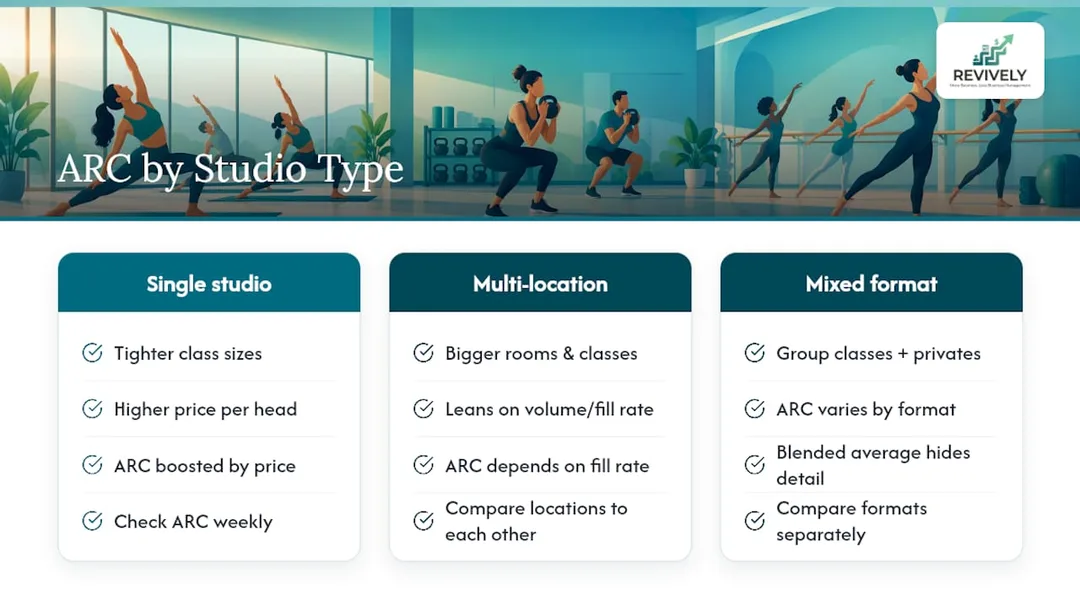
Let's get real: comparing the ARC of a boutique, single-room Pilates studio to a sprawling, multi-location dance school is like comparing apples to mangoes. It misses the whole point. Your most valuable comparison is always against your own studio's history and your specific format mix.
Small Studio vs. Large Operation: Different ARC Drivers
- Boutique & Smaller Studios: Often running with one or two dedicated rooms, these studios thrive on smaller, more intimate class sizes and premium per-head price points. This strategy can drive a higher ARC even with moderate attendance.
- Larger, Multi-Location Operators: Their game is volume. Think bigger rooms, bigger classes. Here, ARC leans heavily on fill rates and efficient multi-resource scheduling rather than just a high individual price tag.
The way you use your ARC also shifts with scale. A single-studio owner might obsess over weekly ARC figures, catching a dip in a specific class before it becomes a trend. A multi-location manager, however, uses ARC to compare performance across locations, quickly pinpointing which site's timetable needs a deeper dive without having to physically visit.
Why Format is King: Don't Blend Your Numbers
A dance studio offering group classes and private lessons will see wildly different ARC figures for each. Blending them into one grand average just obscures the true picture. Segment your data.
For a practical external check, leverage the ATO's small-business benchmarks for health and fitness centres. This allows you to benchmark your labour and rent proportions against turnover ranges for similar-sized Australian businesses, giving you a solid sense of whether your cost structure is competitive.
7. Operator perspective: check ARC weekly and act on it fast
Forget the perfect quarterly report that gathers dust. As an operator, I'd much rather see you check your ARC every single week. Pull those numbers, compare them against your targets, and then - crucially - take one corrective action. Adjust a price. Move a class slot. Have a candid chat with an instructor. Do it before next week's report hits your desk.
Whatever changes you implement, communicate them openly and early. A shifted class time or a repriced pack is always better received as a transparent heads-up than an unwelcome surprise.
"Don't let perfect be the enemy of good enough. Actionable insights beat pristine reports every time." - The Revively Team
8. How Revively automates the same calculations and reconciles to Xero
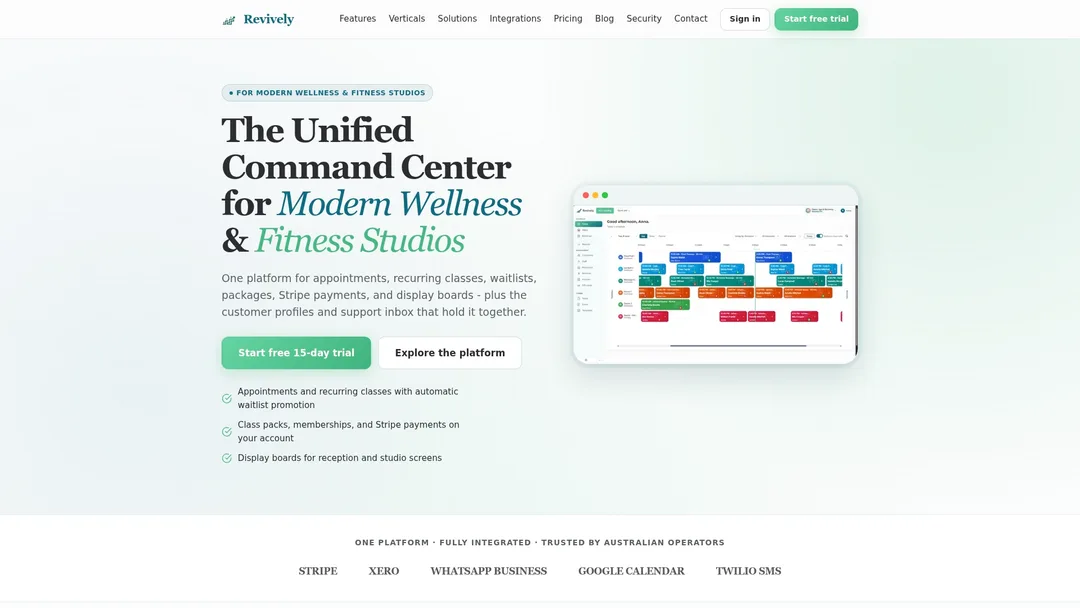
Forget the manual allocation nightmares. Getting a truly trustworthy Revenue per Class (ARC) number, especially one that stands up to ATO scrutiny, demands purpose-built software. Revively.app is your Australian-made, unified cloud command centre (CRM + multi-resource scheduler) designed specifically for wellness and fitness studios across Australia - from spas and recovery centres to yoga, Pilates, clinics, and dance schools.
We handle the intricate allocation for you, delivering precise, GST-compliant ARC figures with zero spreadsheet headaches. Our platform brings together class scheduling, complex membership allocation, and automatic waitlist promotion onto one intuitive dashboard. But the real game-changer for Australian operators? Our native Xero integration.
Why Revively's Xero Integration is a Game Changer for Your BAS:
At BAS time, you need absolute confidence that your session-level revenue perfectly matches what's landed in your accounts. Revively's integration provides:
- Flawless GST & Tax Invoice Handling: We natively handle 10% GST calculations across every casual class, membership, and multi-resource package. This includes automatically issuing legally compliant Australian Tax Invoices to your clients.
- 100% Legal Xero Integration for BAS Accuracy: Our automated, two-way mapping of tax codes, revenue accounts, and liabilities ensures your quarterly Business Activity Statements are flawless and audit-proof. No more manual re-entry errors or frantic reconciliation.
- Australian Data Residency & Privacy: All your client data, booking histories, and sensitive health intake forms are stored securely and locally in Australia, fully complying with the Australian Privacy Principles (APPs). This isn't just a feature; it's a foundation of trust for your Australian business.
When you switch to Revively, you get granular reporting that breaks down revenue by class, instructor, and time slot. Membership and class-pack allocation happens automatically as attendance is recorded, and waitlist promotion actively fills cancelled spots, directly boosting your ARC.
Ready to optimise your studio's profitability the smart, compliant way? Explore Revively's pricing or dive into our robust class scheduling features directly. For studios navigating the tightrope between class packs and memberships, our guide on how class packs might be undermining your memberships is essential reading before you finalise those allocation rules.
9. Primary sources and where to read further
To deepen your understanding of these crucial metrics and ensure your studio remains compliant and profitable, start with these authoritative resources.
Sources
- Health and fitness centres | Australian Taxation Office
- Revenue Per Class: Key Yoga Studio Profitability Metric | Yoga Studio Insider
FAQ
What are the main revenue streams for an Australian wellness studio?
Studios typically earn from memberships, class packs, and drop-in or casual bookings, each needing its own allocation rule when calculating Revenue per Class (ARC). Some studios add a fourth stream from workshops or private sessions, which should be tracked separately from group class revenue.
What's a good revenue per employee ratio for an Australian studio?
There's no single instructor-revenue ratio that applies across formats and studio sizes, so it's best assessed against your own cost structure rather than a generic figure. The ATO's benchmarks for health and fitness centres are a more reliable starting point, comparing labour costs as a proportion of turnover for businesses your size.
What does "revenue per person" signify in a studio class?
Revenue per person usually means the average amount a single attendee generates in a class, calculated by dividing total class revenue by attendance count. It's a useful companion to Revenue per Class (ARC) because it separates pricing performance from occupancy performance.
What's the core formula for Revenue per Class (ARC)?
Revenue per Class (ARC) equals total class revenue divided by the number of classes delivered in the period, with membership revenue converted to a per-visit figure first. Industry guidance on revenue per class treats this as the baseline calculation before breaking results down by instructor or class type.
Recommended
- Stop the Revenue Drain: Are Your Class Packs Undermining Your Memberships?
- The Real Cost of Half-Empty Classes: Why Australian Studios Need to Master Attendance Rates
- Drowning in Spreadsheets? How Smart Studios Sell Prepaid Treatment Packages Online (The Aussie Way)
- Ditching Spreadsheet Chaos: Your Australian Studio's Guide to Seamless Stripe Membership Billing