
Start With 5 Studio KPIs: Measure, Review Weekly, and Unify Data
! Studio manager reviewing weekly KPI dashboard
Start with five: utilisation rate, revenue per available hour, client retention rate, on-time delivery rate, and invoice cycle time (DSO).
Your studio runs on passion, expertise, and a whole lot of hustle. But let's be honest, sometimes it feels like you're flying blind, making big decisions based on a 'gut feeling' or a patchwork of spreadsheets. Empty class slots? Cash flow slowing down? Instructor burnout? These aren't just 'feelings'; they're flashing red lights screaming for attention.
That's where Key Performance Indicators (KPIs) come in. Not a dozen abstract numbers, but a sharp, focused handful designed to cut through the noise and show you exactly where to optimise your operation. Forget the corporate jargon. We're talking about the five core metrics that actually sink - or save - most Australian wellness and fitness studios: wasted capacity and sluggish cash flow.
Start with just five: utilisation rate, revenue per available hour, client retention rate, on-time delivery rate, and invoice cycle time (DSO). Pick the one that's causing the most immediate pain, track it weekly, and only layer in the others once you've got a handle on the first. This isn't about collecting data for data's sake; it's about making smarter, faster decisions for your studio.

The Quick Scan for Busy Studio Owners:
- Cut the Chaos: Stop guessing. Focus on 3-5 high-impact KPIs like utilisation, revenue per available hour, and invoice cycle time to tackle core issues like wasted resources and slow cash.
- Ownership & Rhythm: Every KPI needs a clear owner and a consistent review schedule. This isn't a 'set it and forget it' exercise; it's about creating an actionable feedback loop.
- Australian-Made Confidence: With Revively, your client data is secured locally, compliant with Australian Privacy Principles (APPs). GST is calculated flawlessly, and legally compliant tax invoices are issued automatically.
- BAS Bliss with Xero: Revively's Xero integration guarantees audit-proof BAS via automated two-way mapping of tax codes and revenue, wiping out manual spreadsheet errors and ensuring 100% legal tax compliance.
- One Source of Truth: A unified platform like Revively pulls data automatically from bookings, payments, and accounting, eliminating manual reconciliation headaches and boosting KPI accuracy.
Table of Contents
- What are studio KPIs and why do they matter?
- The KPIs studios actually need, by domain
- How do you choose which KPIs to track first?
- How should you track and report studio KPIs?
- What goes wrong when studios implement KPIs?
- What does a unified studio dashboard actually look like?
- Why metrics should support judgement, not replace it
- Put your studio KPIs on autopilot with Revively
- Sources
- FAQ
What are Studio KPIs and Why Do They Matter for Your Australian Business?
A KPI isn't just any number; it's a Key Performance Indicator. The "key" is crucial. It's a specific, measurable metric directly tied to a business outcome and, critically, to a decision you need to make. For an Australian yoga studio, that means knowing your average class attendance or revenue per available hour, not just "feeling" like Tuesdays are a bit slow.
Adobe's research on creative-team metrics highlights a universal truth: KPIs move businesses from subjective 'gut feel' to measurable, actionable outcomes. A studio owner who sees Tuesday evening's utilisation rate consistently dip below 50% isn't guessing; they're armed with the data to reschedule, re-market, or even cut that class. This isn't about micromanaging; it's about informed strategy.
Most studios trip up by mixing their KPI 'layers'. Understanding where each metric sits helps you decide who looks at it and how often:
- Strategic KPIs: These are the big-picture numbers. Think revenue growth, client retention, or overall profit margin. The owner checks these monthly or quarterly to gauge the studio's health.
- Tactical KPIs: Tracking a specific program or team. What's the fill rate for that new Pilates reformer program? How's that therapist's rebooking rate? Managers or team leads review these.
- Operational KPIs: The daily grind. Room utilisation, no-show rates, staff rostering gaps. The person running the floor needs to glance at these weekly, or even daily, to keep things humming.
As various studio management guides point out, separating these layers stops you from trying to fix a quarterly cash-flow problem with a last-minute roster change. Know the layer, know the owner, know the cadence.
The KPIs Australian Studios Actually Need, by Domain
Different parts of your studio present unique challenges. Here's a practical set of KPIs, complete with formulas and a hint at what action to take when the numbers aren't looking good.
-
Utilisation Rate:
- Formula: (Booked Hours ÷ Available Hours) x 100
- Cadence: Weekly
- Why it matters: Your most valuable asset is your time and space. Low utilisation often signals a mismatch between your schedule and client demand.
- Action: Reschedule classes, adjust therapist hours, or consider new offerings. For example, a low rate in a yoga studio might mean 6 AM is too early, not that nobody wants yoga.
-
Attendance Rate:
- Formula: (Actual Attendees ÷ Bookings) x 100
- Cadence: Weekly
- Why it matters: High bookings with low attendance? You have a no-show problem, not a demand problem.
- Action: Implement stricter cancellation policies, require deposits, or send more effective automated reminders.
-
Booking Conversion Rate:
- Formula: (Completed Bookings ÷ Enquiries/Website Visitors) x 100
- Cadence: Monthly
- Why it matters: Plenty of traffic to your website or calls, but few actual sign-ups? There's friction in your booking process.
- Action: Simplify your online booking flow, clarify pricing, or improve your front-desk conversion script.
-
Revenue Per Available Hour (RPAH):
- Formula: Total Revenue ÷ Total Bookable Hours
- Cadence: Monthly
- Why it matters: The single best profitability signal for any studio selling fixed-capacity classes or rooms. This includes GST, giving you a clear picture of your actual takings.
- Action: Adjust pricing, optimise your schedule for peak times, or cross-sell higher-value services.
-
Class/Service Profitability Margin:
- Formula: ((Class Revenue - Direct Costs) ÷ Class Revenue) x 100
- Cadence: Monthly
- Why it matters: Popular classes aren't always profitable ones. Direct costs include instructor pay, room hire, and any consumables.
- Action: Review instructor rates, optimise class sizes, or adjust pricing for underperforming classes.
-
Days Sales Outstanding (DSO):
- Formula: (Accounts Receivable ÷ Average Daily Sales)
- Cadence: Monthly
- Why it matters: A rising DSO is an early warning sign of slow cash flow, which can cripple a small business.
- Action: Tighten payment terms, send automated invoice reminders, or offer upfront package discounts. This is where seamless GST-compliant invoicing is critical.
-
On-Time Delivery Rate:
- Formula: (Sessions/Projects Delivered on Schedule ÷ Total) x 100
- Cadence: Monthly
- Why it matters: Crucial for spas running treatment packages or dance schools with performance deadlines. Delays frustrate clients and impact your reputation.
- Action: Improve scheduling, clarify client expectations, or review staff capacity.
-
Staff Turnover Rate:
- Formula: (Departures ÷ Average Headcount) x 100
- Cadence: Quarterly
- Why it matters: High instructor churn silently erodes client retention and studio culture long before it hits your revenue line. The cost of replacing staff in Australia can be significant.
- Action: Invest in staff development, review compensation, improve workplace culture, or optimise scheduling to prevent burnout.
Quick Benchmark: Most practitioner guides for wellness and fitness studios consistently flag utilisation rate, revenue per available hour, class/service profitability, client retention, and invoice cycle time as the five non-negotiable metrics for sustainable growth.
How Do You Choose Which KPIs to Track First?
Don't dive headfirst into a spreadsheet full of numbers. Follow a structured approach to ensure your chosen KPIs actually drive results, rather than just adding to your to-do list.
- Identify the Core Pain Point: What's genuinely keeping you up at night? Empty class slots? Clients paying late? High staff churn? Name the actual problem before you even think about a metric.
- Define Your Desired Outcome: What does "success" look like for that pain point? More filled sessions? Faster cash collection? Higher client loyalty? Clear outcomes lead to clear KPIs.
- Start Small: 3-5 KPIs, Max. Practitioner guidance on studio metrics is clear: studios trying to track dozens of numbers end up acting on none. Overwhelm is the enemy of action.
- Assign Ownership and Cadence: A KPI without a named owner is a number nobody is accountable for. Decide who owns it and how often it will be reviewed (daily, weekly, monthly).
Think of it as a pilot program. Run this process for 8-12 weeks focusing on just one area - maybe scheduling or finance. Only once that first set of metrics shows a stable trend and your team has a routine for reviewing them should you even consider adding more.
Your Essential KPI Governance Checklist:
| Element | Description | Why it Matters |
|---|---|---|
| Clear Definition | One agreed, written-down definition for each KPI, leaving zero room for interpretation. | Ensures everyone's speaking the same language. "Utilisation rate" needs to mean the same to your front-desk team as it does to your accountant. |
| Single Data Source | Data is pulled from one reliable, unified system, not manually reconciled from three different spreadsheets. | Eliminates discrepancies, reduces manual errors, and builds trust in the numbers. |
| Named Owner | A specific person is accountable for tracking and reporting the KPI, and for initiating action if needed. | Drives accountability and ensures someone is always keeping an eye on the ball. |
| Review Cadence | A set, consistent frequency for reviewing the KPI (e.g., weekly, monthly, quarterly). | Establishes a routine, prevents numbers from being ignored, and aligns with the KPI's operational/strategic layer. |
| Target Range | Don't just track the number; know what "good" and "needs attention" look like. | Provides context. A 70% utilisation rate isn't good or bad until you know your target is 80%. |
| Action Trigger | A named person or team is responsible for acting when the KPI falls outside its target range. | Turns data into decisions. Without this, KPIs are just interesting figures, not drivers of change. |
How Should You Track and Report Studio KPIs?
A powerful studio dashboard doesn't need to be complex. It just needs to be clear, actionable, and reliable. Think of it as your studio's pulse-check.
Every effective KPI report needs four things:
- The Headline Number: The current status of your metric.
- A Trend Line: Shows movement over the last several weeks or months. Is it improving or worsening?
- A Threshold: Clearly marks "good" versus "needs attention."
- A Note on Action: What was done the last time this number moved significantly? This keeps the conversation focused on solutions.

As Adobe suggests for creative teams, every number on your dashboard should lead to a named action, not just sit there gathering dust.
Different KPIs naturally lend themselves to different reporting rhythms:
- Daily: Attendance rates, no-show rates (especially vital for spas with tight appointment slots).
- Weekly: Utilisation rates, booking conversion, last-minute cancellations.
- Monthly: Revenue per available hour, class/service profitability margins, Days Sales Outstanding (DSO), leads generated.
- Quarterly: Client retention, staff turnover rate, overall revenue growth.
Two formulas worth committing to memory:
- Utilisation Rate = (Booked Hours ÷ Available Hours) x 100
- DSO = Accounts Receivable ÷ Average Daily Sales
When reporting utilisation, always use a rolling four-week window. A single quiet week (hello, school holidays!) can skew a snapshot and send you chasing a problem that doesn't actually exist.
Data hygiene is paramount. Pull your numbers automatically from your booking and payment systems. Resist the urge to manually re-enter data. Run a quick weekly check to ensure the digital totals truly match what happened on the studio floor. This minimises errors and ensures your GST calculations and tax invoices are always precise.
What Goes Wrong When Australian Studios Implement KPIs?
It's easy to get excited about KPIs, but it's even easier to mess them up. Here are the most common pitfalls we see Australian studios fall into:
- KPI Overload: The #1 killer. Tracking too many metrics at once buries the two or three numbers that actually matter under a mountain of noise.
- Inconsistent Definitions: If "attendance rate" means different things to your front desk, your yoga instructor, and your studio manager, every report becomes an argument. Write it down.
- No Accountability: A KPI without a named owner is a number that everybody ignores.
- Chasing Perfection: Don't obsess over hitting a perfect number. Set a simple, actionable threshold instead.
- Lack of Review: KPIs are pointless if nobody reviews them regularly and discusses the implications.
A Crucial Warning: Sustained utilisation above roughly 85% often signals a burnout crisis, not a success story. A perpetually packed timetable with zero roster buffer will exhaust your instructors, lead to mistakes, and inevitably result in high staff turnover. Chasing maximum utilisation as if it's the only scoreboard usually costs studios dearly in staff retention within a year. Prioritise sustainable growth, not just peak capacity.
What Does a Unified Studio Dashboard Actually Look Like for an Australian Studio?
Most KPI headaches boil down to one core issue: your data is scattered. Bookings in one app, payments in another, and accounting cobbled together in a spreadsheet no one truly trusts. This fragmented approach forces constant manual reconciliation - the breeding ground for errors and compliance risks.
Imagine a single, unified cloud command centre (like a genuine Mindbody alternative for Australia) that links everything seamlessly. This removes the manual stitching of utilisation, revenue, and DSO figures, which is precisely where KPI accuracy usually breaks down, especially when factoring in local GST and BAS compliance.
In a unified system, your studio dashboard looks something like this:
- Bookings auto-feed into utilisation and attendance numbers. No more manual tallies; the system knows exactly who booked, who showed up, and what spaces were used.
- Payments and accounting are integrated. This keeps your DSO and cash-flow figures current automatically. Critical for accurate GST reporting and audit-proof Xero integration for BAS accuracy.
- Memberships and class packs provide predictable revenue. These feed directly into your revenue-per-available-hour calculations, giving you a clearer forecast than one-off bookings alone.
- Client data is secured locally. Your client information, booking histories, and sensitive health intake forms reside on Australian servers, fully compliant with the Australian Privacy Principles (APPs). This is non-negotiable for client trust and legal standing.
- GST is handled natively. The system automatically calculates 10% GST on all services, from casual drop-ins to multi-resource packages, and ensures every client receives a legally compliant Australian Tax Invoice.
For a deeper dive into which numbers predict revenue, Revively's guide to the twelve KPIs that actually predict studio revenue is an invaluable companion to your own KPI pilot. It empowers your judgment, rather than replacing it.
Why Metrics Should Support Judgement, Not Replace It
KPIs are powerful tools, designed to sharpen your decisions, not make them for you. A number can tell you your average class size dropped by 15% last month. It can't tell you if that's because it clashed with a public holiday, a popular local event, or if the class content has simply gone stale.
Always keep your KPI conversations open. The instructors, therapists, and front-desk staff closest to the daily operations will spot the "why" behind a number far faster than any dashboard ever could. Use your data to ask better questions, then trust your team's insights and your own expertise to find the answers.
"KPIs guide your focus, but your judgment drives the action." - Andreea (Revively Founder)
Put Your Studio KPIs on Autopilot with Revively
Revively (Revively) was built to solve the precise reconciliation nightmare this article keeps highlighting: bookings, payments, and accounting fragmented across disparate tools. We understand the chaotic reality of running a wellness or fitness studio in Australia, and we've engineered a unified cloud command centre to bring clarity and compliance to your operations.
Here's how Revively puts your essential studio KPIs on autopilot, with an unwavering focus on Australian compliance:
- Unified Data, Seamless Insights: With native multi-resource class scheduling, bookings automatically feed into your utilisation and attendance metrics. No more manual tallies; your dashboard reflects reality in real-time.
- Flawless Australian Financials:
- Native GST Handling: Revively doesn't just process payments; it masters Australian tax. Automatically calculate 10% GST on every casual class, membership, and multi-resource package.
- Automated Tax Invoices: Watch Revively instantly generate and issue legally compliant Australian Tax Invoices to your clients, every single time, without you lifting a finger.
- Audit-Proof Xero Integration: Our direct, two-way Xero integration isn't just a sync; it's a guarantee for your quarterly Business Activity Statements (BAS). Automated mapping of tax codes, revenue accounts, and liabilities ensures your BAS is flawless, audit-proof, and free from those nightmare manual spreadsheet errors.
- Australian Data Residency & Privacy: Your client data, booking histories, and sensitive health intake forms are stored securely on Australian soil. This ensures full compliance with the strict Australian Privacy Principles (APPs), giving you and your clients complete peace of mind.
- Predictable Revenue: If your studio thrives on memberships or class packs, those figures flow directly into your revenue-per-available-hour metrics, offering a far more predictable and actionable financial picture.
- Built-in Stripe Payments: Secure, integrated payment processing means your cash flow figures are always current, making your Days Sales Outstanding (DSO) accurate without a month-end scramble.
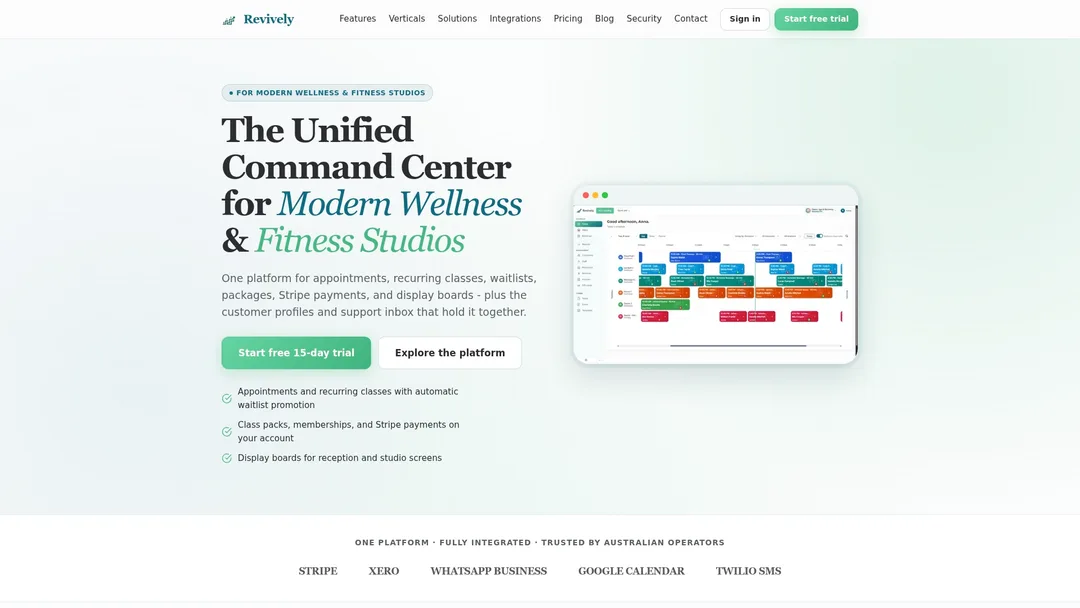
Revively offers tiered subscription plans designed to scale with your team and studio size. Check Revively's pricing page to find the perfect fit for your studio and start optimising your operations today.
Sources
- Key performance indicators creative teams should track
- Studio Management KPIs: 20 Metrics Every Studio Should Track
- 35 KPIs Every Animation Studio Should Be Tracking
FAQ
Got questions about making KPIs work for your Australian studio? Here are some common queries we hear from studio owners.
What are the five main studio KPIs to start with?
To cut through the noise and tackle the most critical operational risks, focus on utilisation rate, revenue per available hour, client retention rate, on-time delivery rate, and invoice cycle time (DSO). These directly address wasted capacity and slow cash flow, two of the biggest threats to studio viability. Start with whichever one is causing the most visible pain in your studio right now.
What are some good KPI examples for a small studio in Australia?
For a lean operation, strong operational KPIs include attendance rate, booking conversion rate, and class profitability margin. Strategically, client retention is paramount for sustainable growth. Practitioner guides consistently highlight these as delivering the highest value for studios of any size, especially when every dollar and client counts.
What are the top KPIs for a studio's sales and bookings?
To truly understand your studio's 'sales' performance, monitor booking conversion rate, revenue per available hour, and your no-show/cancellation rate. Track conversion monthly to spot trends, but keep a weekly eye on utilisation and attendance, as booking-side issues tend to surface faster than overall revenue problems.
What are the key delivery and quality KPIs for a studio?
To ensure client satisfaction and operational excellence, standard indicators include on-time delivery rate, revision rounds per project (if applicable for bespoke services), and first-time-right rate. These metrics, recommended by industry resources, help you pinpoint process breakdowns before they impact client retention. A high number of revisions, for instance, often points to a briefing gap rather than a skills issue.
How much does Revively cost for a studio in Australia?
Revively offers flexible, tiered subscription plans to suit studios of all sizes. The Solo plan starts at $39 AUD per month, Growth at $99 AUD per month, and Pro at $199 AUD per month. All pricing details, including annual billing discounts, are transparently available on Revively's pricing page.
Recommended for Your Australian Studio
Dive deeper into optimising your studio operations and profitability with these insightful articles from Revively:
- Stop Flying Blind: 12 Studio KPIs That Actually Predict Your Revenue (and Save Your Sanity)
- Unify Your Empire: How Australian Studios Nail Multi-Location Reporting with a Single Dashboard
- Studio Scheduling Chaos? Your Resource Utilisation Report Holds the Key to a Calmer Roster
- Beyond the Calendar: Your Guide to a Truly Unified Studio Management Platform in Australia