
Quiet Hours for SMS in Australia: Send Times and Opt-Outs
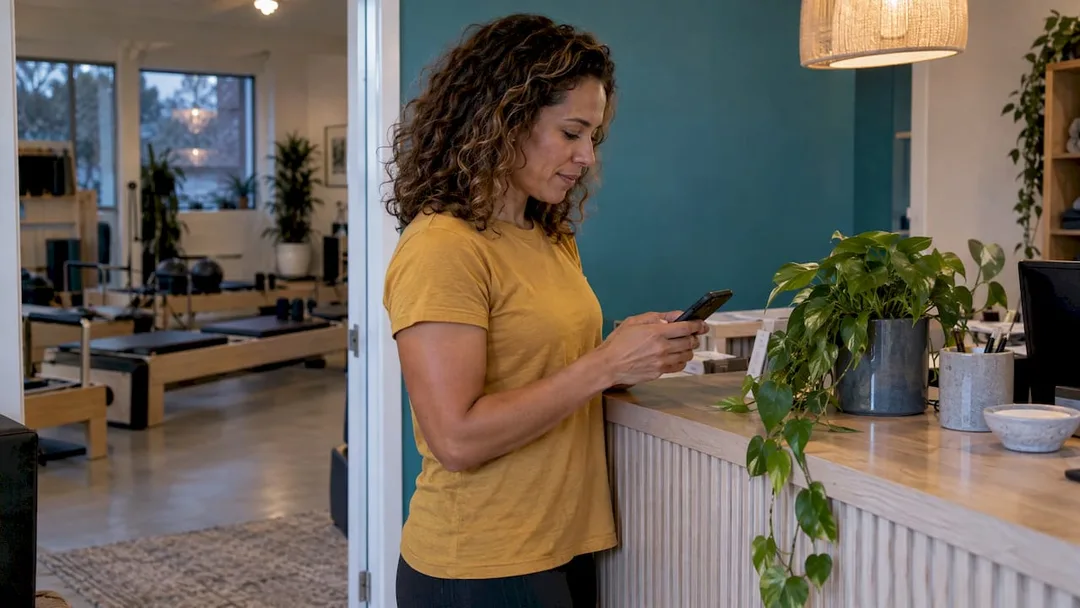
! Studio owner scheduling an early-class text reminder
Australia has no legislated SMS quiet hours.
It's 10 PM. You've finally kicked off your shoes after a back-to-back day of reformer classes, recovery sessions, or dance rehearsals. Just as you're winding down, your phone buzzes - a client. "Did you mean to send that class reminder now? It woke me up!"
Suddenly, you're not just a studio owner; you're an accidental spammer. The guilt hits. You thought you'd set your booking system to send texts at a 'reasonable' hour, but what does 'reasonable' even mean in the wild west of SMS? Especially here in Australia?
You're not alone. Many Australian wellness and fitness studio owners grapple with the murky waters of client communications, desperately trying to balance prompt service with polite boundaries - all while battling a scattered tech stack. This guide cuts through the noise, showing you how to optimise your studio's SMS strategy for both client happiness and rock-solid Australian compliance, no matter if you're a bustling yoga studio, a cutting-edge recovery centre, or a vibrant dance school.
Let's clear this up right now: Australia has no legislated SMS quiet hours. The US-style 8 AM to 9 PM rule? Doesn't apply here. Our ACMA Spam Act focuses on consent, who's sending the message, and providing an easy way to stop receiving them - not the time of day they arrive.
So, while there's no federal 'SMS curfew', your clients certainly have an expectation of considerate timing. And let's be honest, a late-night promo text feels less like an exciting offer and more like an invasion. For Australian studios, that means setting your own sensible send window and having a bulletproof opt-out process.
The Quick Scoop for Busy Studio Owners
- No Legal Curfew: Forget the US rules; Australia doesn't have federal 'quiet hours' for SMS.
- Your Rules, Your Rep: Set your studio's own internal send window and, critically, schedule each text against the client's local time, not your studio's.
- Marketing is Different: Promotional messages always need clear consent, your studio's name, and a working unsubscribe link. Even a subtle upsell can turn a reminder into a marketing message.
- Honour Opt-Outs: Process all unsubscribe requests within 5 working days, and keep a meticulous record of both consent and opt-outs.
- "Do Not Disturb" Isn't an Opt-Out: That's a phone setting on the client's end. It doesn't absolve you from polite timing or compliance rules.
Are There Legal Quiet Hours for SMS in Australia? Nope.
You've probably stumbled upon articles quoting strict SMS quiet hours. Chances are, those are from US sources, where the TCPA (Telephone Consumer Protection Act) has specific time restrictions for marketing texts. Australia has nothing equivalent for SMS. Full stop.
The rules that do apply are under the Spam Act 2003, which the ACMA (Australian Communications and Media Authority) enforces with a no-nonsense approach. This Act covers three non-negotiable pillars:
- Consent: The recipient must have explicitly agreed to receive your messages. No agreement, no text.
- Identification: Your message must clearly state who sent it and include accurate contact details. No mystery senders.
- Unsubscribe: The recipient must have a clear, easy-to-use, and free way to opt out of future messages. No hoops, no logins.
Let's be crystal clear: the absence of a legal curfew isn't a green light for late-night texting. A promotional message pinging a lapsed client at 10 PM is a guaranteed way to rack up opt-outs and damage your reputation faster than a cancelled class.
Crafting Your Studio's SMS Policy: Choosing a Considerate Send Window
Since the law won't draw the line for you, it's up to you to implement a sensible, client-centric policy. Think of it as a crucial part of your studio's customer experience. Here's a smart default for most wellness and fitness studios:
| Message Type | Suggested Timing | Why it Works |
|---|---|---|
| Booking Confirmation | Immediately after booking, any hour | Client has just actively engaged; prompt confirmation is expected and useful. |
| Class/Appointment Reminder | Morning of the day before, or a few hours before for early classes | Gives clients ample time to prepare or cancel, without interrupting late-night routines or early mornings. |
| Waitlist Offer | When spot opens, within daytime window for non-urgent spots; immediately for urgent ones | Balances responsiveness with respect. Urgent spots (class starts in 1 hr) warrant immediate notification. |
| Promotions & Campaigns | Mid-morning to early evening (weekdays); lighter touch on weekends | Targets clients during active hours, avoiding personal time. Weekends often need more consideration. |
| Public Holidays | Reminders only; no campaigns | Respects holiday downtime. Promotions can feel intrusive when people are relaxing or with family. |
A couple of specific scenarios need careful thought:
- Early Bird Classes: That 6 AM Pilates class definitely needs a reminder, but not at 5 AM! Send it the previous afternoon. Clients will check it when they plan their evening, not when they're half-asleep.
- Last-Minute Spots: If a client specifically signed up for a waitlist with the understanding they'd be notified for a class starting in an hour, then yes, send that text. These are the exceptions - time-critical, client-requested updates that directly relate to an immediate action they need to take.
For a deeper dive into timing for reminders specifically, our guide to SMS reminders that work and keep you compliant covers cadence in detail.
Time Zones: Schedule for the Client, Not for You
Australia is a massive continent, spanning multiple time zones, and daylight saving jumps in and out like a rogue kangaroo. What's 8 AM in Sydney is a completely different (and much earlier) time in Perth. This is critical for online classes, retreats, or studios with multiple locations.
The rule is simple: always pick the send window in the recipient's local time, then convert. If your studio operates across states, set messaging windows per location, not just one for your entire business. This meticulous attention to detail is why choosing an all-in-one studio management system built for the Australian context, unlike some overseas Mindbody alternatives, is so vital.

"Do Not Disturb" - What It Means for Your Studio's SMS
This phrase often causes confusion because it refers to two distinct things:
- A Phone Setting: On iPhones, Androids, etc., "Do Not Disturb" (as Apple explains) simply silences calls, alerts, and notifications. Your text still arrives; it just doesn't buzz or light up the screen. Clients using this aren't blocking you, nor does it excuse a 6 AM promotional blast. The message still lands and could be an interruption when they eventually check their phone.
- A Client Request: If a client explicitly says, "Please don't text me in the evenings" or "No messages while I'm on holiday," that's a preference you must act on. Note it on their client profile and respect it. If they ask to stop all marketing messages, treat it as an official unsubscribe and adhere to the 5-working-day processing limit. When in doubt about the wording, send one clarifying email (to a channel they still accept) to understand their preference.
The Opt-Out Imperative: ACMA Rules for Marketing Texts
When it comes to marketing messages, the ACMA's guidance is crystal clear and non-negotiable:
- Always an Option: Every marketing SMS must include a clear, functional unsubscribe option.
- Free & Easy: It must be free (or cost no more than a standard text) and not require logging in, creating an account, or providing extra personal details.
- Long-Lasting: The unsubscribe option must remain active for at least 30 days after you send the message.
- Rapid Action: You must process any unsubscribe request within 5 working days. ACMA reiterates this on its dealing with spam page, confirming that a return SMS is an acceptable method.
Which Keywords to Recognise
ACMA provides "Reply STOP" and "Unsub:" followed by a 1800 number as clear examples. In practice, you should assume variations like STOP, UNSUBSCRIBE, UNSUB, CANCEL, END, and QUIT (case-insensitive, ignoring punctuation) are all valid opt-out requests. And yes, if a client replies "please stop texting me," that's an opt-out too. Common sense, right?
A critical technical point: If your marketing texts appear to come from an alphanumeric sender name (like "REVIVELY_STUDIO"), replies usually can't be received. For opt-out instructions like "Reply STOP" to work, you need to use a dedicated number that can receive replies, or provide an alternative, free, working route (like a freephone number or a direct link to a preference centre).
Identify Yourself Clearly
Every marketing message must include accurate information identifying who authorised it. ACMA stipulates this means your business or legal name and correct contact details. Make it easy for clients: open or close the text with your studio's brand name.
Reminders Versus Marketing: Drawing the Line
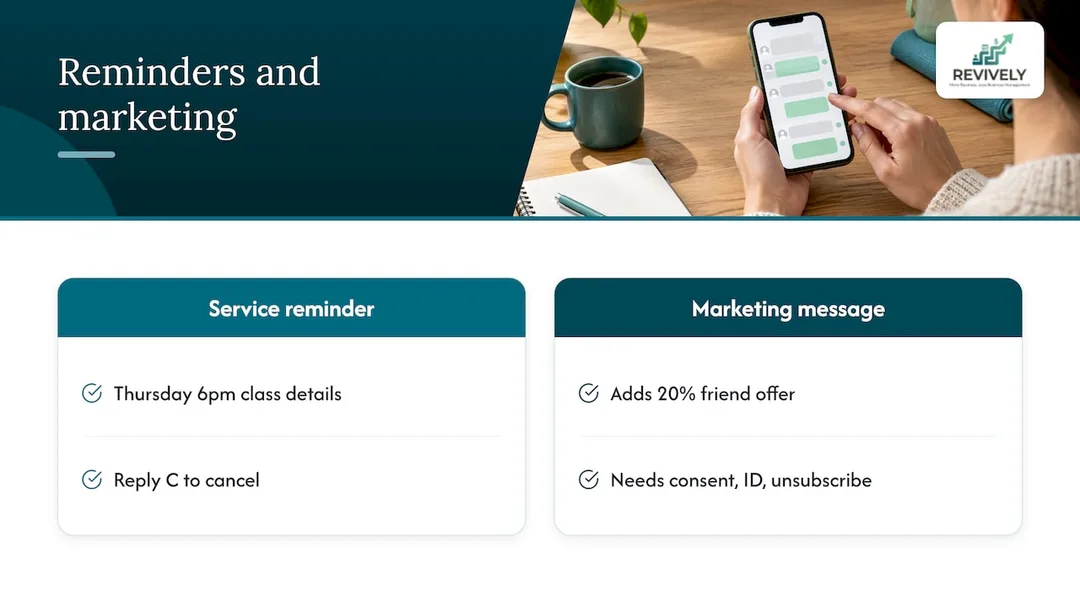
While neither category has quiet hours, the distinction between a service message and a marketing message is crucial for your compliance obligations (consent, identification, unsubscribe). ACMA's consent expectations are broad: a message can be considered commercial if any part of it, including linked content, has a commercial purpose.
Consider this:
"Reformer Pilates, Thursday 6 PM. Reply C to cancel." This is a straightforward service message.
Now, add this: "Book a friend and get 20% off your next session!"
Suddenly, you've got a marketing message that requires explicit consent, clear identification, and an unsubscribe option.
Keep your reminders plain. Save offers and promotions for separate, targeted campaigns sent only to clients who have given clear consent to receive them. Our guide to ACMA compliance for studio SMS goes into much more detail, as does the one on waitlist text notifications.
Consent and Record-Keeping: Your Compliance Backbone
ACMA generally favours express consent and urges caution with inferred consent, especially when the relationship is unclear, the message is unrelated, or the number was only given for a receipt. The best practice? Collect explicit consent where clients are already providing details: at booking, during signup, and on your digital intake form. Use an unticked box with clear wording like, "Yes, send me studio news and offers by SMS."
Crucially, for Australian studios, this client data - consent records, booking history, and sensitive health intake forms - must be stored securely and locally within Australia, fully complying with the Australian Privacy Principles (APPs). This isn't just best practice; it's non-negotiable for trust and legal integrity, ensuring your client's personal information is protected under Australian law.
Keep a meticulous record of when and how each client agreed to receive messages, and when they opted out. Treat SMS consent separately from email consent; a client might want one channel but not the other.
Revively's Approach: Unifying Your Studio's Communication & Compliance
We built Revively for Australian studios, so SMS handling had to fit local rules from the start, not be patched in later.
The pattern we see is fragmentation. Reminders come from one tool, payments from another, client notes sit in a spreadsheet. Then nobody can say what a client agreed to, or whether their opt-out reached every system. Keeping bookings, memberships, waitlists, intake forms, and client profiles on one dashboard makes consent easier to find and easier to honour.
Our advice: write a one-page messaging policy. State your send window, who gets which type of message, which keywords count as an opt-out, and who checks replies. Then make your tools follow it, not the other way around.
Andreea, Co-founder, Revively
This fragmentation is precisely why Revively exists. Imagine a unified cloud command centre (CRM + multi-resource scheduler) where every aspect of your studio's operations and client communication is seamlessly integrated. No more wrestling with disparate systems.
Revively brings scheduling, class packs, memberships, waitlists (with automatic promotion), intake forms, and client profiles together. And when it comes to finances, Revively natively handles all 10% GST calculations across casual classes, memberships, and multi-resource packages, automatically issuing legally compliant Australian Tax Invoices to your clients - no more spreadsheet headaches.
Plus, our seamless, two-way Xero integration maps tax codes, revenue accounts, and liabilities automatically. This ensures your quarterly Business Activity Statements (BAS) are 100% accurate, audit-proof, and completely stress-free, removing manual spreadsheet errors and giving you peace of mind with the ATO.
Our SMS features cover all transactional messages and include a dedicated custom SMS number (just $19 per month). You can ensure consistent, compliant messaging with our powerful email and SMS templates.
Stop juggling platforms and start running your studio with confidence. Revively plans begin at $39 per month for Solo, $99 for Growth, and $199 for Pro (with annual billing options at $390, $990, and $1990). See Revively pricing and discover the peace of mind of an Australian-made, GST-compliant, Xero-integrated solution. Start your free trial today.
Frequently Asked Questions
Is there a legal time I can't text clients in Australia?
No. The Spam Act doesn't specify an SMS curfew. It focuses on consent, sender identification, and unsubscribe options. Your responsibility is to choose a considerate send window and apply it based on the client's local time, not your own.
How fast must I process an SMS unsubscribe?
You must process an unsubscribe request within 5 working days, according to ACMA. However, aiming for the same day is best practice. A delayed processing can mean a client receives a message after they've asked you to stop.
Do I need an unsubscribe line on appointment reminders?
Not for purely service-based reminders. But if that reminder includes any offer, discount, or promotional link, it instantly becomes a commercial message. At that point, consent, clear identification, and an unsubscribe option are all legally required. Always keep your reminders free of promotion.
Does a client's "do not disturb" setting mean they opted out?
No. This is a personal phone setting that silences notifications, as Apple explains. It doesn't prevent your message from arriving and doesn't relieve you of your compliance duties. An explicit written request from a client to stop receiving messages is what constitutes an opt-out.
Sources
- Avoid sending spam | ACMA
- Dealing with spam | ACMA
- Consumer consent: expectations for businesses conducting telemarketing and e-marketing | ACMA
- How to turn Do Not Disturb on or off on your iPhone | Apple Support
More Smart Reads for Your Australian Studio
Looking to fine-tune your messaging strategy and ensure you're always on the right side of ACMA? Dive into these helpful guides:
- Navigating the SMS Minefield: Your Australian Studio's Guide to ACMA Compliance Without the Headaches
- No More Ghosting: The Australian Studio's Guide to SMS Reminders That Actually Work (and Keep You Compliant)
- Sick of Empty Spots? How to Master Waitlist Text Notifications (and Stay ACMA Compliant) in Your Australian Studio
- SMS Confirmations for Appointments That Cut No-Shows