
SMS Opt-In Compliance in Australia: A Guide for Studios
! Studio owner records a client's SMS consent
To text your clients legally in Australia, you need their consent before you send, a working way to opt out in every marketing message, and clear identification of your business.
Picture this: your studio's buzzing, reformer classes are packed, and the waiting list for deep tissue massages is stretching into next month. You're sending out reminders, nudging clients about new classes, and perhaps even celebrating a member anniversary with a cheeky offer. It's all part of keeping your community engaged, right?
But then a little voice creeps in: Am I sending too many messages? Is this legal? What if a client complains to the ACMA?
The truth is, Australia's SMS regulations, primarily the Spam Act 2003, are designed to protect consumers, but for busy studio owners, they can feel like a labyrinth. One wrong move, and you could be facing more than just a disgruntled client; you could be looking at fines and a damaged reputation.
It's not about stifling your communication; it's about making it smart, compliant, and client-centric. Let's cut through the noise and get you sorted.

The Nitty-Gritty, Fast: What Australian Studios Need to Know NOW
Before we dive deep, here's the essential rundown for your yoga, Pilates, dance, or spa studio:
- Consent is King (and you need to prove it): For any marketing SMS, you must have explicit or inferred consent from the recipient. And yes, the ACMA can ask for proof.
- Don't Ask for Consent via SMS: This is a common trip-up. An SMS asking for opt-in is considered a commercial message itself. Collect consent at booking, during intake, or in person.
- Every Marketing Message Needs an Escape Route: A free, simple, and functional unsubscribe option must be present in every marketing text, actioned within 5 business days.
- Mind the Line Between Service & Sale: Booking reminders are fine. Add a discount or promo, and suddenly it's a marketing message, requiring consent and an opt-out.
- Register Your Brand's Sender ID: As of 1 July 2026, if you text from your studio's name (e.g., "Revively Yoga"), that ID needs to be registered. Unregistered IDs risk being flagged as "Unverified," tarnishing your trust.
What Counts as a Commercial Message? The Content, Not the Label, Matters
The ACMA isn't fooled by clever disguises. If your SMS offers, advertises, or promotes a product or service, it falls under the Spam Act. That includes a single line tacked onto an otherwise helpful message.
Think of it this way for your studio:
| Message | ACMA Treatment |
|---|---|
| "Your 6pm Reformer class is tomorrow. Reply C to cancel." | Service Message: Purely informational. |
| "Your massage is booked for Friday 10am. Book a facial too and get 15% off next visit!" | Marketing: Requires consent and unsubscribe. |
| "Term 4 enrolments are open. Secure your child's spot before they fill up!" | Marketing: Promotional. |
| "Your class pack expires in 7 days. Top up now for 10% off your next 10-pack!" | Marketing: Promotional with an incentive. |
| "Welcome! Get ready to sweat in your first Barre class this Saturday. Need a mat? We sell them in-studio!" | Marketing: Even a "welcome" can be commercial if it promotes. |
Even automated "welcome journeys" or confirmation texts can become marketing if they contain commercial content. That confirmation is only safe while it stays a confirmation, not a sales pitch.
Getting Consent Right: Express, Inferred, and the "Don't Text to Ask" Rule
The foundation of compliant SMS communication is consent. Let's break down the two types:
- Express Consent: This is direct and undeniable. A client ticks a clearly labelled box on your online booking form, signs up for your offers via a form on your website, or verbally agrees in person (and you accurately record it). This is your strongest, most defensible position.
- Inferred Consent: This is trickier. It arises from an existing relationship and the client's actions. For example, a client who has booked and paid for classes and provided their mobile number might reasonably expect to receive messages about timetable changes or their current bookings.
Warning: Don't lean on inferred consent for broad promotions or entirely new offerings. It's much harder to defend if challenged, and the evidence is less straightforward to produce. Prioritise express consent wherever possible.
The Evidence Trail You Must Keep
Whatever form of consent you rely on, you need to maintain impeccable records:
- Who & How: The client's name and mobile number.
- When: The precise date and time of consent.
- Where: How they consented (e.g., "online booking form for Intro Offer, 15/05/2026," "front desk sign-up sheet for newsletter, 01/06/2026").
- What They Saw: The exact wording of the consent statement or checkbox they agreed to.
Crucial Point: You cannot send an SMS message to someone asking them if they want to opt-in. The ACMA treats this initial message as a commercial communication itself, which means it already needs consent to be sent! Collect consent at natural touchpoints: your booking process, client intake forms, or when they physically sign up at your studio.
Separating Marketing from Medical: Protecting Sensitive Client Data
Many wellness and fitness studios collect a wealth of personal information: injury history, pregnancy status, medical conditions, and more. In Australia, this is sensitive health information, protected under the Privacy Act and the Australian Privacy Principles (APPs).
Mandate: The Office of the Australian Information Commissioner (OAIC) is clear: do not bundle marketing consent into your general terms and conditions, especially if you're collecting health data. Clients need a distinct, clear choice about receiving promotional messages.
Here's how to get it right:
- Clear Separation: Place the marketing opt-in checkbox on its own line, clearly separated from your core terms or health declarations.
- Unticked by Default: Make sure the marketing consent box is unticked by default. Clients must actively choose to opt-in.
- Transparency: Clearly state what clients will receive (e.g., "Yes, send me class offers and studio news via SMS") and give an indication of frequency if possible.
- No Pressure: Ensure that declining marketing messages has absolutely no impact on their ability to book classes, attend appointments, or access your services.
- Ethical Use: Never use sensitive intake answers (like a specific injury) to target promotions. This breaches privacy principles and erodes trust.
If you're delving into the intricacies of intake forms, our Spa Consent Forms guide offers a complete roadmap for Australian studios. For general two-way texting best practices, this guide for dance studios also offers some great template wording.
Unsubscribe Rules: Making it Easy (and Mandatory) to Opt Out
The ACMA insists that every marketing SMS must include a functioning unsubscribe mechanism. No ifs, buts, or "log in to change preferences."
Here are the non-negotiables:
- Longevity: The unsubscribe facility must remain active and functional for at least 30 days after the message is sent.
- Timeliness: You must process any unsubscribe request within 5 working days. Sooner is always better.
- Cost-Free: Beyond the standard cost of sending a text (if applicable for a reply), the unsubscribe process must be free to the client.
- Frictionless: Clients cannot be required to log in, fill out extensive forms, or provide additional personal details to opt out. It needs to be simple.
Keep the ACMA's email and SMS unsubscribe fact sheet handy for your front-desk team - it's a quick, practical read.
The Sender ID Trap: Why "STOP" Might Not Be Enough
Many studios send texts using a branded sender ID (e.g., "YourStudio" instead of a mobile number). While professional, these often prevent clients from simply replying "STOP." The ACMA has flagged this as a common compliance failure.
If you use a sender ID, your marketing messages must include an alternative, free, and functional opt-out method. This could be a link to an unsubscribe page or a specific mobile number the client can text at no extra charge.
The SMS Sender ID Register: Don't Let Your Brand Be "Unverified"
Big news from 1 July 2026: the SMS Sender ID Register officially applies to all texts sent using an organisation's name. This isn't just for the big end of town; businesses of any size need to register their sender ID through their telco or message provider.
Why does this matter for your studio?
- Trust & Visibility: Unregistered sender IDs can be labelled "Unverified" by telcos. This means your essential class reminders, booking updates, and marketing messages could be grouped with spam or even carry scam warnings, eroding client trust and potentially being ignored.
- Protecting Your Brand: The ACMA frames this register as a vital protection against scams. Being registered isn't just paperwork; it's a tangible way to demonstrate legitimacy and safeguard your studio's reputation.
Don't wait until it's too late. Confirm with your SMS provider today that your sender ID is registered.
Your Studio's Practical Opt-In Checklist: Get Compliant, Stay Compliant
Feeling overwhelmed? Break it down with this actionable checklist:
- Audit All Sign-Up Points: Go through your booking forms, digital intake forms, trial class sign-ups, front desk processes, and any online links (e.g., Instagram bio).
- Implement Separate, Unticked Boxes: For marketing consent, use clear, plain language, and ensure the box is unticked by default.
- Document Everything: For every client, record the date, source, and exact wording of their consent. Store this with their client profile.
- Identify Your Studio Clearly: Every message you send should clearly state who it's from, including contact details.
- Provide a Clear Opt-Out: Ensure an easy, free, and no-login-required opt-out is present in every marketing message, even when using a sender ID.
- Process Opt-Outs Promptly: Aim to action unsubscribe requests immediately, and certainly within the 5-business-day legal limit. Stop all marketing communications to that number.
- Keep Service & Promotional Texts Distinct: Do not mix. Keep reminders clean and informational.
- Verify Your Sender ID Registration: Confirm with your SMS provider that your studio's sender ID is fully registered.
- Review Your Existing Lists: If you can't definitively prove consent for a number, do not send marketing messages to it.
For guidance on crafting effective, compliant SMS reminders, check out The Australian Studio's Guide to SMS Reminders That Actually Work (and Keep You Compliant). And for cutting no-shows, our piece on SMS Confirmations for Appointments That Cut No-Shows is a must-read.
Our View: Why Your Studio Needs One Unified, Compliant Hub
The biggest compliance headaches we see in Australian studios? Fragmentation.
Your online bookings might be handled by one platform, client intake forms on another, your mailing list in a spreadsheet, and SMS messages sent via a third-party tool. When the ACMA comes knocking, asking for proof of consent, this scattered approach becomes a nightmare. Who agreed to what, when, and where? It's impossible to tell.
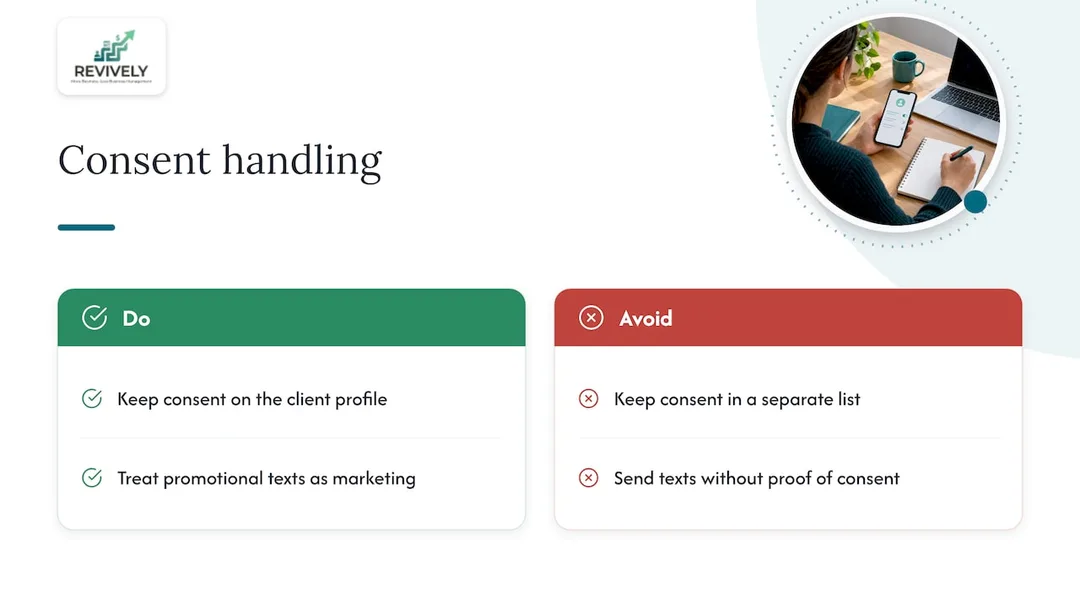
That's why we built Revively. We believe that true operational excellence, and peace of mind, comes from centralisation. Our unified cloud command centre brings online booking, class scheduling, memberships, digital intake forms, and client profiles together on one intuitive dashboard. Your client's consent decision belongs right there on their profile, next to their bookings and health notes, not in a separate, easily outdated list.
Revively isn't just about streamlining your schedule; it's built from the ground up for Australian studio compliance. That means your client data, booking histories, and sensitive health intake forms are stored locally in Australia, fully complying with the Australian Privacy Principles (APPs). We natively handle 10% GST calculations across all services, automatically issuing legally compliant Australian Tax Invoices. Plus, our 100% legal Xero integration ensures automated, two-way mapping of tax codes, revenue accounts, and liabilities for flawless, audit-proof Business Activity Statements (BAS), eliminating manual spreadsheet errors.
The rule we give every studio owner is simple: if a text promotes something, treat it as marketing. And if you can't prove consent, don't send it.
Sending fewer, highly relevant messages to clients who asked to receive them isn't just legally sound; it builds deeper trust and a stronger community. Your clients will notice the difference.
Run Your Entire Studio from One Compliant Dashboard
Revively brings online booking, class scheduling, memberships, intake forms, and comprehensive client profiles together for Australian spas, recovery centres, yoga, Pilates, and dance studios. Streamline your operations, reduce compliance risk, and free up time to focus on what you do best.
Our Growth plan is just $99 AUD per month, with a dedicated custom SMS number available for $19 AUD per month. Visit our pricing page to explore plans and see how our online booking software can transform your studio.
Frequently Asked Questions
Do I need consent to send booking reminders?
A pure reminder, free of any promotional content, is considered a service message. The marketing rules (and thus consent requirements) generally don't apply. However, the moment you add an offer, a discount, or a plug for another service, it becomes a commercial message and does require consent and an unsubscribe option. Our advice: keep reminders strictly informational and promotions completely separate.
Can I text my existing clients without asking again?
Only if you can unequivocally demonstrate valid consent, whether express or inferred, for that specific type of message. A client who booked a single class has not inherently agreed to receive ongoing promotions. If you lack clear records of consent for marketing, it's safer and legally sound to collect a fresh, separate opt-in through your booking or intake forms, rather than sending a "permission request" text.
What does a legally valid SMS opt-out look like?
A valid opt-out must be free for the client (beyond standard text costs), simple to use, and not require a login or additional personal details. You are legally obliged to action the request within 5 working days, and the unsubscribe mechanism must remain functional for at least 30 days after you send the original message. If you send messages via a branded sender ID (where clients can't simply reply "STOP"), you must provide an alternative, free opt-out method, such as a link or a reply number.
What happens if my studio's SMS sender ID isn't registered?
As of 1 July 2026, telcos have the discretion to label messages from unregistered sender IDs as "Unverified." This means your clients could see a warning about scams or suspicious activity on your text messages, severely eroding trust and potentially causing them to ignore or block your communications. It's crucial to contact your telco or message provider immediately to ensure your sender ID is properly registered.
Sources
- Avoid sending spam | ACMA
- Telemarketing and e-marketing: common issues and mistakes | ACMA
- Email and SMS unsubscribe rules fact sheet | ACMA
- SMS Sender ID Register | ACMA
- Sending text messages with your business or organisation name | ACMA
- SMS Sender ID Register goes live | ACMA
- Communications with patients | OAIC
- Two way texting for dance studios
Recommended for Your Australian Studio
Dive deeper into optimising your studio operations and ensuring rock-solid compliance with these Revively resources:
- Spa Consent Forms: A Complete Guide for Australian Studios
- APP 11 & ATO Audits: Your Australian Studio's Bulletproof Guide to Client Record Retention
- Dodging Disaster: Why Australian Studios Need the APSS (and How to Make it Work)
- No More Ghosting: The Australian Studio's Guide to SMS Reminders That Actually Work (and Keep You Compliant)