
Wellness Studio KPIs: 8 Numbers Worth Tracking in 2026
! Instructor checks attendance in Reformer class
Most studio owners track too many numbers or too few.
Ever tried to run a world-class wellness studio while simultaneously playing accountant, scheduler, salesperson, and therapist? It's a chaotic ballet, especially here in Australia, where balancing client experience with local compliance can feel like a full-time job in itself. You're either drowning in a sea of irrelevant data or flying blind, hoping for the best.
The truth is, most studio owners either track too many numbers, getting lost in the noise, or too few, missing critical cues. What if you could cut through the clutter and focus on just eight crucial metrics? The ones that are staring you in the face every week, embedded in your bookings, payments, and client interactions?
These aren't just generic KPIs. These are the core operational insights that, when tracked consistently, empower Australian yoga, Pilates, dance, and spa studios to thrive. They'll tell you where to expand, where to streamline, and critically, how to keep your business not just surviving, but reviving.

Too Busy to Read? Here's the Drill:
- Focus on Eight: Class fill rate, resource utilisation, retention, churn, revenue per active client, no-shows, waitlist demand, and cash flow.
- Know Your Focus: Fill rate is your North Star for class-based studios. Utilisation reigns supreme for spas and appointment-driven centres with rooms or specialised equipment.
- Weekly Wins, Not Monthly Mayhem: Review a concise list of numbers weekly. Ditch the overwhelming 30-metric dashboards.
- Automate, Don't Agonise: Pull your data directly from your unified booking and payment system. Say goodbye to manual spreadsheet nightmares.
- Xero for Certainty: Connect your studio software to Xero. This isn't just about accounting; it's about seeing your cash position before the ATO comes knocking for BAS.
Table of Contents
- The Uncut Truth: Your KPIs Should Drive Decisions (Not Just Data Collection)
- The Eight Non-Negotiable Numbers for Australian Studio Success
- 1. Class Fill Rate
- 2. Resource Utilisation (Spas and Treatment Studios)
- 3. Member Retention
- 4. Churn Rate
- 5. Revenue Per Active Client
- 6. No-Show and Late-Cancel Rate
- 7. Waitlist Demand
- 8. Cash Position and Cash Flow Cycle
- A Week in the Life: Pilates Studio Edition (A Worked Example)
- Stop Drowning in Spreadsheets: Where Your Numbers Should Actually Live
- Revively's Approach: Leaner Metrics, Sharper Decisions for Australian Studios
- Unifying Your Studio: How Revively Delivers These Insights, Seamlessly
- FAQ
- Sources
- Recommended Reading
The Uncut Truth: Your KPIs Should Drive Decisions (Not Just Data Collection)
A Key Performance Indicator (KPI) isn't just a number to glance at; it's a compass pointing towards a decision. If a metric shifts and you wouldn't change a thing about your operations, then it's just noise. Drop it.
For class-based studios (yoga, Pilates, dance), your core focus should be on fill rate, retention, churn, and waitlist demand. If you run a spa or treatment studio, add utilisation of rooms, equipment, and staff time to that essential list. Every single studio, no matter the modality, needs a clear view of revenue per client and, crucially, cash position.
Establish a rhythm. Fill rate, no-shows, and waitlists are weekly indicators that demand swift action. Retention, churn, and revenue per client are better assessed monthly. And cash? That's a daily or weekly check-in, because it's the one that can sink your ship faster than anything else.
The Eight Non-Negotiable Numbers for Australian Studio Success
1. Class Fill Rate
This tells you how efficiently you're using your available class spots. Are you leaving money on the mat, or is demand soaring?
Formula: Attendees ÷ Class Capacity, averaged across a specific period.
Imagine your Tuesday 6 pm Reformer class has 10 spots. If you consistently get 7 bookings, your fill rate for that session is 70%. Don't just look at the studio-wide average; drill down by class, time slot, and even instructor. A 75% overall average can easily hide a booming 100% Saturday morning and a painfully empty 40% Wednesday lunchtime.
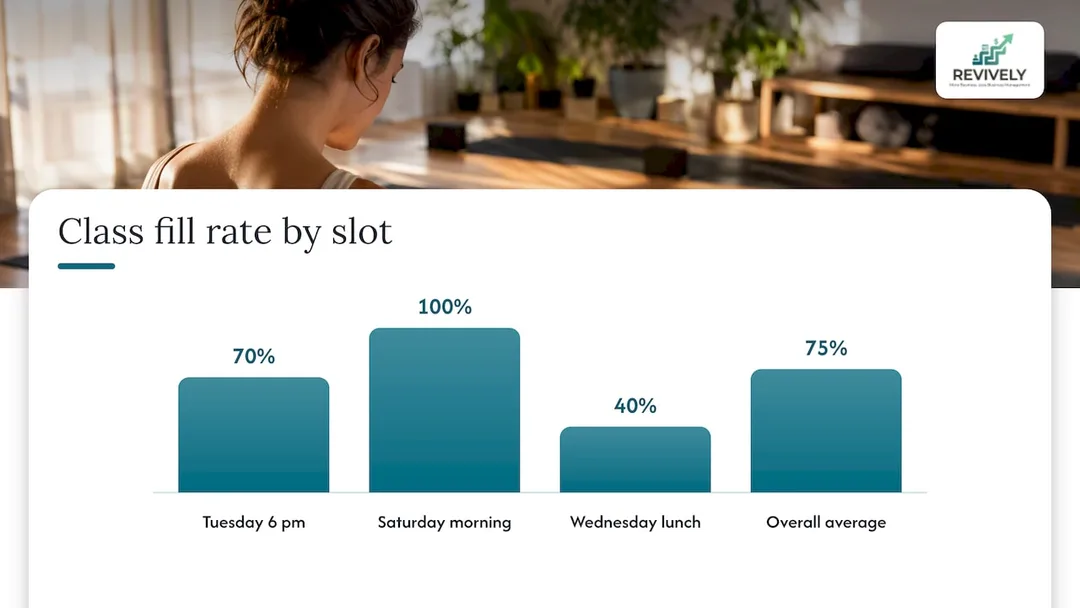
Actionable Insight: Classes consistently performing poorly for six to eight weeks? It's time to cut them, move them, or experiment with a new format. If a specific class is always at 100% capacity with a healthy waitlist, that's your cue to add another session or expand capacity if possible.
2. Resource Utilisation (Spas and Treatment Studios)
For our Australian spa and treatment centre owners, this is gold. It reveals how effectively you're leveraging your most valuable assets: your treatment rooms, saunas, and skilled staff.
Formula: Hours Sold ÷ Hours Available.
Consider a spa with five treatment rooms, open 10 hours a day, seven days a week. That's 350 available room hours. If you sold 250 hours of treatments, your utilisation is 71.4%. This example on spa utilisation uses the same straightforward method, which can also be adapted to calculate revenue per available treatment hour.
Crucial detail: Always factor cleaning and turnover buffers into your booked time. If you don't, you'll overestimate your true available capacity, leading to scheduling headaches and staff burnout.
Actionable Insight: High utilisation on Saturdays but midweek slumps? Test off-peak offers or loyalty programs, rather than blanket discounts. If a particular sauna or room is constantly booked out, that's where investing in a second resource or optimising its schedule will deliver the quickest returns.
3. Member Retention
Are your clients sticking around? This metric is the heartbeat of your studio's long-term viability. A steady stream of new clients is great, but a loyal base is gold.
Formula: Members active at the end of a period who were also active at the start ÷ Members active at the start.
Track this for new clients at critical milestones: 30, 90, and 180 days. This quickly reveals if your onboarding process is working. Separately, monitor long-term members. For Australian studios, a 2024 study by Les Mills Asia Pacific highlights group exercise as a significant driver of member loyalty. This suggests tracking retention by class type could be incredibly insightful, showing which formats keep people coming back for more.
Actionable Insight: Notice someone hasn't booked in 14 days? Reach out with a personalised message. For new clients, make sure they book their second and third visits before they even leave the studio after their first experience. That initial connection is everything.
4. Churn Rate
The flip side of retention, churn tells you who's leaving and how quickly. Understanding this helps you plug the leaks in your membership bucket.
Formula: Members who cancelled in the month ÷ Members at the start of the month.
If you kicked off March with 200 recurring members and 12 decided to cancel, your churn rate is 6%. Don't just track this for memberships; apply it to class packs too. For packs, define churn as a client who used their last credit and didn't purchase another within, say, 30 days.
Actionable Insight: Implement a clear, simple exit survey for every cancelling member. Use a short, fixed list of reasons (price, schedule, injury, moving, service quality, etc.). After a quarter, you'll start to see patterns and can address the root causes of departures.
5. Revenue Per Active Client
This metric provides a holistic view of how much each engaged client is contributing to your studio's bottom line, blending all income streams.
Formula: Total Revenue ÷ Clients who booked at least once in the period.
This figure aggregates income from memberships, class packs, drop-ins, treatments, and even retail sales. Crucially, use active clients - those who've booked recently - not your entire database, which might include long-gone contacts and skew your numbers.
For spas, layer on average spend per visit. Dance studios might benefit from splitting term enrolments from casual classes and workshops to get a clearer picture.
Actionable Insight: Is this figure flatlining while your overall client numbers are growing? This could indicate you're overly reliant on discounted introductory offers that aren't converting into higher-value memberships or longer-term engagements. Investigate your conversion rates from intro offers to sustained client relationships.
6. No-Show and Late-Cancel Rate
Every no-show or late cancellation is a missed opportunity - and often, direct lost revenue.
Formula: (No-shows + Late Cancellations) ÷ Total Bookings.
This hurts most in appointment-based settings (spas, private sessions) where an empty slot often can't be resold. In classes, it means a spot a waitlisted client could have filled was wasted.
Actionable Insight: Implement a clear, strict cancellation window. Send automated reminders (SMS and email are crucial). For high-value treatments or private sessions, require a card on file or prepayment. Review this rate by client segment - you might find it's a handful of repeat offenders impacting your overall numbers.
7. Waitlist Demand
Your waitlist isn't just a queue; it's free, real-time market research.
Formula: Number of waitlisted bookings per class per week, and the share of those that convert into attended spots.
If the same class consistently has six people waiting every week, you have undeniable proof that demand outstrips supply for that session. This is your green light to add capacity. If waitlisted clients rarely get a spot, your cancellation window might be too short for them to react, or your automatic waitlist promotion isn't robust enough.
Actionable Insight: Stop guessing. Add a class in that undeniably busy slot, or consider moving to a larger room if space is the constraint. Ensure your system automatically promotes waitlisted clients when a spot opens, so late cancellations don't leave you with empty spaces.
8. Cash Position and Cash Flow Cycle
Revenue looks great on paper, but cash is king, especially when you're managing staff, rent, and Australian tax obligations. Memberships bill on cycles, class packs are often paid upfront and used over months, while your rent and wages hit on fixed dates. The timing mismatch can catch you out.
The ATO's Cash Flow Kit offers a solid framework for Australian small businesses. One critical takeaway: always differentiate between actual cash in hand and tax/super amounts you will owe. Don't count those as available funds.
A simple weekly check is powerful: opening balance, expected income, committed costs (wages, rent, super, GST), and what's left. The Small Business Assist cash flow spreadsheet offers a practical template for gathering these figures. For Australian studios, seamless integration with your accounting software ensures these numbers are always current and compliant.
A Week in the Life: Pilates Studio Edition (A Worked Example)
Let's imagine an Australian Pilates studio running 30 classes a week, each with 10 spots, totalling 300 available spots.
| Metric | Weekly Figure | Insight |
|---|---|---|
| Bookings Attended | 210 | Fill Rate: 70% (210/300) |
| No-shows & Late Cancels | 18 of 228 bookings | Rate: 7.9% (18/228) |
| Waitlisted Bookings | 34 (across 4 classes) | Strong demand in specific slots. |
| Active Members (start of month) | 180 | Baseline for churn calculation. |
| Cancellations This Month | 9 | Churn Rate: 5% (9/180) |
The real lesson here isn't whether 70% is "good" or "bad." It's that this studio now precisely knows which four classes to potentially expand and which low-fill classes desperately need review. Without this class-level, granular data, an overall 70% fill rate would hide both the opportunities and the drain.
Stop Drowning in Spreadsheets: Where Your Numbers Should Actually Live
Most studio owners hit a wall with reporting because of a fundamental data problem. Bookings live in one system, payments in another, memberships are tracked in a clunky spreadsheet, and your actual books reside in accounting software. Each KPI then becomes a manual project, by which time the month has ended, and the insights are stale.
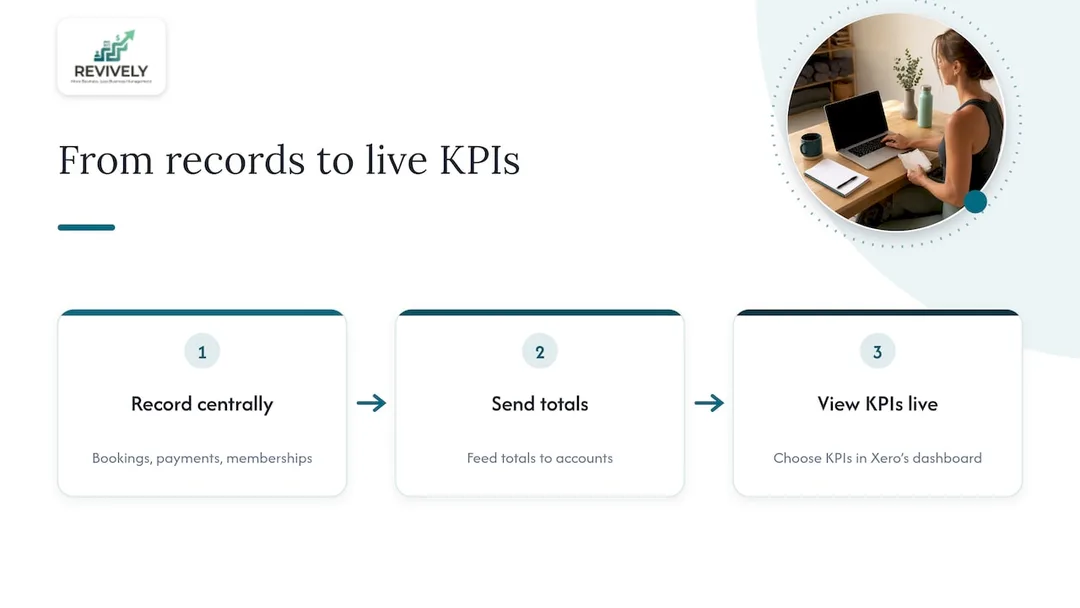
The solution is straightforward: centralise every booking, payment, and membership record into a single, unified system. This data then seamlessly feeds into your accounting platform, like Xero. Xero's own guidance on their business performance dashboard highlights how you can choose your critical KPIs and view them live, not just when reports are due.
For Australian studios, this unified approach is critical for 100% legal tax compliance. Imagine automated two-way mapping of tax codes, revenue accounts, and liabilities directly to Xero. This ensures your quarterly Business Activity Statements (BAS) are flawless and audit-proof, eradicating manual spreadsheet errors and giving you back precious time and peace of mind. Your client data, booking histories, and sensitive health intake forms? Stored locally in Australia, fully complying with the Australian Privacy Principles (APPS).
Want to dive deeper into this? Check out our guides on why Australian studios need Xero integration that actually works and our take on 5 core profitability KPIs for local studios.
Revively's Approach: Leaner Metrics, Sharper Decisions for Australian Studios
At Revively, we build our unified cloud command centre for Australian spas, yoga, Pilates, dance studios, and clinics. We've seen a consistent pattern: the studio owners who feel truly in control aren't the ones buried under the most reports. They're the ones who identify a core set of numbers, review them religiously every week, and act on them.
Two habits consistently make the difference:
- Granular Insight: They dissect every number by class, room, or instructor. Averages are great for a snapshot, but the real power is in the detail.
- Connected Data: Their bookings, memberships, payments, and accounting are all linked. This means a KPI isn't a weekend project; it's a live view of data that already exists, ready to inform their next move.
If pulling a KPI takes more than a few minutes, you'll stop checking it. We design Revively so the answer is always at your fingertips.
"The owners who feel in control are not the ones with the most reports. They look at the same handful of numbers every week and act on them."
- Andreea, Revively Co-Founder*
Unifying Your Studio: How Revively Delivers These Insights, Seamlessly
Revively isn't just another booking system; it's an Australian-made, unified cloud command centre (CRM + multi-resource scheduler) built specifically for wellness and fitness studios. It handles multi-resource appointment grids, recurring class timetables, intelligent waitlists with automatic promotion, flexible memberships and class packs, and secure Stripe payments.
This means all the critical inputs for your fill rate, utilisation, churn, no-shows, and waitlist demand live in one cohesive system. Beyond raw data, Revively provides:
- Flawless GST & Tax Invoice Handling: Our system natively handles 10% GST calculations across casual classes, memberships, and multi-resource packages, automatically issuing legally compliant Australian Tax Invoices to your clients.
- 100% Legal Xero Integration for BAS Accuracy: Our deep, two-way Xero integration maps tax codes, revenue accounts, and liabilities precisely. This ensures your quarterly Business Activity Statements (BAS) are flawless and audit-proof, eliminating manual errors and ATO stress.
- Australian Data Residency & Privacy: Rest easy knowing all your client data, booking histories, and sensitive health intake forms are stored securely and locally in Australia, fully complying with the Australian Privacy Principles (APPs). This isn't just a feature; it's a non-negotiable trust pillar for your Australian clients.
Plans start at $39 AUD per month for Solo, $99 AUD per month for Growth, and $199 AUD per month for Pro, with annual options available. Rolling memberships add $15 AUD per month per 50 active members. Explore Revively pricing, or dive deeper into how our class scheduling, waitlists, and memberships and class packs features can transform your studio.
FAQ
Got questions about tracking your studio's pulse? We've got answers.
What is a good fill rate for a yoga or Pilates studio?
There's no universal "good" benchmark, so be wary of any single figure. Instead, compare each class's fill rate to its own historical performance and, critically, to its break-even point. This is the attendance needed to cover instructor pay and its share of overheads like rent. Your prime-time classes should aim for near-capacity, while off-peak sessions might only need to clear break-even to be worthwhile.
How often should I review my studio KPIs?
It depends on the KPI. Check fill rate, no-shows, waitlists, and cash flow weekly for immediate action. Review churn, retention, and revenue per client monthly, always comparing against the same month in the previous year if you have the data. Seasonal swings - like a January sign-up surge or a school holiday dip - can make month-to-month comparisons misleading.
Which KPIs matter most for an Australian spa or recovery centre?
Start with utilisation of rooms and staff time, average spend per visit, no-show rate, and retention of repeat clients. Utilisation, calculated as hours sold divided by hours available, demands accurate accounting for cleaning and turnover buffers. Once these basics are solid, you can add more advanced metrics like revenue per available treatment hour.
Can I track these KPIs in a spreadsheet?
Yes, for a very small studio, a spreadsheet might work initially. However, it quickly becomes unmanageable as bookings, memberships, and payments grow. Manual data entry is prone to errors and delays, meaning your numbers arrive too late to inform timely decisions. The smart move for any growing Australian studio is to connect your booking and payment data directly to Xero and a unified studio dashboard like Revively. This keeps your KPIs current, accurate, and ready to act upon.
Sources
Here are some of the resources and studies that informed our perspective on these vital KPIs:
- Xero Business Performance Management Software
- ATO Cash Flow Kit
- Small Business Assist: Gather Your Cash Flow Data
- Les Mills Asia Pacific: Group Exercise and Member Retention Study
- Xotels: KPIs for Spa Revenue Management
Recommended Reading
Ready to go deeper? Check out these related articles from Revively:
- Stop Flying Blind: How Australian Studios Nail Profitability with 5 Core KPIs (and Zero Spreadsheet Headaches)
- Studio Scheduling Chaos? Your Resource Utilisation Report Holds the Key to a Calmer Roster
- Stop Flying Blind: 12 Studio KPIs That Actually Predict Your Revenue (and Save Your Sanity)
- Mastering Your Studio: Beyond Salon Software to Holistic Wellness Management in Australia