
Instructor Payout Reports: What to Include and How to Check Them
! Studio owner checking an instructor payout report
An instructor payout report is a record of what each teacher or practitioner is owed for a pay period, and how that figure was worked out.
It's 10 PM. You're slumped over a spreadsheet, staring down a sea of numbers, trying to figure out exactly what you owe every yoga instructor, Pilates teacher, and massage therapist for the last fortnight. A class swap here, a bonus there, a few no-shows... suddenly, the numbers don't add up. Again. You're exhausted, your head aches, and you just want to pay your team accurately, on time, and without the nagging fear of an ATO audit or a Fair Work query.
Sound familiar? For Australian wellness and fitness studio owners, the instructor payout report isn't just a formality; it's the bedrock of trust with your team and the quiet assurance that your books are sound. But get it wrong, and you're staring down discrepancies, awkward conversations, and potential compliance headaches.

This isn't about guesswork. It's about clarity, precision, and making sure every dollar paid is backed by an undeniable record. A solid payout report details precisely what each practitioner or teacher is owed for a pay period, showing how that figure was meticulously calculated. It should list every class or appointment, the specific rate applied, any lawful deductions, and the final net amount. This guide cuts through the noise, detailing what Australian studios absolutely need to include, how to cross-check everything, and why relying on guesswork is a fast track to trouble.
Why Your Studio Needs Bulletproof Payout Reporting
Forget "TL;DR." Let's get real about what matters:
- Transparency is Gold: A clear report means your team knows exactly how their pay was calculated, building trust and reducing queries.
- Compliance, Not Guesswork: Accurately track what you owe. This isn't just good practice; it's essential for meeting your ATO and Fair Work obligations.
- Audit-Proof Records: Should the ATO or Fair Work Ombudsman ever come knocking, you'll have unimpeachable evidence of every payment, saving you stress and potential fines.
- Save Hours of Admin: Ditch the manual spreadsheets. An optimised payout system frees you up to focus on what you do best: running an incredible studio.
The Anatomy of an Iron-Clad Payout Report
Your payout report needs to answer one core question, without hesitation: "Why is this person receiving this exact amount?" If a teacher questions a payment, you should be able to point directly to the report and show them.
For any Australian dance, Pilates, yoga, spa, or recovery centre, these are the non-negotiable fields:
Instructor & Pay Period Details
This is your foundational data. Include the instructor's full name, ABN or employee reference, and the precise start and end dates of the pay period. It sounds basic, but misspellings or wrong dates are common, frustrating errors.
Sessions Delivered
List every single class, treatment, or private session. Each entry needs to specify the date, time, location (e.g., Studio 1, Treatment Room 3), and any specific equipment or resource used. This granular detail is crucial for accountability.
Attendance or Bookings
If your payout model includes per-head rates, tiered payments, or minimum attendance guarantees, you must track the headcount. Show the number of participants for each session.
Applied Rate Rule
Don't just show the dollar figure. Show how you got there. Was it a flat rate per class, an hourly rate, a percentage of revenue, or a per-head fee? Explicitly state the rule applied to each session. This is where most queries originate.
Adjustments
Life happens. Include any cover classes taught, cancelled sessions (with pay conditions applied), bonuses for exceptional work, or specific workshop fees. These should be clearly itemised and explained.
Deductions
Any amount taken off the gross pay must be listed with a clear, lawful reason. This is a common pitfall for studios and needs careful handling (more on this below).
Net Amount & Payment Status
Finally, display the total net amount due, along with the status (owed, approved, paid) and the date the payment was processed.
Keep your report simple and scannable: ideally, one clear line per session. This makes it incredibly easy for an instructor to quickly spot a missing class or an incorrect entry - the most common payout query studios face.
Your Payout Report is Not Your Sales Report (And Why This Distinction Matters for GST)
This is where many studio owners trip up, leading to mismatched figures and a BAS headache. Understanding the difference is vital for accurate payments and spot-on GST compliance.
| Report Type | Answers This Question | Key Use Cases & Australian Nuances |
|---|---|---|
| Sales Report | What did customers buy and pay us? | Tracks revenue, discounts, and the 10% GST collected on casual classes, memberships, and packages. Essential for your BAS and overall business health. |
| Instructor Payout Report | What do we owe each instructor for their work? | Calculates gross and net pay based on sessions taught and applied rates. This is about your operational expenditure and your agreements with staff/contractors. It's not about the initial customer payment. |
| Bank/Settlement Report | What money landed in our bank account? | Reconciles actual cash flow. Card payments often arrive in batches, net of processing fees. Crucial for matching financial records and ensuring your Xero integration balances perfectly. |
These three reports are intrinsically linked. A $30 drop-in class sale appears in your sales report, contributes to an instructor's per-head pay in the payout report, and then, minus a small card fee, eventually lands in your bank as part of a batched settlement. If you only ever look at one, you'll constantly be chasing ghost numbers.
For Australian studios, this linkage is critical for GST. If you pay instructors a share of revenue from class packs or memberships, remember these often don't map neatly to a single session. You need a clear methodology for allocating that revenue before you calculate the payout. Our deep-dive on class pack revenue and GST covers the tax side, while revenue per class for studios walks through allocation strategies.
Deductions? Handle with Australian Care (Fair Work & ATO Won't Tolerate Shortcuts)
This is perhaps the trickiest area for studio owners and where many inadvertently land themselves in hot water. Netting money off a payout isn't as simple as it sounds; it must be lawful and properly documented.
For employees, Fair Work Australia is very clear: a deduction must be reasonable and permitted by law, a court order, a Fair Work Commission order, an award, or a registered agreement. In most circumstances, you also need the employee's written agreement.
Fair Work Warning: Before setting up deductions like uniform costs, locker fees, or room hire, check the specifics for your award or agreement. If you don't have a written agreement, or if the deduction isn't permitted, you could face penalties. The Fair Work Ombudsman's fact sheet on record-keeping and pay slips is essential reading.
A simple, practical review before every pay run will save you headaches:
- Document Everything: Confirm every deduction has a written reason and, where required, a signed agreement from the employee or contractor on file.
- Separate Your Costs: Clearly distinguish between what the instructor genuinely owes you (e.g., a specific late fee agreed upon) and operational costs that are yours (e.g., card processing fees). Don't pass on your business expenses as deductions from an instructor's pay unless explicitly and lawfully agreed.
- Verify Gross Figures: Double-check that the gross amount you're starting with truly matches the sessions actually taught, accounting for last-minute swaps, approved leave, or cancellations.
- Spot Trends: Compare this pay period's figures to the last. A significant swing usually indicates a missing class, an incorrect rate applied, or an unrecorded adjustment.
When in doubt, always ask. If you're unsure whether a deduction is legally allowed, contact the Fair Work Ombudsman or your accountant before you run payroll, not after. Rectifying incorrect deductions is far more difficult than preventing them.
Employee or Contractor: The ATO Cares, So Should You
The payout report is only as robust as the records behind it. The Australian Taxation Office (ATO) clearly states that a worker's status (employee vs. contractor) profoundly impacts your tax, superannuation, employer obligations, and record-keeping requirements. Many Australian studios operate with a mix: employed front-desk staff, casual teachers, and independent contractors running their own specialised classes.
For Employees
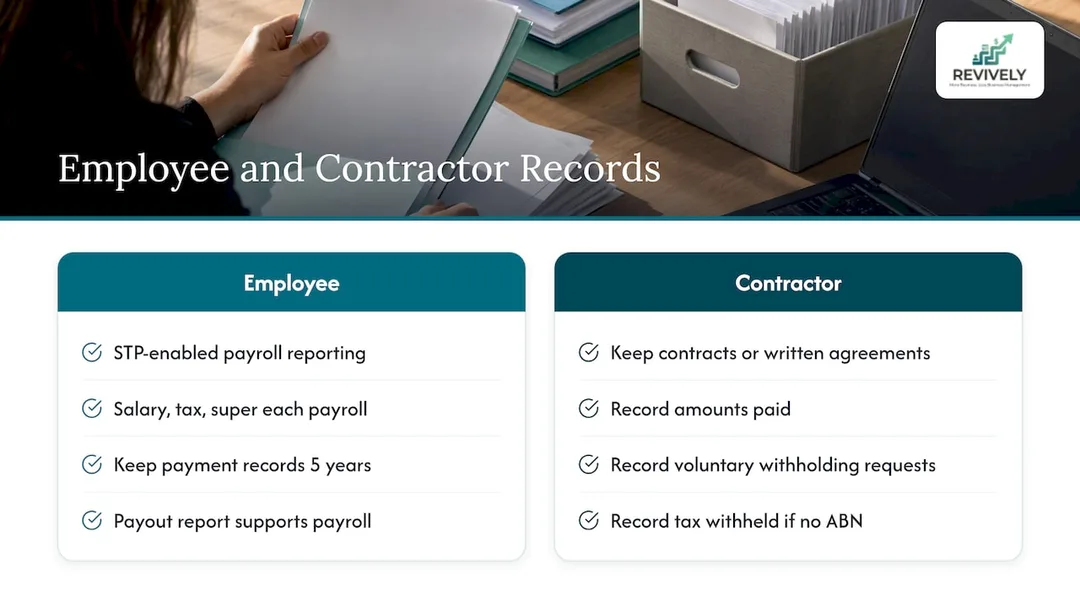
Since 1 July 2019, Australian employers must use a Single Touch Payroll (STP)-enabled solution to report salary, tax withheld, and superannuation each time they run payroll. Your payout report underpins this process, but it doesn't replace it. The ATO mandates you must keep employee payment records for 5 years. These records include payslips, timesheets, superannuation contributions, and details of any Fringe Benefits Tax (FBT) or PAYG withholding.
For Contractors
The ATO also has specific requirements for contractor and supplier payments. You need to keep detailed records of contracts or written agreements, amounts paid, any voluntary requests to withhold tax, and tax withheld if a supplier doesn't quote an ABN. By adding the contractor's ABN and invoice reference as columns in your payout report, you consolidate much of this information in one place.
Don't guess worker status. The ATO's guidance on worker status is extensive. If you're unsure which category a teacher falls into, seek advice from your accountant or the ATO. Incorrect classification can lead to significant penalties, underpaid super, and back-pay liabilities. This decision is a legal one, not just an accounting preference.
Reconciling Payouts: From Bank Account to BAS (Via Xero, Flawlessly)
Your payout report tells you what you owe. Your bank statement tells you what moved. Reconciling these two every single pay period is non-negotiable for BAS accuracy and financial health. This is where a seamless Xero integration becomes your best friend.
A robust monthly reconciliation routine for Australian studios:
- Export & Verify: Export your detailed payout report for the period. Mark each line as paid or unpaid, double-checking against internal records.
- Match to Bank Transactions: Match each individual or bulk payment from your report to the corresponding transaction in your bank feed. For bulk transfers, ensure the sum equals the total of the individual lines.
- Match Customer Payments: Cross-reference customer payments (class bookings, memberships) to bank deposits. Remember, card settlements typically arrive net of fees and in batches, so one deposit might cover several days of sales.
- Investigate Discrepancies: Anything unmatched - a missing payment, an incorrect BSB, a reversed transfer, or a session that wasn't recorded - needs immediate investigation.
- Post to Accounting Software (Flawless Xero Integration): This is the game-changer.
- Automated, Two-Way Mapping: Your system should automatically map instructor costs and processing fees to the correct expense accounts in Xero.
- GST-Compliant: For Australian businesses, this means ensuring 10% GST calculations on relevant revenue streams are accurately reflected and transferred.
- BAS-Ready: This automated Xero integration guarantees that when it's time to prepare your quarterly Business Activity Statement (BAS), the data is 100% legal, audit-proof, and free from manual spreadsheet errors. It saves your bookkeeper hours and prevents those stomach-dropping "BAS panic" moments.
Australian bookkeepers specialising in health and fitness businesses describe this routine as essential for "daily transaction processing, revenue recording, bank reconciliations and BAS-ready reporting." This isn't just about paying staff; it's about the very core of your business's financial integrity. For a general look at how exported data can feed accounting tools and recurring checks, see these online bookkeeping options.
When an instructor's payout looks late, work backwards: first, confirm the session was recorded. Second, verify the report line was approved. Third, check the bank transfer date and reference. Most delays occur in the first two steps.
The Spreadsheet Struggle: Why Manual Payouts Are a Time Bomb
At Revively, we built our platform because we saw too many Australian studio owners wrestling with fragmented systems. Timetables in one tool, payments in another, and payout notes haphazardly recorded in a spreadsheet. This chaotic gap is where payout errors always begin. A class gets swapped on the timetable, but the old teacher is still listed in the spreadsheet. Or a new rate isn't applied consistently.
Our advice is simple: Make your timetable the single source of truth. Every payout line should directly trace back to a session someone actually taught, confirmed by attendance. Keep payments and accounting seamlessly connected, so your bank reconciliation is built on the same, accurate records. And for the love of clarity, keep your rate rules written down and easily accessible, even if you only have a few.
It's tempting for smaller studios to think this is a "problem for later." It's not. A wellness or fitness studio with even ten instructors and a mix of per-head and flat rates can easily haemorrhage hours each month just checking numbers. Those hours are better spent welcoming new members, refining your offerings, or, frankly, enjoying some much-needed downtime.
"Stop building payouts by hand. It's a relic of a time before smart software. Your time is far too valuable to be a human calculator." - Andreea, Revively Co-founder
Revively: Your Australian Command Centre for Payout Peace (and Compliance)
Revively is specifically designed for Australian wellness and fitness studios that need Mindbody alternatives Australia can trust. We bring your entire operation - class timetable, multi-resource appointment grid (perfect for spas and recovery centres), integrated Stripe payments, memberships, and class packs - into one unified, intuitive dashboard.
Crucially, our platform provides:
- Australian Data Residency: All your client data, booking histories, and sensitive health intake forms are securely stored on Australian servers, ensuring full compliance with the Australian Privacy Principles (APPs).
- Flawless GST & Tax Invoice Handling: Revively natively handles 10% GST calculations across all services - casual classes, diverse memberships, multi-resource packages, and retail. It automatically generates and issues legally compliant Australian Tax Invoices to your clients, simplifying your end-of-quarter BAS reporting.
- 100% Legal Xero Integration for BAS Accuracy: Our two-way Xero integration isn't just a basic sync. It intelligently maps tax codes, revenue accounts, and liabilities. This means your quarterly Business Activity Statements (BAS) are consistently flawless and audit-proof, eliminating manual spreadsheet errors and ensuring you're always ATO-compliant.
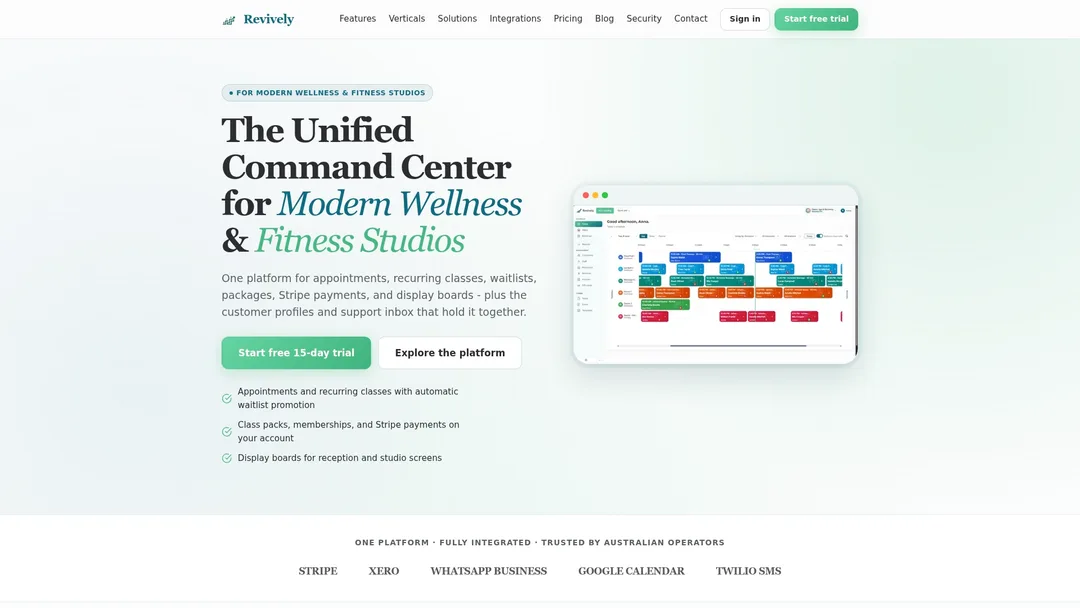
All your reporting and analytics sit alongside your core operations, meaning the session and revenue data that feeds your payout figures lives in one place - not scattered across half a dozen tools. This is what truly enables stress-free, accurate instructor payouts.
Our plans are designed for Australian businesses, starting at just $39 per month for Solo, $99 per month for Growth, and $199 per month for Pro. Annual billing options are also available for savings. Extra bookable staff seats are an affordable $15 per month each. See the full list on the Revively pricing page.
Ready to ditch the payout panic? Start a free trial from the Revively home page and see how an all-in-one spa booking software or a GST compliant studio software can transform your operations.
A Simple Template to Start With (If You're Still on Spreadsheets)
If you're still painstakingly building your reports in a spreadsheet today, use these columns. And for the love of accuracy, keep one row per session:
| Date | Class or Service | Location & Room | Instructor | Attendance | Rate Rule | Gross | Adjustment | Deduction | Net | Paid On |
|---|---|---|---|---|---|---|---|---|---|---|
| Tue, 10/10 | Beginner Ballet | Studio 1 | Jane Doe | 12 | Per Head | $120 | $120 | 12/10 | ||
| Wed, 11/10 | Reformer Pilates | Pilates Studio 2 | John Smith | 8 | Hourly | $60 | $60 | 12/10 | ||
| Thu, 12/10 | Massage (60 min) | Treatment Room 3 | Sarah Lee | 1 | % Revenue | $80 | +$10 bonus | $90 | 13/10 |
For contractors, add a second tab with their ABN, invoice number, and GST status. Most importantly: lock past periods once they've been paid so numbers can't accidentally drift or be altered.
If you pay on revenue share, our guides on seamless Stripe membership billing and recurring class management show how to keep your timetable and payments aligned, laying the groundwork for accurate revenue-based payouts.
FAQ: Your Quick Payout Report Questions Answered
How often should I run instructor payout reports?
Run them on the same cycle you pay your team. Weekly or fortnightly usually suits casual employees, while monthly is common for most contractors. Even if you pay more frequently, it's smart to review a summarised report monthly to catch trends and errors early.
Can I legally deduct costs from an instructor's payout in Australia?
Only if the deduction is lawful and properly documented. For employees, Fair Work Australia states it must be reasonable and permitted by law, a court or Fair Work Commission order, an award, or a registered agreement. Crucially, in many cases, you also need the employee's written agreement. For contractors, any deductions should be clearly set out in your written agreement with them. Always check with Fair Work or your accountant first.
How long do I need to keep payout records for my Australian studio?
The ATO requires employee payment records to be kept for 5 years. This includes payslips, timesheets, and superannuation details. Contractor records, including agreements, invoices, and amounts paid, are also covered by the ATO's record-keeping rules. Keep your payout reports together with supporting invoices and bank evidence for comprehensive records.
What is the difference between a payout report and payroll?
A payout report calculates what each instructor is owed based on their sessions taught and applied rates. Payroll then takes this gross figure and handles the official process of tax withheld, superannuation contributions, and Single Touch Payroll (STP) reporting for employees. Contractors, on the other hand, are typically paid against their invoices based on the payout report's figures.
Sources
Here are the authoritative Australian resources that informed this guide. Bookmark them for your compliance toolkit:
- Fair Work Ombudsman: Record-keeping and pay slips fact sheet
- Australian Taxation Office (ATO): Pay as you go (PAYG) records
- Australian Taxation Office (ATO): Employment and payroll records
- Australian Taxation Office (ATO): Independent contractor and supplier records
- RV Advisory: Health and fitness business accounting in Australia
- Nomadexcel: Online bookkeeping options for freelancers
Recommended Reading
Ready to further optimise your Australian studio's operations and financial health? Dive into these related Revively insights:
- Make Every Session Pay: 4 Steps to Revenue per Class for Studios
- Stop the Roster Roulette: Your Studio's Guide to Bulletproof Instructor Schedules (and BAS-Ready Books)
- Stop the No-Show Bleed: How Deposits (Done Right) Protect Your Studio's Revenue
- Stop the BAS Panic: Master Class Pack Revenue & GST for Your Australian Studio