
Cut No Shows: 4 No Show Policy Wording Templates for Studios
! Empty treatment room after missed appointment
Paste this into your booking page today: "Appointments cancelled with less than 24 hours' notice, or missed entirely, will incur a fee proportional to the service cost as determined by your policy.
The studio floor is humming, the reformer classes are packed, and the aroma of essential oils promises an hour of pure bliss for your massage clients. Then you check the day's bookings. Three no-shows. Two late cancellations. And suddenly, your meticulously planned day - and your bottom line - takes a gut punch. That's the no-show tax, and it's time to stop paying it.
This isn't just about lost revenue; it's about the wasted time, the empty slot another paying client could have filled, and the sheer frustration of having your carefully organised schedule thrown into disarray.
Here's the stark truth: Without a clear, enforceable policy, you're essentially saying "it's okay" when clients don't show up. Ready to turn that around? Let's craft policies that get seen, understood, and respected.
TL;DR - Your Studio's No-Show Shield in a Nutshell:
- Clarity is King: Define "no-show" versus "late cancellation" with specific notice windows (24-48 hours) to justify different fee structures.
- Mandatory Acknowledgment: Implement a non-negotiable, policy-linked checkbox at booking. This is your legal backbone if a dispute arises.
- Tailored Deterrence: Match fee structures (flat, percentage, or full session) to your services. A $15 yoga class has different deterrence needs than a $200 remedial massage.
- Warm Follow-Up: Use a two-stage follow-up: a caring check-in first, then a direct but polite fee reminder. It's about re-engagement, not just penalty.
- Australian Compliance: Your policy must be fair, transparent, and consistently applied, upholding Australian Consumer Law and ensuring flawless GST handling for any charged fees.
Table of Contents
- What Every Bulletproof Australian No-Show Policy Needs
- Copy-Paste Policy Templates for Diverse Australian Studios
- Turning Policy Wording into Real-World Enforcement
- Staying Fair and Legally Defensible Down Under
- What the Numbers Say About Deposits and Fees
- What Actually Moves the Needle in Real Australian Studios
- Let Revively Handle the Policy You Just Wrote
- Sources
- Recommended
What Every Bulletproof Australian No-Show Policy Needs
A no-show policy isn't just words on a page; it's a commitment to your business's value. It needs to hit three crucial marks: define the problem, set a fair deadline, and state the consequence in crystal-clear language. Miss any of those, and you've got a fluffy paragraph, not a policy.
First up, definitions. A "no-show" is that client who simply doesn't turn up for a booked appointment, with zero contact. A "late cancellation" is when they pull out within your specified notice window. Why differentiate? Because a last-minute call for a yoga class is very different from a full-blown private consultation no-show, and your response - and potential fee - should reflect that.
Choosing Your Notice Window: The Golden Rule
Most Australian service businesses gravitate towards a 24 to 48-hour notice window.
- A 24-hour window is ideal for high-turnover bookings like a casual yoga class, a single Pilates session, or a quick beauty treatment. It gives you a fighting chance to fill that spot if someone cancels a day prior.
- A 48-hour window is best for longer, more specialised appointments such as remedial massage, physiotherapy, counselling, or intensive spa treatments. These slots are harder to rebook, often requiring more coordination. Reputable practice-management templates consistently lean on these windows because clients generally understand and accept them.
Crafting Your Fee Structure: Balancing Deterrence with Fairness
You've got three primary options for tackling the "no-show tax," each with its own rhythm and rhyme. Before you commit, weigh them up:
| Fee Structure | Description | Best For | Pros | Cons |
|---|---|---|---|---|
| Flat Fee | A set dollar amount (e.g., $30) charged for any no-show or late cancellation. | High-volume, lower-value services (e.g., casual classes, short treatments). | Simple to communicate, easy for staff to apply consistently. | Can feel disproportionate for very low-cost services; may be too lenient for high-value private sessions. |
| Percentage of Service Cost | A proportion of the total service cost (e.g., 50%) is charged. | Mid-to-high value appointments with varying price points (e.g., longer massages, specific body treatments). | Scales fairly across your diverse price list, reflecting the true cost of a missed appointment. | Requires quoting a range or calculation, which some clients might find less concrete than a single number. |
| Full Session Fee | The entire cost of the booked service is charged. The strongest deterrent. | High-value, 1:1 bookings (e.g., private Pilates, specialist consultations, clients with a no-show history). | Maximum deterrent, ensures you're fully compensated for lost time and revenue. | Can feel punitive to some clients; requires careful communication and justification. Best used selectively. |
Whichever structure you opt for, a robust cancellation and no-show policy must explicitly state the notice window, the fee itself, how you'll communicate it, and what constitutes a reasonable exception. Leave any of these out, and you've written half a policy.
The Non-Negotiable: Client Consent and Australian Consumer Law
Here's where many studios stumble. A policy tucked away in your website's footer is practically invisible. When a client disputes a charge, that buried policy offers zero defence. You need documented consent, front and centre.
A mandatory checkbox at booking, tied directly to the full policy text (not just a link), is your ultimate shield.
Under Australian Consumer Law, fees must be clearly disclosed before the client commits to the booking, and consistently applied. This isn't just good practice; it's a legal requirement. Small business guidance, like that from Small Business WA, explicitly stresses visibility and upfront disclosure.
Consistency is Key: If you waive a fee for one client in a particular scenario, you're expected to do the same for another. Inconsistency brews resentment and legal headaches.
Copy-Paste Policy Templates for Diverse Australian Studios
Different studios, different vibes. A day spa client won't respond to the same clinical wording as a physiotherapy patient. Trying to fit one policy to all simply won't cut it. Here are four templates, finely tuned for the most common Australian studio types, ready for you to optimise and use today.
1. Beauty and Salon Services (Spa, Nail Bar, Hair Salon)
"We require a minimum of 24 hours' notice if you need to cancel or reschedule your appointment. Cancellations made with less than 24 hours' notice, and missed appointments (no-shows), will incur a fee of 50% of the scheduled treatment cost. For all bookings over $100, a credit card is required to secure your appointment."
Adaptation note: If you already take a deposit for high-value treatments (think advanced facials, colour services, or packages), clarify that this deposit is forfeited on a no-show or late cancellation, rather than layering a separate fee. Simpler is always better for client understanding.
2. Clinics and Allied Health / Therapy (Physio, Chiro, Massage, Psychology)
"To ensure fair access for all patients, missed appointments and cancellations with less than 24 hours' notice are charged at the full consultation fee, as this time cannot be offered to another patient. Please be aware that Medicare, private health funds, and NDIS do not cover no-show fees; this cost is the patient's direct responsibility. We kindly ask you to contact us as early as possible if you need to change your appointment."
Adaptation note: For allied health, that disclosure line about Medicare/health funds/NDIS is non-negotiable. Patients often assume insurance will cover everything, so clarifying this upfront prevents significant billing disputes down the track.
3. One-on-One Personal Training & Private Sessions
"Sessions cancelled with less than 12 hours' notice, or missed without prior contact (no-shows), will be deducted from your existing session pack (or charged in full for pay-as-you-go clients). Please message your trainer directly to reschedule wherever possible."
Adaptation note: For trainers using session packs, be explicit: does a no-show burn a full session, or a half? Vague wording here is the number one cause of client complaints. Avoid assumptions; spell it out clearly.
4. Group Classes and Studio Timetables (Yoga, Pilates, Dance, Fitness)
"Our classes have limited spots and are often waitlisted. If you cannot attend, please cancel via the booking app at least 2 hours before class starts so we can offer your spot to someone waiting. Members with three or more unexplained no-shows in a rolling 30-day period may have their booking privileges temporarily paused."
Adaptation note: Group classes rarely need a direct fee. The waitlist itself is a powerful incentive. A tiered consequence (warning, then a temporary pause) generally lands better with members than an immediate charge, simplifying front-desk operations and judgment calls.
Follow-Up Messages That Keep the Relationship Intact
The policy wording is one thing; what you say after a no-show is another entirely. This determines whether that client rebooks with you or quietly disappears.
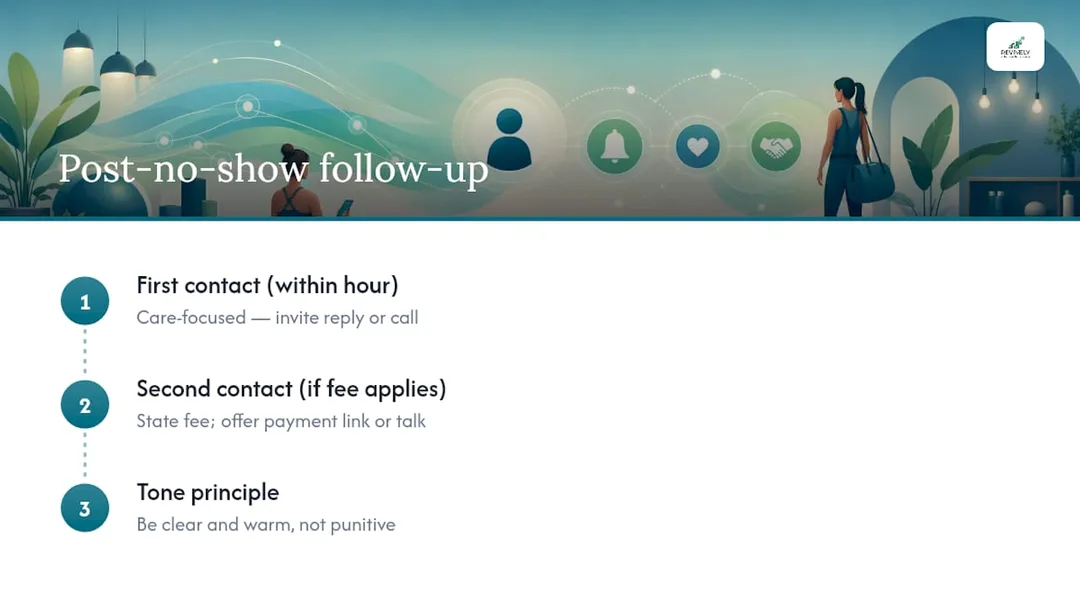
First Contact (send within the hour of the missed booking):
"Hi [Client Name], we missed you at your [time] appointment today. No worries if something came up. Just reply here or call us on [Phone Number] to find a new time that suits you!"
Purpose: Empathetic, offers an easy path to rebook, no mention of fees.
Second Contact (if a fee applies and the first message went unanswered):
"Hi [Client Name], following up on your missed appointment on [Date]. As outlined in our cancellation policy, a fee of [$X / X%] applies to missed sessions. You can settle this via the link below: [Payment Link], or get in touch if you'd like to discuss."
Purpose: Direct about the fee, but still offers a conversation rather than a cold demand. Clarity and warmth aren't opposites, and businesses that communicate plainly often get paid faster.
Turning Policy Wording into Real-World Enforcement
A beautifully written policy is useless if your booking system lets clients bypass it. The game-changer? A mandatory checkbox at the point of booking, linked directly to the full policy text. This isn't just about reducing no-shows; it's about defensibility. Documented consent, tied to that specific booking, is your strongest ally in a chargeback dispute.
Payment Protection: Deposits, Pre-authorisation, and Card-on-File
Different risk levels call for different strategies. Choose wisely:
- Deposits: Ideal for high-value or first-time bookings. "A $20 deposit secures your booking and is deducted from your final bill. This deposit is non-refundable for cancellations inside 24 hours."
- Pre-authorisation: A temporary hold on a card (not a charge) suitable for clients you trust but want a safety net with. "We place a temporary hold on your card to ensure your booking. No charge is made unless the appointment is missed or cancelled late."
- Card-on-File: Perfect for recurring clients on packs or memberships. Reduces friction by removing the need to re-enter payment details every visit, allowing for seamless fee application if a no-show occurs.
The Power of Reminders
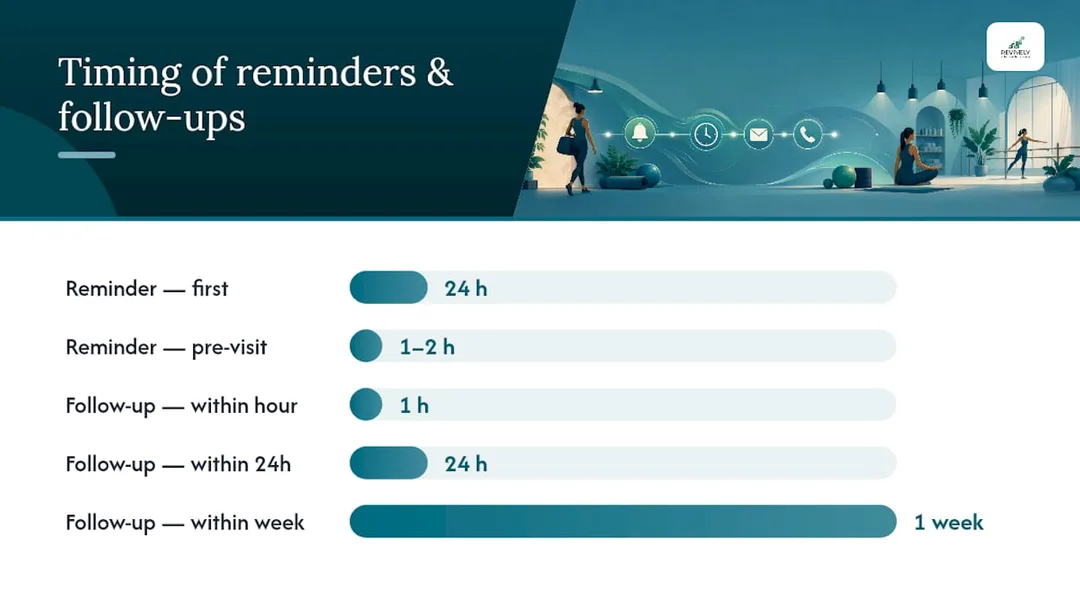
Reminders do the heaviest lifting. Send one at 24 hours and a second at 1-2 hours before the appointment. Crucially, both should include a one-tap reschedule link. This removes the friction that often turns a forgotten booking into a no-show. Research from digital appointment interventions consistently shows that automated reminders and easy rescheduling measurably cut missed appointments.
Empowering Your Team: The No-Show Script
Your front desk staff are your first line of defence. Equip them with a simple script for difficult conversations: "I can see you had a booking with us on [date] that we unfortunately missed you for. Our policy applies a fee of [amount] in these cases. Would you like me to run through the details?" This keeps the conversation calm and consistent, regardless of who's on shift.
Pro Tip: Document Every Exception.
Log every single waiver you grant, no matter how small. A quick note ("waived, family emergency, 3 March") in the client's file is what protects you if they (or another client) later claim you're applying the policy unevenly. This simple act safeguards your reputation and legal standing.
Staying Fair and Legally Defensible Down Under
A no-show fee isn't just a charge; it's a term in a contract, and Australian consumer law treats it exactly that way. Consumer law guidance is clear: fees must be fair, reasonable, and unequivocally disclosed before the client commits. You can't spring a charge on them after the fact.
The ACCC's guidance on contracts reinforces this: clear notice only protects you if you apply the fee consistently to every client in the same situation.
Reasonable Exceptions: The Human Touch
Genuine illness, family emergencies, or documented medical incidents are the standard carve-outs most Australian studios build in. The key is to document these waivers with the same diligence you'd apply a charge - a quick note in the client's file with the date and reason. This proves you're acting consistently and fairly, should it ever be questioned.
A few practical rules to lock in for your studio:
- Never charge a fee the client wasn't clearly shown and acknowledged before booking.
- Apply the same standard to a long-term member as you would to a first-time visitor in identical circumstances.
- Keep a simple, accessible waiver log - don't rely on memory.
- Review your policy wording annually against current small business and consumer law guidance, as expectations around disclosure can shift.
What the Numbers Say About Deposits and Fees
What's an empty slot really costing your Australian studio? It's more than just the service price. It's the cost of your time, the missed opportunity for another client, and the operational ripple effect. A no-show cost calculator takes the guesswork out, factoring in your service price, typical fill rate, and how often a cancelled slot gets rebooked. Once you understand the true cost, setting a deposit or fee becomes a data-driven decision, not a stab in the dark.
Figures worth tracking monthly:
- Cost per missed slot: The full service price minus any revenue from a successful late rebooking.
- Fill rate: The percentage of cancelled slots you manage to refill before the appointment time.
- Rebooking rate: How many no-show clients actually return within 30 days after missing an appointment.
Australian studios that blend a modest, justifiable deposit with a strong, automated reminder cadence and prompt, empathetic follow-up after a miss tend to see far steadier rebooking rates and significantly fewer disputes over enforced fees. Revively's no-show cost calculator empowers studio owners to quickly test different deposit and fee levels against their own operational data before rolling out any changes.
What Actually Moves the Needle in Real Australian Studios
The studios that optimise their no-show rates fastest aren't the ones with the strictest, most aggressive fees. They're the ones with the most visible, clear, and consistently applied policy. A sign at reception, a line in the confirmation SMS, a mandatory checkbox at booking - repetition beats severity every single time.
Reserve deposits for your highest-value or highest-risk slots, rather than applying them across the board. Crucially, invest five minutes in training your staff on the no-show fee script so nobody freezes up when a client pushes back at the front desk.
Before you change a thing, track your current no-show rate for a month. Implement your revised policy, then track it again for the following month. If your new wording or fee structure isn't moving that number, be ready to test a different version. Don't assume clients will just adjust; proactively find what works for your unique studio and clientele.
Let Revively Handle the Policy You Just Wrote
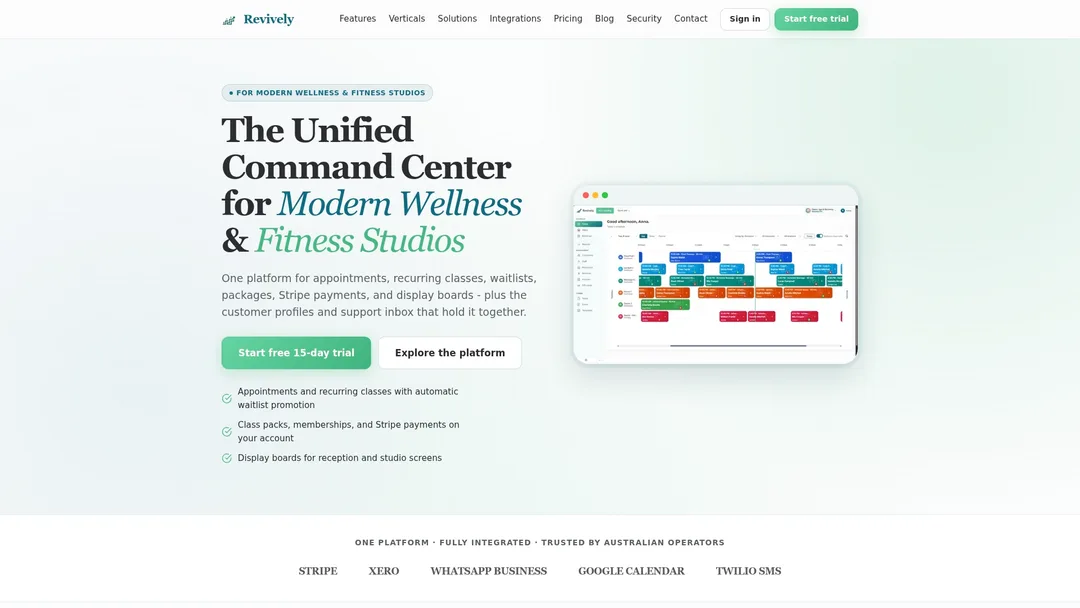
A meticulously crafted no-show policy only truly pays off if it's enforced consistently, without exception, and without bogging down your team in endless admin. That's precisely what Revively is built for. As an Australian-made, unified cloud command centre (CRM + multi-resource scheduler), we understand the unique challenges of local studios.
Revively isn't just about bookings; it's about seamlessly integrating your operations:
- Mandatory Consent: Ensures clients acknowledge your policy at online booking.
- Flexible Payment: Supports deposits, pre-authorisation, and card-on-file with ease.
- Automated Reminders: SMS and email reminders with one-tap rescheduling links.
- Waitlist Promotion: Automatically fills freed-up spots, maximising your revenue.
- Smart Reporting: Provides clear data on your fill rates and rebooking rates, no manual tallying required.
And for the Australian studio owner, this is where Revively truly shines:
Australian Compliance Built-In:
- Local Data Residency & Privacy: All client data, booking histories, and sensitive health intake forms are stored locally in Australia, fully complying with Australian Privacy Principles (APPs).
- Flawless GST & Tax Invoices: The system natively handles 10% GST calculations across casual classes, memberships, and multi-resource packages, automatically issuing legally compliant Australian Tax Invoices to clients.
- 100% Legal Xero Integration for BAS Accuracy: Our automated two-way mapping of tax codes, revenue accounts, and liabilities ensures your quarterly Business Activity Statements (BAS) are flawless, audit-proof, and free from manual spreadsheet errors. This is crucial for seamless financial organisation and peace of mind.
Revively won't write your policy for you - you've done that hard work above - but it will guarantee that your wording gets seen, acknowledged, and applied consistently across every single booking, class, and staff member on your roster.
Run your own numbers through the no-show cost calculator to see what a realistic deposit or fee looks like for your studio, then head to Revively to start a free trial and set it up before your next timetable goes live. Take back control, optimise your revenue, and reclaim your peace of mind.
Sources
- What to include in your cancellation policy | SBDC Blog
- Consumerlaw
- ACCC - Contracts guidance
- Appointment Cancellation Policy - Free PDF Download | Pabau
- Invoice Etiquette for Small Business Owners
- Effectiveness of digital interventions on appointment attendance for healthcare: A systematic review and meta-analysis