What is a good no show rate benchmark for studios and spas?
!
Another Tuesday morning. Three empty reformer beds. Two massages that never materialised. A yoga mat gathering dust. Every Australian studio owner knows that pang of frustration: the dreaded no-show. It's not just an inconvenience; it's lost revenue, wasted staff time, and a silent drain on your bottom line. You might wonder, "Is my studio's no-show rate normal? Am I doing something wrong?"
Let's be honest: benchmarks are only useful if they spur action. So, let's peel back the curtain on typical Australian studio no-show rates and arm you with the strategies - and the tech - to turn those missed appointments into money in the bank.

Generally, pre-paid group classes tend to see a 10-20% no-show rate, while 1:1 spa and appointment bookings often land higher, between 20-25%. These figures align with industry research into studio utilisation and broader appointment statistics. Your specific number will dance within these bands depending on payment structures, booking formats, and how brilliantly you communicate your cancellation policies.
Before you can fix it, you need to measure it. Accurately.
The Hard Truth: Benchmarking Your Australian Studio's No-Show Rate
Not all missed bookings sting the same way. A benchmark means squat until you know precisely what you're comparing against.
- Pre-paid group fitness classes: Expect roughly 10-20% no-show.
- 1:1 spa, beauty, and wellness appointments: Brace for 20-25% no-show.
- Free or community drop-in sessions: Often a whopping 25-35%, well above paid formats.
Money already spent creates a powerful psychological anchor. Clients who've paid upfront show up more reliably than those who haven't committed a cent. This is why studios running memberships or class packs often hover closer to that 10% mark than 20%.
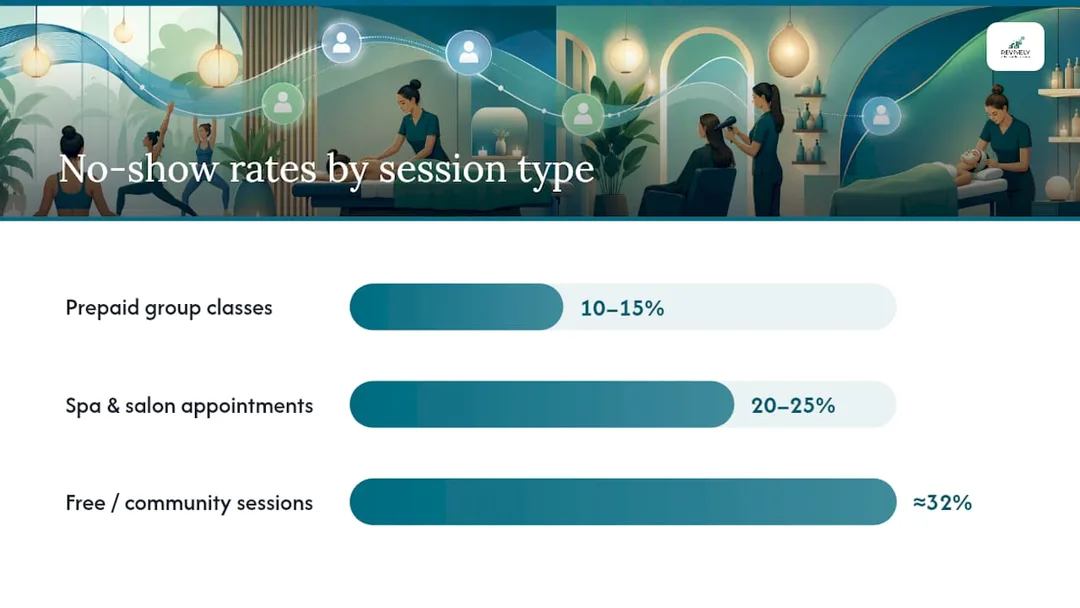
Free and community sessions operate in an entirely different universe. Industry data shows general in-person events average around a 32% no-show rate - roughly double that of paid fitness classes. Remove the financial stake, and attendance becomes an afterthought, not a commitment. If your multi-resource studio scheduling includes free trial classes or open community sessions, expect this higher band and never benchmark them against your paid timetable.
Spa, recovery centre, and clinic appointments carve out their own middle ground. Some industry reports place spa and salon no-shows in the 20-25% range, while other datasets, like SchedulingKit's summary, put salons closer to 20%. The gap between studio classes and spa bookings often boils down to lead time. A float tank session booked three weeks out carries more "forgetting risk" than a Pilates class booked the night before.
The Numbers Game: How to Actually Calculate Your No-Show Rate (The Right Way)
Forget fluffy metrics. You need the cold, hard facts. The standard calculation is straightforward: (no-shows ÷ confirmed bookings) × 100.
But here's the kicker, and it's where many studio owners go wrong: booked seats and attended seats are not the same metric. Mixing them up will absolutely mislead you. Your utilisation should be calculated as (attended seats ÷ scheduled seats) × 100. This tells you the percentage of your actual available capacity that generated revenue or delivered a service. That matters far more than a simple no-show percentage when you're deciding if a timeslot is even worth keeping.
Crucial Insight for Australian Studios: Research from Pulse RevOps found studios counting bookings instead of actual attendance routinely overstate their utilisation by 12 to 18 percentage points. A yoga class that looks 90% full on paper might only be running at 75% once no-shows are stripped out. That real 75% is the number determining profitability and staffing.
Get your measurement rhythm right, and your numbers will start telling a story:
- Daily: At the class or appointment level, empowering your staff to spot patterns before they become ingrained habits.
- Weekly: Rolled up by instructor, service type, and time slot, helping you catch roster-wide trends.
- Monthly: At the management level, directly linked to revenue impact, staffing decisions, and, crucially, your Business Activity Statement (BAS) accuracy.
Pro Tip for BAS Compliance: Log cancellations the moment they happen, not at the end of the day. A late cancellation counted as a "booking" instead of a "cancelled slot" quietly inflates your no-show rate and obscures which policy changes are actually working. This also impacts your revenue recognition for GST purposes.
Why Do They Ditch You? Factors Driving Higher or Lower No-Show Rates
Four key factors do most of the heavy lifting in determining where an Australian studio or spa lands on the benchmark scale:
- Payment Structure: Pre-paid packages and memberships create a strong sense of financial and social accountability. Free trials or pay-on-arrival bookings simply don't carry the same weight.
- Booking Format: Drop-in classes typically see more no-shows than recurring memberships. There's no ongoing relationship or sunk cost attached, making it easier to skip.
- Timing & Convenience: Off-peak slots, early mornings, and late weekend appointments often carry higher no-show rates across many studios. Life just gets in the way more easily when the booking feels less urgent.
- Communication Friction: Unclear cancellation windows, a non-existent reminder system, or a clunky rebooking process all push the rate up. Clients forget, get confused, or simply give up trying to reschedule.
Formats requiring specific equipment or high commitment, like reformer Pilates, hot yoga, or intricate dance classes, generally experience lower no-show rates. When a client books a dedicated piece of equipment, the commitment feels more tangible than a general "come along if you feel like it" session.
Stop the Bleeding: Tactics That Actually Reduce No-Shows
Not every fix delivers the same punch. Prioritise these strategies for maximum impact on your "Mindbody alternatives Australia" or "all-in-one spa booking software" journey.
| Tactic | Details |
|---|---|
| Automated Two-Step Reminders | Send one at 48 hours, a second at 2 hours. Evidence shows reminders cut non-attendance by around 34%, making this the highest-leverage and cheapest tactic. |
| Pre-payment & Deposits | Requiring payment or deducting a credit at booking shifts a "maybe" to a firm commitment. Test on your worst-performing slots first to manage checkout friction. |
| Smart Waitlists | When a cancellation hits, automatically promote the next person on the list within minutes, not hours. Recovers revenue, boosts utilisation, and saves manual effort. |
| Fast Rescheduling | Make moving a booking as easy as cancelling it. A client who can reschedule in two taps is far less likely to simply ghost you. |
| Careful Overbooking | For predictable formats with stable no-show histories, overbooking by one or two spots can lift utilisation. Use with solid data only; unpredictable classes will lead to overcrowding. |
Diving Deeper into Your No-Show Reduction Arsenal
-
Automated Two-Step Reminders (The Undisputed Champ)
Send one reminder at 48 hours and a second, closer to the booking, at 2 hours. Systematic reviews consistently show reminders cut non-attendance by a mean of around 34%. This is the single highest-leverage tactic, and it's also the simplest to set up within any modern unified cloud command center for studios. -
Pre-payment, Deposits, and Class-Pack Deductions
Requiring payment or deducting a credit from a pack at the time of booking transforms a soft "maybe" into a real commitment. The trade-off is potential friction at checkout. So, test this on your highest no-show classes first rather than rolling it out everywhere at once. -
Smart Waitlists with Automatic Promotion
When someone cancels, the next client on the waitlist should be notified and confirmed within minutes, not hours. This recovers revenue that would otherwise sit empty and significantly improves your attended-seat percentage without you lifting a finger. It's a hallmark of efficient multi-resource studio scheduling software. -
Fast Rescheduling Workflows
Make it just as easy to move a booking as it is to cancel it. A client who can reschedule a Pilates class or a massage in two taps is far less likely to simply not turn up. This is where intuitive client portals really shine.
Localised Pro Tip: Layer deposits onto your worst-performing time slots before rolling them out studio-wide. You'll get a cleaner read on whether the policy is working for your Australian client base, and you avoid alienating clients on slots that were never a problem.
Revively: Your Australian-Made Ally in the Fight Against No-Shows
Turning a benchmark percentage into a dollar figure is where most operators stall. Our no-show cost calculator needs just four inputs: average revenue per seat, instructor/therapist hourly cost, fixed overhead per session, and your average monthly no-show count. Feed those in, and you get a real number - not a vague sense that "we lose a bit to no-shows."
Revively's unified cloud command center maps directly onto the tactics above, designed specifically for Australian studios and spas:
- Automated SMS and email reminders, timed precisely to those 48-hour and 2-hour windows the evidence supports.
- Stripe-powered deposits and class-pack deductions seamlessly built into the booking flow.
- Smart waitlists with automatic promotion when a spot frees up, maximising your utilisation.
- Reporting that clearly separates bookings from attended seats, ensuring your utilisation numbers are accurate from day one, giving you the real picture for your profitability.
But Revively goes deeper, directly addressing the unique needs of Australian studio operators:
Australian Data Residency & Privacy: Beyond Just Booking
When you're collecting client names, booking histories, payment details, and even sensitive health intake forms for massage, physio, or Pilates, where that data lives matters profoundly. With Revively, client data is stored locally in Australia, giving you peace of mind. Our system is built from the ground up to comply fully with the Australian Privacy Principles (APPs), ensuring your client's information is handled legally and securely, without leaving Australian shores. This is non-negotiable for trust and compliance in wellness and fitness.
Flawless GST & Tax Invoice Handling: No More Spreadsheet Panic
Every Australian studio knows the headache of GST. Whether it's casual classes, memberships, multi-resource packages, or retail sales, Revively natively handles 10% GST calculations with precision. More importantly, it automatically issues legally compliant Australian Tax Invoices to your clients. This means less time on manual calculations, fewer errors, and instant audit-readiness.
100% Legal Xero Integration for BAS Accuracy: Sleep Easy at BAS Time
Forget manual reconciliation headaches and the dread of BAS time. Revively's two-way Xero integration for BAS Accuracy isn't just a sync; it's a guarantee of 100% legal tax compliance for your Australian studio. Our automated mapping of tax codes, revenue accounts, and liabilities ensures that your quarterly Business Activity Statements (BAS) are flawless and audit-proof. This integration removes manual spreadsheet errors, streamlines your accounting workflow, and gives you back precious hours every quarter. It's the GST compliant studio software solution you've been looking for.
Revively's own analysis on the cost of half-empty classes walks through how these pieces compound over a full term, not just a single week.
Your 30-Day Plan to Optimise Attendance & Slash No-Shows
Instead of changing everything at once and overwhelming yourself, work through this sequence. It's a proven roadmap for any Australian studio looking for an efficient "Mindbody alternatives Australia" approach.
- Days 0 to 7: Measure Your Baseline. Pull attended-seat data for every class and appointment type. Set up weekly reporting on your actual utilisation, not just bookings.
- Days 8 to 15: Activate Two-Step Reminders. Turn on automated reminders at both 48 hours and 2 hours before the booking. Test which timing resonates best with your specific client base.
- Days 16 to 25: Trial Deposits. Implement deposits or a stricter cancellation window on your two or three worst-performing time slots only. Don't roll this out studio-wide yet.
- Days 26 to 30: Activate Smart Waitlists. Turn on automatic waitlist promotion and compare your fill-rate and net revenue against your Day 0 baseline. Celebrate those recovered spots!
See Your Revenue at Risk: Try Our No-Show Cost Calculator
Knowing the benchmark is only half the job. Knowing what a 15% or 22% no-show rate costs your specific Australian studio, in real dollars per week, is what truly justifies changing your booking policy.
Run your numbers through the no-show cost calculator using your own revenue per seat and staffing costs. Then, compare that figure against what Revively's reminder and deposit tools, class scheduling features, and robust membership and pack management could recover. Most studios find the calculation alone is enough to prioritise which slots to fix first.
The Benchmark Matters Less Than Your Follow-Through
The industry often obsesses over the exact benchmark number. Truthfully, it's the least useful part of this entire conversation. Whether your studio sits at 12% or 19% tells you almost nothing on its own. What truly matters is:
- Is that number trending in the right direction?
- Do you know which specific classes or time slots are dragging it up?
Most operators chase the wrong fix first. They see a benchmark, panic slightly, and roll out deposits across the entire timetable when the actual problem was concentrated in two Tuesday morning slots that never had a chance to build a habit-forming client base. The evidence on reminders is strong enough that it should always be step one, before anything that adds friction to the booking process. Deposits work, but they're a second move, not a first one.
The bigger blind spot? Measurement itself. Plenty of studios genuinely don't know their attended-seat percentage because they've only ever tracked bookings. You simply can't fix what you're measuring incorrectly, and no reminder system or deposit policy will outrun bad data. Get your data right, prioritise your fixes, and watch those empty spots fill up.
Frequently Asked Questions About No-Show Rate Benchmarks
What is a good no-show rate for a yoga or Pilates studio in Australia?
While specific Australian benchmarks vary, most yoga and Pilates studios can expect their no-show rates to fall between 15-25%. If your studio consistently sits at the upper edge of this range, it's a reasonable trigger to review your reminder strategy, test deposits on specific classes, or analyse your cancellation policy effectiveness.
How often should I check my no-show rate?
We recommend a multi-tiered approach: daily at the class/appointment level for staff awareness, weekly for trend spotting across instructors and time slots, and monthly for a comprehensive, revenue-focused management review.
Do automated reminders really reduce no-shows, or is that overstated?
Systematic-review evidence consistently points to a mean reduction of around 34% from effective reminder programs. This makes automated two-step reminders one of the most reliable and impactful tactics available to Australian studios and spas for reducing non-attendance.
Sources
- Studio Class Utilization Benchmarks 2026 - Capacity, No-Shows | Who's In Research
- 50+ Appointment No-Show Statistics 2026: Rates, Costs & Data by Industry
- The Best KPIs for Boutique Fitness Studios in 2027 | Pulse RevOps