
Failed Payment Recovery for Studios: A Practical Guide
! Studio owner calmly discusses a failed membership payment
Most failed studio payments are recoverable.
The buzzing of your phone. Another email notification. It's not a new booking, it's a "Payment Failed" alert. For any Australian wellness or fitness studio owner - yoga, Pilates, dance, spa, or clinic - that ping of a declined membership payment or class pack top-up can spark a familiar pang of dread. It feels like lost revenue, an awkward conversation waiting to happen, and another item on an already overflowing to-do list.
But here's the truth: most failed studio payments aren't lost cause. They're recoverable. With a clear, empathetic strategy and the right system in place, you can turn these revenue leaks into resolved payments, all while preserving client relationships and your precious time.
This isn't about chasing debt aggressively. It's about understanding why payments fail, knowing when and how to follow up, and ensuring your operational backbone (like Revively) handles the heavy lifting, keeping you compliant and calm.

Let's dive into a practical, Australian-centric guide to recovering those missed payments, keeping your client data secure down under, and ensuring your GST and BAS are always perfectly squared away.
Table of Contents
- Why studio payments fail
- Step 1: Find the reason before you act
- Step 2: Retry with a gap, not in a burst
- Step 3: Tell the member quickly and kindly
- Step 4: Decide what happens to access
- [Step 5: Handle disputes and members who cannot pay](#step-5: handle-disputes-and-members-who-cannot-pay)
- [Step 6: Stop the same failures happening again](#step-6: stop-the-same-failures-happening-again)
- Our view on failed payments
- How Revively fits in
- FAQ
- Sources
Why Studio Payments Often Go Astray
A "failed payment" simply means your payment gateway or the client's bank couldn't process the charge. It's more common than you might think. Global payment giants like Visa and Mastercard estimate that up to 15% of recurring payments are declined. So, if you're running a studio with a vibrant membership base, you'll see these alerts every billing cycle. It's not a bug; it's a feature of modern commerce.
The vast majority of these snags aren't about a client suddenly deciding they don't want to pay. They're usually technical or timing-related. As Stripe points out, common culprits include:
- Insufficient funds: Often the top reason, easily fixed by waiting for payday.
- Expired cards: A client's card valid last month might not be this month.
- Incorrect payment details: A typo during sign-up or migration.
- Fraud prevention flags: Banks getting a little overzealous.
- Insufficient credit limits: Less common for smaller studio payments, but it happens.
- Account limitations: Rare, but sometimes a bank blocks certain transaction types.
Notice a pattern? Most of these are a "timing problem," not a "loyalty problem." A card expiring, or a pay cycle falling two days after your billing date, is a logistical hiccup. Treat it that way, and you'll recover more revenue and keep your valued members happy.
Step 1: Identify the "Why" Before You Act
Before you send that initial message or try to re-process, take a moment to understand why the payment failed. Your payment gateway (like Stripe, which Revively integrates with) provides a decline code. This little piece of information is your roadmap.
| Decline Reason | The Likely Fix |
|---|---|
| Expired card | Prompt client to update their payment method securely. |
| Incorrect details | Client needs to re-enter correct card or bank details. |
| Insufficient funds | Retry after a short gap, ideally the next business day or two. |
| Bank/Fraud flag | Ask the client to contact their bank, then retry. |
| Repeated failures | Request a different payment method entirely. |
A special note for Australian studios using BECS Direct Debit: the timing game is different. Stripe's guide to BECS Direct Debit explains that these are batch-based, often taking 1-3 business days for bank confirmation. This means you might not even know a payment has failed for a few days, potentially allowing a member to attend a class or two before you're alerted. Factor this delay into your grace period policies.
Step 2: Retry with Thought, Not in a Frenzy
Hammering the "retry" button three times in an afternoon seldom helps. It can even annoy the client's bank and, ultimately, your client. Space out your attempts.
For an "insufficient funds" failure, waiting at least 24 hours - or better yet, until the next business day - gives the account a chance to be topped up. Your client might have simply forgotten about a direct debit and needs time for their next paycheque to clear.
Smart systems like Revively build in automatic retries for this exact reason. A second attempt a few days later often sails through. This is particularly crucial for studios that deliver services immediately after charging.
Here's a workable pattern for recurring memberships:
- First failure: The system notifies the member, and automatically retries in 2-3 days.
- Second failure: A more urgent reminder goes out with a secure link to update details, followed by another retry attempt.
- Third failure: Automatic collection pauses. This is your cue for a personal, human touch. Reach out directly via phone, SMS, or email.
After multiple automatic failures, a personal message almost always trumps another digital poke. Many clients will fix it within minutes once they realise a real person is on the other end.
Step 3: Communicate Swiftly and Graciously
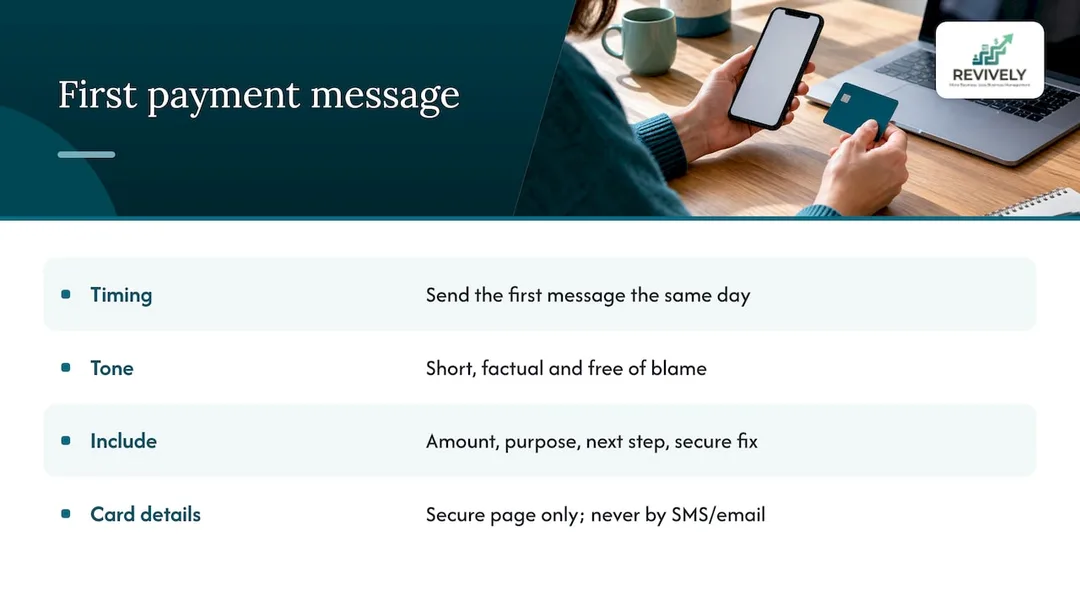
The initial notification should ideally go out the same day the payment fails. Keep it concise, factual, and free of any accusatory language. Your goal is to help them resolve the issue, not to shame them.
Crucially, include:
- The exact amount due.
- What the payment was for (e.g., "your weekly Pilates membership").
- What happens next (e.g., "We'll retry in two days").
- One clear, secure way to fix it.
Here's an example of a message that works well for Australian studios:
Hi Sam, your $35 weekly membership payment didn't go through today. You can securely update your card here: https://yourstudio.revively.app/update-payment. Your upcoming classes are still booked for now. Reply if you'd like a hand.
Absolute non-negotiable: Never ask for card details via SMS or email. Always direct clients to a secure, encrypted payment page. That's not just good practice; it's essential for Australian privacy and security standards.
Remember, tone matters. As Sprintlaw advises Australian yoga studios, keep language calm and commercial, especially with loyal regulars. Aggressive debt collection rhetoric too early on can shatter trust faster than a dropped crystal bowl.
Revively helps you automate these messages, linking them directly to your payment system, so you're not scrambling to chase payments by hand. This means fewer late-night admin sessions and more time focusing on your clients.
Step 4: Define Your Access Rules (and Stick to Them)
This is often where studios hit friction. Do you block access immediately? Offer a grace period? Charge a fee? The answer is: decide before it happens, and embed it clearly in your membership terms.
Australian studios handle this differently, and there's no single "right" answer, only what fits your business and client base.
For example:
- Reforma Pilates (reformapilates.au/policies/terms-of-service) charges a $5 fee per failed payment and temporarily suspends account access on the third day of non-payment. Clients cannot book or attend until the balance and fees are cleared.
- Studio Sculpt (studiosculpt.au/policies/) implements a $10 fee for each day a payment fails to process. By day three, booked classes are cancelled, and the membership is put on hold.
These are just two published examples. Your grace period needs to align with your business values. A short grace period of a few days (covering most bank processing delays) is generally easier to defend and less likely to cause client outrage than instant suspension.
On Failed Payment Fees: A Compliance Check
If you choose to charge a failed payment fee, you must disclose it upfront and clearly in your membership terms and direct debit service agreement. Sprintlaw is clear on this: explain when you retry, any fees that apply, and what happens with repeated failures. These fees should genuinely reflect your administrative costs or a reasonable commercial approach, not just be punitive.
When it comes to GST, the ATO's determination GSTD 2013/1 clarifies that a failed payment fee is typically not considered "consideration for a supply" under specific circumstances outlined in paragraph 2. This means it might not be subject to 10% GST. Always consult your accountant to confirm how your specific fees should be treated for GST purposes to ensure flawless BAS compliance.
Step 5: Navigate Disputes and Hardship with Care
Occasionally, you'll encounter a client who disputes a charge or genuinely cannot pay. Having a clear policy for both scenarios protects your business and maintains your reputation.
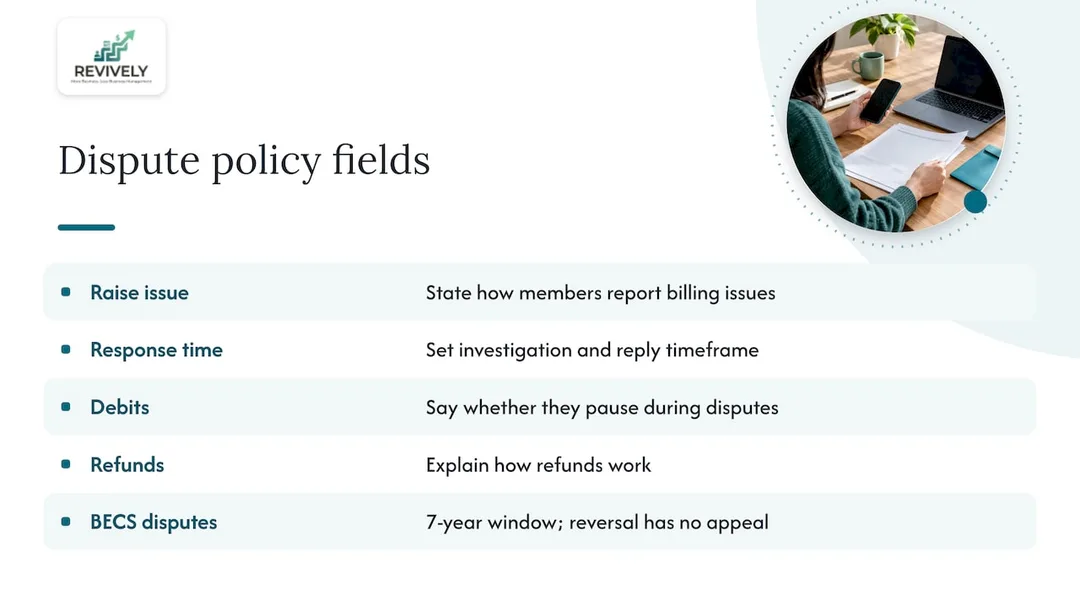
For disputes, your terms should detail:
- How a member raises a billing issue.
- Your investigation and response timeline.
- Whether debits pause during a dispute.
- Your refund policy.
Be aware that Direct Debit disputes (BECS) differ from credit card chargebacks. Stripe's BECS guide notes customers can dispute a BECS payment for up to seven years, and if the bank grants a reversal, there's no appeal process. This underscores the need for impeccable records of client agreements and billing history within a unified system like Revively.
Remember, Australian Consumer Law (ACL) is the bedrock for all consumer memberships. Your terms cannot override it. As Sprintlaw cautions, overly aggressive default wording, like suspending access while still charging without a fair process, often creates more problems than it solves.
For clients experiencing temporary financial hardship, consider offering:
- A short payment pause.
- A switch from recurring memberships to a pre-paid class pack, removing future billing risk.
An empathetic, flexible approach can transform a potentially lost client into a loyal one when their circumstances improve.
Step 6: Proactive Prevention: Stop Failures Before They Start
Recovery is good, but prevention is even better. Many recurring payment failures stem from a few common, easily fixable habits. Optimise your processes to minimise these headaches:
- Collect a secondary payment method: At sign-up, politely ask for a second card or bank account on file. If the primary method fails, you have an immediate fallback.
- Offer diverse payment options: Provide both card and bank-based options (like BECS Direct Debit via Stripe). This gives clients flexibility and a backup if one method encounters issues.
- Pre-billing reminders: Send automated alerts a few days before a recurring payment is due, especially if a client's card is nearing its expiry date.
- Empower self-service updates: Provide a secure, self-service portal where clients can update their payment details independently, without needing to contact your reception. This significantly reduces admin load.
- Align billing with pay cycles: Where possible and practical, align your billing dates with when your client base typically receives their pay cheques.
- Confirm terms at checkout: Ensure your cancellation policies, failed payment rules, and associated fees are explicitly acknowledged by clients during the online checkout process. No surprises, no arguments.
For a deeper dive into streamlining your billing, check out our guides on Stripe membership billing for Australian studios and the critical decisions before going live with Stripe subscriptions. These resources are packed with actionable advice tailored for the Australian market.
Our View on Failed Payments
Most studio owners we talk to face the same frustrating reality: revenue slips through the cracks due to failed payments. The charge declines, it goes unnoticed for days (sometimes weeks!), and then someone has to awkwardly chase it up by hand. This isn't just lost income; it's a huge drain on your time and energy, pulling you away from what you do best: teaching and building your community.
We built Revively around a core philosophy: your billing, bookings, and client communication should all live in one intelligent, unified cloud command centre. When memberships, class packs, and Stripe payments are seamlessly integrated with your timetable and detailed client profiles, you gain immediate visibility. You can see exactly who has an outstanding payment and whether they're booked into tomorrow's class - all without opening a dozen different tabs or wrestling with spreadsheets.
Our advice is simple: settle your internal rules once. Define your grace period, when you pause access, and when a personal call is necessary. Then, let your system do the routine, repetitive work. This approach keeps your members' experience smooth and professional, ensures GST compliance, and critically, frees you up to teach, heal, and inspire.
Andreea, Co-founder, Revively
How Revively Fits In: Your Australian Studio's Command Centre
Revively is more than just booking software; it's an Australian-made, unified cloud command centre (CRM + multi-resource scheduler) designed specifically for wellness and fitness studios like yours. We bring Stripe-powered memberships and class packs together with your timetable, client profiles, and a robust communication hub.
Here's how Revively empowers Australian studios to master payment recovery and compliance:
- Native Australian GST & Tax Invoice Handling: Say goodbye to manual calculations and reconciliation headaches. Revively automatically applies 10% GST to all casual classes, memberships, and multi-resource packages. It then auto-generates and issues legally compliant Australian Tax Invoices to your clients, every single time. This isn't an add-on; it's baked into our core.
- 100% Legal Xero Integration for BAS Accuracy: Our two-way, intelligent integration with Xero is your shield against audit woes. Automated mapping of tax codes, revenue accounts, and liabilities ensures your financial data flows seamlessly. This guarantees that your quarterly Business Activity Statements (BAS) are not just accurate, but genuinely audit-proof, eliminating manual spreadsheet errors and giving you peace of mind.
- Australian Data Residency & Privacy: We understand the critical importance of data sovereignty. All your client data, booking histories, sensitive health intake forms, and payment records are stored locally in Australia. This ensures full compliance with the strict Australian Privacy Principles (APPs) and builds deep trust with your clients, knowing their sensitive information remains safe within Australian borders.
- Automated Recovery Workflows: Set up intelligent retry schedules, automated email and SMS notifications with secure payment update links, and integrate these directly with client access rules.
- Unified Client View: Your support inbox, booking history, and billing conversations all live on one dashboard. If a client queries a payment, you have their full interaction history right there.

Revively plans start at $39 per month for Solo studios, with Growth at $99 per month and Pro at $199 per month. Rolling memberships add just $15 per month per 50 active members. See the Revively pricing page for full details on what each plan includes, or learn more about invoicing with Stripe payments within Revively.
FAQ
How long should I wait before retrying a failed payment?
For "insufficient funds," wait at least 24 hours, ideally until the next business day. For BECS Direct Debit, allow for the 1-3 business days banks can take to confirm. Subsequent retries should be spaced a few days apart, not attempted in quick succession.
How many times should I retry before contacting the member personally?
After about two or three consecutive automatic failures, it's usually best to pause further automatic attempts and reach out to the client directly. At this point, the issue is often an expired card, a closed account, or a temporary financial squeeze, and a human conversation resolves it much faster.
Can I suspend a member's bookings when a payment fails?
Yes, provided your membership terms clearly state this policy and you apply a fair, transparent process. Many Australian studios implement a grace period, suspending booking access only after two or three days of non-payment. Crucially, avoid suspending access while still charging, and always keep your communication calm and professional.
Can I charge a fee for a failed payment?
You can, but this must be clearly disclosed upfront in your membership terms. The fee should reflect a genuine administrative cost or a reasonable commercial approach. For GST treatment, always consult your accountant, as the ATO has specific guidance (GSTD 2013/1) on when such fees are not considered subject to GST.
Sources
- Failed payments? Here's what to do, Stripe
- Understanding declines and failed payments, GoCardless
- BECS Direct Debit for Recurring Payments in Australia, Stripe
- Membership Terms for Australian Yoga Studios, Sprintlaw
- Direct Debit Service Agreement, Sprintlaw
- Terms of service, Reforma Pilates
- Studio Policies, Studio Sculpt
- GSTD 2013/1, ATO
More Smart Studio Strategies
Ready to further optimise your Australian studio's operations? Dive into these related articles:
- Stop the Pro-Rata Panic: Your Guide to Fair & Compliant Membership Billing for Australian Studios
- Taming the "No-Show" Beast: Your Aussie Studio's Guide to Fair & Legal Late Cancellation Fees
- Stop the No-Show Bleed: How Deposits (Done Right) Protect Your Studio's Revenue
- The Aussie Studio Owner's Guide to Automated Cancellation Policies (and Why Yours Isn't Working)