
Late Cancellation Fees: A Fair Policy for Australian Studios
! Therapist prepares an empty spa treatment room
A late cancellation fee is a charge for cancelling inside a notice window you set, such as 24 hours before a massage, Pilates class or dance lesson.
The yoga mat sits empty. The massage bed, prepped and waiting. Your Pilates reformer, perfectly aligned. The studio's ready, your staff are on the clock, and the appointment? Well, that client decided to bail a few hours ago. No explanation, just a phantom gap in your schedule and a very real dent in your day's revenue. Sound familiar?
That gut-punch of a late cancellation isn't just frustrating; it's a constant drain on your bottom line, productivity, and patience. In Australia, you can charge for that missed slot, but it's not a free-for-all. It needs to be disclosed up front, genuinely reflect your loss, and never feel like a penalty.
This isn't about punishing clients; it's about protecting your business, valuing your team's time, and ensuring your wellness or fitness studio remains viable. Let's unpack how to set a bulletproof late cancellation policy for your Australian spa, recovery centre, yoga, Pilates, or dance studio - one that's fair, legal, and keeps your books looking healthy.

The Aussie Studio Owner's Quick Checklist for Cancellation Fees
Before we dive deep, here's what you absolutely need to nail:
- Transparency is King: Your clients must see and acknowledge the fee and notice window before they confirm any booking. Consumer Affairs Victoria is clear: disclosure needs to be upfront and reflect reasonable costs.
- Reflect Real Loss: The fee amount isn't arbitrary. It needs to be a genuine pre-estimate of your lost revenue, staff time, and any costs already incurred (minus the chance of rebooking).
- Define Your Terms: A late cancellation fee is not a no-show fee or a deposit. Clearly define each one in your terms and conditions to avoid confusion and disputes.
- GST Compliance: Cancellation fees can carry GST. Do not assume they're GST-free. Confirm the treatment with your accountant.
- Automate, Then Humanise: Let your booking system handle the policy application consistently, but build in room for your team to make documented exceptions when genuine hardship calls for it.
Late Cancellation, No-Show, & Deposit: Cutting Through the Confusion
These terms get thrown around interchangeably, leading to client disputes and awkward conversations. Let's get crystal clear:
- Late Cancellation Fee: This is charged when a client contacts you to cancel, but it's inside your pre-defined notice window (e.g., less than 24 hours before a scheduled massage or private Pilates session). You had some notice, but likely not enough to refill the slot.
- No-Show Fee: This hits when a client simply doesn't turn up and provides no notice whatsoever. Often, this fee is higher than a late cancellation because you had zero chance to promote someone from a waitlist or fill the slot. It's a complete loss of revenue for that time slot.
- Deposit: Money taken upfront to secure a booking. Be warned: Consumer Affairs Victoria guidance suggests that deposits above 10% may be treated as prepayments, which means they're usually refundable minus your actual or reasonable costs if the client cancels.
Still weighing the pros and cons of deposits vs. fees? We've covered this ground thoroughly in our post on whether booking deposits actually stop cancellations - it's worth a read.
Yes, You Can Legally Charge a Late Cancellation Fee in Australia (With Conditions)
Good news: charging for late cancellations is perfectly permissible in Australia. But there are crucial caveats. The Victorian consumer regulator advises businesses should tell customers about cancellation fees before booking and that fees must not be excessive. That same advice warns that unfair terms in standard form contracts are void and unenforceable under the Australian Consumer Law (ACL), with significant penalties for businesses that get it wrong.
In essence, your fee is far more defensible when:
- Transparency is Absolute: The client saw and acknowledged the policy before confirming their booking. No hiding it in fine print!
- Plain Language: It's written in clear, concise English, not buried under legalese.
- Reflects Real Loss: The amount directly relates to the genuine cost your studio incurs from that late cancellation.
- Consistency is Key: You apply the policy uniformly to every client (with documented exceptions, more on that later).
Australian courts scrutinise whether a fee is reasonable. Sharrock Pitman Legal notes that they treat reasonable fees as those that are not extravagant, exorbitant or unconscionable, taking into account factors like your cash flow impact and whether you were able to rebook the slot.
Disclaimer: This guide provides general information, not legal advice. If your planned fee is more than a modest percentage of the service price, it's wise to have a lawyer specialising in small business contracts review your terms. Better safe than sorry!
Crafting a Fair Amount: The "Genuine Pre-Estimate of Loss" Principle
The golden rule here is "genuine pre-estimate of likely loss." Sprintlaw's guide lists the critical inputs: lost profit, staff and admin time, costs already incurred (like room prep or specific resources), and crucially, how likely you are to rebook that slot.
Tailoring the Fee for Your Studio
Consider a 60-minute spa treatment booking. If a client cancels two hours out, you're probably not refilling that room, and your therapist is still rostered. Your loss is very close to the full service margin. Now, picture a 20-person Pilates class with a robust waitlist. One late cancellation might cost you very little if your system automatically promotes the next person. Charging a full-price fee in the latter scenario becomes much harder to justify.
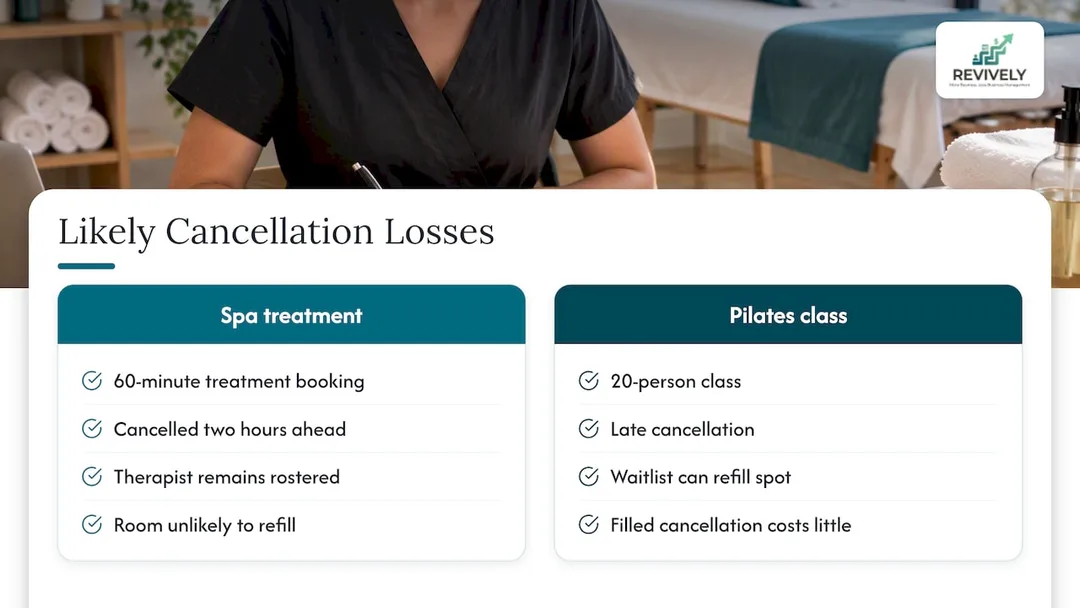
This stark difference highlights why a single, flat cancellation rule for every service across your entire studio can be risky and, frankly, unfair. Need a clearer picture of the financial impact? Our no-show cost calculator helps you pinpoint what missed appointments are truly costing you each month before you even pick a number.
Flat Fee vs. Percentage
- Flat Fee: Simple to explain and administer. Great when your costs are easily quantifiable, or for services with a narrow price range. The ATO notes flat fees are common where costs are easy to quantify, systems cannot do percentages, or industry custom uses them.
- Percentage: Scales directly with the service price. Ideal for spas offering a range of treatments from quick fixes to half-day packages, ensuring the fee always reflects the value of the booking.
The Sliding Scale: Rewarding Early Notice
A smart approach is a sliding scale, which incentivises clients to provide as much notice as possible. Sprintlaw offers an example of 20% within 72 hours and 50% within 24 hours.
Here's an illustrative structure for a multi-service studio:
| Notice Given | Spa Treatment | Private Dance Lesson | Group Class |
|---|---|---|---|
| More than 48 hours | No fee | No fee | No fee |
| 24 to 48 hours | 50% of price | 50% of price | No fee (or 25% if no waitlist) |
| Under 24 hours | 100% of price | 100% of price | Class credit forfeited |
| No-show | 100% of price | 100% of price | Class credit forfeited |
Remember: This is a template. Adjust it to your actual costs, your specific rebooking rates, and the dynamics of your studio.
Setting Your Notice Window: Matching Time to Resources
Your notice period isn't arbitrary; it should directly correspond to how long you realistically need to refill a cancelled slot and minimise your loss.
- Spas and Clinics: Treatments typically tie up a therapist, a specific room, and sometimes specialised equipment (like a sauna or flotation tank), plus cleaning and turnover time. A window of 24 to 48 hours is common and practical.
- Yoga and Pilates Classes: For group classes, a shorter window, often 2 to 12 hours, can work effectively, especially if you have an active waitlist that your system can automatically promote from.
- Dance Studios: Private lessons and term enrolments require longer notice than casual drop-in classes. A dedicated teacher is booked for that specific time, making last-minute rebooking difficult. Consider 24-48 hours for privates, and potentially different terms for term enrolments.
A notice window you can't genuinely enforce or one that doesn't allow you to refill the spot is just a number on paper. Choose a period that reflects your actual operational reality.
What Goes Into a Water-Tight Policy? Transparency and Clarity
Transparency isn't just a buzzword; it's the bedrock of an enforceable policy in Australia. Sprintlaw strongly recommends presenting your policy up front, in plain English, before a booking is confirmed.
A robust policy should clearly state:
- The Specifics: Your exact notice window(s) and the corresponding fee (or forfeited credit) at each stage.
- Definitions: What precisely constitutes a late cancellation, a no-show, and a late arrival (e.g., "more than 15 minutes late may be treated as a no-show").
- How to Cancel: The accepted methods for clients to cancel (e.g., via the online booking portal, SMS, phone call). Make it easy for them to do the right thing!
- Membership & Class Pack Impact: Clearly explain whether class packs lose a credit or if memberships incur a specific fee.
- Exceptions Policy: Detail whether you make exceptions for genuine illness, emergencies, or extenuating circumstances. Sprintlaw advises stating this explicitly, as it helps build trust and compliance with the ACL.
- Your Responsibilities: What happens if your studio cancels an appointment (more on this below).
Don't just hide it on a website page! Put a concise version right at the booking step and require a tick box acknowledgment. Reiterate it in the confirmation message and all reminder emails/SMS. Consumer Affairs Victoria also recommends you document how you set the fees and keep records showing they genuinely reflect your actual costs. A simple one-page note outlining your calculations is usually sufficient.
When Your Studio Cancels: The Other Side of the Coin
A fair cancellation policy flows both ways. The ACL consumer guarantees still apply to your services. Sprintlaw points out that if you cancel or the service isn't provided, the customer may be entitled to a refund or another remedy regardless of your terms.
If a therapist falls ill, an instructor can't make it, or equipment breaks down:
- Communicate Immediately: Inform the client as soon as possible.
- Offer Solutions: Provide a full refund, a complimentary reschedule, or a credit that goes above and beyond.
- Be Transparent: Explain what happened briefly and genuinely apologise for the inconvenience.
GST on Cancellation Fees & Your BAS: Don't Get Caught Out!
Here's a critical one for Aussie studios: GST. The ATO's ruling on this states that a cancellation fee may be consideration for a facilitation supply, and its GST status must be assessed under the GST Act. It explicitly adds that a facilitation supply may still be made even if the intended service is cancelled or the client doesn't show up.
Practically speaking: Never assume a cancellation fee is GST-free. Always ask your accountant how to treat it, then ensure it's recorded the same way, every single time.
This is where your software truly shines. Revively natively handles that 10% GST on all casual classes, memberships, and multi-resource packages, automatically issuing legally compliant Australian Tax Invoices to your clients. Our 100% legal Xero integration is your safeguard for tax compliance. It automates two-way mapping of tax codes, revenue accounts, and liabilities, making your quarterly Business Activity Statements (BAS) flawless and audit-proof. Say goodbye to manual spreadsheet errors and hello to peace of mind, knowing your financials are always precise and audit-ready.
When a Client Disputes a Fee: Grace Under Pressure
Clients can and will dispute fees. Common grounds include unclear disclosure, a fee exceeding your actual loss, or a perceived unfair policy. Sprintlaw suggests offering a partial waiver or resolution first, as this often prevents formal disputes from escalating.
A level-headed approach:
- Review the Record: Check what the client saw at the time of booking and precisely when they cancelled.
- Assess the Impact: Did you manage to refill the slot? If so, your actual loss is smaller, which might justify a reduced fee.
- Genuine Exceptions: If the case is genuinely compelling (e.g., illness with a medical certificate), consider waiving or reducing the fee and make a clear note of the reason in their client file.
- Stand Your Ground (When Justified): If your terms were crystal clear and the slot went empty, you are in a strong, defensible position to hold the fee.
Remember, a waived fee often costs you less in the long run than a disgruntled client, a negative review, or a formal complaint to consumer affairs. It's a delicate balance.
Our View: Automate the Policy, Keep the Judgement
We've seen it time and again in studios of all sizes across Australia. A solid cancellation policy exists on the website, but its actual application is a messy, inconsistent affair handled by whoever's at the front desk that day. One client gets charged, another is waved through, and the studio owner ends up awkwardly navigating both conversations. It's a recipe for resentment and lost revenue.
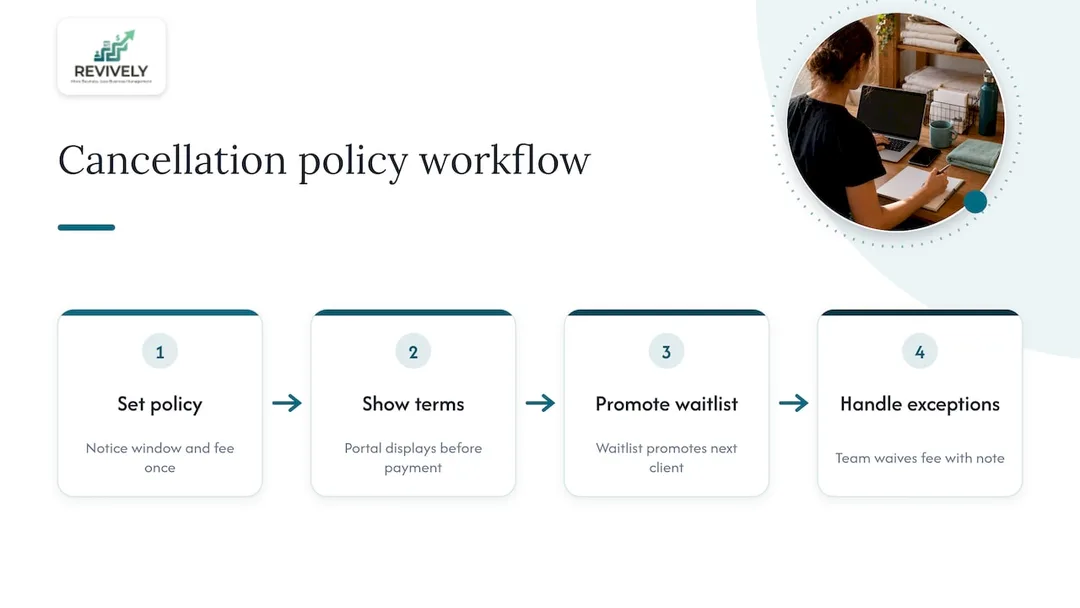
Our philosophy is simple: the system should apply the rule, and a person should handle the exceptions.
Set your notice windows and fees once within your multi-resource studio scheduling software. Let your online booking portal display them prominently and require acknowledgment before payment. Allow your smart waitlist management to automatically promote the next client, instantly reducing the financial sting of a late cancellation. Then, empower your team with a simple, documented way to waive a fee when genuine circumstances demand it.
This approach ensures your policy is fair, consistent, and legally defensible. Crucially, it takes the awkwardness out of the initial conversation, allowing your team to focus on providing exceptional client experiences. We delve deeper into this in our guide to automated cancellation policies.
- Andreea, Co-founder of Revively*
Put Your Policy to Work with Revively
Revively (Revively.app) is an Australian-made, unified cloud command centre designed specifically for wellness and fitness studios like yours. Think of us as your CRM + multi-resource scheduler, built to streamline operations for spas, recovery centres, yoga/Pilates studios, clinics, and dance schools. We understand the chaotic daily reality, and we're here to simplify it.
Our platform lets you manage rooms, staff, and cleaning buffers on one intuitive grid, run dynamic group classes with automatic waitlist promotion, and seamlessly process payments via Stripe. Crucially, we keep your client data - from booking histories to sensitive health intake forms - stored right here in Australia, fully compliant with the Australian Privacy Principles (APPs), giving you and your clients peace of mind.
And yes, as mentioned, our 100% legal Xero integration ensures impeccable GST calculations and audit-proof BAS. It's an all-in-one spa booking software and multi-resource studio scheduling solution that empowers you to run your business, not just manage it.
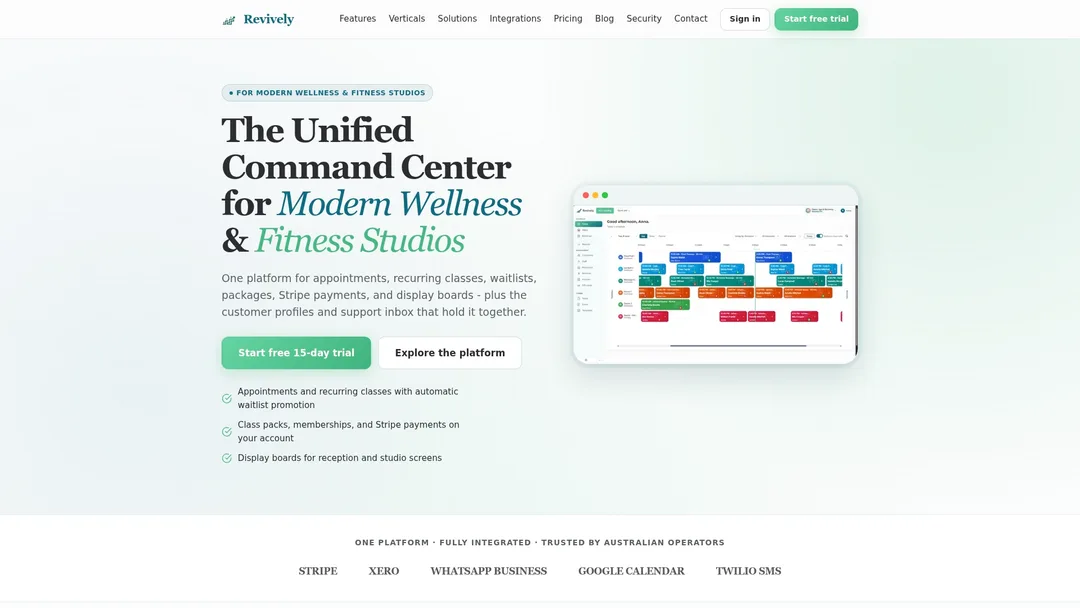
See how online booking for wellness businesses clearly shows your terms at checkout, or compare plans on our pricing page. If you run classes, our class scheduling features demonstrate how waitlists dramatically reduce the financial impact of each late cancel.
Frequently Asked Questions
Is there a fee for cancelling an appointment?
Only if the business has explicitly set one up and disclosed it to you before booking. According to the ATO's GST ruling, a supplier may charge a cancellation fee under the original agreement or a separate one made when or before the fee is paid. The key is prior disclosure.
Can a client refuse to pay a cancellation fee?
A client can dispute a fee, particularly if the terms weren't clearly disclosed, if the fee seems disproportionately high compared to the business's actual loss, or if the overall policy appears unfair. If your terms were transparently shown before booking and the amount genuinely reflects a real cost, you're in a much stronger position. Often, offering a partial waiver or finding a quick resolution can prevent a formal dispute.
How much should a late cancellation fee be?
It should always reflect your genuine, pre-estimated loss, encompassing factors like lost profit, staff time, costs already incurred, and the likelihood of rebooking the slot. Many Australian studios use a percentage of the service price, which may increase as the appointment time draws closer. It's good practice to keep a documented note of how you calculated these figures.
What is the difference between a late cancellation and a no-show fee?
A late cancellation occurs when the client informs you they won't attend, but their notice comes within your specified cancellation window (e.g., less than 12 or 24 hours before). A no-show means the client simply didn't turn up and provided no notification at all. No-shows typically cost studios more as there was zero opportunity to refill the spot, so many businesses charge a higher fee for them.
Sources
- When customers cancel: guidance for tourism businesses, Consumer Affairs Victoria
- Cancellation Fees: Legal Rules for Australia, Sprintlaw
- Cancellation Fees and Australian Consumer Law, Sprintlaw
- Can I legally be charged a cancellation fee for a service? Sharrock Pitman Legal
- GSTR 2009/3, Australian Taxation Office legal database
- GSTR 2009/3, ATO legal database (facilitation supply)
Recommended for Your Studio
- The No-Show Tax: 4 Policy Templates to Stop It Bleeding Your Australian Studio Dry
- The Aussie Studio Owner's Guide to Automated Cancellation Policies (and Why Yours Isn't Working)
- Stop the No-Show Nightmare: How Automated Cancellation Policies Transform Your Aussie Studio
- Ditching the Refund Headaches: An Aussie Studio Owner's Guide to ACL-Compliant Cancellations & Fair Policies