
Pro Rata Membership Billing for Studios: How to Get It Right
! Studio owner confirming a first membership payment
Pro rata membership billing means a new member pays only for the part of the billing period they actually have access to.
You know the drill. A keen new member walks in, excited to sign up for your unlimited yoga or Pilates membership. You run through the benefits, get them pumped, then hit them with the first payment. Suddenly, their eyes narrow. "Wait, why is it this amount? My friend joined last week and paid something different..."

That awkward pause? That moment of doubt? That's the real cost of getting pro-rata membership billing wrong.
"Pro rata" sounds like complex corporate jargon, but it's simply about charging a new member fairly for the portion of the billing period they actually use. If someone joins your studio on the 18th of October, their first payment covers only the remaining days in that month. From the next billing cycle, they pay the full, regular fee.
The concept is straightforward. The execution, however, is where Australian studios often bleed cash, tangle up their accounting, or end up with frustrated members. We're talking:
- Conflicting calculations for different staff members.
- Mysterious GST discrepancies on partial payments.
- Fuzzy agreement terms that lead to customer disputes.
This isn't just about good customer service; it's about Australian Consumer Law compliance and keeping your BAS audit-proof. This guide is your no-nonsense handbook. We'll cover the common methods, demystify GST, unpack the rules, and show you what to demand from your GST compliant studio software.
The Gist: Quick Pro-Rata Wins for Aussie Studios
- Fair First Payment: Pro-rata billing means the first payment covers only the remaining days of the current period, then the member shifts to the full recurring fee. No more overcharging new sign-ups.
- Choose Your Method: You can prorate by days in the month (calendar month billing) or simply bill on each member's join date (anniversary billing), avoiding proration entirely. Or, for schools, bill per week/term.
- Transparency is King: Clearly state the first-payment amount and method in your membership agreement before the member signs. The ACCC has zero tolerance for hidden fees or unclear conditions.
- GST & Xero Sync: Your pricing needs to reflect 10% GST, and your billing system absolutely must push these payments, with the correct tax codes, directly into Xero. This guarantees your BAS is spot-on and audit-proof, removing manual spreadsheet headaches.
- Automate It: Pick one clear rule, publish it, and ensure your system applies it consistently to every single member. Consistency eliminates confusion and protects your revenue.
Table of Contents
- What does pro-rata billing really mean for your studio?
- Three smart ways to handle that first payment
- Why class packs aren't pro-rata (and how to explain it)
- Your membership agreement: A legal compliance shield
- GST on partial payments: Don't get caught out
- The Revively perspective: Automate for sanity and compliance
- What to look for in world-class studio booking software (Mindbody alternatives Australia)
- Revively: Your unified cloud command centre for Australian wellness studios
- Common pro-rata mistakes that cost Australian studios
- FAQ: Quick answers to your pro-rata questions
- Sources
- Recommended Reads for Australian Studio Owners
What does pro-rata billing really mean for your studio?
"Pro rata" is Latin for "in proportion." For your spa, yoga, Pilates, or dance studio, it means the very first charge to a new member is proportional to the time left in your billing period. If your monthly cycle begins on the 1st, a member joining on day 20 of a 30-day month isn't asked to fork out for 30 full days of access they won't use. That's just fair, and it sets a great tone.
But it's not just about new sign-ups. Pro-rata principles often pop up when:
- Mid-cycle joins: The most common scenario. Someone signs up halfway through the month.
- Plan upgrades/downgrades: A client moves from a 2-class-a-week plan to an unlimited membership part-way through their billing cycle.
- Pauses and returns: A member comes back from a membership pause on a date that doesn't align with their usual billing day.
- Term alignment: Dance schools, for instance, might need to align a student's billing to a specific term start date, so a student joining in week 3 pays only for the remaining weeks.
Without a clear, automated rule, your front desk staff are left to make a judgement call every time. That's a recipe for inconsistency: some members pay more, some less, and when someone inevitably asks "why?", nobody can offer a clear, compliant answer.
Three smart ways to handle that first payment
Most studios pick one of these approaches. There's no single "right" way; the best method is the one you can explain simply and apply consistently.
1. Daily proration (calendar month billing)
This is common for studios with predictable monthly billing cycles. All members are billed on the 1st of each month. A new member pays for only the remaining days in the current month, then pays the full fee on the 1st of the next month.
Worked example: Your unlimited Pilates membership is $120 per month (inclusive of 10% GST). A new member joins on 18 October. October has 31 days. The period from 18 to 31 October is 14 days.
Calculation: ($120 ÷ 31 days) × 14 days = $54.19 for the first payment. From 1 November, they pay the full $120.
Pros: Simplifies your cash flow and financial reporting, as all regular membership payments land on the same day.
Cons: The first payment is often an "odd" amount, which can sometimes confuse members. Joining late in the month (e.g., 29th October) means paying for just a few days, only to be charged the full amount two days later - this needs crystal-clear communication in your agreement. Some studios soften this by rolling late joins into the next month's fee at a reduced rate, but if you do, ensure it's clearly documented.
2. Anniversary billing
This method completely sidesteps proration. Each member is billed on the same day of the month as their original join date. A member who joins on the 18th will pay on the 18th of every subsequent month.
Pros: Super simple for the member ("You pay the full fee, and you get a full month's access!"). No odd amounts or complex calculations.
Cons: Your billing dates are spread throughout the month, which can make cash flow less predictable and chasing failed payments more dispersed. While easy for multi-resource studio scheduling software, it's a nightmare with manual spreadsheets.
3. Weekly or per-term proration
Frequently used by dance schools, music schools, or studios that structure their programmes around terms. The fee is set per week or per term, so the first charge is simply the number of weeks remaining multiplied by the weekly rate.
Worked example: A term fee is $240 for 8 weeks, meaning $30 per week. A student joins at the start of week 3 and has 6 weeks left in the term.
First charge: 6 weeks × $30 = $180.
Pros: Extremely easy to explain to parents and students, as the maths is visible and intuitive.
Cons: Less suitable for ongoing, unlimited monthly memberships in yoga or Pilates studios.
| Method | First Payment | Billing Dates | Best For |
|---|---|---|---|
| Daily Proration | Odd amount | One fixed date for all members | Gyms, Pilates, yoga with monthly memberships |
| Anniversary Billing | Full fee (no proration) | Spread across the entire month | Boutique studios, spas with small memberships |
| Weekly/Term Proration | Weeks left × weekly rate | Per term or specific term start date | Dance schools, music schools |
Why class packs aren't pro-rata (and how to explain it)
This is a common point of confusion. A class pack (e.g., 10 classes for $200) isn't prorated because it's not time-based. A member simply buys a bundle of classes and uses them until they're gone or expire.
Pro-rating applies specifically to recurring access - think unlimited monthly memberships, weekly enrolments, or ongoing access plans.
Make this distinction crystal clear on your pricing page and during sign-up. Otherwise, you'll have members requesting a half-price 10-class pack because they're joining midway through the month, which directly undermines your membership revenue.
Your membership agreement: A legal compliance shield
The exact dollar figure of the first payment matters less than ensuring your member understood it before they paid. In Australia, consumer protection laws are robust, and regulators like the ACCC are vigilant.
The ACCC has warned gyms about advertising "No Contracts" when hidden conditions on termination or further payments still applied. Penalties can be significant - up to $1.1 million per contravention for misleading advertising under the Australian Consumer Law. This principle absolutely extends to pro-rata fees: if there's a joining charge, an admin fee, or a partial first payment, you must disclose it up front.
Your membership agreement isn't just paperwork; it's your first line of defence. A robust clause should cover:
- The full recurring fee and its billing frequency.
- How the first payment is calculated, ideally with a brief, clear example.
- The exact date of the first full payment.
- Any separate joining or administration fees.
- How plan changes or pauses impact subsequent payments.
- The cancellation process and required notice period.
State rules can differ significantly. Always check the guidance for your specific state or territory. For example:
- Queensland offers clear advice on creating and using membership agreements.
- The NSW Government's fitness and gyms page provides essential consumer rights information.
- Victoria's guide to preventing unfair terms in health and fitness membership agreements is critical reading.
- In the ACT, the Fitness Industry Code of Practice 2026 defines terms like "fixed term" for periodic billing memberships.
Not every studio is covered by the exact same rules, so confirm which apply to you with your state regulator or a legal professional before finalising your wording. Don't risk a nasty surprise.
GST on partial payments: Don't get caught out
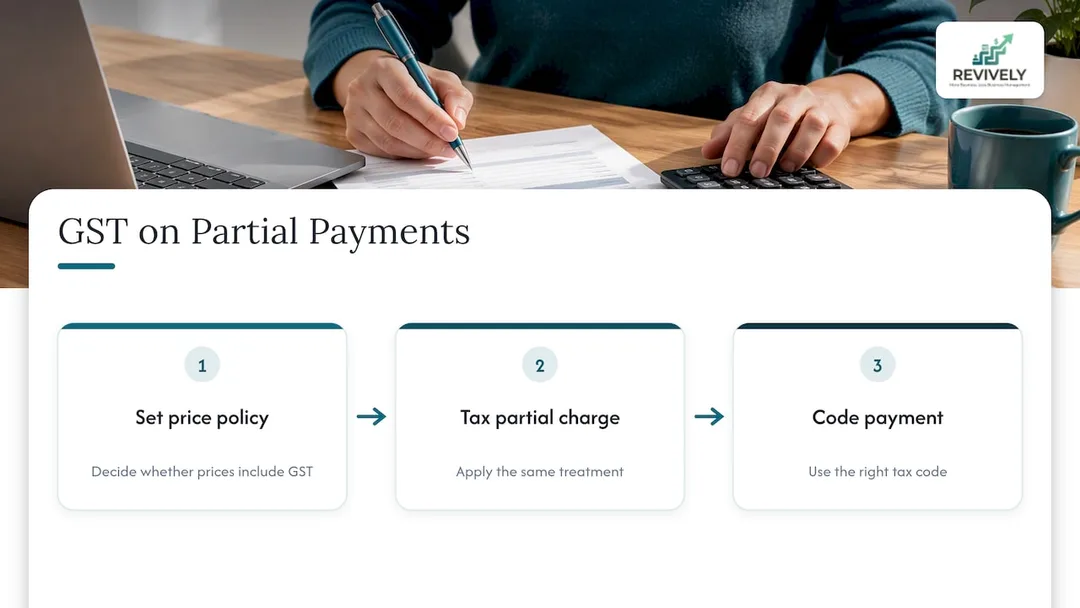
If your studio is registered for GST, almost all your sales are taxable unless specifically GST-free or input-taxed. This absolutely includes that partial-period charge. The prorated $54.19 from our example? That's a taxable sale, just like any other full payment.
The critical factor here is consistency and compliance. You need to decide:
- Do your advertised prices include GST, or is it added at checkout? (Most Australian service businesses quote GST-inclusive prices).
- Is the 10% GST applied correctly to all payments, including pro-rata charges?
- Does your billing and accounting system automatically issue legally compliant Australian Tax Invoices to clients?
- Does each payment land in your accounting software (like Xero) with the right tax code and revenue account mapping, ensuring your quarterly BAS is accurate and audit-proof?
This is precisely where manual billing becomes a dangerous liability. When a front desk team member manually types a custom amount, your bookkeeper later has to play detective, guessing the GST component. That's a direct path to BAS errors, fines, and audit nightmares.
For a deeper dive into memberships and your Business Activity Statements, check out our guide to GST on memberships for Australian studios. If you're keen to streamline payments through your own Stripe account, this walkthrough of seamless Stripe membership billing explains the setup for Australian studios.
The Revively perspective: Automate for sanity and compliance
Here at Revively, we build all-in-one spa booking software and multi-resource studio scheduling solutions specifically for Australian wellness and fitness businesses. We see the same pattern emerge repeatedly: studios rarely get the maths of pro-rata wrong. They get it wrong because the "rule" lives in someone's head.
One staff member rounds up, another generously waives the first week, and three months down the line, nobody can explain why two members on the exact same plan paid different initial amounts. This isn't just confusing; it's a compliance risk and a potential revenue drain.
Our plain-spoken advice:
- Simplicity Wins: Choose the simplest rule your members can understand. For monthly yoga or Pilates memberships, that's often daily proration or anniversary billing. For a dance school, it's usually weeks remaining in the term.
- Document and Display: Write your chosen rule down once, clearly, and include a simple example on your pricing page and in your membership agreement. No ambiguity allowed.
- One Flow, No Gaps: Keep memberships, payments, and accounting tightly integrated. With GST compliant studio software like Revively, Stripe handles the payment, and our 100% legal Xero integration automatically maps it through with correct GST. This ensures your BAS isn't a frantic clean-up job every quarter, guaranteeing BAS accuracy and making your records audit-proof.
- Review and Refine: Quarterly, review how many first payments were manually adjusted. If it's more than a handful, your rule is likely too complicated, or your system isn't robust enough.
"Stop manually calculating awkward first payments. The best rule is the one that's automated, transparent, and always GST-compliant."
- Andreea, Co-founder, Revively.app*
What to look for in world-class studio booking software (Mindbody alternatives Australia)
If you're currently wrestling with spreadsheets, multiple disconnected systems, or looking for Mindbody alternatives Australia, it's time to demand more from your technology. Your booking software should be your operational backbone, not another source of stress.
When evaluating systems, ensure it can confidently handle:
- Automated Recurring Billing: Memberships billed seamlessly via card or direct debit, through your own payment gateway (like Stripe).
- Flexible First Payments: The ability to automatically calculate a pro-rata first payment, or set billing to commence precisely on the join date (anniversary billing).
- Effortless Plan Changes: Process upgrades, downgrades, and pauses without manual amount edits by staff.
- Smart Payment Management: Automated retry for failed payments and a clear dashboard showing overdue members.
- Integrated Accounting & Compliance: Crucially, payments must sync directly to your accounting software (e.g., Xero) with correct 10% GST codes and revenue accounts. This guarantees 100% legal BAS accuracy.
- Robust Reporting: Clear insights into active members, recurring revenue, and the financial impact of your billing rules.
- Australian Data Residency & Privacy: All client data (booking histories, sensitive health intake forms) stored locally in Australia, fully complying with Australian Privacy Principles (APPs). This is non-negotiable for client trust and legal compliance.
For a broader perspective, our guide to choosing gym membership software walks through the essential questions. Spa owners can also discover how memberships drive predictable revenue, and yoga teachers can see how class pricing, memberships, and BAS fit together.
Revively: Your unified cloud command centre for Australian wellness studios
Revively is an Australian-made, unified cloud command centre designed specifically for local wellness and fitness studios. We bring together everything you need - memberships, class packs, multi-resource studio scheduling, waitlists, and Stripe payments - into one intuitive platform.
Our standout features for compliance-focused Australian studios include:
- Flawless GST & Tax Invoice Handling: Natively calculates 10% GST across casual classes, memberships, and multi-resource packages, automatically issuing legally compliant Australian Tax Invoices to your clients.
- 100% Legal Xero Integration: Our automated two-way mapping of tax codes, revenue accounts, and liabilities ensures your quarterly Business Activity Statements (BAS) are flawless and audit-proof, eliminating manual spreadsheet errors.
- Australian Data Residency & Privacy: Rest easy knowing all client data, booking histories, and sensitive health intake forms are stored locally in Australia, fully complying with the strict Australian Privacy Principles (APPs).
- Designed for Your Business: Whether you're a yoga studio, Pilates centre, spa, recovery clinic, or dance school, Revively is built to simplify your operations, enhance client experience, and keep you compliant.
Plans start at just $39 AUD per month for Solo, $99 AUD per month for Growth, and $199 AUD per month for Pro. Annual billing offers a discount at $390 AUD, $990 AUD, and $1990 AUD per year respectively. For rolling memberships, an additional $15 AUD per month per 50 active members applies.
Discover all the details on our pricing page or explore our comprehensive membership and class pack software. Start your free trial today and experience the Revively difference.
Common pro-rata mistakes that cost Australian studios
Steer clear of these pitfalls to protect your revenue and reputation:
- Prorating class packs: Seriously, don't. Class packs are about quantity, not time. Keep them distinct from time-based memberships.
- Hiding the first payment: If a new member sees $54.19 on their bank statement but your website only advertises $120, expect a dispute. Transparency is paramount for compliance and trust.
- Changing the rule per member: Exceptions happen, but they must be rare and documented with a clear reason. Otherwise, your financial data becomes incomparable and unreliable.
- Ignoring cancellation timing: A member cancelling mid-cycle might demand a refund for unused days. Define your refund policy clearly in the agreement. Remember, notice periods are standard, and the NSW Government warns direct debits may continue until you provide written notice.
- Forgetting GST: A part-period charge is always a taxable sale if your studio is GST registered. Don't let this detail trip up your BAS.
FAQ: Quick answers to your pro-rata questions
What does pro-rata membership billing mean for my studio?
It means the initial payment a new member makes is proportional to the time remaining in the current billing period. For example, if they join halfway through the month, they pay for approximately half the month, then switch to the full recurring fee from the next regular billing date.
How do I calculate a pro-rata membership fee?
Take your full monthly fee, divide it by the total number of days in the current month, then multiply that daily rate by the number of days remaining in the month (including the join date). For a $120 monthly fee with 14 days left in a 31-day month, it's: ($120 ÷ 31) × 14 = $54.19. For term-based services, simply multiply the weekly rate by the number of weeks left.
Do I have to charge pro-rata?
No, you don't. Many Australian studios opt for "anniversary billing," where the first payment is the full fee, and the member is simply billed on their join date every subsequent period. Whatever method you choose, it's crucial to state it clearly and upfront in your membership agreement before the member pays.
Is a pro-rata payment subject to GST?
Absolutely. If your studio is registered for GST, any part-period membership charge is considered a taxable sale, just like a full payment, unless it falls under specific GST-free or input-taxed categories. Always confirm the correct GST treatment of your services with your accountant or the ATO to ensure BAS compliance.
Sources
- ACCC warns gyms about 'No Contracts' membership advertising
- NSW Government: fitness and gyms
- Consumer Affairs Victoria: preventing unfair terms in health and fitness membership agreements
- ACT Fitness Industry Code of Practice 2026
- Australian Taxation Office: taxable sales
Recommended Reads for Australian Studio Owners
- Ditching Spreadsheet Chaos: Your Australian Studio's Guide to Seamless Stripe Membership Billing
- Stop the Revenue Drain: Are Your Class Packs Undermining Your Memberships?
- Pricing Yoga Classes in Australia: Master Memberships, Payments & BAS Compliance
- Stripe Subscriptions for Your Australian Studio: 5 Non-Negotiable Decisions Before Go-Live