
Get Online Waivers Live in a Week for Australian Yoga Studios
! Yoga member completing digital waiver
Yes, collect a tailored online waiver from every participant before they set foot on a mat, in a studio or through a screen.
Picture this: A new student, beaming, ready for their first vinyasa. They check in, step onto the mat... and then an incident report lands on your desk a week later, only for you to discover their paper waiver was never signed. Or worse, the "digital" form they filled out online was a generic template, didn't cover your hot yoga class, and now you're scrambling to prove they acknowledged the risks.
It's a daily dance of chaos for Aussie studio owners. You're juggling bookings, staff, and keeping the lights on, while trying to tick off that critical, often-overlooked box: the legally sound, context-specific, and actually enforced online waiver. It's not just a formality; it's your first line of defence.
And yes, you absolutely can get a tailored online waiver system live in a week for your Australian yoga studio. One that protects your business, your instructors, and your peace of mind.

You need to collect a bespoke online waiver from every participant before they step foot on a mat, enter your studio, or even join through a screen. This document isn't just a scribble on a clipboard; it must clearly articulate assumption of risk, a release of liability, a medical declaration, and emergency contact details. Your next move? Pick a robust template, adapt it specifically to your unique class types, then - critically - verify whether your current insurance policy actually covers online delivery risks.
What an Australian Yoga Waiver Actually Needs to Say
A waiver only earns its keep if it meticulously details the actual risks associated with the specific class a participant is about to take. Generic "sport and fitness" language simply won't cut it in an Australian court. Wording built specifically around the nuances of yoga - from inversions to hot studio temperatures - carries far more weight.
Sprintlaw's guidance on waiver templates in Australia sets out the core clauses every studio should treat as non-negotiable.
Here's the minimum a rock-solid Australian yoga waiver requires:
- Assumption of Risk Clause: Clearly describe the physical activity in plain terms (e.g., "stretching, inversions, balance poses, exposure to heat in hot yoga") so participants fully understand what they're agreeing to.
- Release of Liability: Explicitly limit your exposure for ordinary negligence, while being transparent that it cannot excuse gross negligence or reckless misconduct.
- Medical Declaration: Move beyond a simple 'yes/no' tick box. Request specific details on existing conditions, medications, recent injuries, and a prompt for physician clearance where relevant.
- Emergency Contact Details: Collect essential participant identifiers (name, date of birth, phone number) and a reliable emergency contact so you can act swiftly if something goes awry.
- Class-Specific Warnings: Mandatory for specialised formats like hot yoga, aerial yoga, or prenatal classes. Also, include a separate checkbox for recording or livestream consent if applicable.
- Expiry and Re-sign Rules: Define how often waivers need to be renewed. For participants under 18, a guardian consent field, capturing their relationship to the minor, is legally essential.
Why Your Medical Declaration Needs a Deeper Dive
A single, vague "Do you have any injuries?" tick box is a liability in waiting. It invites incomplete answers and doesn't genuinely inform your instructors. Best practise demands specific follow-up questions: "Are you currently taking medications?", "Do you have any cardiovascular conditions?", "What is your pregnancy status?", "Have you had recent surgery?".
This isn't about intrusive interrogation. It's about providing your instructors with just enough critical information to modify a sequence safely, protecting both student and studio, without transforming the form into a full medical history questionnaire.
Don't Forget Recording & Livestream Consent
If you livestream or record a class for later replay, a general liability waiver does not automatically cover the use of someone's image. This is a common oversight. Yoga Alliance's sample release and waiver of liability recommends a distinct checkbox explicitly outlining how footage might be used and who can see it, separate from the core liability release.
Re-Signing Rules: A Hidden Lifesaver
Waiver expiry matters more for online forms than many owners anticipate. A waiver signed twelve months ago, before you introduced a new aerial yoga stream or before a participant's health circumstances shifted, may no longer accurately reflect current risks. Building a re-sign trigger into your digital form - whether annually or whenever a class format significantly changes - ensures the document remains relevant and protective, rather than a forgotten formality from year one.
The Minor Complication: Guardian Consent
Any participant under 18 absolutely requires a guardian's signature. Crucially, the form should capture the guardian's relationship to the minor, not just a signature. If your studio offers teen or family classes, this field isn't optional. Skipping it is one of the fastest ways to render a waiver worthless if a dispute ever reaches an Australian court.
Collecting Online Waivers: The Digital Paper Trail You Need
Getting a signature online is easy. Making that signature legally defensible later is where many Australian studios trip up.
A digital signature only carries weight if it comes with an impeccable audit trail: a timestamp, the signer's IP address, and clear evidence they actively accepted the terms - not just a pre-ticked box. Jotform's yoga student waiver agreement form exemplifies this, offering a mobile-friendly template with secure e-signature capture and storage, making it a common starting point for smaller studios building their first digital waiver.
There are three practical points in the customer journey where you can ask for that crucial signature:
- Directly within the booking flow: The participant signs as the final step before confirming a class, eliminating the need for a separate email chase.
- Via a welcome email or class-access link: Sent immediately after booking, with the waiver gating the link until it's completed.
- Through a QR code at reception: Ideal for walk-ins or first-timers who book on the spot, scanning straight into a mobile-optimised form.
Each approach has trade-offs. Embedding the waiver in the booking flow is the cleanest: no one accesses a class without signing first, but it adds a step to the booking itself. Standalone forms sent by email are lower-friction to build but rely on the participant actually opening the link before showing up, which often leads to unsigned waivers for no-shows.
Pro Tip for Australian Studios: Gate the class access itself, not just the booking confirmation. If a student can join a livestream or walk into your centre without the waiver being marked complete, the form isn't actually doing its job, no matter how robust the wording is. This is a critical workflow gap to plug for legal enforceability.
Dedicated waiver platforms have pushed this further. WaiverDrop's yoga studio waiver template includes features like QR-code signing and automatic expiry tracking, designed for studios needing to collect hundreds of signatures monthly without manual staff intervention.
Australian Data Residency: Where Your Waivers Call Home
Storage matters as much as collection. A signed waiver needs to be securely retrievable years later - not just at sign-up. This is precisely when it gets tested: during an incident review, an insurance claim, or even a legal dispute.
For Australian studios, this means ensuring your client data, booking histories, and sensitive health intake forms are stored locally in Australia. This is non-negotiable for full compliance with the Australian Privacy Principles (APPs) under the Privacy Act 1988. Storing the signed document alongside its full metadata (timestamp, IP, the exact version of the form signed) allows you to reproduce precisely what the participant agreed to on the date they attended, all while keeping that sensitive information within Australian borders.
Tailoring Waivers for Remote Teaching & Higher-Risk Yoga
Teaching through a screen fundamentally alters the risk profile in ways a generic waiver simply can't capture. You can't physically adjust alignment, you can't assess a student's entire home setup, and you have no control over potential hazards around their mat.
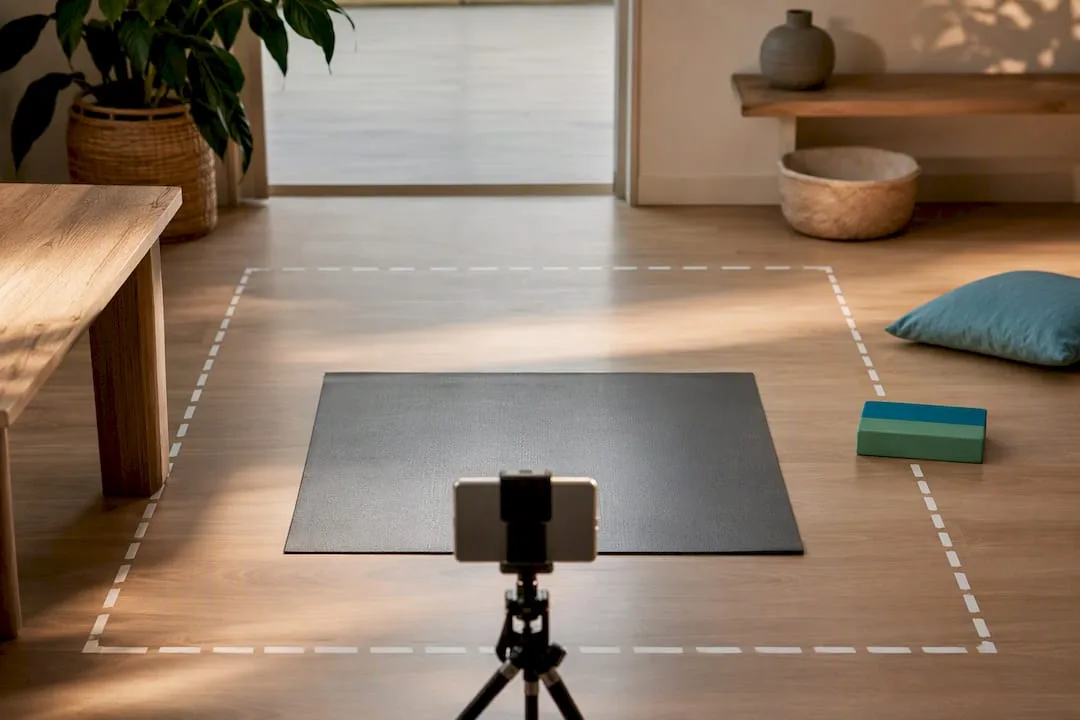
For this reason, Yoga Alliance strongly recommends a separate waiver for online and virtual classes, rather than simply reusing the in-person version with a few words swapped out. The instructor's ability to intervene is profoundly different online, and your waiver should explicitly state this.
Key points to add to an online-specific waiver for your Australian studio:
- A clause confirming the participant has checked their home practice space for hazards (e.g., adequate clear floor space, no loose rugs, sufficient ceiling height for standing poses).
- An explicit acknowledgment that the instructor cannot physically assist or correct alignment during a remote session.
- An emergency contact linked to the participant's actual location during the online session, not just a general contact on file.
- A specific dehydration and cardiovascular warning for online hot yoga classes, given the added strain of heat without direct supervision.
- A separate checkbox for prenatal or aerial classes requiring either physician clearance or an explicit self-declaration (e.g., "I am not currently pregnant and have been medically cleared" or "I have been medically cleared for aerial work").
That prenatal checkbox is worth getting exactly right. A vague "please advise if pregnant" line places the entire burden of disclosure on the participant with no verification. An explicit, affirmative checkbox that requires a deliberate action - ticking "yes" or "no" - creates a much clearer record that the question was asked and answered, rather than being buried in a paragraph no one read closely.
What Waivers Can & Can't Do: Enforceability, Insurance & Best Practise
An Australian waiver is a defence document, not an impenetrable shield against every possible claim. It documents that a participant understood and accepted the inherent risks of yoga and agreed not to sue over injuries arising from those ordinary, acknowledged risks. Crucially, it does not excuse gross negligence, and it cannot override consumer protections that apply regardless of what a form says. LawPath's guidance on yoga studio waivers in Australia makes this distinction perfectly clear: a waiver reduces risk, it doesn't eliminate it.
Australian courts scrutinise waivers for the exact weaknesses studios are most tempted to overlook: vague or generic wording that doesn't describe the actual activity, liability clauses buried in dense paragraphs no reasonable person would read, waivers that have quietly expired, and forms signed by minors without proper guardian consent. Any one of these can unravel the protection a waiver was meant to provide.
A waiver strengthens an Australian studio's legal position by documenting informed consent to known risks, but it works alongside proper safety practises and adequate insurance, not as a substitute for either.
Insurance is the piece studios most often assume is settled when it isn't. A policy written around in-person classes does not automatically extend to livestreamed or recorded sessions. Yoga Alliance's guidance on virtual class waivers specifically advises confirming with your insurer that online delivery, and any recorded content you retain, falls within your coverage before you rely on a waiver to fill the gap.
The most useful thing you can do beyond drafting good clauses is to treat the waiver as a living legal document, not a one-off form. Template providers consistently flag the same point: a template is a starting position, not a finished product. Sprintlaw's guidance recommends studios budget for a lawyer to review wording against their specific class types and insurance terms rather than adopting boilerplate language untouched.
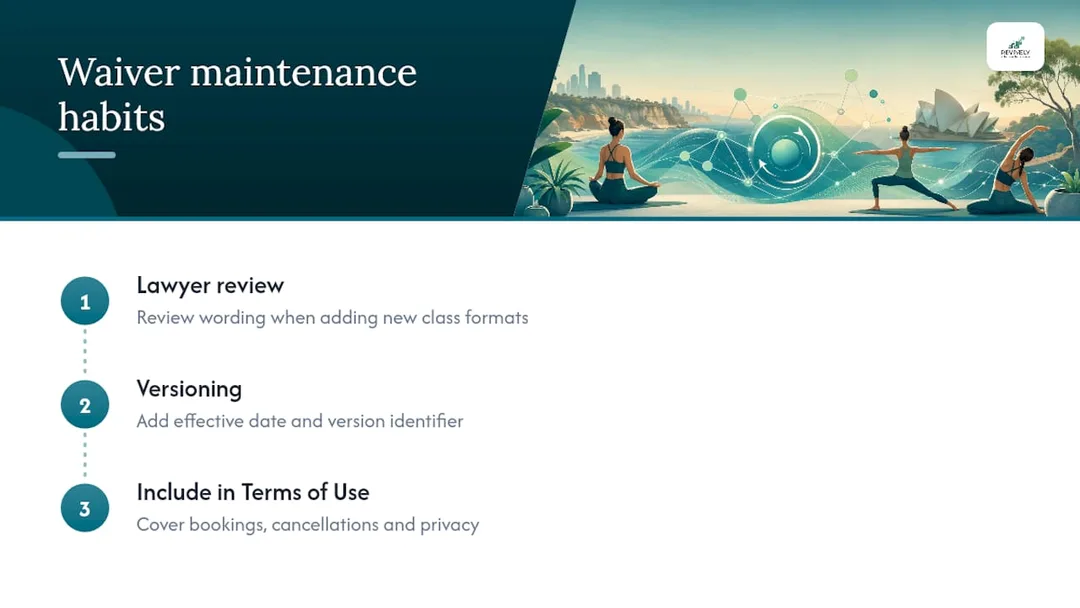
Three practical habits keep an Australian waiver legally robust over time:
- Regular Review: Have a lawyer review the wording whenever you add a new class format, not just when you first draft it.
- Version Control: Version every waiver with an effective date and a unique identifier (e.g., "v3, effective 1 March 2026"). This proves precisely what was signed and when if a dispute arises months later.
- Integrated Terms: Incorporate the waiver into a broader Terms of Use that covers bookings, cancellations, and privacy. This ensures your studio's entire legal framework is consistent, rather than scattered across potentially contradictory documents.
Digital Intake Workflows & Recordkeeping: The Australian Standard
Collecting a signature is just step one. What happens to that sensitive client data afterwards is where most of the ongoing value - and compliance risk - sits.
The cleanest workflow for an Australian studio ties the waiver directly to the booking itself. This means a class booking cannot be confirmed, or a class link cannot be accessed, until the waiver is digitally signed and validated. This eliminates the manual chasing that consumes staff time in smaller studios, and ensures there's zero ambiguity about who has, or hasn't, completed the form on any given day.
Australian Data Privacy Reminder: Health information, once collected, demands careful handling. While instructors need enough to teach safely, they don't need a full medical file. A workable pattern is to surface a limited flag rather than the raw disclosure - an instructor sees "modified poses required" rather than the specific diagnosis. This keeps sensitive information restricted in line with Australian Privacy Principles, while still providing staff with the necessary insights in the room. Remember, all client data, booking histories, and health intake forms must be stored locally in Australia.
Recordkeeping practises worth building into your standard operating procedure:
- Automated Re-sign Cadence: Set a regular re-sign cadence (commonly annually, or when a participant returns after a long absence) and automate the reminder. Don't rely on staff memory.
- Metadata Storage: Store the signed waiver with its full metadata (timestamp, IP address, form version). This allows it to be reproduced exactly as signed for insurers or legal review.
- Audit Trail: Maintain a simple audit trail showing when each form version went live and which participants signed under which version.
- Integrated Profiles: Link waiver records to the same profile as bookings and membership history. Nothing should live in a separate, disconnected spreadsheet or system.
Digital intake forms make this dynamic rather than static: instead of a single form signed once and filed away, a studio can refresh health disclosures periodically, treating consent as an ongoing conversation with each participant rather than a one-off box ticked on day one. Revively's approach to digital intake forms for spa and fitness studios reflects this shift toward continuous, rather than one-off, health disclosure.
Sample Clause Checklist & Quick Template Pointers
Drafting from scratch isn't necessary. What matters is getting the structure right before you send anything to an Australian lawyer for review.
A working assumption of risk line might read: "I understand that yoga involves physical exertion, stretching, and balance poses, and I voluntarily assume all risks associated with participation, including the risk of injury, and specifically acknowledge the increased risks of hot yoga due to elevated temperatures." A release of liability clause typically follows: "I release [studio name] and its instructors from liability for injuries arising from ordinary negligence, except where such injury results from gross negligence or wilful misconduct."
For the health declaration, ask direct, specific questions, rather than a single broad one:
| Avoid (Vague) | Aim For (Specific & Actionable) |
|---|---|
| Do you have any medical conditions? | 1. Do you have any heart conditions, high blood pressure, or respiratory issues? |
| Are you pregnant? | 2. Are you currently pregnant or have you had surgery in the past six months? (If yes, please provide details and medical clearance.) |
| Are you on any meds? | 3. Are you taking medication that could affect balance, blood pressure, heat tolerance, or physical exertion? |
| Anything else to tell us? | 4. Has a doctor advised against any of the following: inversions, high-heat exercise, high-intensity movement, or specific poses? (If yes, please specify limitations.) |
| 5. For Online Classes: I confirm my home practice space is clear of hazards, and I understand the instructor cannot provide physical adjustments or real-time assistance. |
Avoid vague catch-all phrasing like "any relevant medical condition" without examples. It invites incomplete disclosure and gives an Australian court more room to argue the participant wasn't properly prompted to think it through.
Every version needs a signature block with the participant's full name, date of signing, and (for minors) the guardian's name and relationship. Add an effective date and version identifier to the document itself, something as simple as "v3, effective 1 March 2026", so you can always point to the exact wording someone agreed to.
Before rolling any waiver out, test it against every single class type you offer: does the hot yoga stream have its heat warning? Does the prenatal class have its medical clearance checkbox? Does the online stream have its home-safety acknowledgement? A single master waiver rarely covers every format without these essential additions.
Quick Implementation Playbook: Get Waivers Live in a Week
You don't need months to transition from cumbersome paper forms, or having nothing at all, to a fully functional online waiver system for your Australian studio. Here's a realistic sequence:
- Day 1 to 2: Draft & Review. Draft or adapt a comprehensive waiver template. Crucially, send it to an Australian lawyer for review alongside your current insurance policy.
- Day 3: Define Your Gating. Decide your precise gating point: will it be within the booking confirmation, a welcome email, or directly at the class-access link? Set up the collection channel to match.
- Day 4: Test the Flow. Act as a new participant and test the full sign-up flow yourself. Verify that the audit trail correctly captures a timestamp and IP address.
- Day 5: Instructor Dashboard Check. Confirm your instructors can easily see health flags on their dashboard without having to wade through raw, sensitive medical disclosures.
- Day 6: Staff Training & Public Notice. Train your front-desk and online staff on exactly what happens if someone hasn't signed. Publish an updated Terms of Use and privacy notice alongside the new form, specifically referencing compliance with Australian Privacy Principles.
- Day 7: Audit & Adjust. Run a short audit of the first batch of signatures, checking for gaps or common issues. Adjust wording or gating logic based on what you find.
Pro Tip: Don't skip the dry run in Step 3. The fastest way to uncover a broken gating rule - like a class link that still works without a signed waiver - is to try to bypass it yourself before a real participant does.
The lawyer review in Step 1 is the step most owners are tempted to rush. Resist that urge. A week's delay while a qualified Australian lawyer checks your wording against your actual insurance terms will cost exponentially less than discovering a critical gap after an incident.
How Revively Supports Waivers, Intake & Gating for Australian Studios
Revively's digital intake forms and waivers let Australian studios seamlessly collect health declarations and signed agreements as an integrated part of the booking process itself. A class booking and a waiver signature happen in one fluid motion, rather than two disconnected steps.
Signed waivers link directly to a participant's membership record and booking history, providing instructors with a clear dashboard view that flags health considerations without exposing full, sensitive medical detail. Critically, all client data, booking histories, and health intake forms are stored locally in Australia, in full compliance with the Australian Privacy Principles (APPs), giving you and your clients peace of mind.
For studios running class scheduling, Revively can gate access so a class link or physical check-in simply won't activate until the form is fully completed and signed.
Beyond waivers, our Stripe-powered payments and native Xero integration mean signed agreements sit alongside the payment and 10% GST record for that booking. This is invaluable if an insurer or accountant ever needs the full picture, ensuring flawless GST calculations across casual classes, memberships, and multi-resource packages. Revively automatically issues legally compliant Australian Tax Invoices to clients.
Our Xero integration goes deeper. It guarantees 100% legal tax compliance by automating two-way mapping of tax codes, revenue accounts, and liabilities. This ensures your quarterly Business Activity Statements (BAS) are flawless, audit-proof, and free from manual spreadsheet errors - a true game-changer for your accountant.
For studios with a physical front desk, a QR code at reception feeds straight into the intake form. Paired with our display board showing the day's classes, this keeps walk-in sign-ups moving efficiently without staff manually chasing each form.
What This Actually Means for Your Studio
Most advice on yoga waivers treats the document itself as the entire solution. It isn't. An online waiver is one crucial part of a larger system that includes insurance, robust staff training, and - vitally for Australian businesses - how you handle that data once it's signed, ensuring Australian data residency and APP compliance. Studios that focus solely on wording while ignoring the collection workflow often end up with paperwork that looks thorough but is never actually checked before class starts.
The conventional advice - find a template, get it signed, file it - significantly undersells the two things that matter most: gating access so no one can bypass the form, and separating your online waiver from your in-person one because the risks genuinely differ. Studios that skip the gating step are the ones who discover, usually after an incident, that half their online participants never bothered to finish signing.
If you're prioritising one thing this month for your Australian studio, make it gating. Wording matters immensely, but a beautifully drafted waiver that a participant never actually completes protects nobody. Fix the workflow first, then refine the language with a qualified Australian lawyer.
- Andreea, Head of Content & Compliance, Revively.app*
Sources
- LawPath - Yoga studio waiver (Australia)
- Sprintlaw - Waiver template in Australia: what to include and when to use it
- Yoga Alliance - Sample release and waiver of liability (online/virtual classes)
- Jotform - Yoga student waiver agreement form
- WaiverDrop - Free yoga studio waiver template
Recommended for Australian Studio Owners
- Ditch the BAS Headache: The Definitive Guide to Australian Yoga & Wellness Studio Software in 2026
- Pricing Yoga Classes in Australia: Master Memberships, Payments & BAS Compliance
- The Essential Australian Guide to Choosing a Yoga Studio Booking System
- Ditch the WordPress Booking Headache: Why Studios Need a CRM, Not Just a Widget (Especially in Australia)