
Over $75,000? GST Rules for Remedial Massage in Australian Clinics
!
Picture this: your books are booming. Clients are flowing in, appointments are full, and your remedial massage therapists are working their magic. You're feeling good - until that uneasy whisper starts: "Am I charging GST correctly? What if the ATO comes knocking?"
For Australian wellness and fitness studios offering remedial massage, this isn't just a hypothetical worry. The rules around Goods and Services Tax (GST) for these services are notoriously murky, leading many studio owners down a path of confusion, potential compliance pitfalls, and sleepless nights before BAS statements are due.
The short answer, as unwelcome as it might be for some, is that remedial massage is generally taxable in Australia. It's only exempt from GST in very specific, ATO-defined circumstances when it forms a documented, integral part of a recognised health service and meets a strict three-limb test. This isn't just tax jargon; it's a critical operational reality for your studio.
This guide isn't about scare tactics. It's about clarity. We'll strip away the jargon, walk through the ATO's requirements, and equip you with the documentation and invoicing habits that will keep your clinic compliant, your BAS stress-free, and your mind on what you do best: helping clients feel better.

Let's untangle the beast.
The ATO's Bottom Line: The Three-Limb Test for GST-Free Health Services
The Australian Taxation Office (ATO) lays out the rules in Section 38-10 of the GST Act. It's a three-part test, and here's the kicker: all three limbs must be satisfied for a service to qualify as GST-free. Massage therapy itself isn't explicitly listed, which is precisely where the confusion begins for many studios.
Here are the three critical limbs:
- Listed Service: The service must be one of the specific services named in the GST Act. Think physiotherapy, chiropractic, osteopathy, or psychology.
- Recognised Professional: The person delivering the service must hold the appropriate, recognised qualification or membership for that profession. This means registration with a national board or membership of an approved professional association.
- Appropriate Treatment: The treatment must be generally accepted by the relevant health profession as necessary for the patient's specific medical condition or treatment plan, not just generally beneficial.
Here's the rub: standalone remedial massage doesn't appear on the ATO's "listed services" table. This means it fails the first limb outright on its own.
So, how can it ever be GST-free? Only when it's genuinely delivered as a component of a listed service (like physiotherapy), and the practitioner delivering it meets the "recognised professional" and "appropriate treatment" limbs for that listed service. The ATO's guidance is crystal clear: massage is outside the list and needs this direct link to qualify for GST-free status.
Where Remedial Massage Fits (Or Fails) the Test: A Practical Look
Let's break down the real-world application.
If you have a remedial massage therapist working independently, offering general remedial or relaxation massages, every single session they provide is taxable and must include GST. There's no loophole here; massage alone isn't a listed service, so the first limb is never met, regardless of their impressive qualifications or years of experience.
The exception, and this is crucial for mixed studios, is when a physiotherapist, osteopath, or another practitioner delivering a listed service, incorporates massage techniques as a documented part of a specific, individualised treatment plan for a patient's condition. In this scenario, the massage component can "ride" on the GST-free status of the primary listed service, provided the other two limbs (recognised professional, appropriate treatment) are also meticulously met and documented.
Crucial Compliance Check: When in doubt, charge GST. It is far simpler to defend a conservative, GST-inclusive invoice if audited than to try and justify a GST-free one after the fact without bulletproof documentation.
Before you decide how to invoice a remedial massage session, run through this checklist:
- Is there a primary, listed service (e.g., physiotherapy) that this massage is genuinely part of?
- Is the practitioner qualified and registered for that specific listed service? (e.g., a registered physiotherapist providing the massage).
- Is the massage treatment truly necessary for the patient's condition, as accepted by that profession, and not just a "nice-to-have"?
- Do your clinical notes and the invoice clearly link the massage session to the overall treatment plan for the listed service?
- If any of the above are a "no," default to charging GST.
Common Clinic Scenarios & Worked Examples
The GST outcome often hinges on your internal processes and how meticulously you document, rather than just the technique itself.
| Scenario Type | Description | GST Status | Key Compliance Requirement |
|---|---|---|---|
| Standalone Relaxation Massage | A client books a 60-minute "Relaxation Massage" or general "Remedial Massage" without any prior referral, diagnosis, or integrated treatment plan from a listed health professional. | Taxable | Invoice clearly states "Relaxation Massage" or "Remedial Massage" and includes 10% GST. No link to a listed health service. |
| Remedial Massage in Physio Plan | A registered physiotherapist incorporates remedial massage techniques as a necessary component within a documented, individualised physiotherapy treatment plan for a specific patient's diagnosed musculoskeletal condition. | GST-Free | Invoice must reference "Physiotherapy treatment, including remedial massage, per treatment plan dated [date]". Clinical notes must justify. |
| Corporate Wellness Programs | Your studio provides massage services (e.g., chair massage, corporate wellness sessions) to a business for their employees' general well-being. | Taxable | The supply is to a business, not an individual patient for a diagnosed medical condition. Invoice the business with 10% GST. |
| Third-Party Insurer/Comp Scheme | Massage services are billed to an insurer (e.g., WorkCover, NDIS) where the underlying service would have been GST-free if billed directly to the patient due to a listed health condition and treatment plan. | GST-Free | Maintain all primary compliance documentation (treatment plan, practitioner registration) as if billing the patient directly. |
| Pre/Post Event Sports Massage | General sports massage for performance or recovery, not part of a formal diagnosis or treatment plan by a listed health professional. | Taxable | Even if the practitioner is highly qualified, if it's standalone and preventative, it's generally taxable. |
The wording on your invoice is critical. An ATO auditor won't be in your studio to witness the session. If they see "Massage, 45 minutes" on an invoice, they have no way to distinguish a GST-free physiotherapy component from a taxable relaxation session. Be explicit.
GST Registration, BAS, & Accounting: What Mixed Clinics Need to Know
Your studio must register for GST once your annual turnover reaches $75,000. Here's a vital point often missed: GST-free supplies still count towards this threshold. So, if your studio mostly offers GST-free physiotherapy but your combined revenue (including taxable remedial massage) tips over $75,000, you must register for GST.
Once registered, clinics offering a mix of services face a challenge: accurately separating taxable and GST-free items for every Business Activity Statement (BAS) period.
To make your life easier and your BAS accurate:
- Distinct Service Codes: Set up separate product or service codes in your booking and point-of-sale system for taxable services (e.g., "Relaxation Massage - Taxable") and GST-free services (e.g., "Physiotherapy Treatment - GST Free").
- Report Separately: When filing your BAS, ensure you report your GST-inclusive sales and GST-free sales in their distinct categories, rather than lumping them together.
- Claim Input Tax Credits: As a GST-registered business, you can claim input tax credits (ITCs) on eligible business purchases, such as equipment, rent, and software subscriptions. Keep clear records.
- Transparent Pricing: Clearly communicate pricing to clients. Avoid confusion by outlining when GST applies (e.g., "Remedial Massage: $90 inc. GST" vs. "Physiotherapy Session: $110 GST-Free").
Practical Compliance: Documentation, Invoicing & Using Studio Software to Avert GST Errors
Auditors aren't looking for intentions; they're looking for a paper trail. The evidence that withstands scrutiny includes:
- Comprehensive Treatment Plans: Clearly outlining the client's condition, the prescribed listed service (e.g., physiotherapy), and how remedial massage fits into that plan as a necessary component.
- Detailed Clinical Notes: Tied directly to each appointment, referencing the treatment plan and justifying the use of massage within that context.
- Referral Letters: Where relevant, document any referrals from other medical professionals.
- Explicit Invoice Line Items: These should not just state "massage" but specifically name the listed service and reference the treatment plan by date. For example: "Physiotherapy Treatment (incl. Remedial Massage) for [Condition], per plan dated DD/MM/YYYY."
- Practitioner Credentials: Record the practitioner's registration or membership against each GST-free service type in your booking system.
Australian Data Residency & Privacy Alert: When choosing software, especially for health services, always prioritise platforms that confirm client data, booking histories, and sensitive health intake forms are stored locally in Australia. This ensures full compliance with the Australian Privacy Principles (APPs) and provides peace of mind for both you and your clients.
This is where a unified cloud command centre designed for Australian studios shines. A robust system like Revively maps appointment types directly through to invoice line items and into your accounting ledger. This eliminates manual guesswork and prevents front desk staff from having to decide, session by session, whether a massage qualifies for GST-free status. Your online booking portal maps directly through to staff workflows and is tightly integrated with payments and inventory to simplify front desk operations and client self-service.
A native Xero integration is non-negotiable for seamless tax compliance. It guarantees 100% legal compliance by automating two-way mapping of tax codes, revenue accounts, and liabilities. This means your quarterly Business Activity Statements (BAS) are flawless and audit-proof, eradicating manual spreadsheet errors and saving you hours of reconciliation headaches. A native, two-way Xero integration reconciles taxable and GST-free line items without any manual re-entry at BAS time.
Pro Tip: Configure your booking software to default all massage-related appointment types to taxable. Require a manual override, with a mandatory note field for justification, for any GST-free exception. Defaults that assume GST-free are the most common cause of BAS errors in clinics.
Common Compliance Traps & How Clinics Fix Them
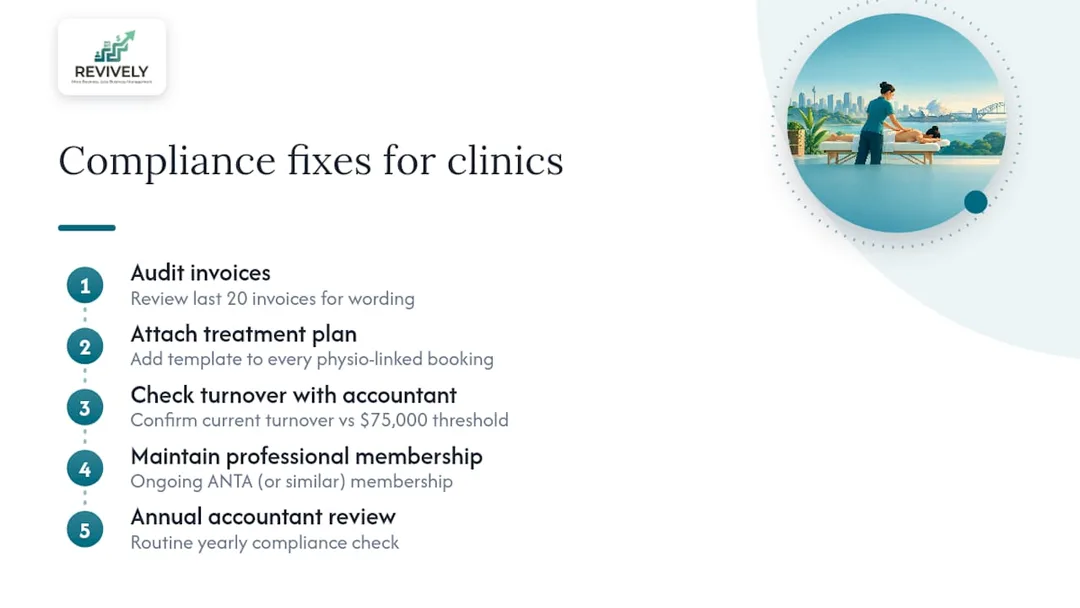
The most frequent mistake we see Australian clinics make is the assumption that a practitioner's qualifications alone render every service GST-free. The ATO test explicitly looks at the specific supply, not just the person. Vague invoice wording and the absence of a comprehensive treatment plan are the next most common failures, and both are entirely preventable.
Here are three immediate steps to shore up your compliance:
- Audit Your Last Twenty Invoices: Review the descriptions for remedial massage. Are they explicit? Do they clearly link to a listed service and treatment plan where applicable?
- Implement a Treatment Plan Template: For every booking that involves a massage component and is intended to be GST-free, ensure a standardised treatment plan is completed and stored with the client's file.
- Chat with Your Accountant: Book a quick session to confirm your current turnover against the $75,000 GST registration threshold and review your current categorisation.
Ongoing professional development, membership with a body like the Australian Natural Therapists Association (ANTA), and an annual review with your accountant are essential to catch any 'compliance drift' that builds up over time.
How Revively Helps Studios & Clinics Streamline GST Compliance & Reporting
Running a mixed clinic or studio means you're juggling relaxation bookings, physiotherapy-linked treatments, and everything in between, often across multiple practitioners, rooms, and even different sites. This operational complexity multiplies your GST risk.
Revively (Revively.app), your Australian-made, unified cloud command centre, is engineered to simplify this. Our intuitive appointment scheduler allows you to tag each service type at the point of booking, ensuring that the GST-free or taxable status travels with the invoice, rather than relying on someone remembering a complex rule later.
Here's how Revively helps you nail your GST obligations:
- Automated GST Tagging: Set your appointment types once, and the GST status is automatically carried through to invoicing, reducing manual errors. This includes seamless handling of 10% GST calculations across casual classes, memberships, and multi-resource packages, automatically issuing legally compliant Australian Tax Invoices to your clients.
- Audit-Proof Xero Integration: Our native, two-way Xero integration reconciles taxable and GST-free line items without any manual re-entry at BAS time. This ensures 100% legal tax compliance, with automated mapping of tax codes and revenue accounts for flawless, audit-proof BAS reporting.
- Australian Data Residency: Sleep easy knowing all client data, booking histories, and sensitive health intake forms are stored locally in Australia, fully complying with the Australian Privacy Principles (APPs). Your clients' privacy is paramount.
- BAS-Ready Reporting: Easily export customisable reports that separate GST-inclusive and GST-free revenue, ready for review with your accountant before your next filing. Explore our powerful reports and analytics features for exports built for exactly this kind of detailed review.
- Multi-Resource Scheduling: Beyond GST, Revively organises your treatment rooms, equipment, and essential cleaning buffers alongside your service tagging, optimising every aspect of your studio's operations.
Ready to take control of your studio's compliance and streamline your operations? Compare our available plans and pricing details on the Revively pricing page.
Key Primary Sources & Guidance
For any dispute or deeper dive, always treat the ATO's health services guidance and ANTA's GST exemption resources as your primary reference points.
Important Disclaimer: This article provides general information and is not a substitute for professional financial or legal advice. Consult a qualified financial professional or tax advisor about your specific business circumstances before acting on any information presented here.
Frequently Asked Questions
Which services have 5% GST in Australia?
Australia's GST system applies a single 10% rate to taxable supplies; there is no reduced 5% GST category for massage or other health services. A supply is either taxable at the standard 10% rate or GST-free under the three-limb test, with no middle ground.
Are medical services GST-free in Australia?
Medical services provided by a recognised medical practitioner are generally GST-free. However, this is a separate category from the allied health three-limb test that governs services like physiotherapy or remedial massage. Allied health services need to satisfy the listed service, recognised professional, and appropriate treatment limbs before they qualify as GST-free.
Is remedial massage considered an allied health service in Australia?
While remedial massage is often practised alongside allied health professions and offers significant health benefits, it is not one of the services explicitly listed under section 38-10 of the GST Act. Therefore, it does not automatically carry allied health's GST-free status. It can only be GST-free when genuinely delivered as a component of a listed service (e.g., physiotherapy), and the ATO's guidance details precisely what that requires.
Which services are exempt from GST in Australia?
Services listed under section 38-10 of the GST Act, including physiotherapy, chiropractic, and psychology, can be GST-free when supplied by a recognised professional as appropriate treatment for a patient's condition. Services not on that list, including standalone remedial massage, remain taxable unless they form a genuine, documented component of one of the listed services.
Recommended for Australian Studio Owners
- The Unsettling Truth About GST on Massage Services for Australian Studios
- Navigating the BAS Beast: Does GST Apply to Your Australian Yoga, Pilates, or Wellness Studio?
- BAS Panic? Master GST on Memberships (and Nail Your BAS) for Australian Studios
- The Australian Studio Owner's Guide to Stripe Fees & GST Compliance