
Room Assignment for Classes: How to Match Class to Room
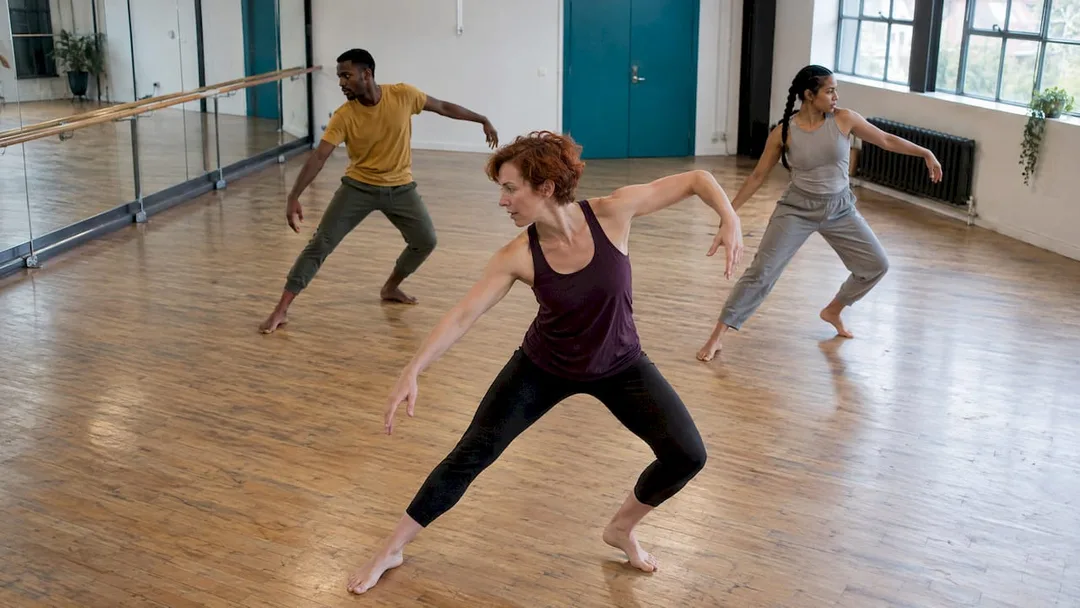
! Dance class using the studio's full floor
Good room assignment comes down to three checks per class: does the room fit the style and the headcount, is there enough time to reset it, and can every client get in and move safely?
Picture this: it's 7 AM, your first yoga class is about to start, but the studio room is still simmering from last night's hot Pilates session. Then, the 8 AM reformer class client arrives early, only to find the room still full of sweaty mats. Your front desk is fielding complaints, teachers are frustrated, and you're already behind before the day even properly begins.
This chaotic dance isn't just a headache; it's a productivity killer, a client experience dampener, and a serious drain on your team. Good room assignment isn't just about avoiding double-bookings; it's about creating a seamless flow that benefits everyone, from your instructors to your clients, and ultimately, your bottom line.
It boils down to three critical checks for every class:
- Does the room truly fit the style and the headcount?
- Is there ample time to reset it between sessions?
- Can every client access it and move safely?
Settle these questions once for each class type, then let smart scheduling software enforce them. This way, two classes will never awkwardly clash, and your team can focus on what they do best: delivering exceptional wellness experiences.
This guide is for any Australian studio owner - whether you run a dance, yoga, Pilates, spa, or recovery centre - that juggles multiple rooms or uses a single space for diverse activities.
Your Studio, Optimised: The Core Principles for Room Assignment
For studio owners in Australia navigating the complexities of multi-resource scheduling, here's a quick-fire rundown of what truly matters:
- Cap Classes by Activity, Not Just Walls: Each class has its own spatial needs (floor space, equipment, sightlines). Set limits based on the actual activity, not just the room's maximum fire capacity.
- Factor in "Buffer Time": Always schedule a changeover buffer after any class requiring setup, deep cleaning, or temperature adjustments. It's non-negotiable for seamless transitions.
- Profile Every Space: Give each room a fixed, detailed profile: size, equipment, access, and the specific class types it suits. This standardises decision-making.
- Prioritise Your Busiest: Reserve your best-fit room for your most popular or frequent classes, using a secondary room as a strategic overflow option.
- Automate, Don't Agonise: Deploy software that automatically blocks double-bookings and enforces capacity rules. This liberates your staff from manual timetable policing.
Crafting Clarity: Profile Every Room in Your Studio
Before you assign a single class, you need to understand your spaces intimately. A simple, one-line profile for each room transforms "which room should we use?" into a swift lookup, empowering any new staff member to make the right call without needing to consult you.
For each room, jot down:
- Usable Floor Area: This isn't the total square footage; it's the actual clear space for movement, excluding mirrors, barres, storage, or fixed equipment.
- Fixed Equipment: Think reformers, aerial rigs, wall-mounted barres, infra-red heating, or built-in sound systems.
- Floor Type: Is it a sprung timber floor ideal for dance, resilient vinyl for high-impact training, or comfortable carpet for restorative work?
- Accessibility: Note step-free entry points, door widths, proximity to accessible toilets, and any other crucial access details.
- Suited Class Types & Maximum Capacity: List the specific activities it perfectly accommodates, along with the realistic maximum participant count for each.
The Perfect Fit: Matching Classes to Their Ideal Space
Once your rooms are profiled, the real magic begins: pairing the right activity with the right environment.
Size Matters: Working from Floor Space Per Person
There's no universal magic number for space per person because activity dictates requirements. Consider these benchmarks from Australian fitness design guides:
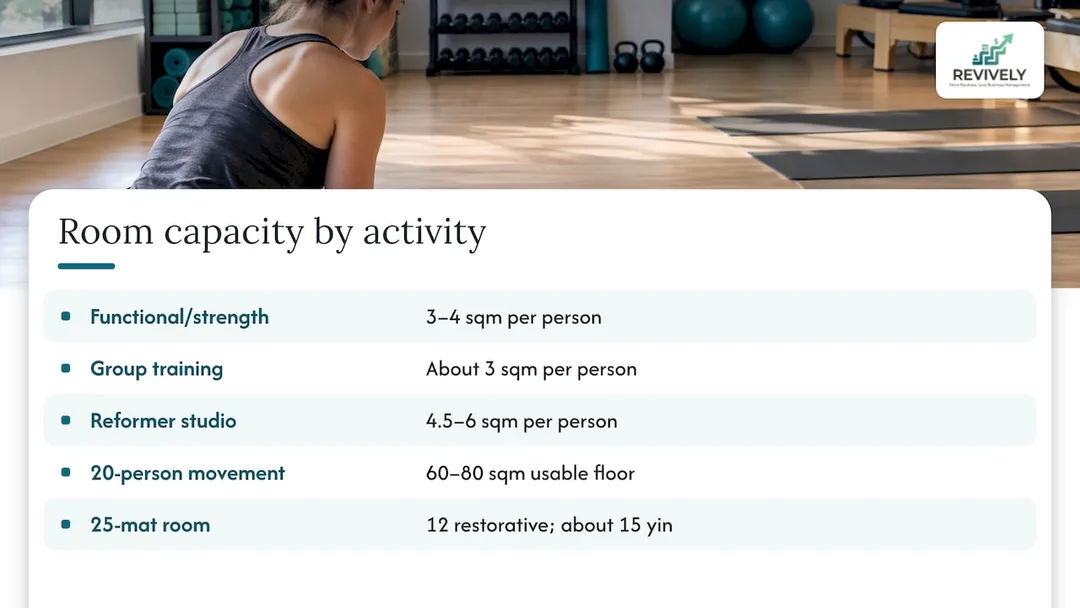
- Functional & Strength Group Training: Roughly 3 to 4 square metres of usable space per participant. The cap here is often determined by the smallest of floor space, equipment count, or the instructor's line of sight.
- Reformer Pilates: Typically needs more, with about 4.5 to 6 sqm per person due to the equipment spacing.
- General Group Training: Around 3 sqm per person.
To put this in perspective for Australian studio owners:
- A 77-square-metre dance studio in Brisbane might comfortably host 15 to 30 people for a movement-intensive class.
- A 20-square-metre "small private dance room" in Sydney, as described by Primavera Tango, is perfect for one-on-one lessons or a tiny group, not a class of twenty.
So, for a dynamic class of twenty, you're looking at 60 to 80 square metres of clear, usable floor for movement-heavy work, and even more if reformers are involved. Stationary mat work allows for tighter spacing, but classes with travelling, jumping, or partner work demand significantly more room. For instance, a room fitting twenty-five mats might only hold twelve for a restorative class and about fifteen for yin due to prop usage and slower movements.
For a deeper dive into how to optimise class capacity beyond simple square metre rules for safe, seamless Australian studios, check out our dedicated guide: Beyond the 6 sqm Rule: Optimising Class Capacity for Safe & Seamless Australian Studios.
Capacity: Set it Per Class Type, Not Per Room
Relying on a single, generic "room holds 25" figure is a recipe for operational headaches. A high-energy vinyasa class and a slow, meditative restorative session in the same room demand completely different limits. The smarter approach is a pre-defined table you build once:
| Room | Class Type | Max Participants | Notes |
|---|---|---|---|
| Studio 1 (large) | Contemporary Dance | Set by travel space | Needs clear floor on all sides for movement |
| Studio 1 (large) | Vinyasa Yoga | Set by mat count | Leave ample aisle for teacher adjustments |
| Studio 1 (large) | Restorative Yoga | Lower than Vinyasa | Props take extra space, slower movements |
| Studio 2 (small) | Reformer Pilates | Number of reformers | Cap by equipment availability, not just floor |
| Studio 2 (small) | Private Session | 1 to 2 clients | Ideal for 1:1 coaching or small duos |
Fill in the "Max Participants" column with your studio's specific figures. Always cross-reference these with your insurer, lease agreements, and local council requirements to ensure compliance.
Equipment & Conditions: The Non-Negotiables
Some rooms are inextricably linked to their core equipment. Reformers, aerial rigs, and fixed barres are rarely moved, making those classes inherently tied to a specific space.
Temperature is another major constraint. As one studio-operations team notes, hot yoga is often the biggest scheduling challenge in a multi-style studio. Heating a room takes time, and cooling it down takes even longer. Their suggestions are spot on for Australian conditions: a dedicated hot room, block scheduling with at least sixty minutes of transition, or reserving hot classes for the end of the day.
Spas and recovery centres face similar multi-resource challenges. A sauna, a treatment room, and a specific therapist all need to be available concurrently. Our guide to sauna bookings that run themselves delves into mastering this kind of intricate setup.
The Buffer Zone: Building in Time to Reset & Reinvigorate
Room clashes aren't usually about two classes booked for the exact same minute. More often, it's a class ending at 10:00, another starting at 10:00, and the room simply isn't ready. This is where buffer time becomes your best friend. Buffer rules create essential gaps between successive bookings for equipment teardown, cleaning, setup, or environmental changeover, and they can (and should) vary by space and activity.
A practical approach to setting your buffer times:
- Time a Real Changeover: Actually time how long it takes for each class type. Include stacking props, wiping down equipment, resetting reformer springs, moving sound gear, and even a quick tidy-up.
- Add a Realistic Margin: Factor in potential late finishes or unexpected delays. Better to have a few extra minutes than always running behind.
- Set Room Defaults, Then Override: Apply a standard buffer to the room, then increase it for specific class types that genuinely need more time (e.g., hot classes, aerial, or spa treatments requiring deep sanitisation).
- Consider Instructor Travel: If a teacher is leading back-to-back classes in different rooms, ensure the buffer allows them enough time to physically move between spaces.
We dive into the nitty-gritty of this in How Appointment Buffers Keep Studios Running Smoothly and our comprehensive guide to Cleaning Buffer Times.
Layout for Impact: Designing for Activity & Experience
Room layout isn't just about aesthetics; it directly impacts client participation, safety, and instructor effectiveness.
- Dance Studios: Keep the mirror wall clear. Designate personal zones for each dancer, particularly for classes involving dynamic movement. Place barres strategically on a long wall. Position beginners where the teacher can clearly see their feet and offer direct feedback.
- Yoga Studios: Arrange mats in staggered rows, ensuring every participant has an unobstructed view of the teacher. Maintain clear aisles, allowing instructors to move freely for hands-on adjustments (where appropriate).
- Pilates (Reformer): Equipment spacing is the absolute cap here. Ensure enough room to safely manoeuvre around each machine and that the instructor has a clear line of sight to every client for corrections and guidance.
- Spa & Treatment Rooms: Establish a fixed layout for each treatment type. Crucially, document the turnover steps and approximate time needed so your reception team can accurately schedule and manage room availability.
A consistent routine helps clients settle faster and classes start on time, regardless of the room. Think: same entry point, same designated area for bags and shoes, same familiar start cue.
Ditch the Chaos: Stop Clashes with Smart Software, Not Memory
A paper timetable or a shared spreadsheet is a ticking time bomb. It works until a teacher swaps a class, a private session is squeezed in, or an unexpected change occurs. The only sustainable fix is a unified cloud command centre - an all-in-one spa booking software or multi-resource studio scheduler that treats rooms, equipment, and even staff as fully bookable resources. Every class, private session, and buffer automatically draws on the same room, eliminating conflicts. If you want the deeper reasoning behind this, read our piece on recurring class timetables beyond spreadsheets.
When evaluating Mindbody alternatives in Australia or other studio management software, look for:
- Room & Resource Management: The ability to set up rooms and specific equipment as bookable resources, automatically blocking them when in use.
- Flexible Capacity Limits: Capacity limits that can be set per class type, with integrated waitlists that automatically promote clients when a spot opens up.
- Automated Buffers: Buffer times that seamlessly apply after each booking, ensuring adequate changeover.
- Integrated Private Session Scheduling: Handles private session scheduling by checking both room and teacher availability concurrently.
- Robust Booking System Integration: Crucially, the software should allow you to set different enrolment limits for each class and room, so the carefully crafted rules you built above are automatically enforced when clients book online.
Most operational clashes we see aren't caused by careless staff. They stem from rules that live in someone's head: 'this room is hot on Tuesdays,' 'that room only takes eight reformers,' or 'the small studio needs ten minutes after a spray tan.'
We built Revively so those critical rules sit directly in the schedule. Rooms, saunas, and treatment spaces are treated as bookable resources. Cleaning buffers apply automatically. Classes have their own specific caps, and waitlists promote clients on their own. Your front desk stops being the last line of defence against chaos.
Start by meticulously writing a profile for each room. Remember, even the smartest software is only as good as the rules you give it - and a clear room profile takes about an hour of focused effort.
Andreea, Co-founder, Revively
Revively: Your Australian-Made, GST Compliant Studio Software Solution
Revively.app is specifically designed for Australian spa, yoga, Pilates, dance, and recovery studios. We're not just another multi-resource studio scheduling tool; we're built from the ground up to understand the unique operational and compliance needs of Australian studio owners.
With Revively, you effortlessly set up rooms and equipment as resources, apply custom buffers, cap each class accurately, and let the waitlist automatically fill empty spots - taking the stress out of your daily operations.
Crucially, as a truly GST compliant studio software solution, Revively natively handles 10% GST calculations across casual classes, memberships, and multi-resource packages. It automatically issues legally compliant Australian Tax Invoices to your clients, simplifying your financial administration.
Our seamless, 100% legal Xero integration for BAS accuracy is a game-changer. Revively provides automated two-way mapping of tax codes, revenue accounts, and liabilities directly into Xero. This ensures your quarterly Business Activity Statements (BAS) are flawless and audit-proof, completely eliminating the manual spreadsheet errors that keep many studio owners up at night. All client data, booking histories, and sensitive health intake forms are stored locally in Australia, fully complying with the strict Australian Privacy Principles (APPs), giving you and your clients complete peace of mind about data residency and privacy.
Our pricing tiers are designed for Australian businesses, starting at just $39 per month (AUD) for Solo, $99 for Growth, and $199 for Pro, with yearly options available. An additional location is $79 per month. See our Revively pricing page for the full list of features and plans.

If you're actively comparing options and searching for genuine Mindbody alternatives in Australia for your dance studio, our guide to dance studio software alternatives outlines exactly what to look for in a local, compliant solution.
Frequently Asked Questions (FAQs)
How do I decide which room a class goes in?
Start by evaluating the class type and its expected headcount, then match it to the room whose profile best fits its requirements: suitable floor space, necessary equipment, and appropriate access. Prioritise your most popular classes for your best-fit room, keeping a secondary room as a flexible overflow option. Regularly review attendance each term and adjust class-to-room assignments if a class is consistently oversubscribed or under-utilised.
How much floor space does each participant truly need in an Australian studio?
It genuinely depends on the activity. An Australian design guide suggests roughly 3 to 4 square metres of usable space per person for dynamic group training, while reformer work demands more, often 4.5 to 6 sqm, due to equipment spacing. Stationary mat classes can operate with less space, whereas dance classes with travelling movements require significantly more. Always set the capacity limit per class type and verify it against your insurer's guidelines and local council requirements.
How long should the gap (buffer) between classes be?
To determine this, time a real changeover for each class type, then add a realistic margin for unforeseen delays. Simple mat-based classes might only require a few minutes. However, hot yoga classes or spa treatments needing deep cleaning will demand significantly longer; one source recommends at least sixty minutes of transition time for heated rooms. Set a default buffer on the room itself, then override it for specific class types that necessitate more extensive changeover time.
How can I reliably prevent double-booking of rooms?
The most effective way is to implement a smart scheduling system that treats each room as a bookable resource. This ensures that every class, private session, and buffer period automatically blocks out the designated space. Manual timetables are prone to failure when classes are swapped or added last-minute. Automated checks catch conflicts instantaneously when a booking is attempted, preventing headaches for both your staff and clients at the front desk.
Sources
- Gym Class Timetable Design That Fills Classes
- How Many Members Can a Gym Hold Per Sqm?
- Studio Hire, BG Performing Arts
- Private Dance Studio, Primavera Tango
- Multi-Style and Level Scheduling for Yoga Studios
- Buffer time, Skedda Support
- Inclusive and accessible event guidelines, City of Sydney